What you'll learn
- What a theme is, and how to turn it into a strong exam argument.
- The main themes in Romeo and Juliet: love, conflict, fate, family, youth, and death.
- How Shakespeare uses language, form and structure to develop those themes.
- How to write about themes in a closed-book AQA GCSE answer using short, accurate quotations.
What is a theme?
A theme is one of the big ideas a writer explores across a text. In Romeo and Juliet, Shakespeare does not just include “love” or “violence”; he asks what happens when love grows inside a violent society.
Theme
A theme is a central idea or concern in a text. A strong theme point says what the writer suggests about that idea, not just that the idea appears.
So, “love” is a topic. A stronger thematic argument would be: Shakespeare presents love as powerful and beautiful, but dangerously rushed when trapped by family hatred.
Writing about a topic only
Avoid writing: “The theme of love is shown.” That is too general. Instead, explain Shakespeare’s message: “Shakespeare presents love as intense and transformative, but also vulnerable in a violent society.”
Turning a topic into an argument
-
Start with the topic: love. This is too broad because it does not yet say what Shakespeare suggests about love.
-
Add a judgement: Shakespeare presents love as intense, sudden and idealised. This already moves towards an argument.
-
Add complication: the lovers’ love exists inside a world of family hatred, so it becomes secretive and risky.
-
Shape it into an exam-ready point: Shakespeare presents Romeo and Juliet’s love as sincere and transformative, but he also shows that a society ruled by feud and honour makes that love impossible to protect.
How the themes connect
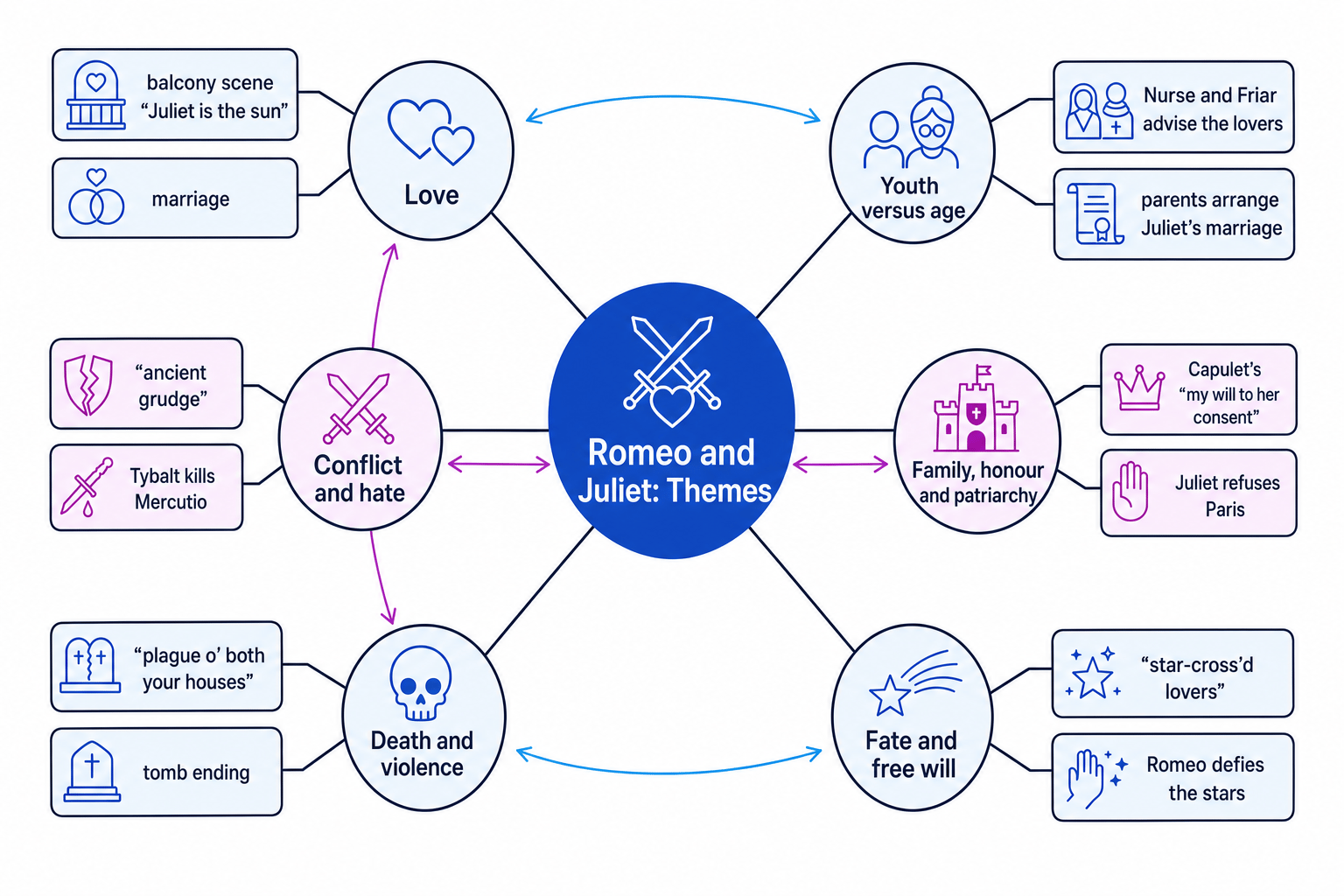
The themes in Romeo and Juliet do not sit separately. Love connects to death; family honour connects to violence; fate connects to the play’s tragic structure.
Tragedy
A tragedy is a drama that ends in suffering or death, often showing how human flaws, social pressures and forces beyond control lead to disaster.
The web below shows the main themes and some key evidence you can use when revising.
Themes overlap
The best answers do not treat themes as isolated boxes. They show how Shakespeare makes one theme intensify another: love becomes dangerous because of conflict; fate feels cruel because the lovers seem so young and sincere.
Love
Love is the most famous theme in the play, but Shakespeare presents it in several ways: romantic love, family love, friendship, and love as a force that challenges social rules.
Romeo’s love for Juliet is immediately described through light imagery. In Act 2 Scene 2, he says, “Juliet is the sun.” A metaphor is a direct comparison where one thing is described as another. By making Juliet the “sun”, Romeo presents her as life-giving, beautiful and almost heavenly.
Their first meeting in Act 1 Scene 5 is also shaped like a shared sonnet. A sonnet is a fourteen-line poem traditionally linked with love. Shakespeare uses this form to suggest harmony: Romeo and Juliet complete each other’s lines, even though their families are enemies.
The language is also religious. Romeo calls Juliet a “holy shrine”, and Juliet calls him “Good pilgrim”. This suggests that their love feels sacred to them, not merely physical or impulsive.
Analysing love as light
-
Choose a precise quotation: Romeo calls Juliet “the sun” in the balcony scene.
-
Identify the method: this is a metaphor, because Juliet is directly described as the sun rather than simply being compared to it.
-
Explain the effect: the sun suggests warmth, life and guidance, so Romeo sees Juliet as a source of hope in a dark, divided world.
-
Link to the theme: Shakespeare presents love as powerful and uplifting, but the brightness also contrasts with the secrecy and danger surrounding the lovers.
Memorable love quotations
For a closed-book exam, learn short quotations you can use flexibly: “Juliet is the sun”, “My only love sprung from my only hate!”, and “These violent delights have violent ends”.
Conflict and hate
The play opens with the feud before we even meet the lovers. The Prologue mentions an “ancient grudge”, showing that the conflict is old, inherited and hard to escape.
A prologue is an opening speech that introduces key ideas before the main action begins. Shakespeare’s Prologue tells the audience that the lovers will die, so every moment of love is shadowed by violence.
Tybalt represents aggressive family honour. In Act 1 Scene 1, he says, “I hate the word” when Benvolio speaks of peace. This blunt statement shows how deeply hatred has become part of his identity.
Romeo’s early language also links love and conflict. In Act 1 Scene 1, he says, “O brawling love! O loving hate!” An oxymoron places contradictory words together. The phrase suggests that love and hate are already tangled in Verona before Romeo even meets Juliet.
Oxymoron
An oxymoron is a phrase that combines opposite ideas, such as “loving hate”, to reveal confusion, tension or contradiction.
Conflict is not just physical fighting. It is also emotional, social and verbal. The lovers must hide their relationship because their surnames make them enemies.
Fate and free will
From the beginning, Shakespeare presents fate as a powerful force. The Prologue calls Romeo and Juliet “star-cross’d lovers”, suggesting that the stars — linked to destiny — are against them.
Fate
Fate means the idea that events are controlled by forces beyond human choice, such as destiny, fortune or the stars.
Shakespeare uses foreshadowing, which means hinting at future events before they happen. In Act 1 Scene 4, Romeo fears “some consequence yet hanging in the stars”. This prepares the audience for tragedy.
He also uses dramatic irony. This is when the audience knows more than the characters. Because the Prologue has already told us the lovers will “take their life”, we watch their happy moments with sadness and tension.
However, do not argue that fate alone causes everything. Human choices matter too: Tybalt chooses violence, Capulet pressures Juliet, Friar Lawrence takes risks, and Romeo acts impulsively.
Blaming only fate
A top answer usually balances fate with human responsibility. Shakespeare makes the ending feel destined, but he also criticises the feud, haste and adult failures that help cause the tragedy.
Family, honour and patriarchy
Family identity controls the world of the play. Juliet’s famous question, “What’s in a name?”, challenges the idea that a surname should decide who someone is allowed to love.
Patriarchy
Patriarchy is a social system where men hold most authority, especially in the family and public life.
At first, Capulet seems cautious about Juliet’s marriage. In Act 1 Scene 2, he says, “My will to her consent is but a part”, suggesting Juliet’s agreement matters. Later, when she refuses Paris, his language becomes cruel: “Hang thee, young baggage! disobedient wretch!” This shift reveals how fragile Juliet’s freedom is.
For Shakespeare’s original audience, daughters were often expected to obey fathers, and marriage could strengthen family status. This context — the social and historical circumstances around a text — helps you see why Juliet’s resistance is so bold.
Family honour also drives male violence. The feud teaches young men that reputation matters more than peace. Mercutio’s curse, “A plague o’ both your houses!”, condemns both families, not just one side.
Youth and age
Shakespeare contrasts the passion of the young with the caution, control or failure of the older generation.
Romeo and Juliet are young, and their love moves extremely quickly. This speed creates excitement, but also danger. Friar Lawrence warns, “These violent delights have violent ends” in Act 2 Scene 6. The repeated word “violent” connects love with destruction, suggesting that intensity without patience can become dangerous.
The adults are not simply wise guides. The Nurse helps Juliet marry Romeo, then later advises her to marry Paris. Friar Lawrence tries to help, but his plan depends on secrecy and timing. Capulet and Lady Capulet fail to understand Juliet’s emotional crisis.
Youth versus age
Shakespeare does not present young people as foolish and adults as wise. Instead, he shows a society where both youthful haste and adult pressure contribute to tragedy.
Death and violence
Death is present from the Prologue onwards. The phrase “death-mark’d love” suggests that Romeo and Juliet’s relationship is marked for death from the beginning.
Motif
A motif is a repeated image, idea or pattern that helps develop a theme across a text.
Death becomes a motif through repeated references to poison, graves, weapons and the tomb. Even love language often carries danger. Friar Lawrence’s “violent delights” warning links pleasure and destruction in one phrase.
The play’s structure — the order and pattern of events — also makes death feel unavoidable. It begins with the Prologue announcing death and ends in the tomb with the Prince saying, “For never was a story of more woe / Than this of Juliet and her Romeo.” This circular movement makes the tragedy feel complete and devastating.
Writing about themes in an exam answer
AQA rewards an argument that is clear, supported and analytical. That means you should make a point about Shakespeare’s message, support it with a short quotation, analyse the writer’s method, and connect it to the wider play or context.
Building a theme paragraph about fate
-
Make a theme-focused point: Shakespeare presents fate as powerful, but he also shows that human violence and haste help fulfil that fate.
-
Select evidence from different parts of the play: “star-cross’d lovers” from the Prologue, Romeo’s “O, I am fortune’s fool!” after killing Tybalt, and “I defy you, stars!” before he returns to Verona.
-
Analyse the pattern: the repeated references to stars and fortune create a fate motif, making Romeo seem trapped by forces larger than himself.
-
Add interpretation: when Romeo says “I defy you, stars!”, he thinks he is resisting fate, but the audience sees that his impulsive choice actually moves him closer to the tragic ending.
-
Link back to Shakespeare’s message: the play suggests that destiny may shape events, but social hatred and reckless decisions make the catastrophe possible.
In the exam
-
Start with a clear argument about what Shakespeare suggests through the theme, not just where the theme appears.
-
Use short, accurate quotations from memory and embed them smoothly into your sentences.
-
Analyse methods such as metaphor, oxymoron, foreshadowing, dramatic irony, motif, form and structure only when you can explain their effect.
-
Add context briefly when it sharpens your point, especially for patriarchy, marriage, family honour and tragedy.
-
Check expression carefully: the Shakespeare question also rewards accurate vocabulary, sentence control, spelling and punctuation.
Check yourself
- How does Shakespeare connect love with death from the Prologue onwards?
- Which theme is developed through the repeated language of stars, fortune and destiny?
- Can you explain why Juliet’s challenge to her family name is also a challenge to patriarchy?
