Willy Russell’s Blood Brothers is a landmark of modern British drama. While it tells a deeply moving story of separated twins, the characters themselves are not just realistic individuals; they are carefully constructed to illustrate the deep social, economic, and political divisions of 1980s Britain.
What you'll learn
- How Russell uses Mickey and Edward as foils to explore the "nature vs. nurture" debate.
- The contrasting psychological profiles of Mrs Johnstone and Mrs Lyons as victims of their respective social classes.
- How secondary characters (Linda, Sammy, and the Narrator) drive the tragic plot.
- How to link character analysis directly to Russell's social and political themes (AO3) using precise literary terminology (AO2).
The Concept of Characterization in Modern Drama
Before diving into individual characters, it is vital to understand how Russell presents them. In a musical, characters often express their innermost thoughts through song. Russell combines this with elements of social realism and non-naturalistic theatre to make a broader political point.
Social Realism
An artistic movement that aims to draw attention to the real-world socio-political conditions of the working class, avoiding romanticization or idealization.
Rather than asking you to simply describe what a character is like, the GCSE exam asks you to analyse how and why Russell has constructed them. Every character is a tool used by the playwright to challenge the audience's assumptions about class, opportunity, and choice.
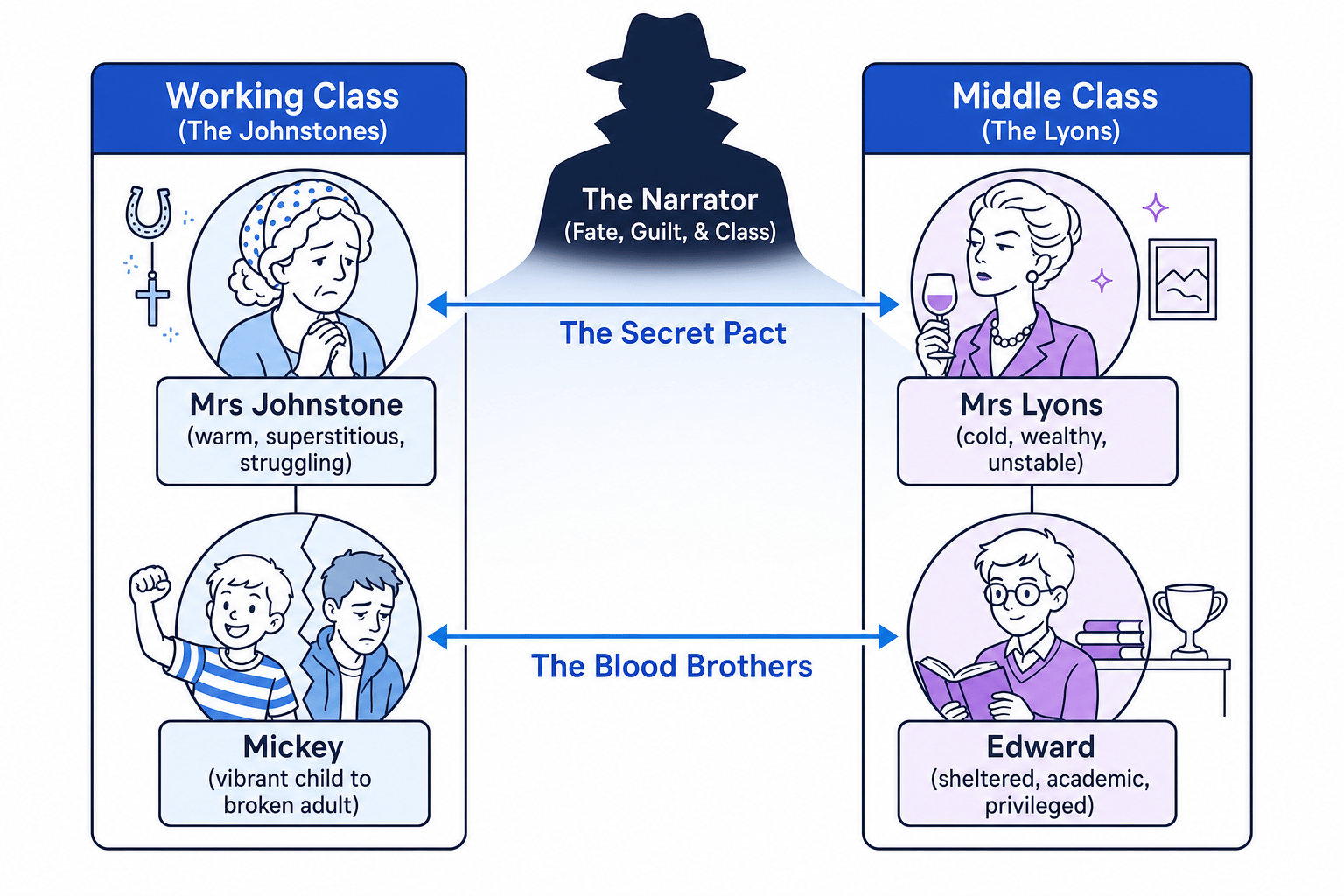
The Twins: Mickey and Edward
Mickey and Edward are the central focus of the play’s structural design. They are identical twins separated at birth, making them the perfect dramatic experiment to test whether our lives are shaped by our genetics (nature) or our upbringing and social class (nurture).
Foil
A character who contrasts sharply with another character (usually the protagonist) to highlight particular qualities, values, or flaws in that character.
Mickey Johnstone
Mickey represents the working-class experience in deindustrialised Liverpool.
- Childhood: Mickey is lively, imaginative, and uses colloquial, energetic language ("We're blood brothers, us two"). Despite his poverty, his childhood is full of warmth and freedom.
- Adulthood: As he enters the workforce, his choices narrow. He is trapped in a low-wage factory job, which he eventually loses due to the economic recession of the late 1970s and early 1980s.
- The Downward Spiral: Unemployment strips Mickey of his dignity. After participating in a robbery with his brother Sammy out of desperation, he is imprisoned and develops a dependency on anti-depressants. By the end of the play, his physical and mental state is shattered.
Edward Lyons
Edward represents the middle-class experience, shielded from the harsh realities of economic depression.
- Childhood: Edward is polite, grammatically correct, but sheltered and lonely. He is drawn to Mickey’s energy because his own life is highly structured and sterile.
- Adulthood: Edward’s path is smooth and pre-determined. He goes to university, travels, and easily secures a high-paying job as a housing councillor.
- The Blindspot: Because of his privilege, Edward is utterly oblivious to Mickey's struggles. He naively tells Mickey to "just draw your money at the brough" (on the dole) and "buy a new mouth," showing a complete lack of understanding of poverty.
The Class Divide as a Tragedy
Russell does not make Edward a villain. Instead, he shows that the tragedy lies in how class divides two people who are fundamentally identical. Their final confrontation is not caused by personal hatred, but by the systemic inequality that gave Edward everything and Mickey nothing.
The Mothers: Mrs Johnstone and Mrs Lyons
The two mothers embody the psychological and social consequences of class division. Their secret pact is the catalyst for the entire tragedy.
Mrs Johnstone
Mrs Johnstone is the play's emotional heart. She is a working-class single mother struggling to feed her ever-growing family.
- Maternal Instinct: She is defined by her warmth, love, and resilience. Despite her poverty, she refuses to view her children as financial burdens, singing of them with deep affection.
- Superstition: Lacking formal education or systemic power, she relies on superstition to make sense of her chaotic world. Mrs Lyons exploits this vulnerability to bind her to the secret pact ("if either twin learns that he once was a pair, they shall both immediately die").
- Victim of Circumstance: She is constantly at the mercy of debt collectors, landlords, and employers. Yet, Russell presents her sympathetically, challenging the contemporary Thatcherite view that poverty was a result of personal laziness.
Mrs Lyons
Mrs Lyons is Mrs Johnstone's wealthy employer. Lonely, insecure, and unable to have children of her own, she manipulates Mrs Johnstone into giving away one of her twins.
- Cold and Transactional: Mrs Lyons views motherhood as something that can be bought. She uses her wealth and class power to manipulate Mrs Johnstone, telling her "you'll be locked up" if she confesses.
- Descent into Madness: Unlike Mrs Johnstone, who is haunted by genuine grief, Mrs Lyons is consumed by guilt and paranoia. She begins to believe the very superstition she invented. Her mental stability deteriorates to the point where she attempts to attack Mrs Johnstone with a kitchen knife.
- Structural Critique: Russell uses Mrs Lyons to critique the sterile, isolated nature of middle-class life, proving that material wealth does not guarantee psychological well-being.
Reducing Mrs Lyons to a pantomime villain
Do not write off Mrs Lyons as simply "evil." In a sophisticated essay, you should acknowledge that Russell presents her as a victim of a patriarchal society that placed immense social pressure on women to be mothers, driving her to extreme desperation.
Secondary Characters: Catalysts of Fate
While the twins and mothers dominate the narrative, secondary characters are crucial in driving the plot toward its inevitable, tragic conclusion.
Linda
Linda is the childhood friend and eventual romantic interest of both Mickey and Edward. She represents the limited opportunities available to working-class women of the era.
- The Protector: Throughout her childhood, Linda fiercely defends Mickey ("Leave him alone!").
- The Domestic Trap: She falls pregnant young, marries Mickey, and is quickly forced into the grim reality of poverty, housing struggles, and caring for a depressed husband.
- The Catalyst: Out of sheer exhaustion and loneliness, she seeks comfort in Edward. Her brief, desperate affair with Edward is the final spark that ignites Mickey's jealousy and leads to the fatal climax.
The Narrator
The Narrator is a non-naturalistic device who acts as a modern equivalent of a Greek Chorus.
- Omnipresence: He remains on stage throughout the play, watching the action unfold, often unnoticed by the characters.
- Voice of Doom: He continuously reminds both the characters and the audience of their looming fate, using motifs of the devil ("the devil's got your number") to represent guilt, consequence, and class.
- Challenging the Audience: In his final speech, the Narrator directly questions whether the tragedy was caused by fate or social class: "And do we blame superstition for what came to pass? Or could it be what we, the English, have come to know as class?"
Analyzing Character: Worked Example
To get top marks in your GCSE (AO1, AO2, and AO3), you must be able to write structured paragraphs that analyse how Russell uses a character's dialogue to convey a deeper thematic message.
Analyzing Mickey's Despair
Read the following quotation from Act Two, where Mickey, now unemployed and depressed, confronts Edward:
"I could have been... I could have been him!"
Follow these steps to write a high-level analytical paragraph on this moment.
-
State your main analytical point (AO1): Connect the character's state of mind directly to Russell's larger thematic message.
Example: "In the play's tragic climax, Russell uses Mickey’s desperate confrontation with Edward to highlight how systemic class inequality robs working-class individuals of their potential, turning life into a lottery of birth."
-
Embed a short, precise quotation (AO1): Seamlessly integrate the text into your sentence structure rather than dropping it in as a standalone quote.
Example: "Mickey's agonizing realization of what his life could have been is crystallized in his final, heartbreaking cry, 'I could have been... I could have been him!'"
-
Analyse the writer's methods and language (AO2): Look for structural and linguistic choices. Mention repetition, punctuation, and dramatic irony.
Example: "The repetition of the modal verb 'could' emphasizes the lost potential and stolen opportunities that Mickey has suffered due to his social class. This is amplified by the ellipsis, which represents his physical and emotional breathlessness, conveying a sense of fractured sanity. Furthermore, there is profound dramatic irony in his pronoun choice: Mickey does not realize that Edward is literally his identical twin, yet he instinctively recognizes that Edward is his exact duplicate in everything but social privilege."
-
Link to context and writer's purpose (AO3): Explain why Russell wrote this scene and how it reflects 1980s Britain.
Example: "Through Mickey's collapse, Russell is delivering a direct critique of Thatcherite Britain, where the decline of traditional manufacturing industries left working-class men like Mickey with no sense of purpose, driving them to despair while the educated middle-classes remained cushioned from the economic fallout."
In the exam
When writing about characters in Blood Brothers, follow these three structural guidelines to maximize your marks:
- Focus on the "Why": Never treat the characters as real people. Always write about them as constructs. Use phrases like "Russell constructs Mickey to represent..." or "Mrs Lyons is utilized as a vehicle to critique..."
- Track Character Journeys: Show how characters change from Act 1 to Act 2. Contrast Mickey's early energetic colloquialisms with his later monosyllabic, drug-induced speech to prove your understanding of structural character development.
- Integrate Context Seamlessly: Do not just "dump" historical facts about Margaret Thatcher or Liverpool. Only mention the economic context when it directly explains a character's actions or mental state (e.g., linking Mickey's crime to the lack of welfare support and mass unemployment of the early 1980s).
Check yourself
- How does the change in Mickey's language from Act 1 (childhood) to Act 2 (adulthood) reflect his loss of agency?
- Why is it significant that Mrs Lyons is the one who first introduces superstition to Mrs Johnstone, rather than the other way around?
- In what ways does the Narrator act as the collective conscience of the audience throughout the play?
