Willy Russell’s Blood Brothers is not just a tragic story about separated twins; it is a fierce critique of the British class system. By exploring how different environments shape the lives of two genetically identical boys, Russell challenges his audience to think about opportunity, fairness, and the forces that control our lives.
What you'll learn
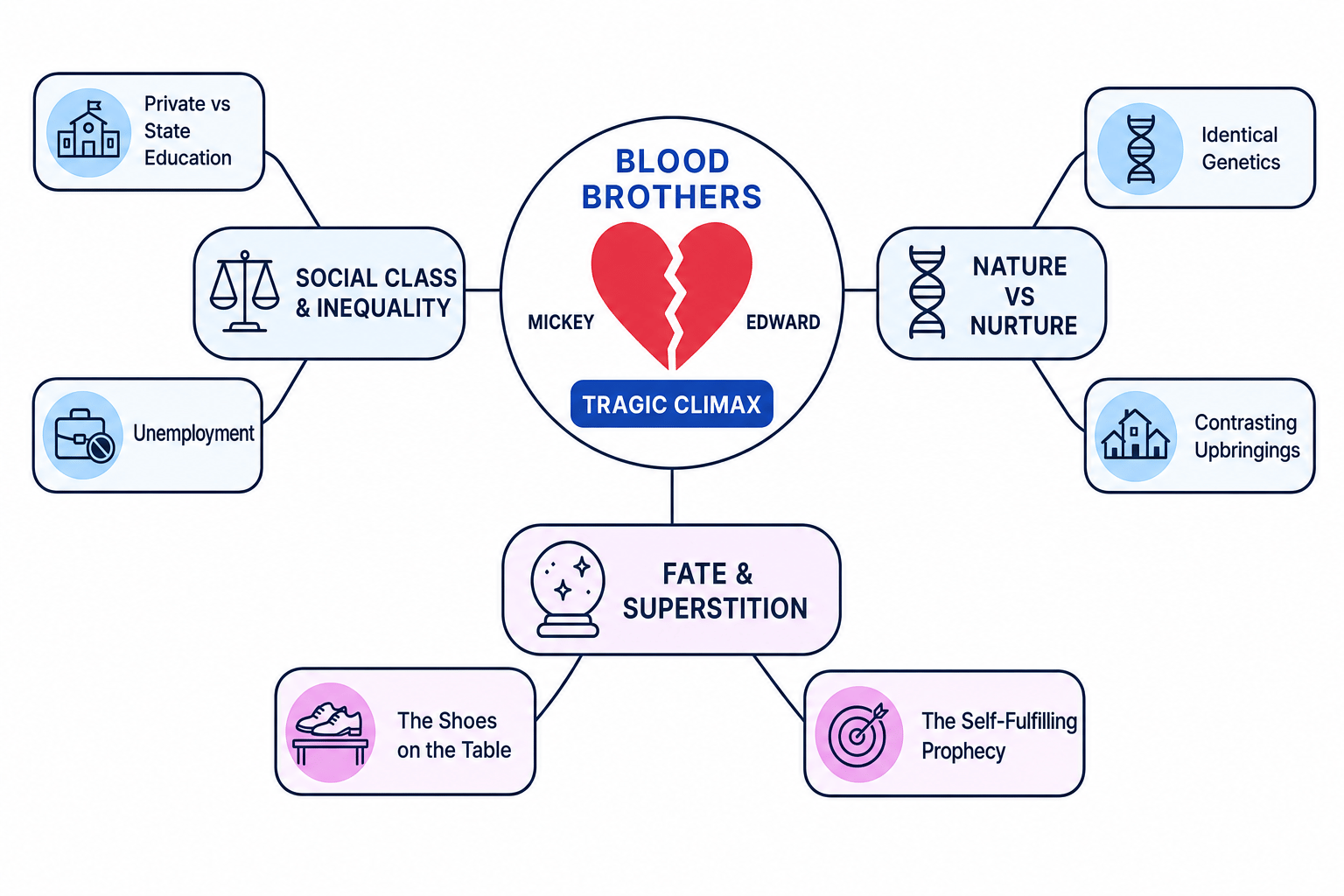
- How social class and economic inequality dictate the contrasting fates of Mickey and Edward.
- The tension between "nature" (genetics) and "nurture" (upbringing and environment).
- How Russell uses the motifs of superstition and fate to represent the real-world limits imposed by the British class system.
Introduction: What is a Theme?
Before we look at the specific ideas in Blood Brothers, let's establish what a theme is and how you should write about it in your GCSE exam.
Theme
A theme is a central, recurring idea or message that an author explores throughout a literary work. It is not just a topic (like "money"), but an argument or statement about that topic (like "poverty limits human potential and destroys mental health").
In Blood Brothers, Russell uses his characters and their journeys to express his views on 1980s Britain. To score highly in your exam, you must show how these themes are constructed using dramatic methods (such as contrast, motifs, dramatic irony, and the structure of the play) and connect them to the historical context of the time.
1. Social Class and Economic Inequality
The most prominent theme in Blood Brothers is the division between the working class and the middle class. Russell wrote the play in the early 1980s, a period when the UK, particularly industrial northern cities like Liverpool, was experiencing mass unemployment due to deindustrialisation (the closure of traditional factories and docks).
Russell presents class not as a minor difference in lifestyle, but as a system that completely controls a person's life chances, health, and happiness.
The Contrast of Two Families
Russell structurally juxtaposes (places side-by-side to contrast) two families to show how wealth and status dictate their experiences:
- The Johnstones (Working Class): Mrs Johnstone is a struggling single mother who lives on credit, faces constant debt, and has her children threatened by social services. Her life is characterised by a lack of control. Mickey, raised in this environment, attends a poorly funded state school, gets a low-paying factory job, and is easily made redundant.
- The Lyons (Middle Class): Mrs Lyons is wealthy but isolated in a large house. Edward is raised with immense privilege, attends a prestigious private boarding school, goes to university, and easily secures a high-paying professional career.
Structural Parallelism and Inequality
Russell uses parallel scenes to highlight how class privilege protects Edward while exposing Mickey to hardship. The most powerful example of this occurs when the boys are caught by the police for throwing stones at windows.
The policeman treats the two families completely differently, demonstrating that the justice system itself is biased by class. This highlights that "crime" is often judged by social status rather than the act itself.
2. Nature vs. Nurture
The debate of nature versus nurture asks whether our personalities, abilities, and successes are determined by our genetics (nature) or our upbringing and environment (nurture).
The Twin Experiment
By using identical twins separated at birth, Russell creates a dramatic "scientific experiment" on stage. Because Mickey and Edward share the exact same genetic blueprint (nature), any differences in their adult lives must be the result of their differing environments (nurture).
How Nurture Wins the Battle
At age seven, the boys are incredibly similar: they are both playful, adventurous, and instantly bond as "blood brothers." However, as they grow older, the impact of their environments pulls them apart:
- Education: Edward's elite education teaches him confidence and opens doors to power. Mickey’s education is authoritarian and prepares him only for repetitive manual labour.
- Opportunities: When Edward makes a mistake, his family's money protects him. When Mickey loses his job, he has no safety net, leading him to desperate crime and eventual imprisonment.
- Mental Health: Mickey is crushed by the physical and mental toll of poverty and clinical depression, becoming dependent on anti-depressants. Edward, insulated by his wealth, cannot understand Mickey's despair, asking him, "Why is a job so important?"
By the end of the play, Mickey's tragic realisation—"I could have been him!"—shows that his downfall was not due to a lack of character or intelligence, but simply because he was kept in the working class. Russell argues passionately that nurture (and specifically class-based opportunity) is far more powerful than nature.
3. Fate, Superstition, and Social Determinism
Throughout the play, characters—particularly Mrs Johnstone—are ruled by superstitions. Mrs Lyons manipulates this by inventing a curse: "They say that if either twin learns that he once was a pair, they shall both immediately die."
While the characters believe they are being hunted by a supernatural "fate," Russell suggests a different force is at play.
Social Determinism
Social determinism is the theory that social interactions and constructs alone determine individual behavior and life outcomes, meaning people have very little free will to escape the social class they are born into.
Superstition as a Mask for Class Control
Mrs Lyons, despite her education, uses superstition as a weapon of psychological control over Mrs Johnstone. Later, as Mrs Lyons' mental health deteriorates, she becomes a victim of her own lies, showing how guilt and paranoia can destroy a person.
The Narrator acts like a Greek Chorus, constantly reminding the audience of the impending doom with the recurring motif of the "devil's got your number." He warns that no matter how far they run, the truth will catch up to them.
Blaming Superstition Alone
Do not write that the twins died because of a superstitious curse. Russell makes it clear in the final lines that superstition is just a metaphor. The real killer is the class system. As the Narrator directly asks the audience at the very end:
"And do we blame superstition for what came to pass? / Or could it be what we, the English, have come to know as class?"
Worked Example: Analyzing how social class shapes institutional power
When writing a GCSE essay, you must analyze how Russell uses dramatic methods to convey his themes. Here is how you can build a high-scoring analytical paragraph showing how class inequality is reinforced by authority.
Analyzing the policeman's double standard
Analyze how Russell uses the Policeman scene to explore the theme of social class inequality.
- State your point clearly linking theme, method, and authorial intent: Russell uses structural parallelism in the policeman's interactions with Mrs Johnstone and Mr Lyons to demonstrate how institutional authority protects the middle class while criminalizing and intimidating the working class.
- Provide precise, integrated evidence (quotations): When addressing the working-class Mrs Johnstone, the policeman adopts a threatening register, warning her that her son will be "integrated into a court" if she cannot "keep him in." Conversely, when speaking to the wealthy Mr Lyons, the policeman dismisses the exact same crime as a mere "prank," politely advising him to ensure Edward keeps away from "rougher chalks."
- Analyze the specific methods and link them directly to the historical context (AO2 & AO3): The contrast between the nouns "court" and "prank" highlights the systemic double standard. By warning Mrs Johnstone of the legal system, the policeman exploits her lack of social power to intimidate her. However, his deferential tone with Mr Lyons, combined with the classist idiom "rougher chalks" (referring to working-class children like Mickey), shows how the police force acts as an extension of middle-class interests. Through this structural contrast, Russell exposes how the 1980s British justice system actively reinforced class divisions rather than policing impartially, ultimately trapping working-class youth in a cycle of marginalisation.
The Marilyn Monroe Motif
Keep track of how Russell uses the Marilyn Monroe motif across different scenes. It is never just a random pop-culture reference. It acts as a thematic barometer:
- At first, it represents youth, beauty, and optimism for Mrs Johnstone.
- Later, it represents falling from grace and physical deterioration.
- Finally, it represents Mickey's drug addiction and loss of control. Comparing how this motif changes is a great way to show the examiner you understand the play's structure!
In the exam
- Focus on Russell's message: Always ask yourself why Russell wrote the play. He didn't write it just to entertain; he wrote it to criticize the social divisions of 1980s Britain under Margaret Thatcher. Frame your arguments around his social commentary.
- Compare the parallel structures: The play is built on pairs: two mothers, two brothers, two schools, two police interactions. When analyzing a theme, contrast how it affects a working-class character versus a middle-class character.
- Embed short, high-impact quotes: Instead of memorising long passages, memorise 3-5 word phrases (e.g., "I could have been him", "rougher chalks", "devil's got your number", "scrap heap"). Weave them naturally into your own sentences to keep your writing fluid and academic.
Check yourself
- Why does Mrs Lyons invent the superstition about the separated twins, and how does this power dynamic backfire on her later in the play?
- How does the theme of "Nature vs. Nurture" challenge the idea that Mickey's tragic end was entirely his own fault?
- What is the dramatic purpose of the Narrator, and how does his presence reinforce the theme of fate?
