To write a high-scoring GCSE essay on Romeo and Juliet, you must look beyond simply what happens. You need to understand how Shakespeare structures the events to build tension, manipulate time, and convey his core themes.
Rather than memorizing a flat list of scenes, treating the plot as a deliberate piece of dramatic architecture will allow you to analyse structural choices with confidence.
What you'll learn
- How to map the events of the play onto classical five-act dramatic structure.
- How Shakespeare uses structural compression to elevate the tragedy's stakes.
- How to identify and analyse key structural turning points in your essays.
Prerequisites: The Tragedy Framework
Before looking at the scene-by-scene events, we must establish how Shakespeare structures his tragedies. Shakespeare wrote Romeo and Juliet using a five-act structure, which aligns closely with classical dramatic theory.
Freytag's Pyramid
Freytag's Pyramid is a structural framework mapped out by 19th-century playwright Gustav Freytag. It divides a drama into five distinct parts: exposition, rising action, climax (or turning point), falling action, and catastrophe (resolution).
In Elizabethan theatre, this structure was not just a theoretical formula; it was a physical and temporal rhythm that audiences expected. The movement from order to chaos, and eventually to a cold, restored peace, is the engine of Shakespearean tragedy.
The Act-by-Act Plot Journey
Below is the trajectory of the star-crossed lovers. As you read through, pay close attention to how the tension builds to a peak in Act 3 before falling into inevitable tragedy.
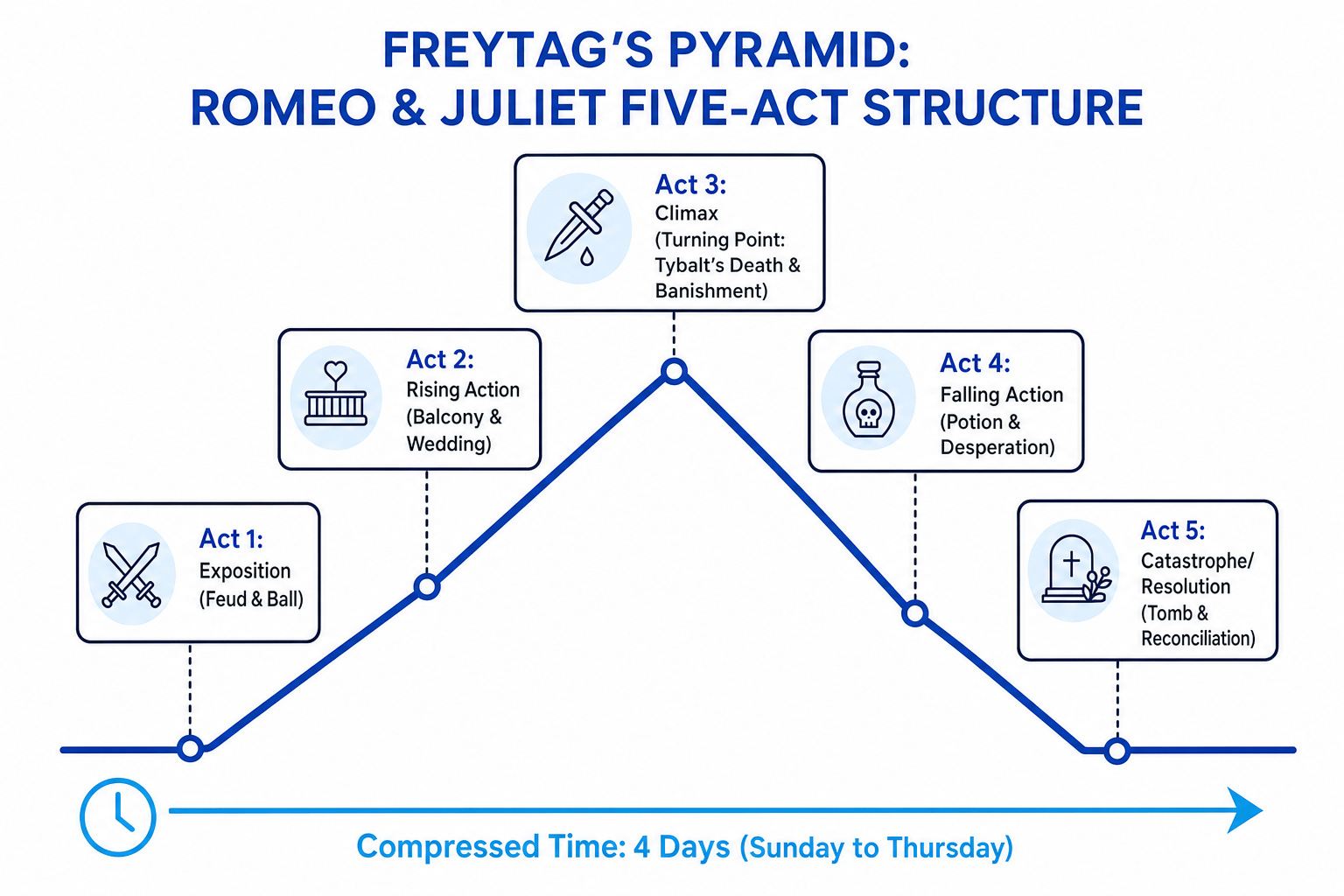
Act 1: Exposition (The Setup)
We are introduced to the Italian city of Verona, torn apart by an "ancient grudge" between two noble families: the Montagues and the Capulets.
- The Street Fight: The play opens with a public brawl initiated by servants. This establishes the omnipresence of the feud. Prince Escalus warns that any future brawlers "shall pay the forfeit of your lives".
- The Lovesick Romeo: Romeo, a Montague, is introduced as a melancholic courtly lover, pining for Rosaline, a woman who does not love him back.
- The Capulet Feast: Seeking to help Romeo move on, his friend Mercutio and cousin Benvolio convince him to crash a masquerade ball hosted by Lord Capulet.
- The First Meeting: Romeo and Juliet meet and fall instantly in love. Their first conversation forms a shared, perfect sonnet, showing their profound spiritual connection. However, Tybalt (Juliet’s fiery cousin) spots Romeo and vows revenge.
Act 2: Rising Action (The Complication)
The momentum of the play accelerates rapidly as the lovers seek to bypass their families' hatred.
- The Balcony Scene: Romeo sneaks into the Capulet orchard. Juliet, speaking her private thoughts aloud on her balcony, laments the barrier of their names ("O Romeo, Romeo! wherefore art thou Romeo?"). They declare their love and resolve to marry in secret.
- The Alliance: Romeo visits Friar Laurence. Though skeptical of Romeo’s sudden shift from Rosaline to Juliet, the Friar agrees to perform the ceremony, hoping that "this alliance may so happy prove, / To turn your households' rancour to pure love."
- The Secret Wedding: Guided by Juliet’s Nurse as a messenger, the lovers meet at the Friar's cell and are secretly wed.
Act 3: The Climax (The Turning Point)
Act 3 is the structural hinge of the entire tragedy. Up to this point, the play has the lighthearted, romantic energy of a comedy; here, it turns irrevocably dark.
- The Duel: Tybalt encounters Mercutio and Benvolio, searching for Romeo. When Romeo arrives, he refuses to fight Tybalt because they are now secretly related by marriage. Mercutio, disgusted by Romeo's "vile submission", steps in to fight instead.
- Mercutio's Death: Romeo tries to intervene, but Tybalt stabs Mercutio under Romeo's arm. As Mercutio dies, he curses both families: "A plague o' both your houses!"
- Romeo's Revenge: Fuelled by guilt and grief, Romeo fights Tybalt and kills him. Realising the gravity of what he has done, he cries, "O, I am fortune's fool!"
- The Exile: Prince Escalus banishes Romeo from Verona upon pain of death.
- The Forced Engagement: Lord Capulet, unaware of the marriage, commands Juliet to marry Paris, a wealthy nobleman, threatening to disown her if she refuses ("hang, beg, starve, die in the streets").
Act 4: Falling Action (The Trap)
With Romeo banished to Mantua, Juliet is trapped. The pressure on her escalates, driving her to extreme measures.
- The Friar's Plan: Juliet visits Friar Laurence, threatening suicide. The Friar devises a high-risk plan: he gives her a potion that will make her appear dead for 42 hours. Her family will place her in the Capulet tomb, Romeo will be summoned by a letter, and they can escape together.
- The Potion: Juliet returns home, pretends to submit to her father, and drinks the potion alone in her bedroom, overcoming her terror of waking up surrounded by dead bodies.
- The Discovery: The Nurse finds Juliet "dead" on the morning of her scheduled wedding to Paris. The Capulets plunge into mourning, and Juliet is taken to the family tomb.
Act 5: Catastrophe and Resolution (The End)
Fate and poor timing collide to ensure the lovers' destruction.
- The Failed Letter: Friar John, tasked with delivering the secret plan to Romeo, is quarantined due to an outbreak of the plague and cannot deliver the letter.
- The Misunderstanding: Romeo’s servant, Balthasar, witnesses Juliet's funeral and rides to Mantua to tell Romeo she is dead. Grief-stricken, Romeo buys a powerful poison from a poor apothecary and rides back to Verona to die beside his wife.
- The Tomb Scene: At the tomb, Romeo encounters Paris and kills him in a brief fight. Romeo enters the tomb, delivers a final soliloquy, kisses Juliet, and drinks the poison.
- The Awakening: Friar Laurence arrives just as Juliet wakes up. Finding Romeo dead, and hearing the watchmen approaching, the Friar panics and flees.
- Juliet’s Death: Juliet refuses to leave. Seeing Romeo’s empty poison vial, she uses his dagger to end her life: "O happy dagger! / This is thy sheath; there rust, and let me die."
- The Reconciliation: The Prince, the Capulets, and Montague (whose wife died of grief overnight) gather at the tomb. The Friar explains the secret marriage. Faced with the tragic cost of their hatred, Capulet and Montague clasp hands and promise to raise golden statues of each other's children.
Structural Technique: The Tyranny of Time
In your exam, to hit the highest marks for AO2 (Analysis of Language, Form, and Structure), you must show how Shakespeare uses structural compression.
Arthur Brooke’s poem The Tragical History of Romeus and Juliet (1562), which was Shakespeare's primary source material, took place over nine months. Shakespeare famously compresses this timeline into just four days (Sunday to Thursday morning).
The Compressed Timeline
By compressing the story into four days, Shakespeare creates an intense, claustrophobic atmosphere where characters act on rash impulse. Speed is the enemy of the lovers; every decision is rushed, making their tragic end feel fatalistic and unavoidable.
Confusing the Climax
Many students write that the climax of the play occurs in Act 5 when the lovers die. In terms of classical dramatic structure, this is incorrect. The climax is the turning point in Act 3, Scene 1 (the deaths of Mercutio and Tybalt). From this moment on, Romeo and Juliet lose control of their own destinies. The deaths in Act 5 are the catastrophe (the inevitable fallout of the climax). Identifying this correctly in your writing shows a sophisticated understanding of dramatic form.
Analyzing Structural Pivots
When writing about the plot of Romeo and Juliet, you should always link structural turning points to thematic meaning.
Below is an illustration of how to construct an analytical response tracking how the transition from comedy to tragedy occurs structurally in Act 3, Scene 1.
Analyzing the structural pivot of Act 3
Analyze how Shakespeare uses the fight scene in Act 3, Scene 1 to shift the play from a romance to a tragedy.
-
Locate the turning point within the wider structure: Identify where this scene sits in the five-act structure. It occurs immediately after the secret wedding of Act 2, which was the highest point of hope in the play. This placement creates a sharp, agonizing contrast for the audience.
-
Examine how dramatic irony is used to heighten tension: Analyse Romeo's behavior in this scene. Because the audience knows he is married to Tybalt's cousin Juliet, his refusal to fight ("I tender thy name as dearly as my own") makes sense to us, but looks like cowardice to Mercutio. This structural divide between what the characters know and what the audience knows drives the conflict forward.
-
Link the immediate consequence to the play's ultimate catastrophe: Connect Mercutio's dying curse ("A plague o' both your houses!") to the final scene. Mercutio’s verbal curse is structurally realized when a literal plague prevents Friar John from delivering the letter to Romeo in Act 5. Thus, the turning point of Act 3 directly triggers the mechanical failure of the plan in the catastrophe.
The Chorus as a Structural Tool
Remember to reference the Prologue! The Chorus acts as a structural framing device, revealing the ending in the first lines ("A pair of star-cross'd lovers take their life"). By telling us the plot summary before the play even begins, Shakespeare removes any hope of a happy ending. Every happy scene in Acts 1 and 2 is experienced by the audience through the lens of tragic anticipation.
In the exam
- Focus on Cause and Effect: Do not just list plot points. Use transitional phrases that show structural consequence, such as "This event directly catalyzes...", "The immediate fallout of this decision is...", or "Shakespeare structurally mirrors this later when...".
- Name the Dramatic Devices: Use accurate structural terms like foreshadowing, dramatic irony, climax, catastrophe, and anagnorisis (the moment of tragic realization, such as Romeo discovering Juliet is "dead").
- Connect Plot to Context (AO3): Explain why Elizabethans would react to these plot points. For example, the Capulets' absolute control over Juliet's marriage reflects the highly patriarchal nature of Elizabethan society, making her desperate plot in Act 4 structurally plausible to the contemporary audience.
Check yourself
- Why does Shakespeare compress the timeline of the play from Brooke's original nine months into just four days?
- What is the difference between the "climax" of the play and the "catastrophe" in Freytag's Pyramid, and where does each occur?
- How does the literal plague in Act 5 mirror Mercutio’s figurative curse in Act 3?
