To score highly in your GCSE English Literature exam, you cannot just list what happens in Blood Brothers. You need to understand how Willy Russell structures the plot to convey his key messages about class, fate, and society.
In this guide, you will learn how the events of the play unfold, how Russell uses a distinct structural framework to build dramatic tension, and how to write about these plot developments in a way that meets the assessment objectives.
What you'll learn
- The chronological sequence of key events across Act One and Act Two.
- How Russell uses a cyclical structure and dramatic irony to create a sense of inescapable fate.
- How to analyse key structural turning points where the twins' paths diverge due to class division.
The Shape of the Play: A Cyclical Tragedy
Before looking at individual scenes, you must understand the overall framework of Blood Brothers. Russell does not write a traditional mystery where the ending is a surprise. Instead, he uses a cyclical structure.
Cyclical Structure
A cyclical structure is a narrative pattern where the ending of a text refers back to or mirrors its beginning. In Blood Brothers, the play starts and ends with the same tragic event: the deaths of Mickey and Edward.
The play opens with a prologue delivered by the Narrator, who stands over two dead bodies and asks: "Could it be what we, the English, have come to know as class?" By revealing the tragic climax in the very first minute, Russell shifts the audience's focus. We are not asking what will happen, but how and why it happens. This technique is called dramatic irony.
Dramatic Irony
Dramatic irony is a literary device where the audience knows vital information that the characters on stage do not. Throughout the play, we know Mickey and Edward are twins, but they remain completely unaware of their true relationship.
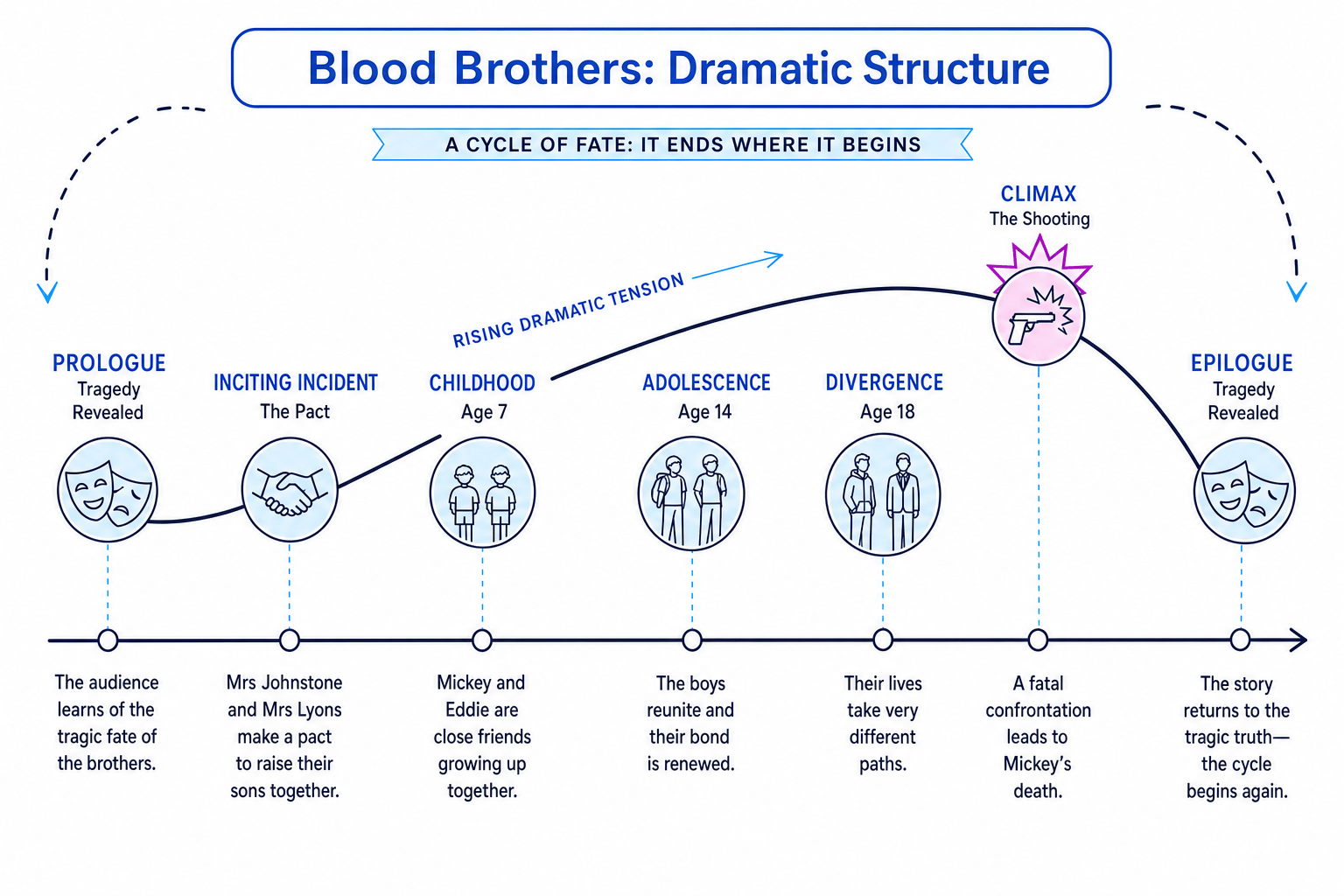
Act One: Secrets and Childhood (Ages 0 to 7)
Act One establishes the inciting incident—the event that sets the rest of the plot in motion—and introduces the extreme contrast between the lives of the two families.
The Pact
We meet Mrs Johnstone, a struggling, working-class mother of seven who has been abandoned by her husband. She finds out she is pregnant with twins and knows she cannot afford to keep them. She works as a cleaner for Mrs Lyons, a wealthy but childless woman who desperately wants a baby.
Mrs Lyons manipulates Mrs Johnstone into agreeing to give her one of the twins. To bind the agreement, Mrs Lyons makes Mrs Johnstone swear on the Bible.
The Birth of the Lie
When the twins are born, Mrs Lyons takes Edward, and Mrs Johnstone keeps Mickey. To ensure Mrs Johnstone keeps the secret, Mrs Lyons invents a superstition: "they say that if either twin learns that he once was a pair, they shall both immediately die." This fake curse becomes a self-fulfilling prophecy.
The Meeting (Age 7)
Despite their mothers' efforts to keep them apart, Mickey and Edward meet by chance at age seven. They instantly bond and discover they share the same birthday. In a moment of deep situational irony, they seal their friendship by declaring themselves "blood brothers".
When Mrs Lyons discovers their friendship, her mental health begins to deteriorate. Terrified that the truth will be revealed, she convinces her husband to relocate the family to the countryside. Shortly after, the Johnstones are also rehomed to the same area (Skelmersdale) as part of a government slum clearance scheme, giving Mrs Johnstone a fresh start.
Confusing the mothers' motivations
Do not write that Mrs Johnstone gave her baby away because she didn't love him. She gave Edward away out of desperate love, wanting him to have a life of security. Conversely, Mrs Lyons acts out of intense insecurity, isolation, and social pressure to be a mother. Contrast their motives to show a deep understanding of Russell's characterisation.
Act Two: Adolescence, Class Divergence, and Climax (Ages 14 to ~20s)
Act Two shifts the play from a lighthearted exploration of childhood to a darker, politically charged tragedy. The gap between the characters' social classes widens, leading to the final catastrophe.
The Reunion (Age 14)
At age fourteen, Mickey and Edward meet again by chance in the countryside. Along with their childhood friend Linda, they form a close-knit trio. However, the differences in their social classes are now visible:
- Edward attends a prestigious boarding school, wears a smart uniform, and is destined for university.
- Mickey attends a poorly funded secondary modern school and is prepared only for manual factory work.
Mrs Lyons sees them together again and confronts Mrs Johnstone, offering her money to leave. When Mrs Johnstone refuses, Mrs Lyons attempts to attack her with a kitchen knife, illustrating her complete descent into paranoia.
The Divergence (Age 18)
As the boys reach adulthood, their paths split permanently:
- Edward goes to university, enjoys a carefree student life, and has a bright, wealthy future ahead of him.
- Mickey is made redundant from his factory job due to the economic recession. He faces poverty, has to marry a pregnant Linda, and is forced to live with his mother.
Desperate for money, Mickey agrees to act as a lookout for his criminal older brother, Sammy, during a robbery. The robbery goes wrong, and Sammy kills a filling-station worker. Mickey is sentenced to seven years in prison.
The Spiral of Decline
In prison, Mickey is diagnosed with clinical depression and becomes dependent on prescription anti-depressants. When he is released early, he is a shadow of his former self—sluggish, bitter, and unable to function without his pills.
The Climax and Catastrophe
Edward, now a successful local councillor, helps Mickey secure a house and a job. However, Mickey's pride is wounded by this charity. Meanwhile, Edward and Linda have a brief romantic affair.
A bitter Mrs Lyons points out the affair to Mickey, driving him into a state of manic fury. Mickey takes Sammy’s gun and storms into the Town Hall to confront Edward.
Climax
The climax is the point of highest tension in a narrative, where the main conflict comes to a head. In Blood Brothers, this is the final showdown at the Town Hall.
At the Town Hall, Mickey confronts Edward with the gun. Mrs Johnstone rushes in to stop him and screams the truth: they are twins. Mickey's tragic realisation—his anagnorisis—is not one of relief, but of profound grief and anger:
"I could have been him!"
As Mickey's hand shakes, the gun accidentally discharges, killing Edward. Instantly, the police marksmen open fire and shoot Mickey dead. The play ends exactly where it began, with the Narrator asking the audience if the tragedy was caused by superstition, or by class.
Worked Example: Analysing Structural Contrast
The exam will require you to analyse how Russell uses structure to present his themes. Let's look at how to construct an analytical paragraph focusing on the structural contrast in Act One.
Analysing structural contrast in Act One
Suppose you are answering a question on how Russell presents the differences between the lives of Mickey and Edward. Follow these steps to build a high-level structural analysis.
-
State your point clearly, focusing on structure: Explain how Russell uses the immediate juxtaposition (placing two contrasting things close together) of the boys' environments to highlight social inequality.
- Example: "Russell structures the transition between the two households to highlight the stark inequalities of the British class system."
-
Provide precise evidence and name the dramatic method: Focus on how the stage directions or character speech patterns reveal this structural contrast.
- Example: "Immediately after Mrs Johnstone's home is depicted as chaotic and impoverished, Russell introduces the Lyons household. Here, Mrs Lyons speaks in standard English, fretting over 'the nursery' and the placement of her furniture. This rapid shift in setting functions as a visual and auditory juxtaposition."
-
Analyse the effect on the audience and link to context (AO2/AO3): Explain what this structure makes the audience feel or understand about Russell's social message.
- Example: "By forcing the audience to witness these two extremes side-by-side, Russell creates a sense of social injustice. The structural contrast reveals that the twins' early childhood development is dictated entirely by wealth. Edward is insulated from the harsh realities of life, while Mickey's childhood is cut short by poverty. Russell uses this structural divide to argue that class, rather than nature, shapes a person's destiny."
Structure is more than just the plot!
When writing about structure, don't just write a list of events. Use structural terms such as:
- Juxtaposition (contrasting scenes placed next to each other).
- Parallelism (similar situations happening to both boys, highlighting their different outcomes).
- Foreshadowing (clues about the tragic ending, like the children's game of "shooting" each other in Act One).
In the exam
- Never tell the story for the sake of it: Every time you mention a plot point, you must explain why Russell chose to include it and how it links to a theme (e.g., class inequality, superstition, or fate).
- Track the character arcs: Show how Mickey's trajectory is a downward spiral of declining opportunities, whereas Edward’s is an upward trajectory of privilege. Contrast these paths directly in your body paragraphs.
- Reference the Narrator's role: Remember that the Narrator acts as a structural device. He keeps the audience focused on the theme of fate, stepping in at key transition points (like the change of seasons or the passage of time) to remind us of the impending tragedy.
Check yourself
- Why is the cyclical structure of the play so important to our understanding of the theme of fate?
- What is the exact moment of "anagnorisis" (tragic discovery) for Mickey, and what are his final words to his mother?
- How does the "toy gun" game played by the children in Act One foreshadow the final scene of the play?
