Willy Russell’s Blood Brothers (first performed in 1983) is a powerful, politically charged musical set in Liverpool. On the surface, it is a heartbreaking story of twin brothers separated at birth who grow up on opposite sides of the social divide, only to meet a tragic, joint end. Beneath this narrative lies a fierce critique of the British class system under Margaret Thatcher's government in the late 1970s and early 1980s.
To excel in your GCSE exam, you must understand how Russell uses the form of a modern musical tragedy to criticize social inequality, arguing that nurture (our social environment) shapes our lives far more than nature (our biological makeup).
What you'll learn
- The unique generic blend of musical theatre and classical tragedy.
- How the contrasting lives of Mickey and Edward expose deep-seated class inequality.
- The structural role of the Narrator and how the play's opening shapes our viewing experience.
Form and Genre: A Modern Tragedy
To analyze Blood Brothers effectively, you first need to understand its unique structure. Russell combines the popular appeal of a musical with the devastating inevitability of a classical tragedy.
Tragedy
A tragedy is a genre of drama characterized by serious and dignified events, leading to the downfall of a main character (the tragic hero), usually driven by fate, a tragic flaw, or societal pressures.
Unlike traditional musical theatre, which often ends happily, Blood Brothers is designed as a tragedy from its very first moments. The play begins in media res (in the middle of things) with the final scene: the dead bodies of Mickey and Edward on the stage.
By showing us the catastrophic ending first, Russell shifts our focus. We are not watching to find out what happens, but rather why and how it was allowed to happen. This dramatic design prevents us from getting swept up in a simple, escapist story. Instead, it forces us to critically analyze the social forces that drive the twins to their deaths.
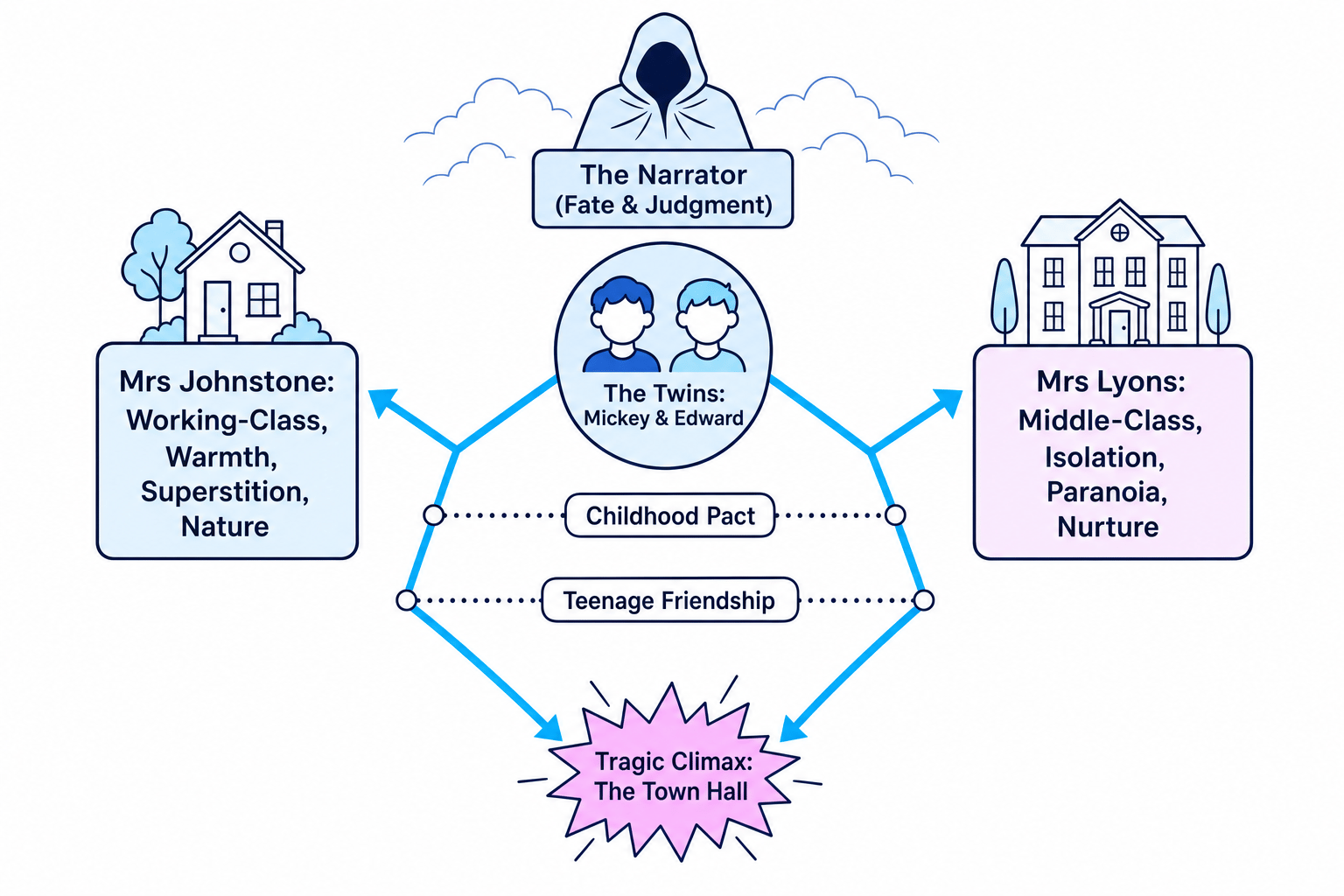
The Parallel Worlds: Nature vs. Nurture
At the heart of the play's overview is a controlled sociological experiment. Russell takes identical twin boys—sharing the exact same DNA—and places them into contrasting environments.
Nature vs. Nurture
The nature vs. nurture debate is a psychological and philosophical argument over whether human behavior and life outcomes are determined primarily by genetics (nature) or by upbringing, social class, and environment (nurture).
Through the split of Mickey and Edward, Russell addresses this debate directly:
- Mickey Johnstone is raised by his biological mother, Mrs. Johnstone, in a struggling, working-class household. His life is defined by poverty, overcrowding, inadequate state education, unemployment, and eventually, crime and chemical dependency.
- Edward Lyons is raised by the wealthy, middle-class Mrs. Lyons. His life is defined by material comfort, private schooling, university, and an assured professional career as a councillor.
By keeping their "nature" identical, Russell demonstrates that their vastly different life outcomes are entirely the result of "nurture" (or, more specifically, the British class system). Mickey's descent into despair is not a personal failure, but the predictable result of systemic deprivation.
Russell's Core Message
The tragic deaths of Mickey and Edward are not caused by bad luck or fate, but by a rigid class system that deprives the working class of opportunity while shielding the middle class from economic reality.
The Narrator: The Voice of Fate and Conscience
A key dramatic method in Blood Brothers is the character of the Narrator. He does not exist within the realistic world of the play's characters; instead, he stands outside of it, frequently breaking the "fourth wall" to speak directly to the audience.
Greek Chorus
A Greek chorus is a device from ancient drama where a performer or group of performers comments on the action, themes, and moral implications of the play, often warning characters or reminding the audience of inescapable fate.
The Narrator acts as Russell's modern version of a Greek Chorus. He is a brooding, menacing figure who:
- Foreshadows the inevitable tragedy to maintain dramatic tension.
- Represents superstition and guilt, constantly reminding Mrs. Johnstone and Mrs. Lyons of their secret agreement ("the devil's got your number").
- Acts as a moral judge, asking the audience at the end of the play to consider whether it was really "fate" that killed the twins, or "what we, the English, have come to know as class."
Dismissing the Narrator as just a storyteller
Do not write that the Narrator is simply there to guide the audience through the plot. In a GCSE essay, you must analyze him as a structural device used by Russell to represent the psychological burden of guilt, the societal pressure of class, and the unavoidable march of fate.
Analyzing the Opening Prologue's Dramatic Function
In the exam, you may be asked how Russell establishes his main themes and dramatic atmosphere at the start of the play. Let's walk through how to construct a high-level analytical response to the opening prologue.
Analyzing the opening prologue's dramatic function
- Analyze the prompt and identify the focus: The goal is to explain how Russell uses the opening of the play to set up the tragedy and introduce his core themes.
- Select precise evidence: Look at the Narrator's opening lines:
"Have you ophthalmia? Or is it a story / of two brothers, born on the self-same day, / who died on the self-same day?" And later, his description of Mrs. Johnstone: "the mother, so cruel, / There's a stone in place of her heart."
- Identify the literary methods:
- Direct address: "Have you..." directly challenges the audience, breaking the theatrical illusion.
- Parallel phrasing: "born on the self-same day / died on the self-same day" establishes the cyclical, balanced structure of their lives and deaths.
- Metaphor / Motif: The "stone" in the mother's heart introduces the motif of coldness and harsh reality, contrasting with Mrs. Johnstone's natural warmth.
- Link to context and audience effect (AO3 & AO1): Explain that by starting with the image of death and a judgment on the mother, Russell engages the audience's sense of morality. He forces us to question our own biases about working-class women and sets up the play as an investigation into social guilt rather than a light-hearted musical.
Structural Overview: The Two Acts
The play is neatly divided into two acts, mirroring the stages of the twins' lives. This structural symmetry is crucial for your essays.
Act One: Childhood and Innocence
- Focus: The innocence of childhood and the instinctual bond between the twins.
- Key Events: The secret deal between the mothers; the blood brother pact at age seven; the contrast between the freedom of street play and the confinement of Mrs. Lyons’ middle-class home.
- Tone: Energetic, nostalgic, and humorous, though punctuated by the Narrator's ominous warnings.
- Key Idea: At age seven, Mickey and Edward do not understand class. They naturally gravitate toward each other, suggesting that class divides are artificial and learned, not natural.
Act Two: Adulthood and Experience
- Focus: The crushing reality of the adult world and social division.
- Key Events: The reunion of the twins as teenagers; Edward going to university while Mickey goes to the factory; Mickey's redundancy; Mickey's imprisonment; the final, fatal confrontation in the town hall.
- Tone: Increasingly dark, tense, and tragic.
- Key Idea: As they grow up, the class system forces them apart. Edward's wealth buys him freedom and second chances, while Mickey's poverty traps him, leading to his psychological breakdown.
Look for structural parallels
Always look for parallel events between Act One and Act Two. For example, the toy guns they play with in Act One ("The Christmas Game") tragically transform into a real, loaded revolver in Act Two. This structure emphasizes how childhood games foreshadow adult tragedies.
In the exam
- Acknowledge the genre: Always refer to Blood Brothers as a play or a musical drama. Never call it a "book" or a "novel." Refer to "the audience" rather than "the reader."
- Address Russell's intent: Keep Willy Russell's purpose at the center of your essay. Use active verbs like Russell exposes, Russell challenges, Russell satirizes, or Russell deconstructs to show you understand the writer's craft.
- Connect methods to themes: Whenever you analyze a quote (AO2), immediately link it to context (AO3). For example, if you quote Mrs. Johnstone singing about "Marilyn Monroe", explain how this motif represents the false promise of glamour and escape in post-war working-class Britain.
- Focus on structure: Show the examiner you see the big picture. Contrast Mickey's and Edward's situations at the start of Act Two versus the end of the play to show how social forces wear Mickey down while elevating Edward.
Check yourself
- Why does Willy Russell choose to reveal the tragic ending of the play in the opening minutes?
- What are the main differences between the environments in which Mickey and Edward are raised, and how do these support the "nurture" side of the debate?
- In what ways does the Narrator function similarly to a traditional Greek Chorus?
