What you'll learn
- What Romeo and Juliet is about at a whole-play level.
- How Shakespeare shapes the play as a tragedy.
- The main ideas you should keep returning to in essays.
- How the AQA Shakespeare question asks you to use both the extract and the wider play.
The play in one sentence
Romeo and Juliet is a tragedy about two young people whose private love is destroyed by public hatred, family control, speed, secrecy, and a world that repeatedly turns emotion into violence.
Tragedy
A tragedy is a drama that ends in serious suffering or death, often showing how personal choices, social pressures and forces beyond human control combine to destroy the characters.
Shakespeare sets the play in Verona, where the Montague and Capulet families are trapped in an “ancient grudge”. Romeo Montague and Juliet Capulet fall in love, marry secretly, and are separated by violence and exile. Their deaths finally force the two families to recognise the damage caused by their feud.
This overview map shows the main pressures working on the lovers throughout the play.
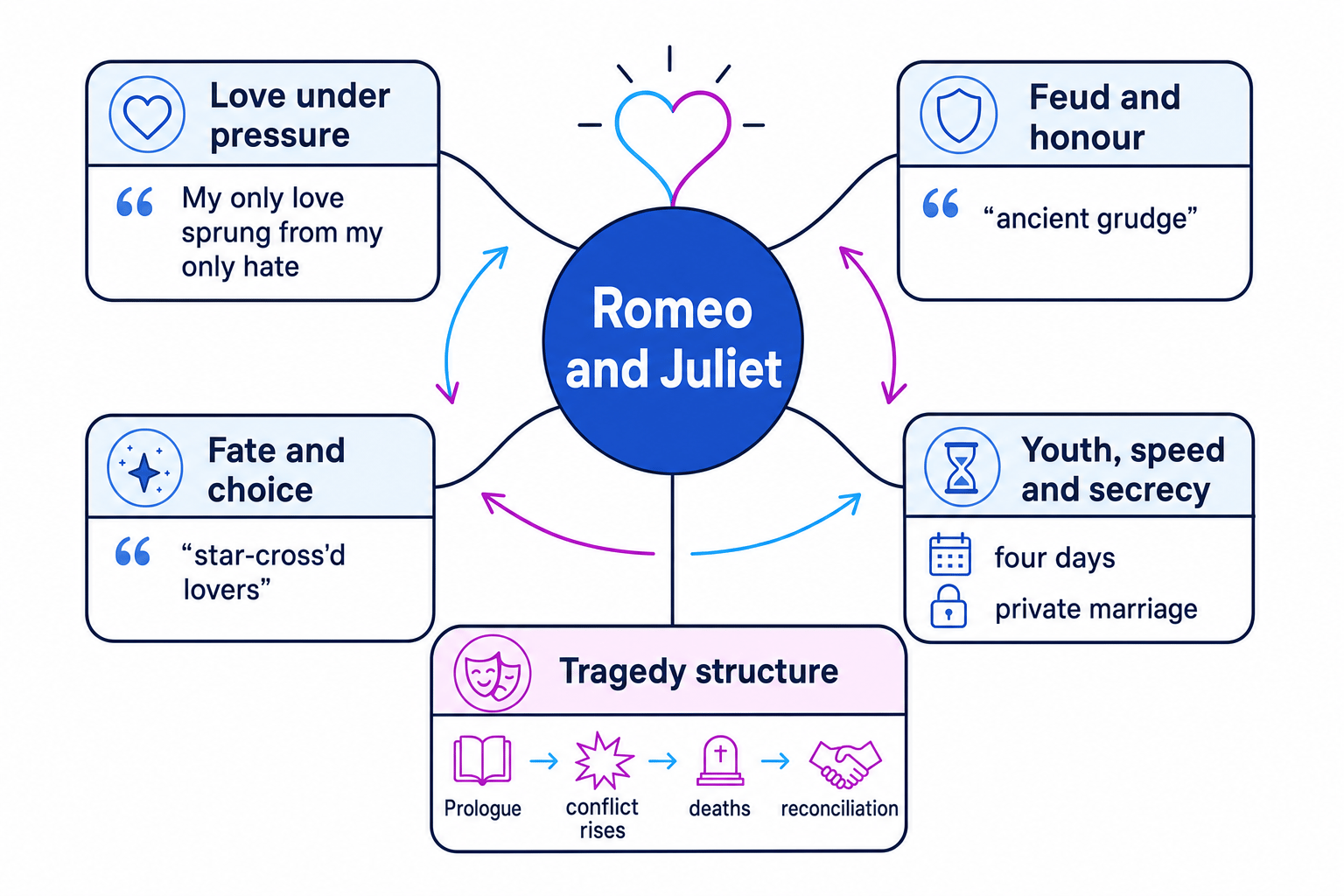
The big idea
The play is not simply “a love story”. It is a tragedy in which love appears beautiful and sincere, but it exists inside a society ruled by conflict, male honour, family loyalty and haste.
Why the Prologue matters
The play opens with a Prologue: a short introductory speech that prepares the audience for the story.
Prologue
A Prologue is an opening section of a play that introduces key information before the main action begins.
The Prologue tells us the ending before the story properly starts: “A pair of star-cross’d lovers take their life.” This creates dramatic irony, because the audience knows from the beginning that Romeo and Juliet will die, while the characters do not.
Dramatic irony
Dramatic irony happens when the audience knows something important that one or more characters do not know.
The phrase “star-cross’d” suggests that the lovers are opposed by fate. However, Shakespeare does not make fate the only cause. Human decisions matter too: the feud, Tybalt’s aggression, Capulet’s pressure, Romeo’s impulsiveness, Friar Lawrence’s risky plan and the failed message all contribute.
Foreshadowing
Foreshadowing is when a writer gives early hints about what will happen later.
Reading the Prologue as tragedy
-
Start with the phrase “star-cross’d lovers”. The adjective “star-cross’d” links the lovers to astrology and suggests their relationship is doomed by forces beyond their control.
-
Compare this with “ancient grudge”. The noun “grudge” shifts attention from fate to human hatred, showing that the feud is a man-made cause of suffering.
-
Link the two ideas: Shakespeare makes the tragedy feel both unavoidable and preventable. The lovers seem doomed, but the adults and families still share responsibility.
The basic dramatic shape
The play moves quickly. The action takes place over only a few days, which makes the relationship feel intense and urgent.
A simple way to understand the structure is:
- Beginning: Verona is divided by the feud; Romeo is unhappy in love with Rosaline.
- Meeting: Romeo and Juliet meet at Capulet’s feast and instantly fall in love.
- Secret union: they marry privately with Friar Lawrence’s help.
- Turning point: Tybalt kills Mercutio; Romeo kills Tybalt and is banished.
- Catastrophe: Juliet’s false death plan fails; Romeo and Juliet die; the families reconcile.
Structure
Structure means the way a writer organises a text: the order of events, turning points, contrasts, repetitions and the pace of the action.
The key structural pattern is that moments of love are repeatedly interrupted by violence or danger. The balcony scene is followed by the secret marriage; the marriage is followed almost immediately by Mercutio and Tybalt’s deaths; Juliet’s attempt to escape family control leads towards the tomb.
Retelling the plot
Do not spend an essay simply narrating what happens. A strong answer explains how Shakespeare shapes events to present an idea, such as love, conflict, fate, youth or family power.
Love and conflict are joined together
One of the most important overview points is that Shakespeare refuses to keep love and hatred separate. Juliet realises this immediately after meeting Romeo: “My only love sprung from my only hate!”
This line matters because it compresses the whole tragedy into one sentence. Juliet’s love is real, but it is born from the enemy family. The juxtaposition of “love” and “hate” shows the emotional contradiction she is trapped inside.
Juxtaposition
Juxtaposition is when a writer places two contrasting ideas close together to highlight the difference between them.
Shakespeare also uses oxymoron, where opposite words are placed together, to show confused emotions. Romeo says “O brawling love! O loving hate!” early in the play. At that point he is talking about love in a dramatic, exaggerated way, but the language prepares us for a world where love and violence are closely connected.
Oxymoron
An oxymoron is a phrase that combines contradictory terms, such as “loving hate”.
Romeo and Juliet as young protagonists
Protagonist
A protagonist is a main character whose experiences and choices drive the story.
Romeo and Juliet are the central protagonists, but Shakespeare does not present them in exactly the same way. Romeo is often impulsive and guided by powerful feelings. Juliet is young, but she becomes increasingly decisive, especially when she chooses Romeo over her family’s expectations.
Their youth matters because the play explores speed: quick love, quick marriage, quick violence, quick punishment and quick death. Shakespeare makes the audience feel how little time the lovers have to think clearly.
A useful overview phrase
You can describe the play as a tragedy of haste and pressure: characters act quickly because Verona gives them very little safe space to pause, speak honestly or choose freely.
Society, family and authority
The lovers are not destroyed by emotion alone. They live in a patriarchal society, meaning a society where men hold most public and family power.
Patriarchy
Patriarchy is a social system in which men have authority over women in the family, law and wider society.
Juliet is especially affected by this. Lord Capulet initially seems protective, but later threatens her when she refuses to marry Paris: “Hang thee, young baggage!” This shows how quickly a father’s love can become control when Juliet challenges his authority.
For a GCSE essay, context is strongest when it is linked directly to Shakespeare’s presentation. Do not bolt on a random sentence about Elizabethan society. Instead, connect context to the language and action: Juliet’s limited choices make her secret marriage and potion plan more understandable.
Context should support meaning
Context is not background decoration. Use it to explain why Shakespeare’s audience might see family obedience, marriage, honour or religion differently from a modern audience.
Shakespeare’s methods at a glance
For AQA, you are rewarded for analysing how Shakespeare creates meaning. That means looking at language, form and structure.
Language, form and structure
Language means Shakespeare’s word choices and imagery. Form means the type of text and dramatic conventions, such as tragedy, soliloquy or sonnet. Structure means how events and contrasts are arranged across the play.
Some methods to keep in mind across the whole play:
- Religious imagery: Romeo calls Juliet a “holy shrine”, presenting love as sacred.
- Light and dark imagery: Juliet is “the sun”, making her seem life-giving and powerful.
- Violent imagery: love is often surrounded by death, swords, poison and tombs.
- Dramatic irony: the audience often understands the danger before the characters do.
- Fast pace: the compressed timescale increases tension and makes the tragedy feel breathless.
Do not list methods without explaining their effect. “Shakespeare uses imagery” is not enough. You need to say what kind of imagery, what it suggests, and how it shapes the audience’s response.
Turning a method into analysis
-
Choose a precise quotation: Romeo describes Juliet as “the sun” in the balcony scene.
-
Identify the method and meaning: the metaphor presents Juliet as bright, life-giving and central to Romeo’s world.
-
Link to the wider play: this idealised image of love contrasts with the darkness of the feud, making the audience feel that their relationship offers hope in a violent society.
How the AQA question works
In AQA GCSE English Literature Paper 1, you answer one Shakespeare question on your set play. The exam is closed book, so you need to know short quotations from memory.
The question gives you a printed extract and asks you to write about that moment and the play as a whole. Your response is marked mainly for your argument, evidence and analysis. In the Shakespeare section, spelling, punctuation and grammar are also assessed.
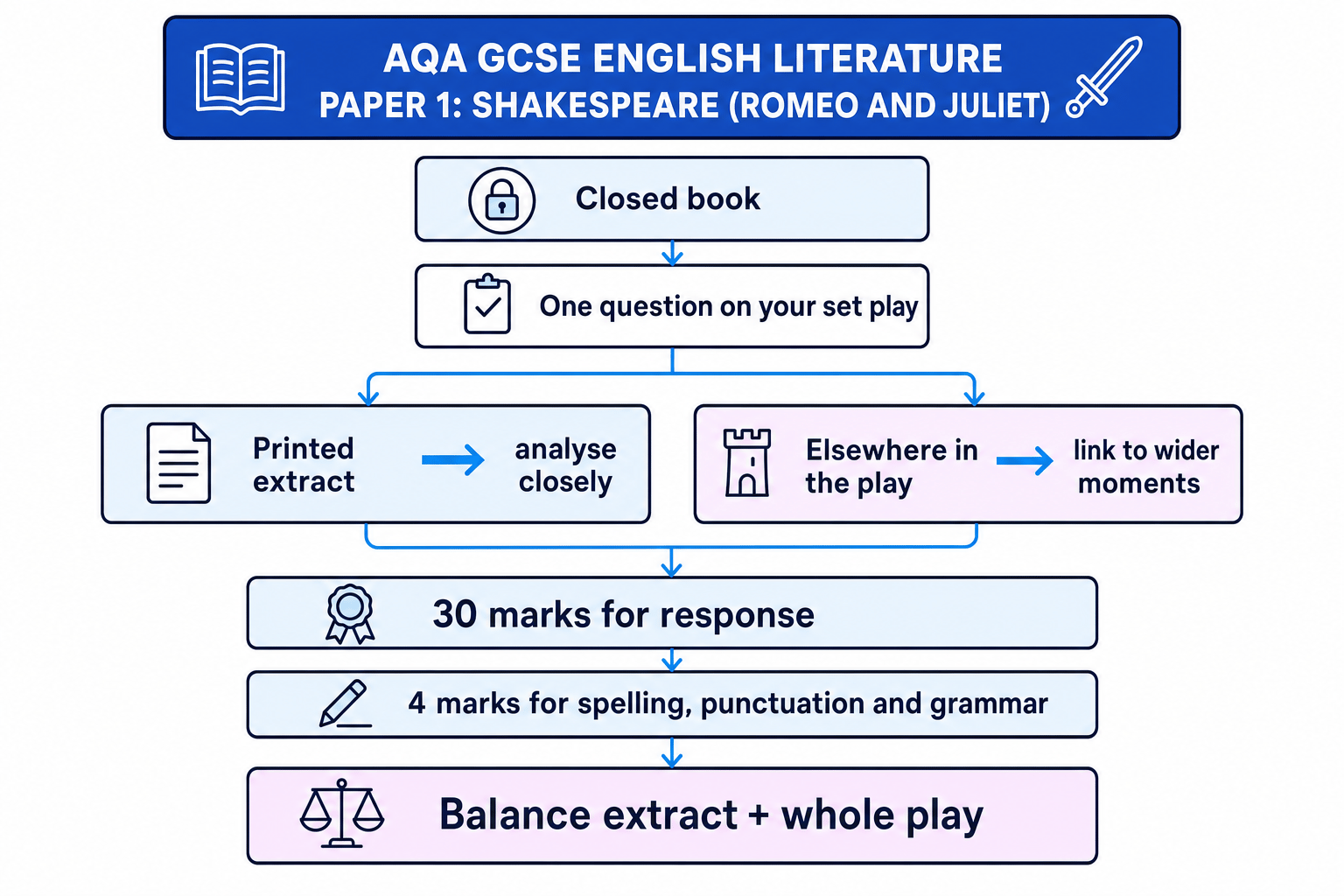
A strong answer usually moves between the extract and the wider play. If the question is about conflict, for example, you might analyse a fight scene in the extract, then connect it to the feud in the Prologue, Tybalt’s aggression, Romeo’s banishment, or the final reconciliation.
Only writing about the extract
The extract is your starting point, not your whole answer. You need close analysis of the extract and references to relevant moments elsewhere in the play.
A simple overview paragraph shape
When you write about the play, aim for a clear analytical chain:
Point → evidence → method → effect → link
For example:
Shakespeare presents love as powerful but trapped within social conflict. Juliet’s exclamation “My only love sprung from my only hate!” uses juxtaposition to place “love” and “hate” against each other, showing that her feelings for Romeo cannot be separated from the family feud. This makes the audience sympathise with Juliet because her private desire is immediately restricted by public hostility. Across the play, Shakespeare develops this conflict until the lovers’ deaths become the only event strong enough to end the “ancient grudge”.
Notice how the paragraph does not just say what happens. It explains how Shakespeare presents an idea and why that matters.
In the exam
-
Begin with a clear argument about what Shakespeare is presenting, not a vague plot statement.
-
Use the extract closely, but connect it to at least two relevant moments from elsewhere in the play.
-
Keep quotations short and accurate, then analyse Shakespeare’s method and the effect on the audience.
Check yourself
- Why is it important that the Prologue tells the audience the ending?
- How are love and conflict connected from the start of the play?
- What is the difference between retelling the plot and analysing Shakespeare’s methods?
