What you'll learn
- How a strong Macbeth model essay is built, from question to conclusion.
- How to turn short quotations into analysis of Shakespeare’s methods.
- How to weave context into your argument without “bolting it on”.
- How to avoid common essay mistakes in the AQA Shakespeare question.
What a model essay is for
A model essay is not something to memorise word-for-word. It is an example of how a successful answer thinks: it answers the question, uses precise evidence, analyses Shakespeare’s methods, and keeps returning to the writer’s message.
In Macbeth, the best essays usually show a journey: Macbeth changes from “brave Macbeth” to a guilty murderer, then to a tyrant. Lady Macbeth changes too, from controlling ambition to psychological collapse. Your essay should track that movement.
Model essays model thinking
A high-quality essay is not a quotation dump. It is a clear argument about how Shakespeare presents a character, theme, or idea across the play.
Start with the question
Before writing, identify the focus of the question. The focus is the character, theme, or idea you must keep discussing, such as ambition, guilt, kingship, violence, or the supernatural.
AQA Shakespeare questions usually ask you to start with an extract and then write about the play as a whole. The play is closed book, but the extract is printed for you.
Thesis
A thesis is your overall argument in one or two sentences. It should answer the question directly and suggest Shakespeare’s bigger message.
Decoding a Macbeth question
Suppose the question is: How does Shakespeare present Macbeth as a violent character?
-
Identify the focus: the answer must stay on Macbeth’s violence, not just Macbeth generally.
-
Decide whether the presentation changes across the play: at first, violence makes Macbeth seem heroic in battle — “brave Macbeth” — but later it becomes immoral, secretive, and tyrannical.
-
Build a thesis: Shakespeare first presents Macbeth’s violence as loyal service to the king, but gradually shows it becoming a sign of corrupted ambition and unnatural kingship.
Shape the essay as an argument
A strong essay usually has:
- a short introduction with a thesis;
- three main paragraphs, each developing the argument;
- a brief conclusion that returns to Shakespeare’s message.
You do not have to write about events in exact plot order, but chronological movement often helps in Macbeth because Shakespeare shows moral decline over time.
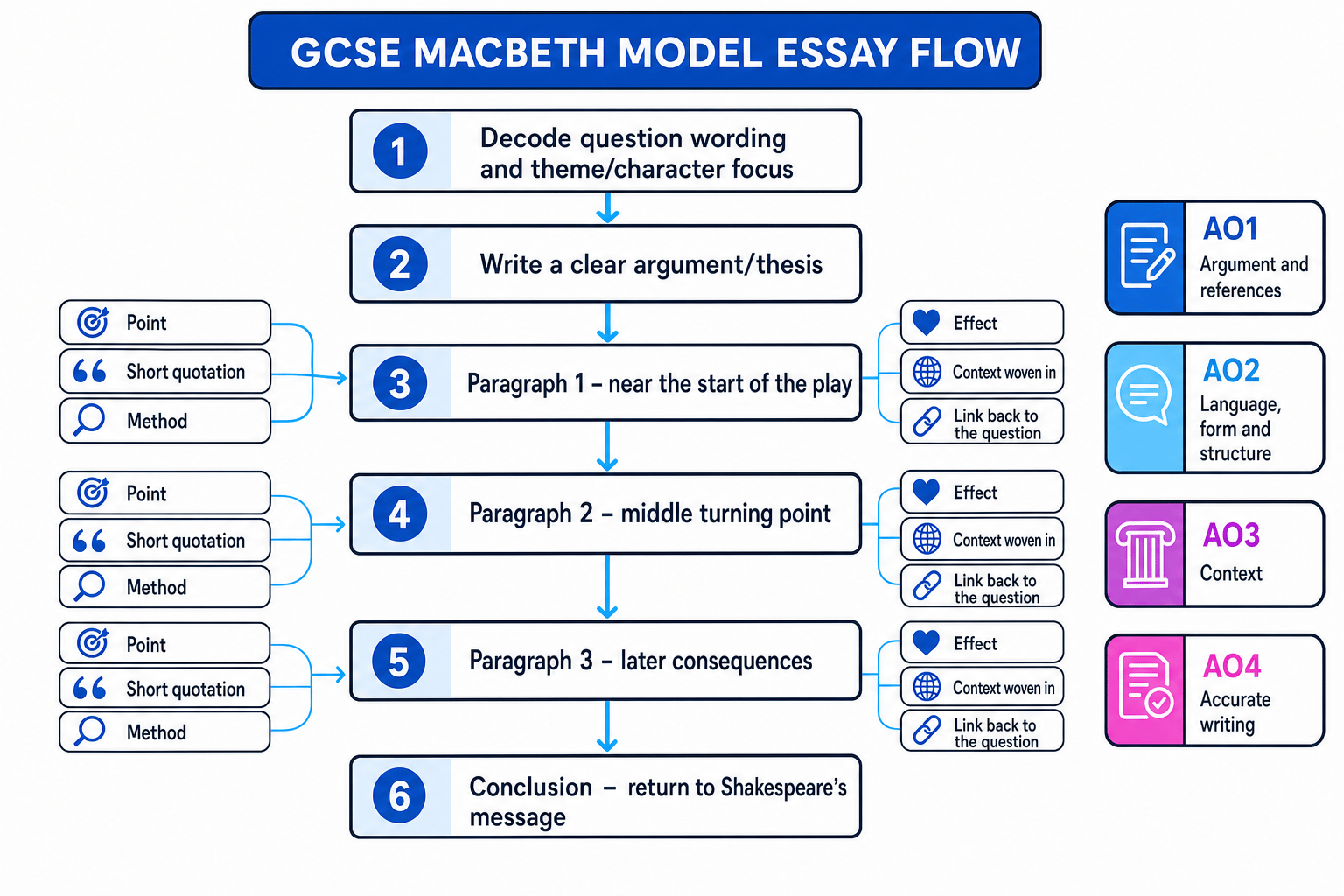
Use a journey structure
For many Macbeth questions, think: beginning → turning point → consequences. This helps you write about the whole play, not just the extract.
Build each paragraph carefully
Each main paragraph needs a topic sentence. A topic sentence is the first sentence of a paragraph that states the paragraph’s main idea.
Then use a short quotation. An embedded quotation is a quotation smoothly fitted into your own sentence. For example: Macbeth admits his “black and deep desires” rather than writing, “The quote is ‘black and deep desires’.”
After that, analyse a method. A method is a deliberate choice made by Shakespeare, such as metaphor, imagery, soliloquy, symbolism, dramatic irony, or structure. Naming the method is not enough: you must explain its effect.
Analysis
Analysis means explaining how Shakespeare’s choices create meaning. It connects quotation, method, effect, and the question.
Building a paragraph on ambition
For the question How does Shakespeare present ambition in Macbeth?:
-
Make a precise point: Shakespeare presents Macbeth’s ambition as hidden and morally dangerous before he kills Duncan.
-
Choose short evidence: Macbeth asks, “Stars, hide your fires; / Let not light see my black and deep desires” in Act 1 Scene 4.
-
Analyse the method: the contrast between “light” and “black” uses imagery of darkness to suggest Macbeth knows his desires are sinful and wants to conceal them.
-
Link to context and meaning: to a Jacobean audience, plotting against a king would seem especially unnatural because kingship was associated with divine authority.
-
Return to the question: Shakespeare therefore presents ambition not as confidence, but as a corrupting force that begins in secrecy.
A model paragraph
Here is what those choices might look like as a finished paragraph:
Shakespeare presents Macbeth’s ambition as dangerous because he recognises its evil before he acts on it. After Malcolm is named heir, Macbeth asks, “Stars, hide your fires; / Let not light see my black and deep desires.” The contrast between “light” and “black” creates a moral opposition between goodness and corruption, suggesting Macbeth already understands that his ambition is shameful. Shakespeare also uses the adjective “deep” to imply that Macbeth’s desire is buried within him, as though ambition is an inner darkness he cannot easily escape. For a Jacobean audience, his wish to hide thoughts of regicide would be disturbing because killing Duncan means attacking God’s chosen order. Shakespeare therefore presents ambition as a secret force that tempts Macbeth away from loyalty and towards damnation.
Notice that the paragraph does not just say “this is imagery”. It explains what the imagery suggests about Macbeth and why it matters.
Device spotting
Do not write a sentence like: “This is a metaphor and it is effective.” Always explain the idea created by the method: guilt, corruption, disorder, fear, masculinity, temptation, or another relevant meaning.
Weave in context, don’t bolt it on
Context means relevant knowledge about the time, beliefs, and audiences connected to the text. In Macbeth, useful context includes Jacobean beliefs about kingship, treason, witchcraft, religion, gender expectations, and the natural order.
Context should support your interpretation. It should not interrupt the paragraph like a history fact copied from revision notes.
Weaving context into guilt analysis
For the question How does Shakespeare present guilt?:
-
Choose a moment where guilt is visible: after Duncan’s murder, Macbeth asks, “Will all great Neptune’s ocean wash this blood / Clean from my hand?” in Act 2 Scene 2.
-
Analyse the symbol: “blood” symbolises both Duncan’s murder and Macbeth’s permanent guilt.
-
Analyse the scale of the image: the reference to “great Neptune’s ocean” exaggerates the amount of water needed, suggesting Macbeth feels his guilt is too vast to be cleansed.
-
Connect context tightly: because regicide was seen as a sin against God’s order, Shakespeare presents Macbeth’s guilt as spiritual as well as psychological.
Write introductions that are useful
A good introduction should be brief. Do not retell the play. Do not begin with vague sentences like “Shakespeare presents many themes in Macbeth.”
A stronger introduction might look like this:
Shakespeare presents guilt as an inescapable punishment for violating moral and natural order. Through Macbeth and Lady Macbeth, he shows that murder does not bring security: instead, it destroys the mind, sleep, and identity.
This works because it answers the question and sets up an argument.
Write conclusions that return to Shakespeare’s message
A conclusion should not repeat all your points. Instead, zoom out to what Shakespeare may be suggesting.
For an essay on ambition, you might conclude:
Ultimately, Shakespeare presents unchecked ambition as self-destructive. Macbeth gains the crown, but loses honour, peace, love, and finally his life, warning the audience that power gained through evil cannot create true security.
This links character, theme, and writer’s purpose.
Retelling the plot
Avoid paragraphs that simply say what happens next: “Then Macbeth kills Duncan. Then he becomes king. Then he kills Banquo.” Turn events into argument: explain what Shakespeare reveals through those events.
A compact model essay plan
For a question on ambition, a strong plan could be:
-
Introduction: ambition is presented as a corrupting force that begins in temptation and ends in destruction.
-
Paragraph 1: Macbeth recognises his ambition as morally wrong — “black and deep desires”.
-
Paragraph 2: Macbeth understands ambition may destroy him — “vaulting ambition, which o’erleaps itself”.
-
Paragraph 3: once king, Macbeth becomes trapped in violent ambition — “I am in blood / Stepp’d in so far”.
-
Conclusion: Shakespeare warns that ambition without morality destroys both the individual and the kingdom.
Short quotations are powerful
You do not need long quotations. Phrases like “damned spot”, “false face”, “fruitless crown”, “sleep no more”, and “black and deep desires” are easier to remember and easier to analyse.
Keep your writing accurate
For the Shakespeare question, AQA also assesses accuracy of writing. That means your spelling, punctuation, vocabulary, and sentence control matter.
Use literary terms, but only when they help. For example, soliloquy means a speech where a character speaks their thoughts aloud, usually alone on stage. Macbeth’s “Is this a dagger which I see before me” is powerful because the soliloquy reveals his unstable mind before Duncan’s murder.
In the exam
-
Start with a clear thesis that answers the exact question, then make every paragraph develop that argument.
-
Use short quotations and analyse Shakespeare’s methods: language, form, structure, and stagecraft.
-
Weave context into analysis only when it helps explain Shakespeare’s presentation or the audience’s reaction.
Check yourself
- Can you write a thesis for a question on Macbeth and ambition without retelling the plot?
- Can you analyse one short quotation by naming a method and explaining its effect?
- Can you add context in one sentence without turning it into a separate history paragraph?
