Writing a top-band essay for Romeo and Juliet requires more than just memorising the plot or identifying metaphors. The examiners are looking for a cohesive, convincing argument that treats the characters as literary constructs used by Shakespeare to deliver a powerful message to his Elizabethan audience.
What you'll learn
- How to construct a persuasive, thesis-led introduction.
- The structure of a high-scoring analytical paragraph that integrates context seamlessly.
- Techniques for elevating your close language analysis to secure top marks.
The Core Ingredients of a Grade 9 Essay
Before drafting your essay, you must understand the Assessment Objectives (AOs) that the examiners use to grade your writing. For your Shakespeare essay (Paper 1, Section A), you are marked on four criteria:
- AO1 (Response & Quotations): Maintaining a clear, focused argument that answers the prompt, supported by well-chosen, integrated quotations.
- AO2 (Analysis of Methods): Analysing how Shakespeare uses language, form, and structure to create meaning. This involves looking at specific word choices (zooming in) and dramatic devices.
- AO3 (Context): Explaining how the play reflects the historical, social, and cultural realities of Elizabethan/Jacobean England, and how it aligns with Shakespeare’s overall message.
- AO4 (Spelling, Punctuation, and Grammar): Writing with technical accuracy, a wide vocabulary, and well-structured sentences. This is worth 4 distinct marks on the Shakespeare question.
Dramatic Construct
A dramatic construct is a character who is not a real person, but a symbolic tool created by the playwright to represent a specific theme, ideology, or social group to the audience.
When writing about Romeo, Juliet, Tybalt, or Lord Capulet, you must refer to them as constructs. Instead of writing "Juliet is scared of her father," write "Shakespeare constructs Juliet as a victim of patriarchal control to highlight the vulnerability of young women in Elizabethan society."
Crafting a Powerful Thesis Statement
A great essay does not start with a plot summary. It starts with a thesis statement.
Thesis Statement
A thesis statement is a one- or two-sentence summary of your central argument that directly answers the essay prompt, setting up the line of reasoning you will prove in your main paragraphs.
A weak thesis statement simply repeats the question: "In this essay, I will show how Shakespeare presents Tybalt as a violent character."
A strong, analytical thesis statement explains why Shakespeare presents the character or theme in this way: "Shakespeare constructs Tybalt as the embodiment of toxic masculine pride and tribal honour, using his aggressive nature to demonstrate how unchecked patriarchal conflict inevitably destroys the youth of Verona."
The 'What, How, Why' Rule
Every thesis statement and topic sentence should address three elements:
- What is happening/being presented?
- How is Shakespeare presenting it (what are his methods)?
- Why is he presenting it (what is his moral message or purpose)?
The Anatomy of an Outstanding Paragraph
To achieve the highest marks, your analytical paragraphs must not feel like a list of disconnected observations. Instead, they should follow a logical flow where your ideas, evidence, analysis, and historical context are synthesised.
Synthesis
Synthesis is the seamless blending of text-based analysis (AO2) and historical context (AO3) within a single paragraph to support a unified, analytical point (AO1).
The flow diagram below illustrates how a top-band paragraph moves from a thesis-led point into close analysis and, finally, into the writer’s overall purpose.
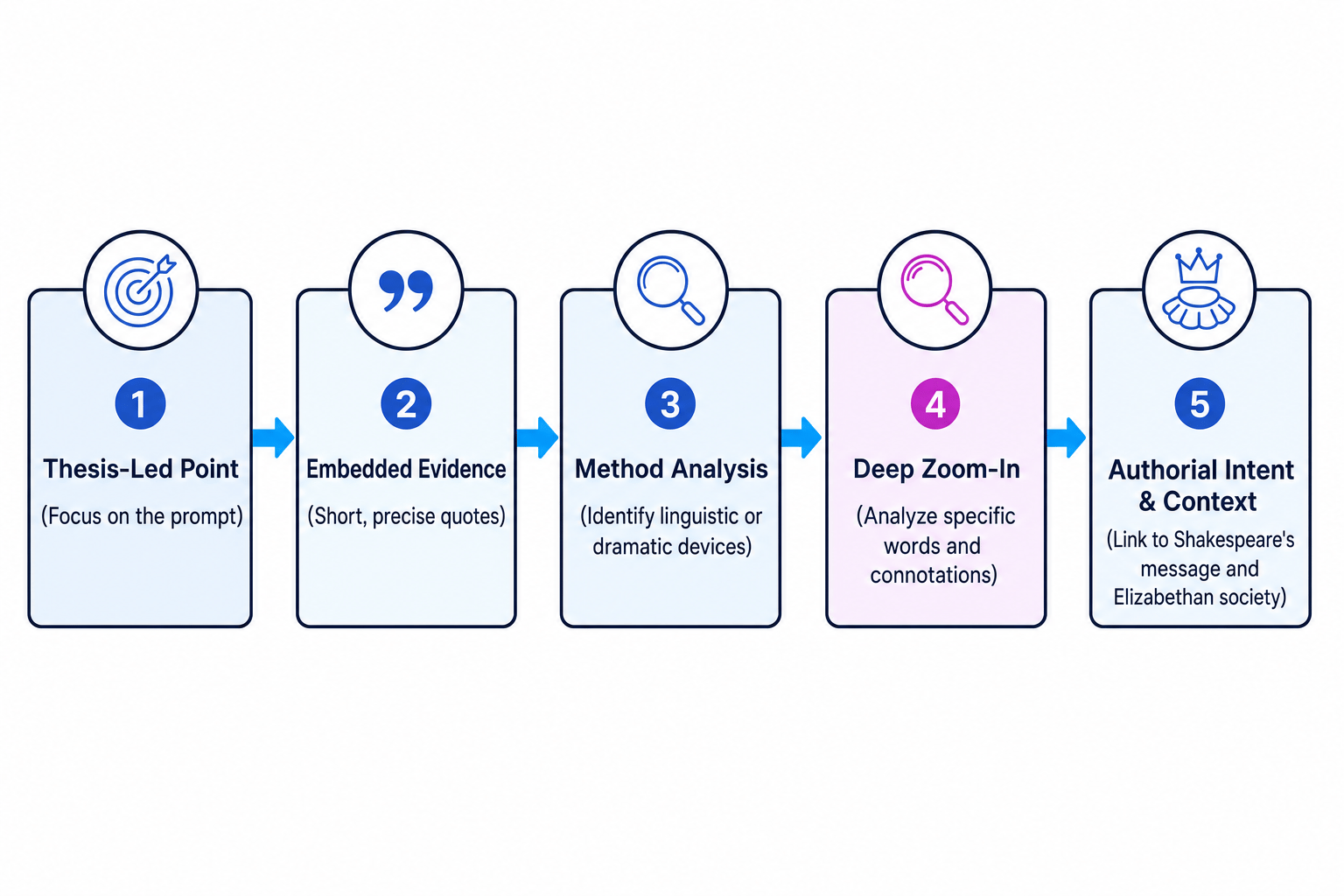
1. Thesis-Led Point (AO1)
Begin with a clear, conceptual topic sentence that answers the prompt. Do not mention plot details yet; focus on Shakespeare's intent.
2. Embedded Evidence (AO1)
Integrate short, precise quotations directly into your own sentences. Avoid using long, block quotes. Instead of writing, "Juliet says: 'My grave is like to be my wedding bed.' This shows she thinks she will die," write: "From her very first meeting with Romeo, Juliet foreshadows her tragic end, lamenting that her 'grave is like to be' her 'wedding bed'."
3. Method Analysis (AO2)
Name the literary, structural, or dramatic method Shakespeare is using. Is it a metaphor? Foreshadowing? Dramatic irony? Use precise terminology, but always connect the method back to how it affects the audience.
4. Deep Zoom-In (AO2)
Isolate a specific word or phrase from your quotation and dissect its connotations (the ideas or feelings associated with the word). Look for patterns of language (semantic fields) or structural shifts (such as a change from blank verse to prose).
5. Authorial Intent & Context (AO3)
Explain why Shakespeare made these choices. Connect your analysis to Elizabethan context (e.g., the Great Chain of Being, the patriarchy, the Courtly Love tradition, or the realities of family honour). What was he warning his audience about?
Upgrading an analytical paragraph on Capulet's anger
In this worked example, we will walk through how to upgrade a basic, descriptive paragraph about Act 3, Scene 5 into an insightful, synthesised Grade 9 response.
- Construct a thesis-led topic sentence (AO1): Instead of writing "In Act 3, Scene 5, Lord Capulet gets very angry with Juliet because she won't marry Paris," write: "Shakespeare constructs Lord Capulet as a domineering patriarch whose sudden transition from a protective father to an aggressive tyrant exposes the absolute authority of men in Elizabethan households."
- Embed a precise, memorable quotation (AO1): Integrate Capulet’s aggressive threats directly into the analysis: "When Juliet refuses to marry Paris, Capulet violently threatens to 'drag' her on a 'hurdle thither' and calls her 'baggage', illustrating how quickly his love turns to transactional ownership."
- Identify and analyse Shakespeare’s dramatic and linguistic methods (AO2): Identify the specific linguistic features and their immediate impact: "The derogatory epithet 'baggage' objectifies Juliet, reducing her to a heavy, useless burden that Capulet owns. Furthermore, the noun 'hurdle' refers to the wooden sledges used to drag convicted traitors to their executions, which structurally aligns Juliet's filial disobedience with treason against the domestic state."
- Synthesize the historical context and authorial intent (AO3): Explain the societal norms that governed this interaction: "In the patriarchal Elizabethan era, daughters were regarded as the legal property of their fathers, expected to secure family status through arranged marriages. By staging Capulet's explosive, terrifying rage, Shakespeare exposes the violent underbelly of this patriarchal system, prompting his contemporary audience to question the absolute power wielded by fathers over their children’s lives."
Model Paragraph Analysis
Let’s study a complete model paragraph answering the prompt: "How does Shakespeare present the relationship between love and violence in the play?"
Notice how the analysis moves fluidly between language, structure, and Elizabethan context.
Throughout the play, Shakespeare presents love and violence not as opposites, but as dual, destructive forces that are deeply intertwined. This is most vividly illustrated through Friar Laurence’s prophetic warning that "these violent delights have violent ends".

The oxymoronic pairing of "violent delights" creates an immediate sense of tension, suggesting that passion, when experienced in its extreme, contains the seeds of its own destruction. The adjective "violent" connotes physical brutality and warfare, yet here it describes "delights", highlighting how the intense ecstasy of the lovers' passion is inherently volatile and dangerous. Furthermore, the repetition of "violent" in close proximity acts as a structural foreshadowing of the tragic resolution in Act 5.

To an Elizabethan audience, this warning would resonate deeply with contemporary ideas about balance and the "golden mean" — the belief that moderation was a virtue and that excessive passion of any kind was a form of madness that disrupted the rational mind. Shakespeare uses the Friar, a figure of religious and moral authority, as a mouth-piece to warn the audience that the lovers' attempt to isolate their passion from the violent reality of the Verona feud is ultimately a fatal illusion.
Feature-Spotting
A very common error is "feature-spotting" — pointing out a metaphor, simile, or oxymoron without explaining its effect or how it supports your overall argument. Identifying an oxymoron gets you low marks; explaining how the oxymoron reflects the conflict between love and violence gets you high marks.
The 'Instead of... Try...' Strategy
When preparing for your exam, practise rewriting your notes to shift your perspective from character-focused to writer-focused.
- Instead of: "Romeo is very sad in Act 1."
- Try: "Shakespeare uses Romeo's initial petrarchan melancholy to satirise the superficial, courtly love conventions of the Elizabethan era."
In the exam
- Spend 5 minutes planning: Do not start writing immediately. Read the extract, highlight 2–3 key quotes from it, and write down 2 short quotes from memory from elsewhere in the play. Write a quick 3-point essay plan.
- Track the character or theme's trajectory: High-scoring essays show how a character or theme changes over the course of the play. Structure your paragraphs chronologically (e.g., beginning, middle, and end of the play) to demonstrate your understanding of the play's overall structure.
- Integrate the extract naturally: The exam prompt asks you to write about the printed extract and the play as a whole. Aim for a 50/50 split. A great structure is to use the extract for your first main paragraph, and then branch out to other scenes for your next two paragraphs.
- Keep your quotes short: Aim for quotes of 1 to 5 words. They are easier to remember, easier to embed seamlessly, and much easier to zoom in on for deep language analysis.
Check yourself
- Can you explain the difference between writing about a character as a "real person" and writing about them as a "dramatic construct"?
- What are the three parts of the "What, How, Why" framework for writing thesis statements?
- How does Capulet's language in Act 3, Scene 5 reflect the patriarchal structure of Elizabethan society?
