What you'll learn
- How to turn a Romeo and Juliet question into a clear line of argument.
- How to build paragraphs that combine quotations, methods, effects and context.
- How to plan common essay types: love, conflict, fate, family and individual characters.
- How to avoid writing a plot summary when the exam wants analysis.
Why essay plans matter
In the AQA Shakespeare question, you answer on an extract and the whole play. The exam is closed book, so you need short, accurate quotations from memory, plus the ability to use the printed extract intelligently.
A good plan stops your essay becoming “everything I know about Romeo and Juliet”. It gives your answer direction.
Line of argument
A line of argument is the clear thread running through your essay: your overall view of how Shakespeare presents the question focus, supported by each paragraph.
The main goal
A strong essay plan is not a list of scenes. It is a sequence of analytical points that prove one central argument about Shakespeare’s message.
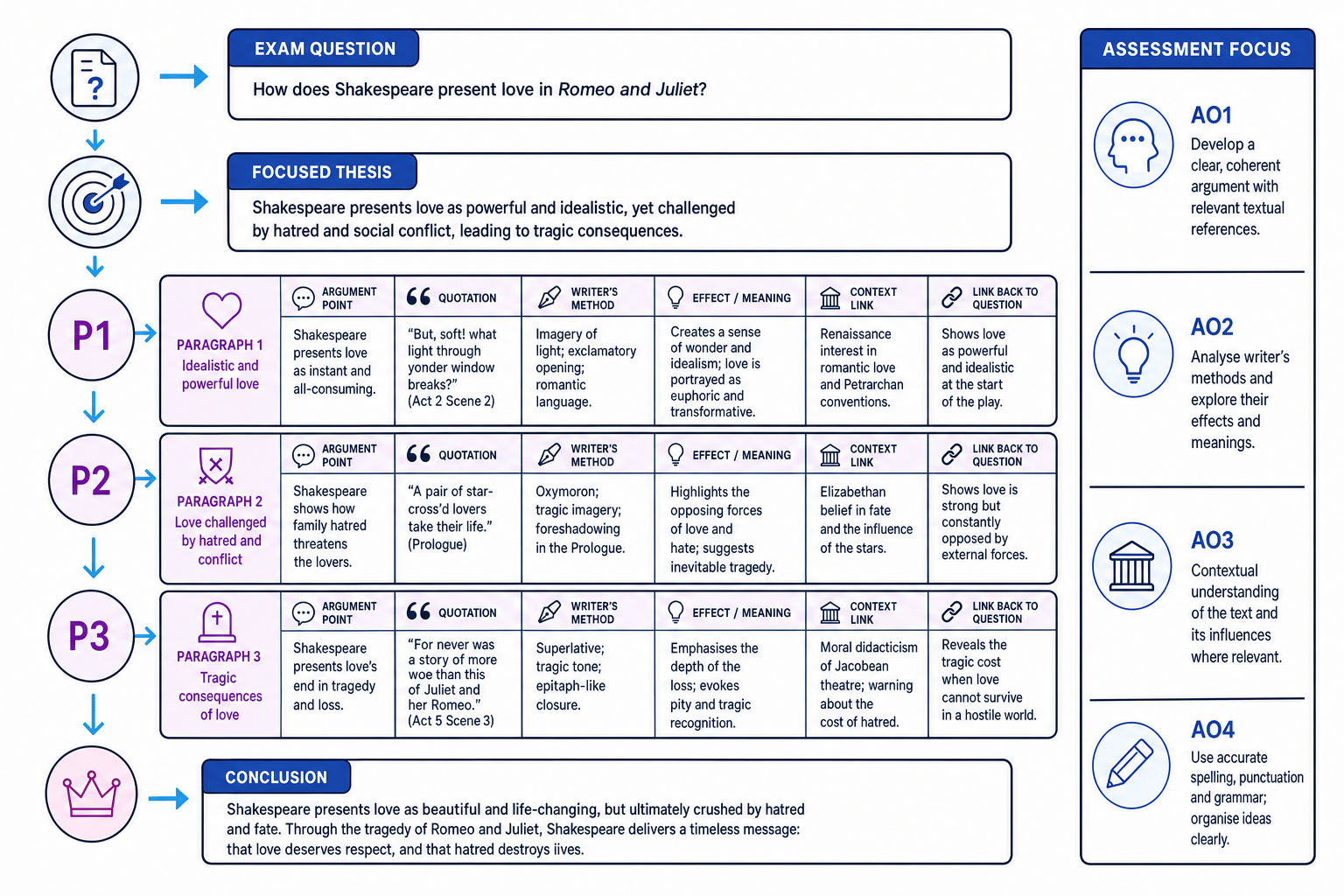
This diagram shows the basic journey from question to thesis, then into three analytical paragraphs and a conclusion.
Step 1: Unpack the question
Most questions use wording like:
Starting with this extract, explore how Shakespeare presents love in Romeo and Juliet.
The focus word is usually a theme, character or relationship. But you must go beyond simply spotting it. Ask: what kind of love, conflict, fate, power or change is being presented?
Unpacking a conflict question
Question focus: How does Shakespeare present conflict in Romeo and Juliet?
-
Narrow the meaning of “conflict”. In the play, conflict is not only sword-fighting. It includes the public feud, masculine honour, family control, and inner emotional conflict.
-
Turn the focus into an argument. A basic answer says, “There is conflict between the Montagues and Capulets.” A stronger argument says, “Shakespeare presents conflict as inherited, irrational and socially destructive.”
-
Choose a beginning-middle-end route. You could move from the opening brawl in Act 1 Scene 1, to Mercutio’s death in Act 3 Scene 1, to the families’ reconciliation in Act 5 Scene 3.
-
Attach methods to each stage. The opening uses violent public action and imperatives; Mercutio’s “A plague o’ both your houses!” uses a curse and repetition; the ending uses tragic closure to show the cost of hatred.
Step 2: Write a thesis before planning paragraphs
Thesis
A thesis is a one-sentence answer to the question. It gives your main judgement before you start proving it.
Your thesis should mention Shakespeare, the focus of the question, and the overall message. It should not sound like a plot summary.
Weak thesis:
Shakespeare presents love in many ways.
Stronger thesis:
Shakespeare presents love as intense, transformative and sincere, but tragically vulnerable in a society ruled by hatred, haste and family control.
This gives you three paragraph directions: love is intense, love is opposed by society, and love becomes tragic.
Use a three-part thesis
A useful pattern is: Shakespeare presents [focus] as ___, but also ___, ultimately suggesting ___. This helps you sound thoughtful rather than one-sided.
Writing a thesis about fate
Question focus: How does Shakespeare present fate?
-
Avoid a flat answer. “Fate causes the deaths” is too simple because the play also shows human choices: Tybalt’s aggression, Romeo’s haste, Friar Lawrence’s risky plan.
-
Use the play’s structure. The Prologue calls Romeo and Juliet “star-cross’d lovers” and tells us their “death-mark’d love” will end tragically, so Shakespeare frames the story with inevitability.
-
Add complexity. A strong thesis can argue that fate feels powerful, but Shakespeare also shows how social hatred and impulsive decisions make tragedy more likely.
-
Shape the final thesis. Shakespeare presents fate as an ominous force hanging over the lovers from the beginning, yet he also suggests that human violence and haste help bring the prophecy true.
Step 3: Build analytical paragraphs, not quotation dumps
Each paragraph should prove one part of your thesis. A strong paragraph usually moves through:
- a clear point answering the question
- a short quotation or precise reference
- a writer’s method
- analysis of meaning and effect
- a relevant context link, where useful
- a link back to your argument
Writer’s method
A writer’s method is a deliberate choice Shakespeare uses to create meaning, such as metaphor, oxymoron, dramatic irony, foreshadowing, sonnet form, soliloquy, symbolism or structure.
For example, if you quote Romeo saying, “O brawling love! O loving hate!” in Act 1 Scene 1, do not just label it as oxymoron. Explain that the contradictory language shows Romeo’s immature, confused idea of love before he meets Juliet.
Feature spotting
Do not write, “This is an oxymoron, which makes the reader interested.” Instead, explain what the oxymoron reveals about Romeo, love, conflict or the tragedy.
Turning evidence into analysis
Focus: Romeo’s early attitude to love
-
Start with an arguable point. Shakespeare first presents Romeo’s love as performative and self-absorbed, shaped by the fashionable language of courtly love.
-
Select a short quotation. Romeo describes love through contradictions: “O brawling love! O loving hate!” in Act 1 Scene 1.
-
Analyse the method. The oxymorons combine opposites, suggesting Romeo does not fully understand love but enjoys the emotional drama of suffering.
-
Link to development. This makes his later meeting with Juliet more striking, because their shared sonnet in Act 1 Scene 5 presents love as mutual, spiritual and more balanced.
Step 4: Use the extract as a launchpad
In the Shakespeare question, the extract is printed for you. Use it early, but do not stay trapped inside it. The question always asks about the extract and the whole play.
A simple structure is:
- Paragraph 1: analyse the extract closely.
- Paragraph 2: connect to an earlier or later moment in the whole play.
- Paragraph 3: widen to Shakespeare’s overall message by the ending.
This shows range, which helps your argument feel developed.
Do not ignore the extract
Even if you know brilliant quotations from elsewhere, you must use the printed extract. The safest approach is to begin with it, then move out to the whole play.
Step 5: Plan with progression
Good essays often move through the play’s structure: beginning, turning point, ending. This is especially useful for Romeo and Juliet because Shakespeare shows ideas changing under pressure.
Structure
Structure means how Shakespeare organises the play: the order of events, turning points, contrasts, patterns and the tragic movement towards the ending.
For example, love begins as romantic excitement, becomes secret rebellion, and ends in sacrifice. Conflict begins as comic street violence, becomes fatal, and ends in public grief.
Adaptable essay plans
These are not full essays to memorise. They are flexible frameworks you can adapt to the exact wording of the question.
Plan A: Love
Possible thesis: Shakespeare presents love as powerful and sincere, but also dangerous when it exists inside a world of hatred and social control.
| Paragraph | Main idea | Evidence and method |
|---|---|---|
| 1 | Love is idealised and transformative when Romeo meets Juliet. | “Did my heart love till now?” — rhetorical question; shared sonnet in Act 1 Scene 5 suggests spiritual unity. |
| 2 | Love challenges family identity and social boundaries. | Juliet: “My only love sprung from my only hate!” — exclamation and antithesis show love trapped inside inherited hatred. |
| 3 | Love becomes tragic because it cannot survive the feud. | “For never was a story of more woe / Than this of Juliet and her Romeo” — rhyming couplet gives tragic closure. |
Plan B: Conflict
Possible thesis: Shakespeare presents conflict as irrational and destructive, exposing how masculine pride and inherited hatred damage the whole community.
| Paragraph | Main idea | Evidence and method |
|---|---|---|
| 1 | Conflict infects public life from the start. | “civil blood makes civil hands unclean” — the Prologue uses violent imagery to show society corrupted. |
| 2 | Male honour turns conflict deadly. | Tybalt says, “I hate the word” in Act 1 Scene 1; his absolute language shows aggression and refusal of peace. |
| 3 | The ending condemns the feud. | The Prince says, “All are punish’d” in Act 5 Scene 3 — collective judgement shows shared responsibility. |
Plan C: Fate
Possible thesis: Shakespeare presents fate as a powerful tragic force, but he also shows that human choices and social hatred help bring the disaster about.
| Paragraph | Main idea | Evidence and method |
|---|---|---|
| 1 | The lovers are marked for tragedy before they appear. | “star-cross’d lovers” and “death-mark’d love” — foreshadowing creates inevitability. |
| 2 | Romeo increasingly feels controlled by fortune. | “O, I am fortune’s fool!” in Act 3 Scene 1 — metaphor/personification suggests he sees himself as fate’s victim. |
| 3 | The final deaths fulfil the Prologue. | The tragic structure circles back to the opening warning, making the ending feel both shocking and inevitable. |
Plan D: Juliet
Possible thesis: Shakespeare presents Juliet as developing from obedient daughter to courageous tragic heroine, challenging patriarchal expectations.
| Paragraph | Main idea | Evidence and method |
|---|---|---|
| 1 | Juliet initially appears dutiful and controlled. | “I’ll look to like, if looking liking move” in Act 1 Scene 3 — careful conditional phrasing shows obedience. |
| 2 | Love makes Juliet more decisive and independent. | “Deny thy father and refuse thy name” in Act 2 Scene 2 — imperatives challenge family identity. |
| 3 | Juliet shows courage in death. | “O happy dagger!” in Act 5 Scene 3 — oxymoron and symbolism show tragic resolve. |
How to include context without bolting it on
Context should help your interpretation. It should not become a separate history paragraph.
Useful context for plans might include:
- Elizabethan expectations of obedience to parents, especially daughters.
- Patriarchal power, shown through Lord Capulet’s control over Juliet.
- Beliefs in fate, astrology and fortune.
- The conventions of tragedy: warning, reversal, suffering and tragic recognition.
- The sonnet tradition, especially in Romeo and Juliet’s first meeting.
Context test
After writing a context sentence, ask: Does this explain Shakespeare’s presentation of the character or theme? If not, cut it or link it more clearly.
A quick planning routine
Before you write, spend a few minutes creating a mini-plan. It can be rough, but it should make decisions.
Building a plan on love
Question focus: How does Shakespeare present romantic love?
-
Create the argument. Romantic love is presented as beautiful and sincere, but Shakespeare places it in a hostile society where it becomes dangerous.
-
Choose the extract angle. If the extract is the balcony scene, use Romeo’s “love’s light wings” to show love as powerful and imaginative, overcoming physical boundaries.
-
Select whole-play evidence. Use Act 1 Scene 5 for first love and the shared sonnet; Act 3 Scene 5 for separation and pressure; Act 5 Scene 3 for tragic devotion.
-
Attach methods. Analyse religious imagery and sonnet form for idealised love, dramatic irony for the audience’s awareness of danger, and tragic structure for the final deaths.
-
End with Shakespeare’s message. The conclusion can argue that the tragedy does not mock love itself; it condemns the hatred and social pressures that destroy it.
Planning your conclusion
A conclusion should be short. Do not introduce new quotations. Return to your thesis and explain Shakespeare’s overall message.
For example:
Overall, Shakespeare presents love as deeply powerful, but not powerful enough to survive a society shaped by hatred, patriarchal control and impulsive violence. Through the lovers’ deaths, he turns private romance into a public warning about the cost of division.
Notice that this does three things: it answers the question, sums up the argument, and links to the play’s wider tragic purpose.
In the exam
- Spend a few minutes planning your thesis and three paragraph ideas before you write.
- Use the extract early, then range across the whole play with short, accurate quotations.
- Analyse Shakespeare’s methods by explaining meaning and effect, not just naming techniques.
- Add context only when it strengthens your point about the play.
- Leave time to check sentence boundaries, spelling of character names, and punctuation, because accurate writing is assessed on the Shakespeare response.
Check yourself
- Can you turn a theme word like “love” or “conflict” into a more precise argument?
- Can each paragraph in your plan name a quotation, a method and a link back to the question?
- Does your plan cover the extract and at least two moments from the wider play?
