When you study Romeo and Juliet for your GCSE, it is easy to focus only on what happens to the characters. However, the examiners are highly focused on AO2: how Shakespeare uses language, form, and structure to create meaning.
Instead of just looking at the plot, we must examine the "mechanics" of the play—how the architectural design of a scene, the rhythm of a line of poetry, or a specific metaphor can completely change how an audience feels.
What you'll learn
- How to identify and analyze Shakespeare's structural choices, including the compression of time and structural contrasts.
- How to distinguish between different literary forms (blank verse, prose, and sonnets) and explain why Shakespeare switches between them.
- How to closely analyze language techniques, such as light/dark imagery, religious metaphors, and oxymorons, to reveal deeper character motivations.
1. Structural Techniques: The Architecture of the Play
Structure refers to how Shakespeare builds and orders the play. It is the framework of the story: when things happen, how scenes are placed next to each other, and how the tension rises and falls.
The Compression of Time
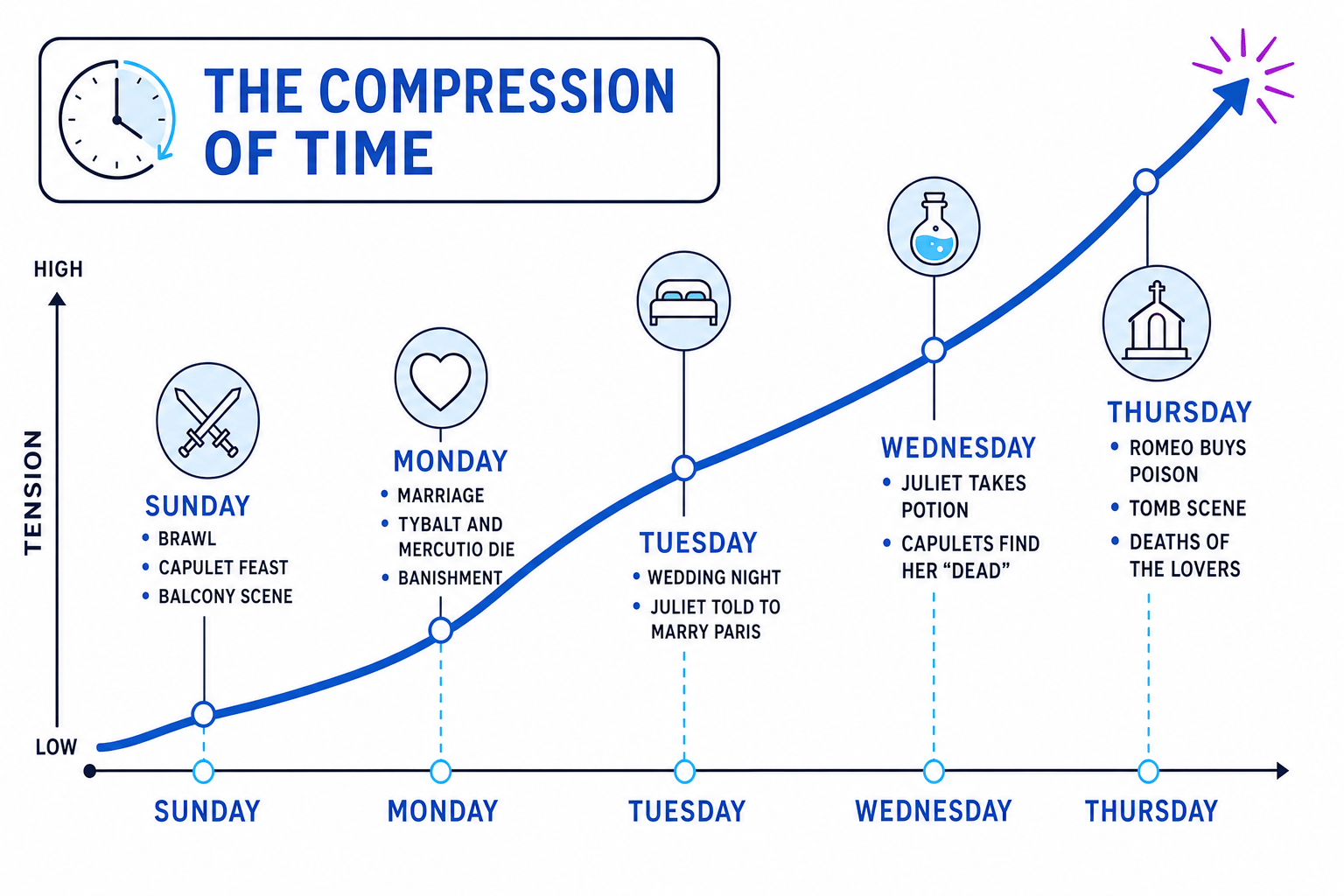
In his original source material (an Italian poem by Arthur Brooke), the story of the star-crossed lovers takes place over several months. Shakespeare made the radical structural decision to compress this timeline into just under five days (Sunday to Thursday night).
This extreme compression of time acts as a structural pressure cooker. By forcing the characters to make life-and-death decisions in a matter of hours, Shakespeare heightens the dramatic tension and highlights the reckless, impulsive nature of youth.
The Theme of Speed
Almost everything in the play happens too quickly. The lovers marry within twenty-four hours of meeting; Tybalt is killed hours after the wedding; the capulet marriage to Paris is brought forward suddenly. This structural "rushing" is a key vehicle for the tragedy, mirroring the "violent delights" that have "violent ends."
Juxtaposition and Parallelism
Shakespeare frequently uses juxtaposition to create friction and dramatic irony.
Juxtaposition
Juxtaposition is the deliberate placing of two contrasting scenes, characters, or ideas close together to highlight their differences and create a stronger dramatic effect.
For example, look at the transition between Act 1, Scene 4 and Act 1, Scene 5:
- Act 1, Scene 4: Romeo is in a dark, melancholy mood, filled with a sense of dread about "some consequence yet hanging in the stars."
- Act 1, Scene 5: Instantly, we are thrown into the loud, bright, chaotic prep work of the Capulet feast.
By juxtaposing Romeo's heavy dread with the light-hearted domestic chaos of the servants and Capulet’s boisterous hosting, Shakespeare intensifies the emotional shifts of the play.
Similarly, Tybalt’s fiery rage at the feast ("I will withdraw, but this intrusion shall / Now seeming sweet, convert to bitt'rest gall") is juxtaposed directly against the tender, holy shared sonnet between Romeo and Juliet. Love and hate do not just coexist in Verona; they are structurally welded together.
2. Form: The Poetic Blueprint
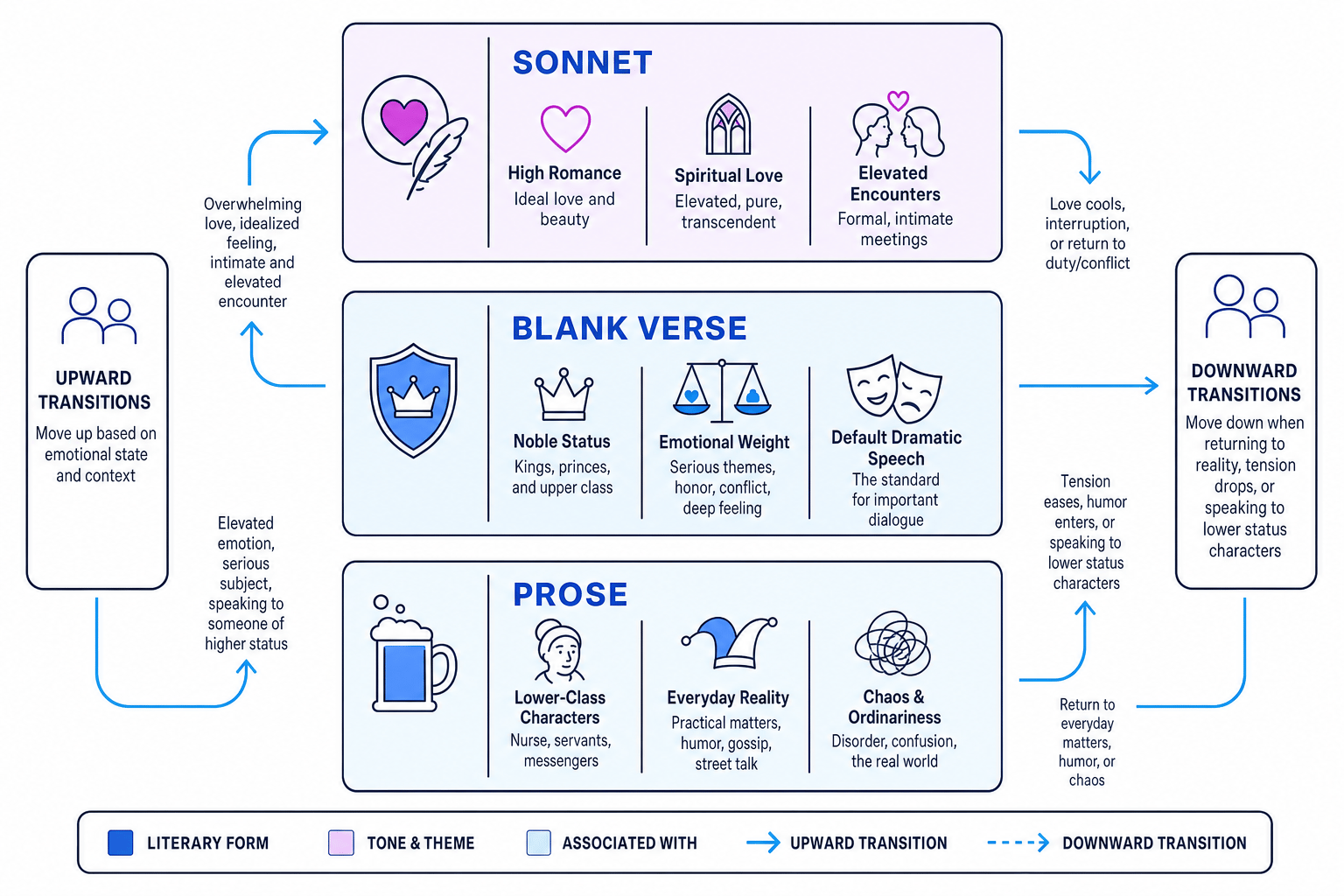
Form refers to the literary style in which the play is written. Shakespeare does not write his characters' dialogue in a uniform way. Instead, he moves fluidly between three distinct forms: Blank Verse, Prose, and the Sonnet.
Blank Verse
Most of the noble characters in the play speak in blank verse.
Blank Verse
Blank verse is poetry written in unrhymed iambic pentameter. It has a strict, steady rhythm but does not rhyme at the end of lines.
To understand iambic pentameter, think of a heartbeat. Each line has ten syllables, divided into five "feet" (called iambs). Each foot contains one unstressed syllable followed by a stressed syllable:
da-DUM | da-DUM | da-DUM | da-DUM | da-DUM
When Romeo says:
"But soft, / what light / through yon / der win / dow breaks?"
He is speaking in perfect iambic pentameter. This formal, rhythmic structure signals high social status, emotional control, and nobility.
Prose
In contrast to blank verse, prose is ordinary, everyday written or spoken language without any deliberate metrical structure.
Shakespeare uses prose for:
- Lower-class characters: The Nurse, the servants, and Peter speak in prose to reflect their lower social standing and lack of formal education.
- Comedy and chaos: When Mercutio is joking, teasing Romeo, or engaging in bawdy, vulgar humor, he often drops into prose.
- Loss of control: When characters are highly agitated, highly rational, or acting in an unrefined manner, the structured poetry breaks down into prose.
Ignoring the switch between Verse and Prose
Many students read the play without noticing when a character switches from verse to prose. Always ask yourself: Why has this character stopped speaking in poetry? If Mercutio switches from prose to verse, or the Nurse suddenly tries to speak in structured rhythm, Shakespeare is telling us something vital about their state of mind or their desire to be taken seriously.
The Sonnet
The sonnet is a traditional 14-line love poem, written in iambic pentameter with a specific rhyme scheme (ABAB CDCD EFEF GGABAB\ CDCD\ EFEF\ GGABAB CDCD EFEF GG) that ends in a rhyming couplet.
Shakespeare uses the sonnet form in two highly deliberate ways:
- The Prologues: The Chorus delivers both the Act 1 and Act 2 prologues as sonnets. This immediately associates the entire play with the theme of love, but also—because the sonnet is a highly rigid, predetermined poetic form—it structurally represents fate. The characters' lives are as locked into a tragic path as the lines of the poem are locked into their rhyme scheme.
- The First Meeting: When Romeo and Juliet first speak in Act 1, Scene 5, their dialogue combines to form a single, shared sonnet ("If I profane with my unworthiest hand...").
3. Language: Imagery, Contrast, and Tension
To gain high marks in AO2, you must look at how Shakespeare's language choices mirror the central conflicts of the play.
Light and Dark Imagery (Chiaroscuro)
Throughout the play, Romeo and Juliet construct a private world of safety that exists only in the night, while the daylight brings danger, violence, and public duty.
- When Romeo first sees Juliet, he claims she "teaches the torches to burn bright" and is a "rich jewel in an Ethiope’s ear."
- In the balcony scene, Juliet is the "sun" who must "kill the envious moon."
- In Act 3, Scene 5, as the dawn breaks, Romeo notes: "More light and light, more dark and dark our woes."
Normally, light is associated with safety and goodness, while darkness is associated with evil. Shakespeare structurally and linguistically inverts this. For the lovers, the day is hostile and dangerous (the brawls happen in the hot midday sun), whereas the night is their sanctuary of love and safety.
The Photography of Verona
Think of the play's imagery as a black-and-white photograph with high contrast (chiaroscuro). The starker the contrast between the blinding light and the deep shadows, the more dramatic and intense the image becomes. This visual tension matches the emotional intensity of the lovers' doomed romance.
Religious Metaphors
When Romeo and Juliet first speak, they use the language of religion:
- Romeo describes his lips as "two blushing pilgrims."
- Juliet is described as a "holy shrine" and a "saint."
By using these religious metaphors, Shakespeare elevates their love from a physical or hormonal attraction to something spiritual, pure, and sacred. However, this language also borders on blasphemy (worshipping a human instead of God), which would have shocked a deeply religious Elizabethan audience and foreshadowed the ultimate tragedy.
Oxymorons and Paradox
At the start of the play, Romeo is in love with the idea of being in love with Rosaline. He expresses his emotional confusion using lists of oxymorons (contrasting terms placed side-by-side):
"O brawling love, O loving hate... O heavy lightness, serious vanity..."
These oxymorons sound artificial, rehearsed, and performative. They reveal that Romeo's grief is self-indulgent.
Contrast this with Juliet's use of paradox in Act 3, Scene 2 when she finds out Romeo has killed Tybalt:
"Beautiful tyrant, fiend angelical! Dove-feathered raven, wolvish-ravening lamb!"
Here, the oxymorons represent a profound, agonized internal conflict. She is genuinely torn between her loyalty to her family (the Capulets) and her absolute love for her husband (Romeo).
4. Worked Example: Analyzing Form and Language
Let's look at how to construct a high-scoring analytical paragraph focused on AO2 (Language, Form, and Structure).
Analyzing the Shared Sonnet
Question: How does Shakespeare use poetic form to present the relationship between Romeo and Juliet in Act 1, Scene 5?
-
Step 1: Identify the method and make a precise point. Identify that the dialogue forms a shared Shakespearean sonnet and state what this reveals about their connection.
Example: "In Act 1, Scene 5, Shakespeare utilizes the poetic form of a shared Shakespearean sonnet during Romeo and Juliet’s first conversation to structurally demonstrate their perfect emotional and spiritual compatibility."
-
Step 2: Integrate precise, memorable quotations. Select key words from the sonnet that show how they interact, focusing on the religious imagery.
Example: "Romeo initiates the sonnet by metaphorically describing his lips as 'two blushing pilgrims,' while Juliet responds by matching his religious conceit, noting that 'palm to palm is holy palmers' kiss.'"
-
Step 3: Analyze the poetic structure and language choices (AO2). Explain how the actual structure of the sonnet (the rhymes, the turn-taking) reflects their relationship.
Example: "The shared structure of the 14-line sonnet is highly significant. Rather than one character dominating the poetic space, they split the lines and complete each other's rhyme schemes. When Juliet completes Romeo's quatrain, she structurally completes his thoughts. This immediate, seamless weaving of voices creates a sense of symmetry and mutual equality, indicating that their love is cooperative and instant, contrasting sharply with Romeo’s earlier, one-sided petrarchan lamentations over Rosaline."
-
Step 4: Connect the form to context or the wider tragic trajectory (AO3/AO1). Link this formal perfection to the wider play, noting how fate or tragedy looms over it.
Example: "However, because the sonnet is a highly rigid, formal structure, Shakespeare also subtly reminds the audience of the structural presence of fate. Just as a sonnet must strictly resolve in a rhyming couplet, the lovers are trapped within a predetermined tragic narrative, meaning their lyrical harmony is beautiful but structurally doomed from its very inception."
In the exam
When writing about language, form, and structure under exam conditions:
- Avoid "Device Spotting": Never just point out a metaphor or an oxymoron and say "this makes the reader want to read on." Always explain how the device works. (e.g., "The oxymoron highlights Juliet's psychological fracture...").
- Track the Metre: Look at the length of lines. If a character speaks a line that is unusually short (fewer than ten syllables) or breaks the iambic pentameter, comment on it. This structural breakdown usually signals sudden shock, death (like Mercutio's final lines), or immense grief.
- Connect Structure to Theme: Always link structural choices—such as the rapid 5-day timeline—to the wider themes of youth, fate, and the feud.
- Use Transition Words: Use analytical transitions like "Moreover," "Crucially," "This formal shift signals," or "Through this structural juxtaposition, Shakespeare..." to keep your essay structured and academic.
Check yourself
Before your next mock exam, make sure you can answer these questions:
- Why does Shakespeare have Romeo and Juliet speak in a shared sonnet when they first meet, rather than blank verse?
- How does the structural transition between the street brawls and the quiet balcony scenes highlight the theme of conflict?
- Which characters speak exclusively in prose, and what does this show about their role and social class in Verona?
