Willy Russell’s Blood Brothers is not a traditional, realistic play. It is a musical that blends traditional drama with musical theatre techniques to explore themes of social class, fate, and inequality.
To score highly in your GCSE English Literature exam (specifically assessing AO2: analysing how the writer uses language, form, and structure), you must look beyond what the characters say and examine how Russell uses stagecraft, music, and dramatic structure to influence the audience's reaction.
What you'll learn
- How Russell uses non-naturalistic techniques to create emotional distance and highlight his political message.
- The role of the Narrator as a structural device representing fate and social conscience.
- How recurring musical motifs (like "Marilyn Monroe") evolve from symbols of hope into markers of tragedy.
- How to write a high-scoring analytical paragraph that unpacks these dramatic methods.
1. Structural Form: The Non-Naturalistic Musical
Before looking at specific songs, we must understand the overarching genre and form of the play. Russell deliberately avoids naturalism.
Naturalism vs. Non-Naturalism
- Naturalism: A style of theatre that attempts to create a perfect illusion of real life on stage, with realistic sets, chronological time, and believable everyday behavior.
- Non-Naturalism: A theatrical style that does not attempt to mimic real life. Instead, it uses stylized movement, direct address, symbolic props, and song to remind the audience that they are watching a performance.
Russell was heavily influenced by the German playwright Bertolt Brecht, who pioneered the alienation effect (Verfremdungseffekt). Brecht believed that if an audience is too emotionally swept up in a story, they cannot think critically about its social message.
By making Blood Brothers a musical, Russell uses songs to interrupt the action. Just as we get caught up in the drama of Mrs Johnstone’s poverty or Mickey and Edward's childhood friendship, a song begins. This forces us to step back, reflect on the social circumstances driving the characters' choices, and consider the wider political message about class divide in 1980s Britain.
2. The Narrator as a Dramatic Device
The Narrator is perhaps the most significant non-naturalistic device in the play. He does not belong to the physical, realistic world of the Johnstones or the Lyons. Instead, he acts as a bridge between the play and the audience.
The Narrator as Fate
The Narrator does not represent a real person. He is a multi-functional dramatic device who represents:
- Fate and Destiny: He constantly reminds the characters and the audience that the twins' death is inevitable.
- Social Conscience: He challenges the audience’s morality, asking whether class inequality is natural or man-made.
- A Greek Chorus: In ancient Greek tragedy, a chorus stood apart from the action to comment on the themes and warn of impending doom. The Narrator performs exactly this role.
The Song "Shoes upon the Table"
The Narrator's signature song is "Shoes upon the Table." This song is repeated throughout the play as a motif (a recurring image or theme).
When Mrs Lyons plays on Mrs Johnstone’s superstition by telling her that twins separated at birth will die if they discover the truth, she invents a superstition. However, the Narrator takes this superstition and elevates it to a symbol of inescapable guilt.
"Shoes upon the table, an’ a joker in the pack, A mirror broken, a yallow-faced cat..."
The list of trivial superstitions builds a sense of dread. The Narrator suggests that no matter how hard Mrs Johnstone or Mrs Lyons try to hide their secret, "the devil’s got your number."
Confusing the Narrator with a villain
Do not write about the Narrator as a villain who wants the characters to fail. He has no physical power over them. Instead, describe him as a manifestation of their internal guilt and the unstoppable force of social inequality that dooms Mickey and Edward from the start.
3. Shifting Meanings of Recurring Motifs
In a musical, songs do not just provide entertainment—they act as structural milestones. Russell uses recurring musical motifs to show the slow, painful decay of the characters' lives.
The most famous of these is the "Marilyn Monroe" motif.
The Evolution of "Marilyn Monroe"
The actress Marilyn Monroe is referred to at multiple points in the play. However, her symbolic meaning shifts dramatically as the characters age:
- In the beginning (Hope & Glamour): Mrs Johnstone sings that her husband compared her to Marilyn Monroe because she was young, carefree, and beautiful. It represents her youthful optimism and desire for romance.
- In the middle (The Reality of Poverty): As Mrs Johnstone is abandoned with a growing family, she sings that she goes dancing, but it's a "light romance" because "by Giles' Collier's / We're into Marilyn Monroe." Here, Marilyn represents the harsh reality of her working-class life—she has aged rapidly under the pressure of poverty.
- In the Climax (Mental Illness and Decline): When Mickey is imprisoned and becomes deeply depressed, he becomes addicted to anti-depressants. Mrs Johnstone laments that he is "treating his chronic/schizophrenia" and is "on the line / Of Marilyn Monroe."
By the end of the play, Marilyn Monroe no longer represents glamour; she represents a tragic figure who died of an overdose, directly mirroring Mickey’s drug dependency and ultimate mental collapse.
4. Visualizing the Dramatic Architecture
To understand how these methods work together structurally, we can trace how the major dramatic devices and musical themes develop across the play’s timeline.
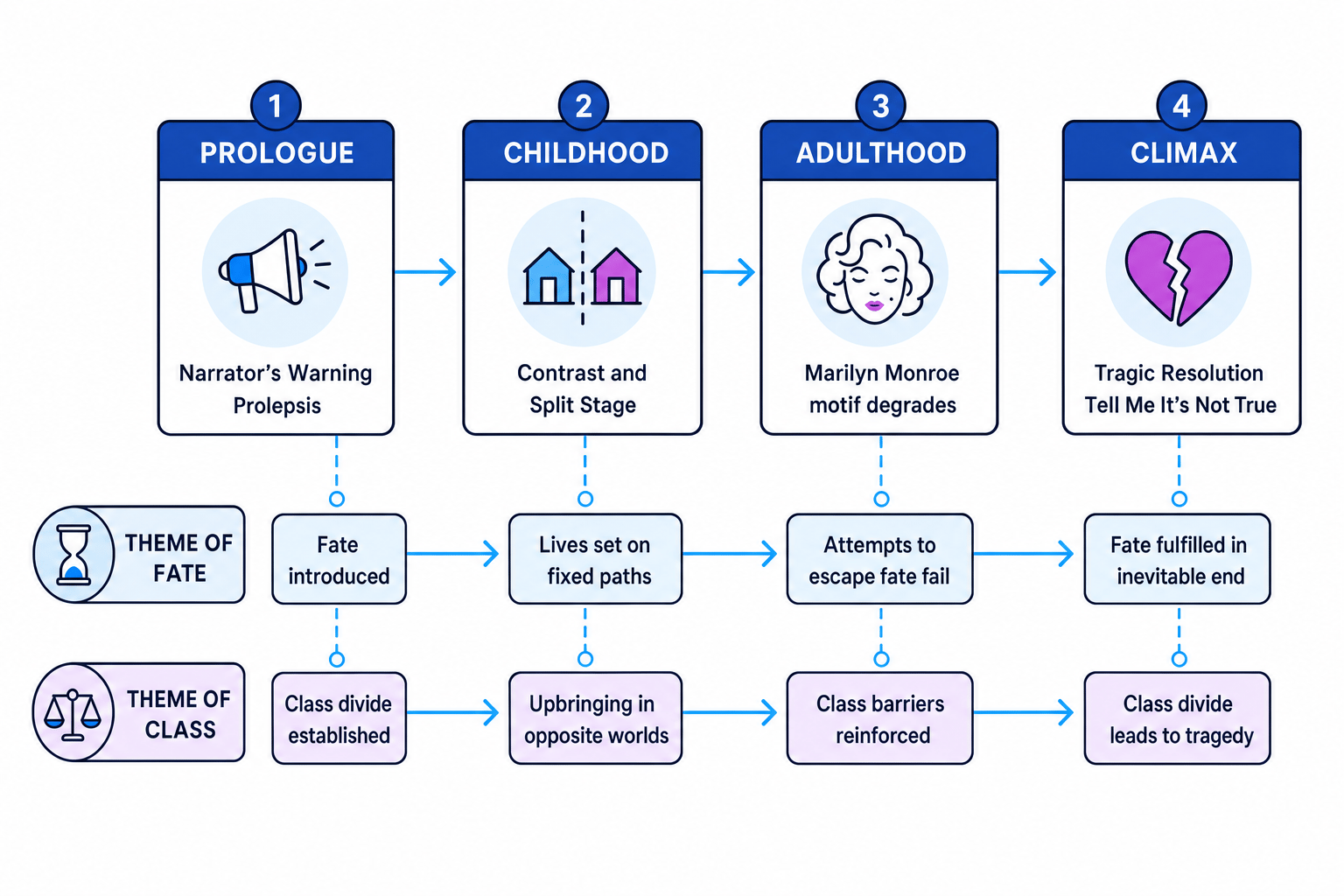
5. Spatial Stagecraft: Parallels and Split Stages
Because Blood Brothers is a piece of theatre, you must write about how the play looks on a physical stage. Russell uses stagecraft to emphasize the class divide.
The Split Stage
Throughout the play, Russell uses a split stage to contrast the lifestyles of the working-class Johnstones and the middle-class Lyons.
- While Mickey plays in the dirty streets, Edward is confined to a clean, gated garden.
- When the families move, we see the contrasting fortunes of both mothers simultaneously.
- When both boys fall in love with Linda, the split stage allows us to see their differing reactions to adulthood at the same time.
This juxtaposition is a highly visual way of demonstrating to the audience that your social class dictates your environment, your opportunities, and your mental well-being.
Dramatic Parallels
Russell structures the scenes to mirror each other. For example:
- "Kids' Game": As children, the boys play a game where they shoot each other with toy guns and say: "You're dead, an' you have to stand up again."
- The Climax: At the end of the play, Mickey holds a real gun to Edward. When he pulls the trigger, Edward cannot "stand up again."
This structural parallel creates a crushing sense of dramatic irony—the audience understands the tragic weight of the gunplay long before the characters do.
Drafting a structural point
When analysing structure, always use the formula: "The contrast between [X early in the play] and [Y late in the play] emphasizes..." This shows the examiner you are tracking structural developments across the entire text, which is highly rewarded under AO2.
6. Deconstructing a Scene
Let's look at how to pull these musical and dramatic methods together in an analytical response.
Analysing the transformation of the 'Marilyn Monroe' motif
Question: How does Russell use the recurring musical motif of "Marilyn Monroe" to present Mickey’s decline?
-
Step 1: Formulate a thesis point (AO1)
Start with a clear, direct answer to the question that links the method (the motif) to its dramatic effect and theme.
Draft: Russell uses the recurring musical motif of "Marilyn Monroe" to structurally mirror Mickey’s tragic transition from a vibrant, energetic child into a broken, chemically dependent adult, illustrating how the pressures of working-class life destroy individual agency.
-
Step 2: Introduce precise textual evidence (AO1)
Embed short, memorable quotes from the lyrics that highlight this specific transition.
Draft: At his lowest point, Mickey becomes dependent on prescription medication to cope with the despair of unemployment and his time in prison. Mrs Johnstone sings that her son "is clean out of plaster" and has "got a mind that's gone / Of Marilyn Monroe."
-
Step 3: Name and analyse the writer's methods (AO2)
Identify the literary and dramatic terms (motif, metaphor, juxtaposition) and explain how they work.
Draft: The phrase "mind that's gone" acts as a stark metaphor for Mickey's loss of mental stability. By linking this directly to the "Marilyn Monroe" motif, Russell utilizes a powerful juxtaposition. Earlier in the play, Marilyn symbolised Mrs Johnstone’s carefree youth and cinematic escapism. By repurposing the icon here, Russell highlights the tragic reality of Monroe's life—her struggle with mental illness and her drug-related death.
-
Step 4: Connect to context and the writer's overall purpose (AO3)
Explain why Russell wanted the audience to feel this way, linking it to the historical context of 1980s working-class struggle.
Draft: Through this musical transformation, Russell exposes how the harsh socio-economic conditions of Thatcherite Britain do not just cause financial poverty, but also inflict deep psychological damage. The degradation of the motif from a symbol of Hollywood glamour to a marker of clinical depression underlines the complete eradication of hope for working-class individuals like Mickey, emphasizing that their tragic fates are systematically predetermined.
In the exam
- Never refer to the songs as "poems": They are musical compositions written for the stage. Refer to them as songs, musical motifs, or lyrical passages.
- Mention the physical space of the theatre: Use terms like upstage, downstage, split stage, lighting cues, and physical contrast to prove you understand that Blood Brothers is a performance, not just a book.
- Link methods to the "Why": Every time you identify a device (e.g., the Narrator's direct address), explain why Russell chose it. How does it make the audience feel? What political point about class or fate is he making?
Check yourself
- Why did Willy Russell choose to write Blood Brothers as a non-naturalistic musical rather than a realistic play?
- How does the meaning of the "Marilyn Monroe" motif change from the beginning of Act 1 to the end of Act 2?
- What are three ways the Narrator acts as a "Greek Chorus" throughout the play?
