Knowing the right quotations is only half the battle in your GCSE English Literature exam. Because the exam is closed-book, you need a bank of highly versatile, memorable quotations that you can analyze deeply.
In this guide, you will learn how to select and analyze quotes that unlock Willy Russell’s structural choices, character developments, and socio-political themes.
What you'll learn
- How to select and memorize short, high-impact "micro-quotes".
- How to analyze language, form, and dramatic techniques within these quotes.
- How to link quotes directly to 1980s British context and Russell's social messages.
The Power of Strategic Quote Selection
When studying Blood Brothers, you do not need to memorize huge chunks of the script. Instead, you should focus on short, precise phrases that can be integrated seamlessly into your sentences.
We call these micro-quotes.
Embedding micro-quotes allows you to maintain a fluid academic voice while proving your points with precise textual evidence. To score highly in your analysis (AO2), you must choose quotes that contain rich language features or strong dramatic significance.
The Power of Micro-Quotes
Don't try to memorize whole paragraphs. Memorize 2-4 word "micro-quotes" that you can embed seamlessly into your own sentences. For example, instead of quoting Mickey’s entire speech about his job, use the phrase "I shrink to the back of the queue."
Theme 1: Social Class and Inequality
Willy Russell wrote Blood Brothers to critique the rigid class system of 1970s and 1980s Britain. The play acts as a social experiment, showing how two genetically identical twins live completely different lives based purely on their adoptive families' wealth.
"He’s a friggin' poshie" (Young Mickey)
- Context: Young Mickey says this about Edward when they first meet.
- Analysis: The colloquial dialect ("friggin'", "poshie") immediately establishes Mickey’s working-class background. It contrasts sharply with Edward’s polite, standard English. This linguistic divide highlights how class is learned and reinforced from early childhood.
"In your position, Edward, you can make demands... I can't." (Adult Mickey)
- Context: Said by Mickey to Edward after Mickey loses his factory job and Edward returns from university.
- Analysis: The noun "position" refers to Edward’s secure middle-class status, wealth, and education. Mickey's blunt declaration "I can't" highlights his complete lack of agency in a Thatcherite capitalist economy. It signals the death of their childhood bond and the reality of class alienation.
"I could have been... I could have been him!" (Adult Mickey)
- Context: Mickey’s climatic exclamation before the tragic shooting.
- Analysis: The repetition of "I could have been" shows Mickey’s heartbreaking realization of the arbitrary nature of class. The pronoun "him" refers to Edward, emphasizing that Mickey’s tragic downfall was not due to personal failure, but to social deprivation.
Theme 2: Fate, Superstition, and the Narrator
The play uses a Narrator who acts like a Greek Chorus—a traditional dramatic device used to remind the audience of impending tragedy, judge the characters' actions, and represent the voice of fate or conscience.
Greek Chorus
A group of actors (or a single narrator) in classical drama who comment on the main action of the play, offering objective moral commentary and foreshadowing future events.
"There’s a shoe upon the table an’ a joker in the pack" (The Narrator)
- Context: The Narrator sings this early in the play, warning the mothers of their sin.
- Analysis: The domestic imagery of a "shoe upon the table" represents working-class superstition, which Mrs Johnstone fears. The "joker in the pack" is a metaphor for fate playing a cruel game with the twins. Russell uses these symbols to suggest that the tragic ending is inescapable.
"The devil’s got your number" (The Narrator)
- Context: A recurring motif sung by the Narrator throughout the play at moments of tension.
- Analysis: The metaphor of the "devil" represents guilt, consequence, and fate. The idiom "got your number" suggests that no matter how hard the characters try to escape their past actions (specifically the mothers' secret pact), they are constantly monitored and destined to be caught.
Theme 3: The Marilyn Monroe Motif
Russell uses the tragic American actress Marilyn Monroe as a recurring motif. The references to her shift in meaning as the play progresses, reflecting the characters’ journeys from hope to self-destruction.
Motif
A recurring image, sound, action, or other figure that has a symbolic significance and helps to develop the theme of a literary work.
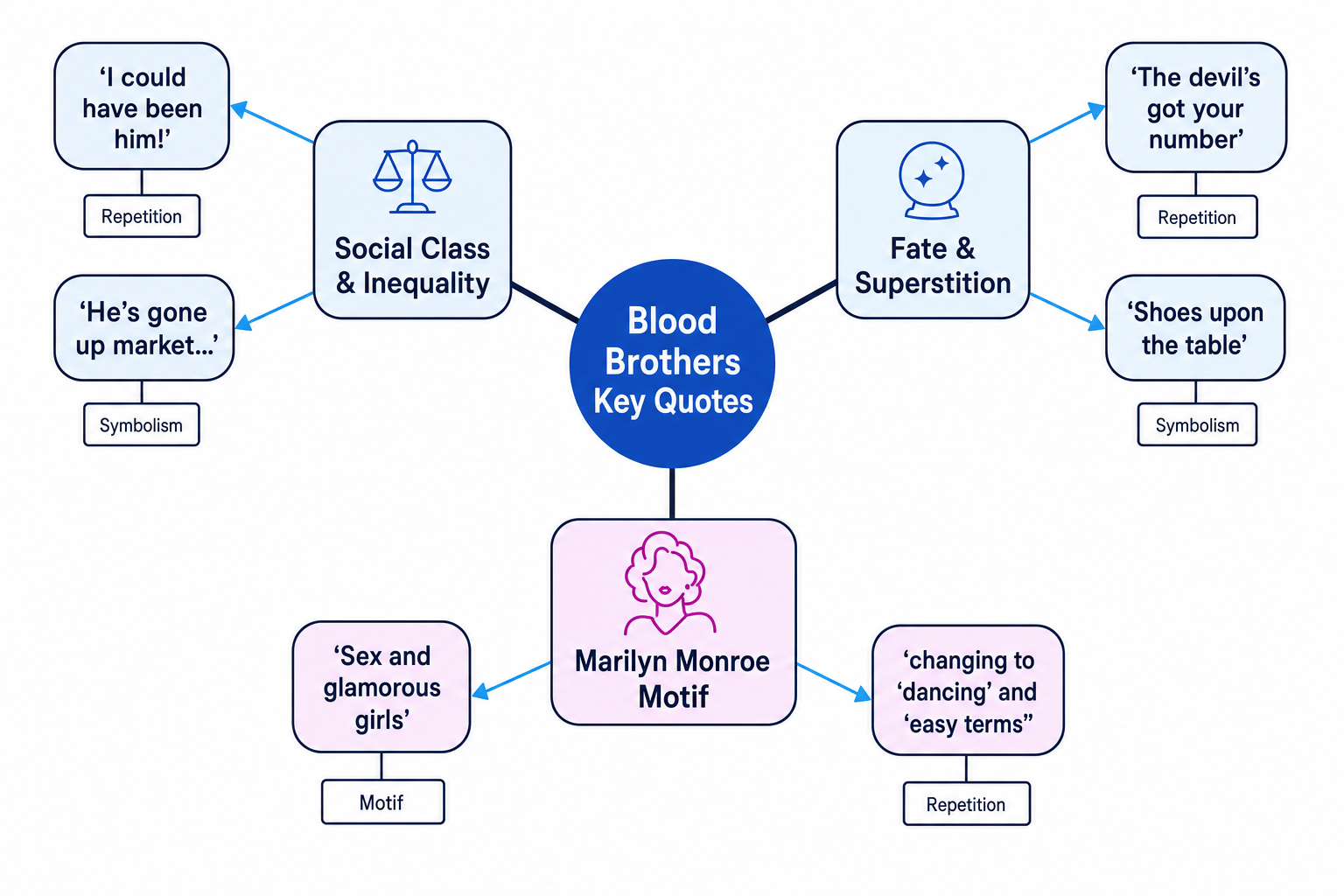
"No more dancing" / "Like Marilyn Monroe" (Mrs Johnstone / Mickey)
- Phase 1: Youth and Glamour: Early on, Mrs Johnstone compares herself to Marilyn Monroe to represent romance, optimism, and escape from her mundane reality.
- Phase 2: Mental Health and Addiction: By Act 2, Mickey is described as being "like Marilyn Monroe" when he becomes addicted to antidepressants.
- Analysis: The shift in this motif tracks the decline of the characters' dreams. Just as Marilyn Monroe’s glamorous public image masked a tragic personal life ending in an overdose, the characters' search for happiness is destroyed by poverty and mental illness.
Feature-Spotting
Do not just name the "Marilyn Monroe motif" and move on. To score highly, you must explain how the motif changes. Show how its meaning transitions from a symbol of youthful romance to a tragic symbol of clinical depression, prescription drug dependency, and societal neglect.
Analyzing a Quote: Step-by-Step
Let's look at how to unpack a quotation and turn it into a high-scoring analytical paragraph. We will use Mickey’s final, tragic realization: "I could have been him!"
Analyzing Mickey's dramatic climax
Analyze how Russell presents the theme of social class through Mickey's final lines.
- Contextualize the quotation: Identify exactly when and why the line is spoken. Mickey says this at the climax of the play in the Town Hall, holding a gun, having discovered that Edward is his twin brother.
- Identify the linguistic and structural methods: Look closely at the language. Russell uses repetition ("I could have been... I could have been"), contrast of pronouns ("I" vs "him"), and an exclamatory sentence structure ("!").
- Analyze the deeper meaning: Explain what these methods reveal. The repetition emphasizes Mickey's overwhelming grief and frustration. The contrast between "I" and "him" encapsulates the entire play's class divide—Mickey represents the neglected working class, while "him" represents the privileged middle class.
- Link to context and audience effect (AO3/AO1): Connect your analysis to Russell's wider message. By showing that Mickey's life could have been Edward's, Russell challenges the audience to realize that poverty is not a personal choice, but a structural trap of 1980s Britain. The exclamatory delivery creates intense pity and terror (catharsis) in the audience.
The Narrator's Delivery
When writing about the Narrator, remember to mention form. Blood Brothers is a musical. The Narrator's quotes are often sung or spoken over tense, recurring music. This increases the dramatic tension and highlights the inescapable, rhythmic march of fate.
In the exam
- Focus on the Question: Let the question dictate which quotes you select. If the question is about Mrs Johnstone, use quotes that highlight her superstition or her love for her children. If it is about class, focus on the differences between Mickey and Edward's speech.
- Embed your Quotes: Never drop a quote in as a standalone sentence (e.g. Mickey says, "I could have been him!"). Instead, weave it into your own analytical sentence: Mickey's despair peaks when he realizes that under different circumstances he "could have been him", highlighting the tragic randomness of class division.
- Explore Multiple Interpretations: Try to offer more than one reading of a quote. For example, does the "devil" represent superstition, or does it represent the characters' internal guilt? This shows the examiner a sophisticated, personal response (AO1).
Check yourself
- Which quote best illustrates the difference in education and opportunities between Mickey and Edward during their childhood?
- What are the three stages of the "Marilyn Monroe" motif, and which characters are associated with each stage?
- How does the Narrator use the metaphor of "the devil's got your number" to build dramatic tension?
