What you'll learn
- How to recognise why a scene is “key” in Romeo and Juliet.
- Which scenes are most useful for exam answers on love, conflict, fate, family and violence.
- How Shakespeare uses structure, language and stagecraft to make turning points dramatic.
- How to connect short quotations to big ideas without retelling the plot.
What makes a scene “key”?
A scene is a section of a play set in one place and time. In Shakespeare, scenes often shift location, mood, or dramatic focus.
A key scene is not just a memorable moment. It is a scene that changes something important: a relationship, a conflict, a character’s future, or the audience’s understanding of the tragedy.
Dramatic structure
Dramatic structure means the way a play is organised to create tension, turning points and resolution. In a tragedy, the structure usually moves from hope and possibility towards suffering and death.
For Romeo and Juliet, the most useful key scenes are the ones where Shakespeare makes private love collide with public hatred.
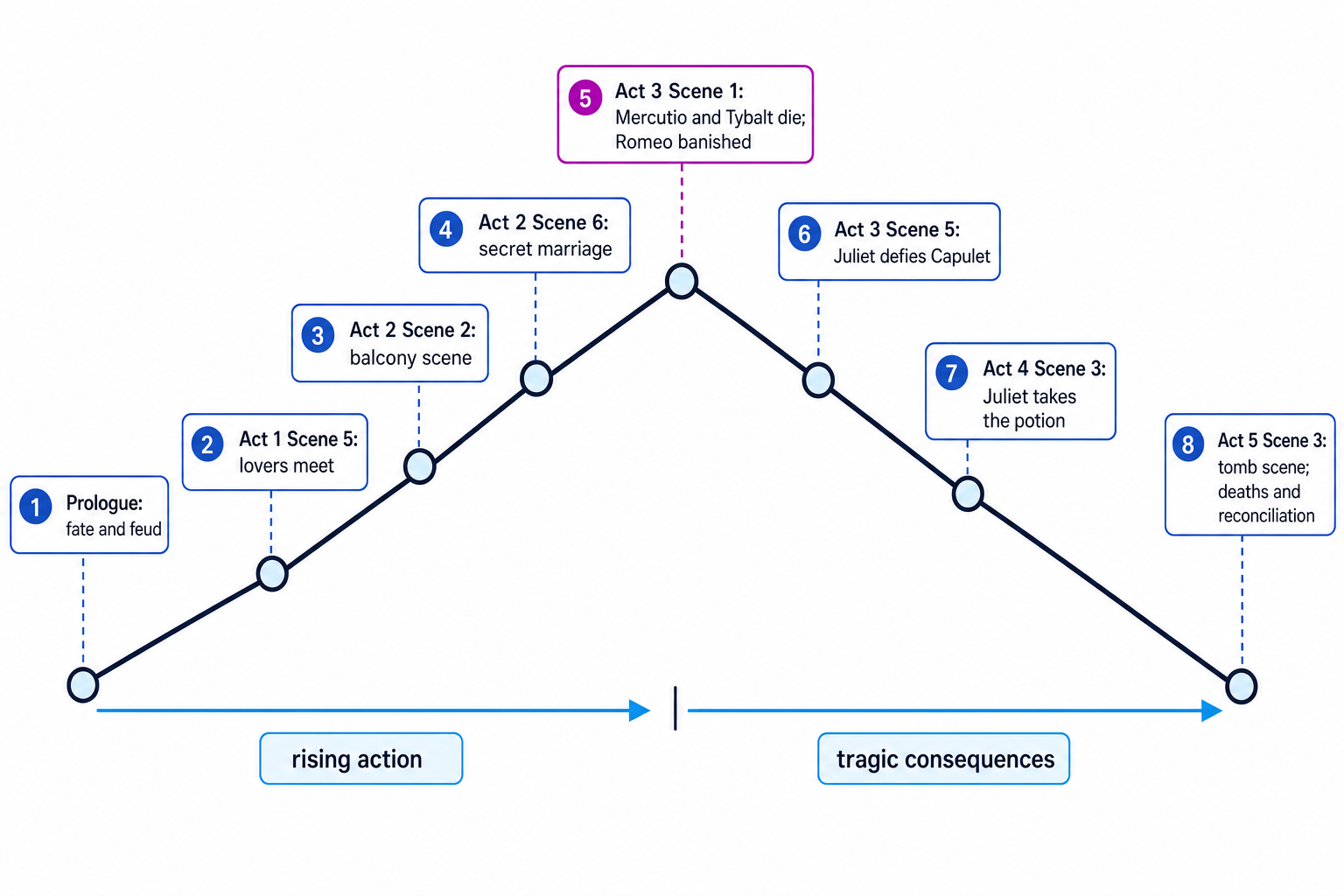
The diagram below shows how the key scenes build towards Act 3 Scene 1, then fall into tragic consequences.
Remember the turning point
Act 3 Scene 1 is the major turning point: before it, Romeo and Juliet’s love seems risky but possible; after it, Romeo’s banishment makes the tragedy feel almost unavoidable.
Deciding whether a scene is key
- Ask what changes permanently in the scene. In Act 3 Scene 1, Mercutio and Tybalt die, and Romeo becomes a killer.
- Link that change to structure. The mood shifts from secret romance to public violence, so the play moves from rising action into tragic consequence.
- Connect the scene to a theme. The feud destroys friendship, marriage and family honour, showing that social hatred is stronger than private love in Verona.
The Prologue: fate and feud are introduced
The Prologue is the short opening speech before the main action begins. It tells the audience that the lovers are “star-cross’d” and that their deaths will “bury their parents’ strife”.
Foreshadowing
Foreshadowing is when a writer hints at future events before they happen. The Prologue foreshadows the deaths of Romeo and Juliet, so the audience watches with dread rather than surprise.
This matters because Shakespeare removes suspense about what will happen and creates suspense about how it will happen. The audience knows the ending, but the characters do not.
The phrase “star-cross’d” links the lovers to fate, the idea that events are controlled by forces beyond human choice. However, the Prologue also mentions the “ancient grudge”, reminding us that human hatred causes the tragedy too.
Act 1 Scene 5: Romeo and Juliet meet
This scene takes place at the Capulet ball. It is key because Shakespeare places Romeo and Juliet’s first moment of love inside enemy territory.
Romeo’s first description of Juliet is intensely visual: “O, she doth teach the torches to burn bright!” The image presents Juliet as brighter than the lights around her.
Metaphor
A metaphor describes one thing as if it is another thing. Romeo’s language makes Juliet seem like light, suggesting beauty, purity and emotional awakening.
Their first conversation is also unusual. Romeo and Juliet speak together in the form of a shared sonnet, a 14-line love poem. This shows harmony: they complete each other’s lines before they truly know each other.
Analysing the shared sonnet
- Start with the dramatic situation: Romeo and Juliet meet at a party, but they belong to enemy families.
- Choose evidence that shows connection. Romeo calls his hand “unworthiest”, while Juliet replies with “Good pilgrim”, continuing his religious imagery.
- Identify the method. Shakespeare uses a shared sonnet and a semantic field of religion, meaning a group of words linked by meaning, such as “pilgrim”, “saints” and “prayer”.
- Explain the effect. Their love seems sacred and perfectly matched, but the audience knows the feud makes it dangerous.
- Link back to tragedy. Shakespeare makes the relationship feel beautiful before revealing it is socially impossible.
Only writing that they fall in love
Do not stop at “Romeo and Juliet meet and fall in love.” Explain how Shakespeare makes their love feel immediate, mutual and dangerously placed within the feud.
Act 2 Scene 2: the balcony scene
The balcony scene is key because Romeo and Juliet move from attraction to commitment. This is where private love becomes a plan for marriage.
Juliet asks, “wherefore art thou Romeo?” This does not mean “where are you?” It means “why are you Romeo?” She is asking why he has to be a Montague.
Soliloquy
A soliloquy is a speech where a character speaks their thoughts aloud, often when they believe they are alone. Juliet’s early speech in the balcony scene lets the audience hear her private conflict between love and family identity.
Juliet’s line “That which we call a rose / By any other name would smell as sweet” argues that names are not the same as identity. Shakespeare uses the image of the rose to show Juliet questioning the power of inherited family labels.
Romeo, meanwhile, uses light imagery again: “It is the east, and Juliet is the sun.” Juliet becomes life-giving and radiant, but this also suggests Romeo’s tendency to idealise her.
Useful pairing
Pair Act 2 Scene 2 with Act 5 Scene 3. In the balcony scene, love seems to rise like the sun; in the tomb, light is replaced by death, darkness and finality.
Act 2 Scene 6: the secret marriage
This scene is brief, but it is structurally important. Romeo and Juliet marry in secret with Friar Lawrence’s help.
Friar Lawrence warns, “These violent delights have violent ends.” This is one of the most useful short quotations in the play because it links love and danger in one memorable phrase.
Dramatic irony
Dramatic irony happens when the audience knows more than the characters. Friar Lawrence warns about “violent ends”, and the audience already knows from the Prologue that the lovers will die.
The phrase “violent delights” is almost contradictory. Love should be joyful, but Shakespeare attaches it to violence, foreshadowing how passion and conflict will become tangled together.
Act 3 Scene 1: Mercutio and Tybalt die
This is arguably the most important scene in the play. It changes the direction of the tragedy.
Peripeteia
Peripeteia means a sudden reversal of fortune. In Romeo and Juliet, Act 3 Scene 1 reverses Romeo’s situation from newly married husband to banished killer.
At the start, Benvolio warns that “the day is hot”. This can be read as pathetic fallacy, where weather reflects mood. The heat suggests rising anger and loss of control.
Mercutio curses both families: “A plague o’ both your houses!” His death exposes the destructiveness of the feud. He is not a Montague or Capulet parent, yet he becomes a victim of their hatred.
Romeo then cries, “O, I am fortune’s fool!” The word “fortune” suggests fate, while “fool” suggests Romeo feels controlled and mocked by forces beyond him.
Explaining the turning point
- Identify the reversal. Romeo begins the scene trying to avoid fighting Tybalt because he has secretly married Juliet.
- Track the consequence. Mercutio dies, Romeo kills Tybalt, and the Prince banishes Romeo from Verona.
- Analyse Romeo’s language. “fortune’s fool” personifies fate as if it has tricked him.
- Link to the whole play. Banishment separates the lovers and causes the desperate plan with the potion.
- Shape the argument. Shakespeare presents tragedy as a mixture of fate, impulsive masculinity and the poisonous feud.
Act 3 Scene 5: Juliet defies her parents
This scene is key because Juliet becomes isolated. After her wedding night with Romeo, she is told she must marry Paris.
Capulet’s language becomes brutal: “Hang thee, young baggage! disobedient wretch!” The insults show the power of patriarchal authority, where fathers expect obedience from daughters.
Patriarchy
Patriarchy is a social system where men hold most power, especially in family, law and public life. In this scene, Capulet treats Juliet as property to be controlled through marriage.
Juliet’s earlier confidence collapses because the Nurse advises her to marry Paris. This leaves Juliet emotionally alone, pushing her towards Friar Lawrence’s dangerous plan.
Ignoring Juliet’s development
Juliet is not simply a passive victim. In this scene, she resists her father, rejects the Nurse’s advice privately, and chooses to seek another solution.
Act 4 Scene 3: Juliet takes the potion
This scene is key because Juliet acts alone. Shakespeare gives her fearful imagination centre stage.
Juliet worries that she might wake “madly play with my forefathers’ joints” in the tomb. The disturbing imagery shows her terror of death, darkness and family burial.
Her final line before drinking is “Romeo, Romeo, Romeo! Here’s drink. I drink to thee.” This makes her action an act of loyalty as well as desperation.
The scene shows Juliet’s courage, but it also shows how little choice she has left. The adults who should protect her have trapped her between obedience, bigamy and death-like sleep.
Act 5 Scene 3: the tomb scene
The tomb scene is the tragic ending. It brings together love, death, fate and reconciliation.
Romeo says, “Here’s to my love!” before drinking poison. His final words focus on Juliet, but his speed also shows his fatal impulsiveness.
Juliet wakes too late and says, “O happy dagger!” This oxymoron, a phrase that joins contradictory ideas, makes death seem both horrifying and welcome because it reunites her with Romeo.
After the deaths, the Prince says, “For never was a story of more woe / Than this of Juliet and her Romeo.” The final ordering of “Juliet and her Romeo” is important: Juliet is given prominence, perhaps because her suffering and courage have become central to the tragedy.
The ending
The lovers’ deaths finally end the feud, but Shakespeare makes the reconciliation feel painfully late. Peace is achieved only after the young have been sacrificed.
How to use key scenes in an essay
In the exam, you do not need to write about every key scene. You need to choose scenes that help answer the question.
If the question is about love, Act 1 Scene 5, Act 2 Scene 2 and Act 5 Scene 3 are especially useful.
If the question is about conflict, Act 1 Scene 1, Act 3 Scene 1 and Act 3 Scene 5 work well.
If the question is about fate, use the Prologue, Friar Lawrence’s warning in Act 2 Scene 6, Romeo’s “fortune’s fool”, and the failed message before the tomb scene.
Scene-linking sentence starter
Try: “Shakespeare develops this idea from ___, where ___, to ___, where ___, showing that…” This helps you write about structure rather than treating scenes as separate episodes.
In the exam
- Choose two or three scenes that directly answer the question, rather than retelling the whole play.
- Use short quotations you can remember accurately, such as “star-cross’d”, “violent delights”, “fortune’s fool” and “O happy dagger!”
- Always link method to meaning: explain how Shakespeare’s language, form or structure shapes the audience’s view of love, conflict, fate or family.
Check yourself
- Which scene is the main turning point of the play, and why?
- How does Shakespeare make Romeo and Juliet’s first meeting feel both beautiful and dangerous?
- Why is Act 3 Scene 5 important for Juliet’s character development?
