Because your GCSE English Literature exam is closed-book, you do not need to memorize vast blocks of text. Instead, your goal is to master a small, curated selection of high-yield quotations. A high-yield quote is short, packed with literary methods, and highly versatile—meaning you can use it to answer questions on several different themes or characters.
In this guide, we will explore the absolute essential quotes for Romeo and Juliet, break down their linguistic and structural features, and look at how to analyze them step-by-step to satisfy the AQA assessment objectives.
What you'll learn
- How to select and memorize short, high-yield quotations that adapt to multiple essay questions.
- How to identify and analyze Shakespeare's dramatic and linguistic methods (AO2).
- How to link your quote analysis directly to Elizabethan and Jacobean contexts (AO3).
- How to integrate quotations seamlessly into your essays to build a coherent argument (AO1).
The Strategy: Quality Over Quantity
Many students make the mistake of trying to memorize fifty different quotes before the exam. This often leads to half-remembered lines, inaccurate citations, and shallow analysis.
The 'Swiss Army Knife' Approach
A few highly flexible quotes analyzed in extreme depth will always score higher than dozens of quotes that are simply dropped into your essay without analysis. Think of your selected quotes as Swiss Army knives—tools that can adapt to fit questions on love, conflict, fate, or individual characters.
To get the most out of your quotes, you must learn to "zoom in" on specific words. Instead of just writing down what a quote means, you must identify the writer's methods and analyze their effects on the audience.
Writer's Methods
Any deliberate choice made by the playwright to convey meaning. This includes language devices (like metaphors, similes, and personification), structural choices (such as juxtaposition or shift in tone), and dramatic techniques (such as dramatic irony or soliloquies).
Theme 1: Fate and Destined Doom
Fate is a central force in the play, constantly working against the lovers. In Elizabethan England, many people believed in astrology and the idea that the stars dictated human destiny.
"A pair of star-cross'd lovers take their life" (Prologue)
-
Who says it: The Chorus
-
Where it appears: The very beginning of the play (Prologue).
-
Key Methods: Celestial imagery, foreshadowing, adjectives.
-
Analysis: The adjective "star-cross'd" suggests that Romeo and Juliet's destinies have been written in the stars—and those stars are actively working against them ("crossed"). By revealing the tragic ending ("take their life") in the first few lines of the play, Shakespeare uses foreshadowing to create a sense of inevitable doom.
No matter what choices the characters make, the audience knows they cannot escape their fate. This structural choice heightens the dramatic irony throughout the play, turning every moment of joy into a bittersweet step toward their deaths.
"O, I am fortune's fool!" (Act 3, Scene 1)
-
Who says it: Romeo
-
Where it appears: Immediately after killing Tybalt.
-
Key Methods: Personification, alliteration.
-
Analysis: Romeo personifies "Fortune" (fate) as a cruel master playing a game, reducing himself to a helpless "fool" or plaything. The harsh, plosive alliteration of "fortune's fool" emphasizes his anger and despair.
Rather than taking responsibility for his violent actions, Romeo blames external cosmic forces. This highlights his impulsive, passionate nature—a key tragic flaw (hamartia) that ultimately seals his doom.
Theme 2: The Clash of Love and Hate
The play is built on opposing forces: love versus hate, light versus dark, youth versus old age. The best quotes capture these tensions simultaneously.
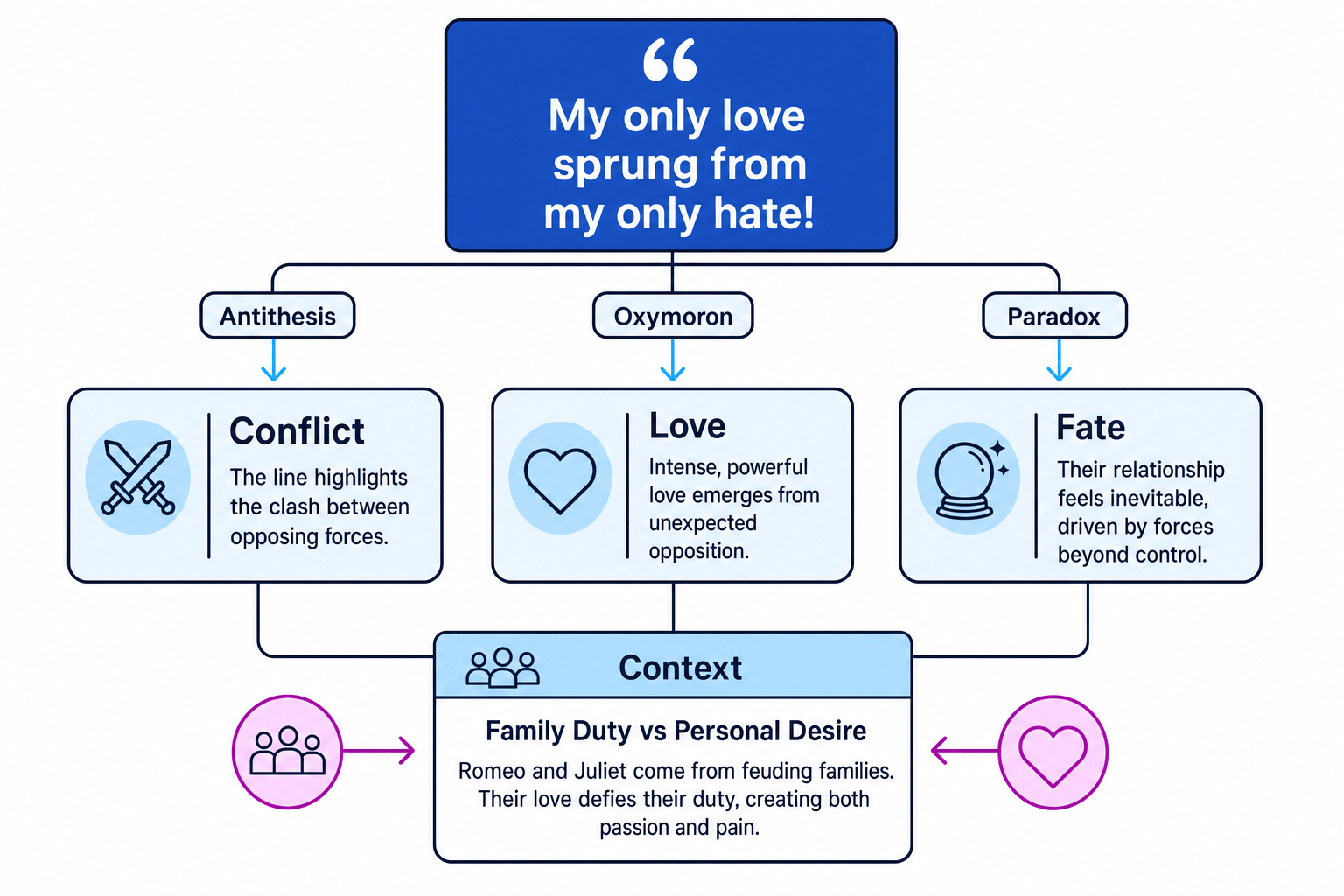
"My only love sprung from my only hate!" (Act 1, Scene 5)
-
Who says it: Juliet
-
Where it appears: Upon discovering Romeo is a Montague.
-
Key Methods: Antithesis, juxtaposition, repetition.
-
Analysis: Juliet uses antithesis—the direct contrast of opposing ideas—by placing "love" and "hate" in the same line. The repetition of the determiner "only" emphasizes the absolute nature of her feelings: her first and only romantic awakening is tied directly to her family's sole, historic enemy.
This structural juxtaposition mirrors the central conflict of the play: their personal, pure passion is trapped inside a corrupt, public feud.
Antithesis
A literary device in which two opposite ideas are put together in a sentence or line of verse to achieve a contrasting effect.
"O brawling love, O loving hate" (Act 1, Scene 1)
-
Who says it: Romeo
-
Where it appears: Describing his unrequited love for Rosaline.
-
Key Methods: Oxymoron, petrarchan sonnet conventions.
-
Analysis: Romeo uses a series of oxymorons ("brawling love," "loving hate") to describe his emotional state. An oxymoron pairs two contradictory words. Here, it shows that Romeo is in love with the idea of being in love, enjoying the dramatic melancholy of it.
However, Shakespeare also uses this language to foreshadow the genuine, violent clash of love and hate that Romeo will experience later with Juliet.
Theme 3: Patriarchal Control and Family Honor
In Elizabethan society, fathers held absolute authority over their households. Daughters were often treated as property, used to secure political or financial alliances through marriage.
"Hang thee, young baggage! disobedient wretch!" (Act 3, Scene 5)
-
Who says it: Lord Capulet
-
Where it appears: When Juliet refuses to marry Paris.
-
Key Methods: Insult, violent verbs, exclamations.
-
Analysis: Capulet's sudden shift from a loving father to a furious patriarch is captured in these highly offensive, degrading terms. The metaphor "baggage" literally reduces Juliet to an object or cargo—something heavy to be carried and easily discarded if it is not useful.
His threat of violence and social exclusion ("hang thee") demonstrates the absolute power fathers held in Elizabethan society. Juliet's rebellion is not just a family dispute; it is a direct threat to the patriarchal order of Verona.
The 'Quote-Dumping' Trap
Never drop a quote into your essay without explaining how its specific words work. Writing "Capulet is angry when he says 'Hang thee, young baggage!'" does not score high marks because it only describes the plot. You must point out how the metaphor of "baggage" objectifies her and links to the patriarchal context.
Worked Example: Deconstructing a Quote
Let's walk through how to take a quote, analyze its methods, and write a high-scoring analytical paragraph. We will use Juliet's famous declaration of love:
"O, speak again, bright angel!" (Act 2, Scene 2)
Analyzing Romeo's religious and celestial imagery
-
Contextualize the quote briefly: Place the quote in the play. This line is spoken by Romeo during the balcony scene (Act 2, Scene 2), as he stands in the dark garden below, looking up at Juliet.
-
Identify the primary literary methods: Identify the key techniques used. Romeo uses a metaphor, comparing Juliet to a "bright angel," and employs the imperative verb "speak." There is also a strong semantic field of light and religion.
-
Analyze the word choices and their immediate effects: Analyze what these choices suggest. The metaphor "bright angel" elevates Juliet to a divine, celestial status. By calling her "bright" against the night sky, Romeo emphasizes her purity and beauty. The word "angel" suggests she is a messenger from heaven, highlighting his idolization of her. This religious language is highly intense and borders on blasphemy, as he is worshiping Juliet instead of God.
-
Connect the analysis to the wider theme and context: Link the language to the broader themes of the play and its Elizabethan context. In the highly religious society of Elizabethan England, comparing a mortal lover to an angel would be seen as transgressive and dangerous. It signals to the audience that their love is so intense it defies conventional social and religious boundaries. This extreme adoration foreshadows their tragic end, as their love exists on a spiritual plane that cannot survive in the corrupt, violent world of Verona.
The Three-Word Rule
Try to weave short quotes of just three or four words directly into the grammar of your own sentences. Instead of writing: Romeo shows he is dramatic. He says, "O, I am fortune's fool!" write: Romeo behaves dramatically, viewing himself as "fortune's fool" and blaming cosmic destiny for his own impulsive violence.
In the exam
- Keep it short: Only quote the exact words you are actually going to analyze. If you quote three lines of verse but only analyze one word, you waste valuable writing time.
- Focus on verbs, adjectives, and nouns: Identify the parts of speech you are analyzing. Labeling a word correctly (e.g., "the plosive noun 'baggage'") shows high-level subject knowledge.
- Connect methods to meaning: Never spot a technique without explaining its effect. Saying "Shakespeare uses an oxymoron" is useless unless you finish the sentence with "...to show the painful division in Juliet's loyalty."
- Explore multiple interpretations: To access the top marks, offer alternative readings. Use phrases like: "On one hand, this suggests... but it could also imply..."
Check yourself
- Can you list three different themes that Romeo's quote "O, I am fortune's fool!" can be used to write about?
- What literary device is Juliet using when she contrasts "love" and "hate" in Act 1, Scene 5?
- Why is it highly effective to analyze Lord Capulet's noun "baggage" when discussing the theme of patriarchy?
