Willy Russell’s Blood Brothers is a tightly structured tragedy. In the GCSE English Literature exam, you will need to discuss how specific scenes function as turning points, how they develop the characters, and how they convey Russell's deeper social messages.
What you'll learn:
- How to analyze the structural importance of pivotal scenes in Blood Brothers.
- How to decode Russell's dramatic techniques, including dramatic irony, juxtaposition, and foreshadowing.
- How to link key moments directly to context (social class, Margaret Thatcher's Britain, and the "nature vs. nurture" debate).
Understanding Tragedy and Structure
To analyze any scene in Blood Brothers, you must first understand the play's tragic structure. Russell uses a circular narrative, beginning at the end with the tragic deaths of the twins. This means every scene that follows is viewed through the lens of inevitability.
Anagnorisis
Anagnorisis is a term from classical tragedy referring to the moment when a character makes a critical discovery or moves from ignorance to knowledge. In Blood Brothers, this occurs at the climax when Mickey realizes Edward is his biological twin.
Russell relies on several dramatic techniques to make these scenes powerful:
- Dramatic Irony: The audience knows the boys are twins, but the boys do not. This creates tension whenever they interact.
- Juxtaposition: Placing two contrasting elements close together to highlight their differences. Russell constantly juxtaposes the lives of the rich and poor.
- Foreshadowing: Using dialogue, songs, or actions to drop hints about the characters' ultimate doom.
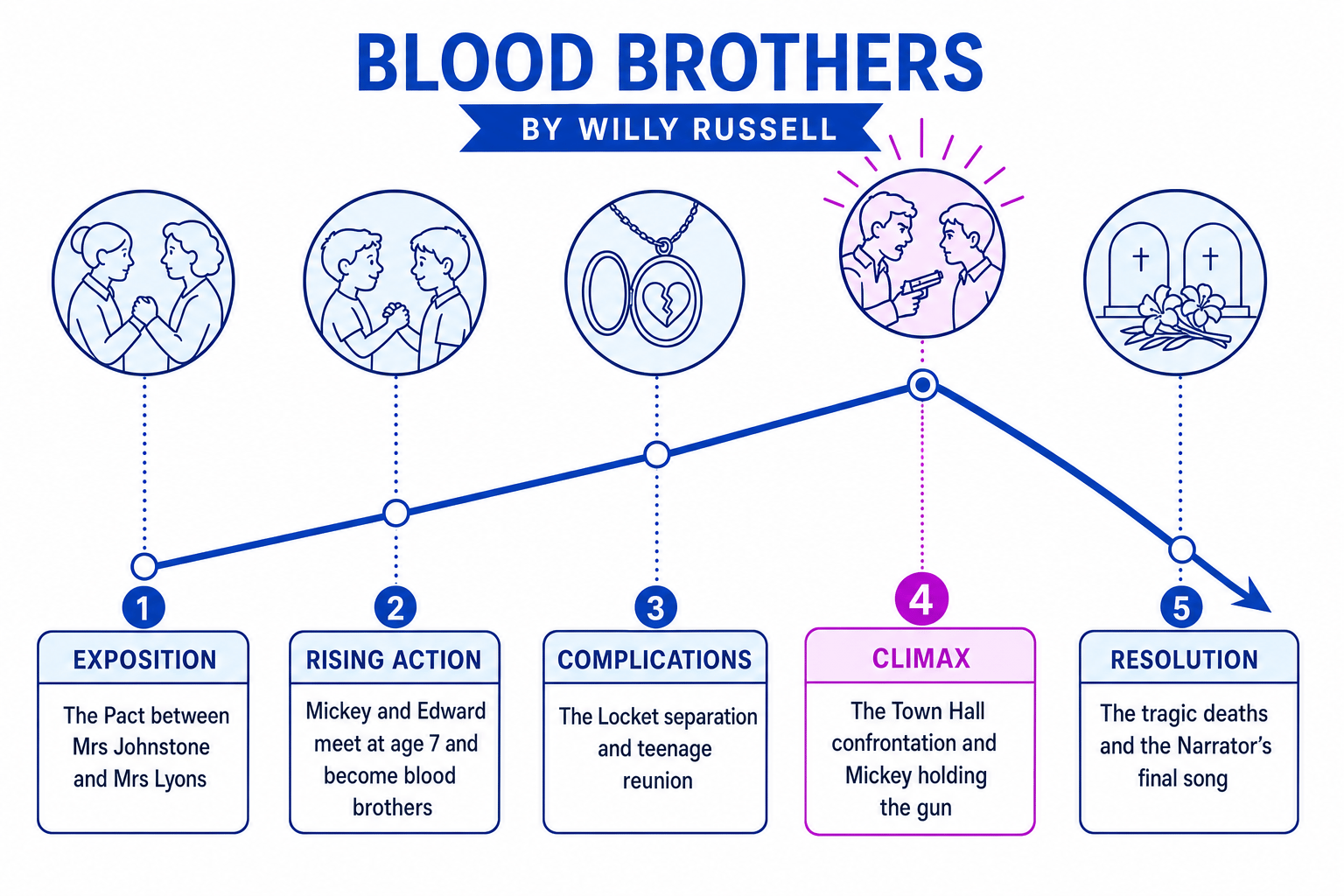
The diagram below shows how these key scenes map onto the play's dramatic arc, rising toward the tragic climax.
Scene 1: The Pact (Act One)
The play’s inciting incident occurs when Mrs. Lyons manipulates Mrs. Johnstone into giving away one of her unborn twins.
Key Dramatic Features
Mrs. Lyons uses Mrs. Johnstone's superstitious nature to seal the deal. She tells her that if either twin learns the truth, "both twins shall immediately die." This false superstition becomes a self-fulfilling prophecy, driving the tragic momentum of the play.
Thematic Significance
This scene highlights class exploitation. Mrs. Lyons uses her wealth and higher social status to exploit a desperate, working-class mother who cannot afford to feed her children.
The Power of Class
Russell shows that in 1960s/1970s Britain, class did not just dictate your income; it dictated your power over other people's lives. Mrs. Lyons literally buys a child because she has the financial capital to do so.
Scene 2: The Meeting (Act One)
The moment Mickey and Edward meet by chance at age seven is a masterclass in dramatic irony and juxtaposition.
Key Dramatic Features
The boys are instantly drawn to one another, sealing their friendship by becoming "blood brothers." The dramatic irony is thick: they are already brothers by blood, but they believe they are making a symbolic pact.
MICKEY: ...But you can't have warm plates.
EDWARD: Why?
MICKEY: Because our house is drafty, and if you put a warm plate on the table, it cracks.
Russell uses this simple, childlike dialogue to expose the massive gulf in their material realities. Edward is clean, polite, and generous with his sweets; Mickey is streetwise, uses slang ("effin"), and is fascinated by Edward's vocabulary.
Look at the songs!
Always pay attention to the musical numbers. Songs like "My Friend" allow the boys to express their longing for each other’s lives, illustrating that neither upbringing is perfect, though one is far safer.
Scene 3: The Climax (Act Two)
The final confrontation in the Town Hall is the peak of the play’s tension. Mickey, driven to despair by redundancy, imprisonment, and chemical dependency, discovers that Edward (now a counselor) has helped him secure a home and a job—and has been having an affair with his wife, Linda.
Mickey confronts Edward with a gun. Mrs. Johnstone rushes in to stop them, finally revealing the truth: "Mickey. Don't shoot Eddie. He's your brother."
Missing the structural tragedy
Many students focus only on the gun in this scene. However, the real tragedy is not the weapon, but Mickey’s realization of what his life could have been. Focus your analysis on his devastating response: "I could have been... I could have been him!"
Worked Example: Analyzing the Climax
Here is a step-by-step guide to writing a high-level analytical paragraph on the Climax scene, focusing on how Russell uses structure and language to present class inequality.
Analyzing the Climax scene for theme and structure
-
Formulate a clear point linking the scene's structure to Russell’s social message: Example: Russell structures the play's climax to show that the tragic end of the twins is not caused by fate or superstition, but by the unavoidable divisions of the British class system.
-
Integrate a short, precise quotation from the climax: Example: When Mickey discovers he is Edward's twin, he does not react with joy or relief, but with a desperate cry of frustration: "Why didn't you give me away? ... I could have been... I could have been him!"
-
Analyze the specific linguistic and structural methods used by the writer: Example: The repetition of "I could have been" highlights Mickey's sudden, agonizing realization of his stolen potential. The word "him" becomes a symbol of the wealth, security, and education that Edward enjoyed solely due to his adoptive class. The structural placement of this revelation at the very end of the play serves as a tragic anagnorisis, proving that nurture—their upbringing—has completely divided their paths.
-
Link the analysis back to the historical/social context (AO3): Example: Through Mickey’s despair, Russell criticizes the lack of social mobility in 1980s Margaret Thatcher's Britain. The contrast between Edward’s successful political career and Mickey’s spiral into unemployment and addiction demonstrates how systemic inequality suffocates working-class lives, making their tragic destruction inevitable.
Summary of Key Scenes and Themes
| Scene | Key Method | Core Theme | Context Link |
|---|---|---|---|
| The Pact (Act 1) | Superstition & Manipulation | Class and Power | Financial desperation of the working class in the mid-20th century. |
| The Meeting (Act 1) | Juxtaposition & Dramatic Irony | Nature vs. Nurture | The natural bond of family versus the artificial separation of social class. |
| The Climax (Act 2) | Tragedy & Anagnorisis | The Inevitability of Inequality | Deindustrialization, unemployment, and the lack of social safety nets in 1980s Liverpool. |
Superstition vs. Class
Do not write that the twins died because of the "superstition" of the locket or the salt on the table. Russell uses the Narrator to explicitly mock this idea at the end: "And do we blame superstition for what came to pass? Or could it be what we, the English, have come to know as class?" The real villain is class, not bad luck.
In the exam
- Focus on the "Why": Never just list the events of a scene. Always ask why Russell chose to structure the play this way. What does he want the audience to feel or realize about British society?
- Anchor your analysis with quotes: Because you won't have the book in the exam, memorize short, high-impact quotes from these key scenes (e.g., "a bargain's been struck", "I could have been him!").
- Trace the dramatic tension: Explain how a scene builds on what came before. For instance, the climax is only tragic because we remember the innocent "blood brothers" oath from Act One.
Check yourself
- Why does Mrs. Lyons invent the superstition about the twins being separated?
- How does Russell use the prop of the "toy gun" in Act One to foreshadow the "real gun" in Act Two?
- What is the significance of Mickey's final line, "I could have been him!"?
