An outstanding essay plan is your secret weapon in the GCSE English Literature exam. For a closed-book exam like Paper 2, walking into the exam room with a flexible, highly structured mental template is the difference between writing a disorganized "plot-telling" response and writing a sophisticated, high-scoring academic argument.
Willy Russell's Blood Brothers is a highly structured, musical play. The examiner wants to see that you understand the play as a play—a deliberate construct designed to deliver a specific social message.
What you'll learn
- How to construct a compelling, thesis-led argument that addresses Willy Russell's political intent.
- How to structure a cohesive, three-part essay plan that traces the play's chronological progression.
- How to integrate quotation analysis (methods) and historical context seamlessly into your planning.
The Prerequisites of a High-Scoring Essay Plan
Before you put pen to paper, you must shift your mindset from what happens in the play to why Russell wrote it. A great essay is not a summary of the story of Mickey and Edward; it is an investigation into how Russell uses these characters to challenge his audience.
To do this, you need to understand two essential concepts:
Thesis Statement
A thesis statement is a one- or two-sentence argument that directly answers the exam question. It acts as the "umbrella" under which your entire essay sits, stating your core line of inquiry and identifying the writer's deeper thematic purpose.
Dramatic Intention
Dramatic intention refers to the playwright's underlying purpose in writing the text. In Blood Brothers, Russell’s intention is polemical: he seeks to expose the devastating impact of class inequality, the cruelty of Thatcherite economic policies, and the falsity of the "self-made man" myth.
Your essay plan must be built around these two ideas. If your plan does not have a clear thesis, your writing will drift into a simple recount of the plot.
The Structural Blueprint (Three-Stage Progression)
Because Blood Brothers is structured chronologically, tracking the twin brothers over nearly three decades, your essay plans should follow a similar progression.
By structuring your essay chronologically—moving from Childhood to Adolescence and finally to Adulthood—you naturally mirror the tragic structure of the play. This shows the examiner that you are analysing the play's form and structure (which is a key requirement of your analysis).
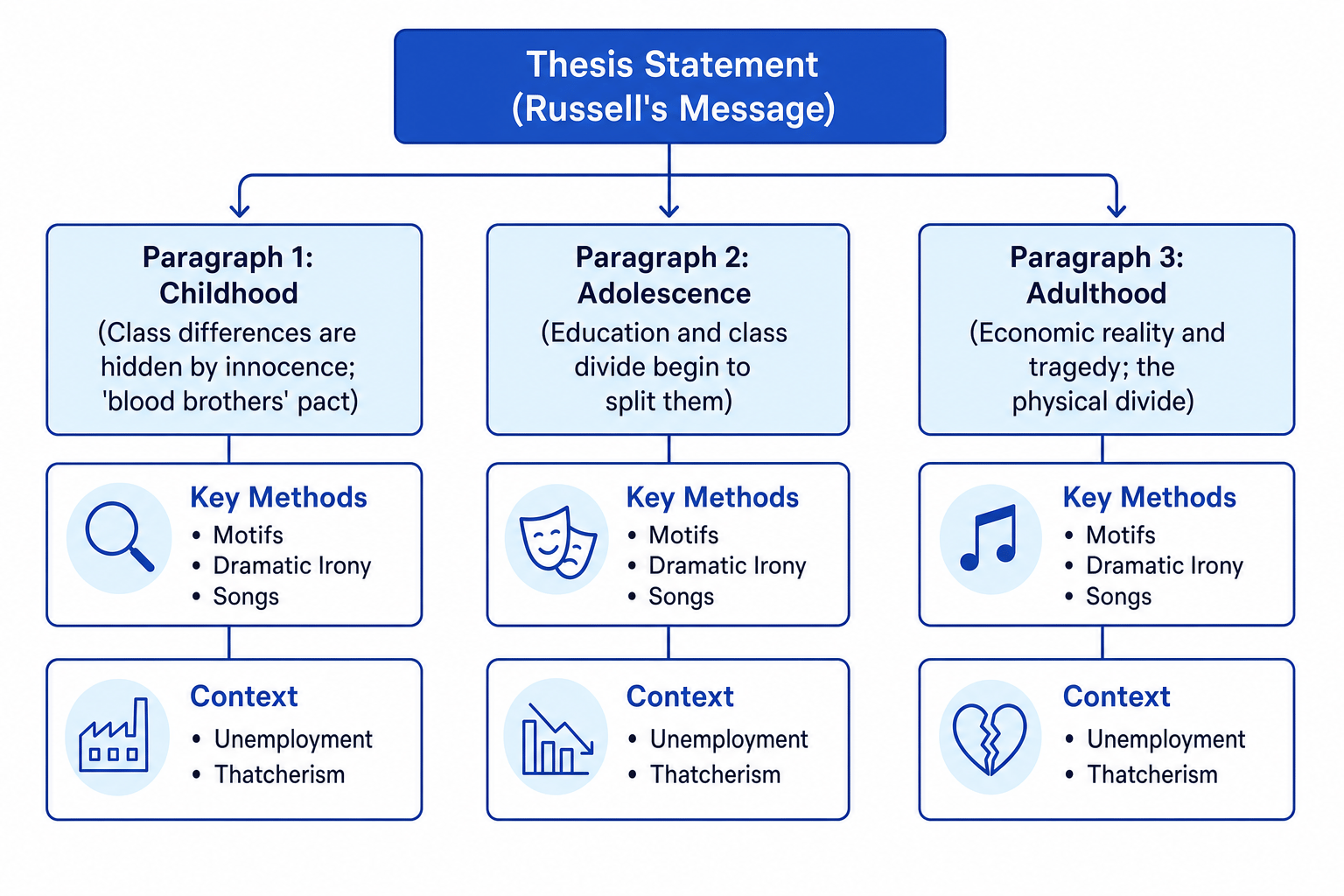
The Tragedy of Social Determinism
By planning your essay chronologically, you show how class inequality acts as a "trap." In childhood, the boys are identical; in adolescence, the gap widens; in adulthood, the trap snaps shut. The structure of your essay should prove Russell's point: that class destiny in 20th-century Britain was almost impossible to escape.
Worked Example
Planning an essay on the class divide
Let us walk through how to construct a high-yield, thesis-driven essay plan in response to the following prompt:
How does Russell present the influence of class on the lives of Mickey and Edward?
-
Formulate a dual-sided thesis statement: Draft a thesis statement that addresses both sides of the coin—how class privilege shields Edward, while class deprivation dooms Mickey—and link this directly to Russell's political message. Example: "Russell uses the contrasting fates of Mickey and Edward to demonstrate that social class is a deterministic force in 20th-century Britain. While Edward's middle-class wealth shields him from economic hardship and grants him opportunity, Mickey's working-class background traps him in a cycle of poverty, proving that nurture and social conditioning ultimately triumph over nature."
-
Select three structural points (The Chronological Arc): Divide the play into three logical, chronological stages that show the progression of this class divide. These will form your three main body paragraphs.
- Paragraph 1: Childhood innocence. The boys are uniform in their nature, ignoring social boundaries to form their "blood brothers" pact.
- Paragraph 2: Adolescent divergence. The education system and domestic environments begin to divide them, foreshadowing their different futures.
- Paragraph 3: Adult tragedy. The economic realities of 1980s Britain seal their fates, culminating in the physical and psychological destruction of Mickey.
- Map key quotations and dramatic methods to each paragraph: Select short, memorable quotations that you can easily remember, and identify the literary or dramatic devices Russell uses in them.
- For Paragraph 1: "I wish I was our Sammy" and the "blood brothers" pact. Method: Dramatic irony (the audience knows they are actual brothers) and the symbolism of the blood pact (a rejection of class lines).
- For Paragraph 2: The contrasting school scenes. Method: Juxtaposition of Edward’s polite, protected boarding school experience with Mickey's harsh, authoritative secondary modern school. The transition from toy guns to real threats.
- For Paragraph 3: "Why didn't you give me away?" and "How come you got everything, an' I got nothin'?". Method: Anaphora and rhetorical questions emphasizing Mickey’s despair; the motif of the chemical keys/industrial decay.
- Align each section with targeted social and historical context: Ensure that your context is not just "dropped in" as a historical fact, but tied directly to the characters' experiences.
- For Paragraph 1: Link the Johnstone family's poverty to the post-war decline of Liverpool's working-class communities.
- For Paragraph 2: Link the educational divide to the tripartite system (grammar vs. secondary modern schools) which cemented class boundaries from age eleven.
- For Paragraph 3: Link Mickey's redundancy and depression to Margaret Thatcher’s deindustrialisation policies of the early 1980s, which led to mass unemployment and the erosion of working-class male identity.
The Resulting Essay Plan: - Introduction: Thesis statement linking class to social determinism and Russell's socialist critique of Thatcherite Britain.
- Paragraph 1 (Childhood): Focus on the illusion of equality. Analyse the blood pact. Methods: Dramatic irony, symbolic blood. Context: The myth of equal opportunity in childhood.
- Paragraph 2 (Adolescence): Focus on institutional division. Juxtaposition of schools. Methods: Parallel scenes, class-coded language ("pissed off" vs. "superb"). Context: The UK educational divide.
- Paragraph 3 (Adulthood): Focus on economic tragedy. Redundancy vs. university. Methods: Motif of the gun, tragic climax, contrasting stage presence. Context: 1980s unemployment, deindustrialisation, and mental health crises.
- Conclusion: Reiterate thesis. Conclude with the Narrator's final question: "And do we blame superstition for what came to pass? Or could it be what we, the English, have come to know as class?"
Key Planning Pitfalls and Strategies
To make sure your essay plan translates into a top-grade essay under exam pressure, keep these strategies and warnings in mind:
The 'Quote-Dumping' Pitfall
Many students write down a list of great quotes in their plan, but fail to think about how they will analyse them. A quote without an associated method (like a motif, juxtaposition, or dramatic irony) is just a plot point. Always write the method next to the quote in your plan to ensure you hit your analysis targets.
The Rule of Three
When choosing quotations for your plan, aim for three short quotes per paragraph. Using three short, precise quotes (such as "Our Mickey", "clean, neat", and "fucking mad") is far more effective than trying to memorise and analyse one massive, clunky block of text.
In the exam
When the exam begins, do not start writing your essay immediately. Instead, follow this five-minute planning routine:
- Deconstruct the prompt: Underline the key words in the question (e.g., "power", "superstition", "Mrs Lyons") and identify the core theme.
- Draft your thesis first: Write out your thesis statement at the top of your planning page. This will keep your entire essay focused and prevent you from drifting.
- Sketch a three-part timeline: Draw three quick columns (Childhood, Adolescence, Adulthood) and drop in your three key scenes.
- Jot down 2–3 precise quotes per column: Write only the key words of the quotes, alongside the specific literary device you will analyse.
- Add context triggers: Write down 1-2 contextual buzzwords (e.g., "Thatcherism", "educational divide", "working-class marginalisation") at the bottom of each column to remind you to weave context throughout your essay.
Check yourself
Before you tackle your next practice essay, test your planning skills with these questions:
- Can you write a thesis statement for an essay about the character of the Narrator? (Hint: Think about how he represents fate, conscience, or the Greek chorus).
- If you were planning an essay on superstition, how would you divide your plan chronologically across the three stages of childhood, adolescence, and adulthood?
- What are three short, high-yield quotations that show the psychological breakdown of Mrs Lyons across the play?
