To secure a top grade in your GCSE English Literature exam, you must understand context (assessed under Assessment Objective 3, or AO3). Context is not just a list of historical facts that you "bolt on" to the end of a paragraph. Instead, it is the relationship between the play and the ideas, beliefs, and values of the society in which it was written and performed.
By understanding how Shakespeare's Elizabethan audience would have reacted to the play—and how those ideas compare to our modern views—you will unlock a much deeper level of analysis.
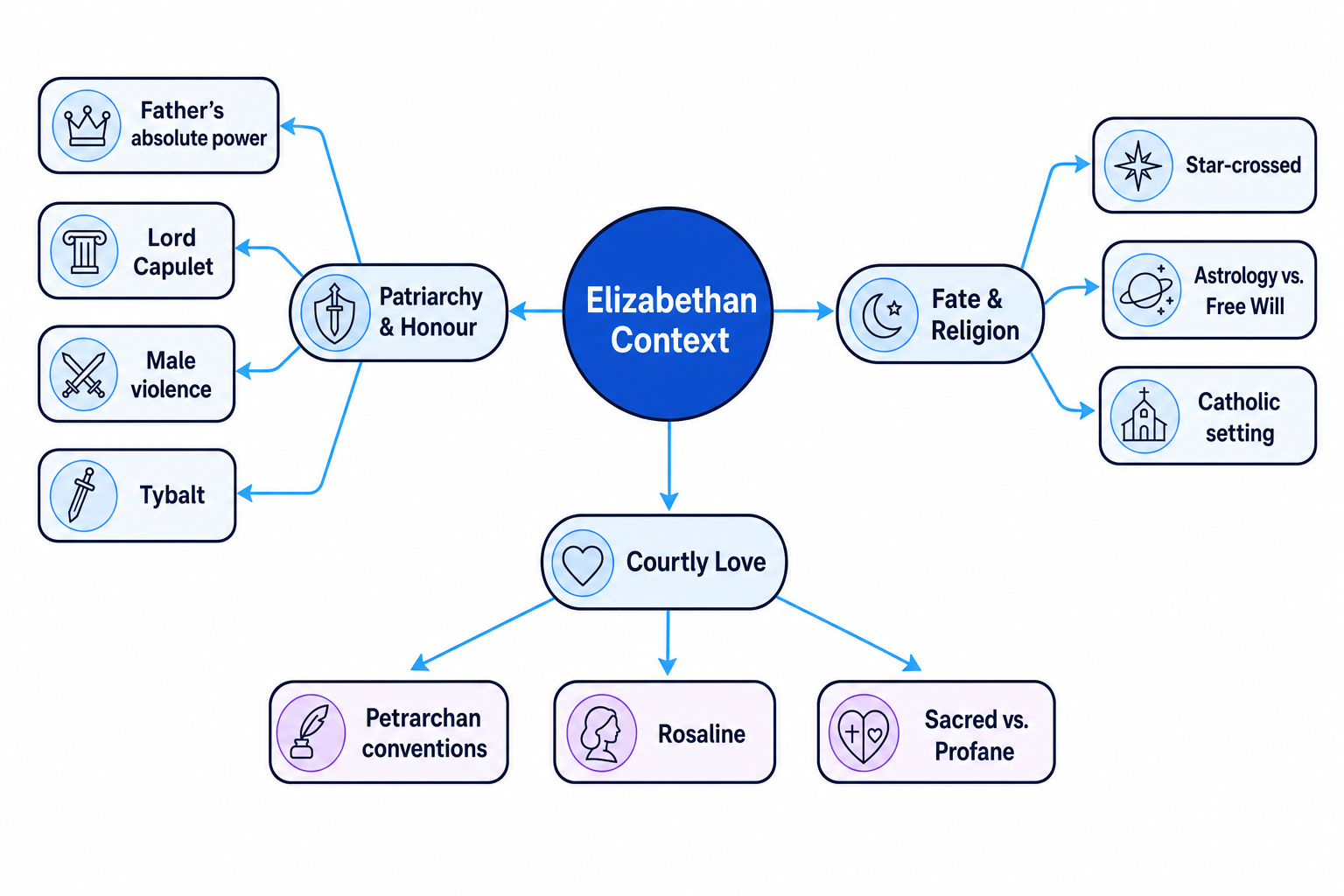
What you'll learn:
- How the Elizabethan patriarchal family structure drives the tragedy.
- Why the Elizabethan belief in fate, astrology, and the "Great Chain of Being" makes the lovers' end feel inevitable.
- How Shakespeare uses the Italian setting and the literary tradition of "Petrarchan love" to challenge his society's views on romance and conflict.
- How to weave contextual details seamlessly into your essays alongside language and structural analysis.
1. Patriarchy and Family Honour
In Elizabethan England, daily life was dictated by strict social hierarchies. One of the most powerful structures was the family.
Patriarchy
A social system in which men hold primary power and predominate in roles of political leadership, moral authority, social privilege, and control of property. In Elizabethan England, families were strictly patriarchal; a father had absolute authority over his household, and children were expected to be completely obedient.
The Authority of the Father
In the 16th century, children—particularly daughters—were legally and socially the property of their fathers. Marriage was rarely about romantic love. Instead, it was a business transaction designed to secure wealth, social status, and political alliances.
When Juliet refuses to marry Count Paris in Act 3, Scene 5, Lord Capulet’s explosive rage is not just a personal temper tantrum. To an Elizabethan audience, Juliet’s refusal was a direct threat to the natural social order. Capulet's threat to let Juliet "starve, die in the streets" was a realistic consequence for an disobedient daughter who had been disowned.
The Code of Masculine Honour
While women were expected to be submissive and chaste, young men were pressured to uphold family honour through physical violence. The streets of Elizabethan London, much like the streets of Shakespeare's Verona, were often plagued by street fights between rival factions and noble families.
The Trap of Masculinity
Shakespeare uses characters like Tybalt and Mercutio to critique the destructive nature of "toxic" male honour. Both characters are trapped by societal expectations of violence: Tybalt must defend his family's name against any slight, and Mercutio would rather die than see Romeo submit to Tybalt's insults ("O calm, dishonourable, vile submission!").
2. Fate, Religion, and the Celestial Order
Elizabethans lived in a deeply religious world, but they also held strong beliefs in astrology and the supernatural. These dual belief systems shape how the audience views the tragedy of Romeo and Juliet.
The Great Chain of Being
A strict hierarchical structure of all matter and life, believed to be decreed by God. At the top was God, followed by angels, monarchs, nobles, commoners, animals, plants, and minerals. Any attempt to break this order (such as disobeying a father or ending one's own life) was believed to bring cosmic chaos.
"Star-Cross'd" Lovers and Astrology
When Shakespeare describes Romeo and Juliet as "star-cross'd" in the Prologue, he is tapping into the Elizabethan belief in astrology. People firmly believed that the positions of the stars and planets at their birth dictated their destiny.
By telling the audience right from the start that the lovers are doomed, Shakespeare uses dramatic irony to make every action they take feel like a desperate struggle against an inescapable fate. Every time Romeo defies the stars ("I defy you, stars!"), the contemporary audience would feel a sense of dread, knowing that mortal men could not overcome celestial design.
The Catholic Italian Setting
Elizabethan England was a Protestant nation under Queen Elizabeth I, but the play is set in Verona, Italy—a deeply Catholic society.
Setting the play in Catholic Italy allowed Shakespeare to explore themes that might have been controversial in England. To a Protestant English audience, Italy was viewed as an exotic, dangerous place of intense passion, corruption, and extreme violence.
Furthermore, the Catholic setting explains the vital role of Friar Laurence. While Elizabethan Protestants were highly suspicious of Catholic priests, the Friar is presented as a well-meaning but flawed character who tries to use herbal medicine and secret schemes to bring peace to Verona.
Ignoring the Prologue's impact
Do not write that the tragedy is purely Romeo and Juliet's fault. An Elizabethan audience would view their deaths as a tragic necessity ordained by fate to heal a fractured society, as the Prologue states that only their deaths could "bury their parents' strife."
3. Courtly Love vs. Real Love
To understand Romeo's character journey, we must look at how Shakespeare plays with the literary trends of his time.
Petrarchan Love
A highly conventional, stylized form of unrequited love popular in Renaissance poetry. The lover worships an unattainable woman from afar, suffering from extreme emotional mood swings and expressing his pain through exaggerated, contradictory language (oxymorons).
Romeo's Initial Infatuation
At the start of the play, Romeo is in love with Rosaline, but this is not genuine love; it is textbook Petrarchan love. Romeo locks himself in his dark bedroom, sighs deeply, and uses artificial, cliché oxymorons to describe his feelings:
"O brawling love, O loving hate [...] O heavy lightness, serious vanity!" (Act 1, Scene 1)
This language is performative. Romeo is playing the role of the tragic, suffering lover because it was fashionable in Elizabethan courtly culture.
Subverting the Convention
Everything changes when Romeo meets Juliet. Their first conversation is written as a shared sonnet (a 14-line love poem). Instead of Romeo worshipping Juliet from a distance, they speak to each other in a spiritual, reciprocal dialogue using religious metaphors ("holy shrine," "saints," "pilgrims").
Shakespeare's Message on Love
By shifting Romeo's language from clichés to a shared sonnet, Shakespeare subverts (challenges) the artificial Petrarchan conventions of his day. He presents Romeo and Juliet's love as holy, physical, and highly egalitarian (equal), contrasting it sharply with the cold, transactional marriage proposed between Juliet and Paris.
4. The Threat of the Plague
To a modern audience, Friar John being quarantined due to an outbreak of the plague might seem like a convenient, frustrating plot device. To Shakespeare’s original audience, however, this was a terrifyingly realistic event.
The Plague in Elizabethan London
Just as we understand the sudden, disruptive reality of modern lockdowns, Elizabethan theatregoers lived in constant fear of the Bubonic Plague. Outbreaks regularly shut down London theatres, including the Globe.
When Friar John is locked in a house by searchers because he was suspected of being "in a house / Where the infectious pestilence did reign" (Act 5, Scene 2), the audience would have deeply understood this panic.
Mercutio’s dying curse, "A plague o' both your houses!" (Act 3, Scene 1), acts as a structural foreshadowing. The literal plague that prevents the delivery of Friar Laurence's letter is the physical manifestation of Mercutio's metaphorical curse, showing how the hatred of the two families infects and destroys the innocent youth of Verona.
5. Integrating Context (AO3) into Your Essays
The biggest secret to high marks in AQA GCSE English Literature is integrating your context. You should never write a paragraph of pure history. Instead, use the PEEL structure, making sure that your context explains why the characters behave the way they do, and what Shakespeare was trying to teach his audience.
The AO3 Golden Rule
Always link historical context directly to the writer’s intentions and the effect on the audience. Use active verbs: Shakespeare critiques..., Shakespeare reflects..., Shakespeare challenges..., This would shock an Elizabethan audience because...
Here is a worked example of how to build a paragraph that integrates AO3 seamlessly with AO1 (your argument) and AO2 (your language analysis).
Analyzing context in an essay paragraph
Essay Question: Explore how Shakespeare presents the conflict between parents and children in Romeo and Juliet.
- Point (AO1): Shakespeare presents the conflict between parents and children as an inescapable trap, driven by the absolute authority of the Elizabethan patriarch who views his children as financial assets rather than individuals.
- Evidence & Method (AO2): This is made clear when Lord Capulet reacts violently to Juliet’s refusal to marry Paris, dehumanizing her with the derogatory insults: "Hang thee, young baggage! disobedient wretch!" (Act 3, Scene 5). The exclamatory insults and the noun "baggage" reduce Juliet to a physical burden and a piece of luggage to be traded away.
- Contextual Analysis (AO3): To a modern audience, Capulet’s explosive rage appears monstrous, but an Elizabethan audience would have recognized this as the extreme reality of a patriarchal society. Under Elizabethan law and custom, a daughter was legally the property of her father, and her defiance of his marital arrangements was seen as a direct sin against the "Great Chain of Being."
- Writer's Intention & Effect (AO3/AO1): By framing Capulet's patriarchal dominance as a volatile threat that drives Juliet to fake her own death, Shakespeare critiques the rigid social expectations of his era. He warns his contemporary audience of the tragic consequences of prioritizing family pride and transactional marriages over the genuine emotional lives of their children.
In the exam
- Do not write a "history dump": Do not start your essay with a long biography of William Shakespeare or a history of the Elizabethan era. Only mention context when it helps explain a specific quotation or character action.
- Focus on the "Why": Ask yourself, Why did Shakespeare choose to write this scene this way? For example, did he make Capulet angry to show the dangers of unchecked patriarchal power? Did he use the plague to show the consequences of civil conflict?
- Use active context verbs: Write sentences like: "Through the character of Tybalt, Shakespeare exposes the destructive nature of the Elizabethan code of honour..." rather than "In Elizabethan times, honour was very important."
- Remember AO4 (SPaG): The Shakespeare question is one of the few places where you are assessed on spelling, punctuation, and grammar. Take care to spell literary terms (like iambic pentameter, soliloquy, patriarchy) and character names correctly.
Check yourself
- Why would an Elizabethan audience react differently to Juliet disobeying her father compared to a modern audience?
- How does the literal plague in Act 5 connect to Mercutio's metaphorical curse in Act 3?
- What is "Petrarchan love", and how does Shakespeare show that Romeo moves past it when he meets Juliet?
