When you sit down to write your GCSE essay on Blood Brothers, you are not just looking at a story about two twins separated at birth. You are looking at a sharp, angry, and deeply compassionate critique of British society in the late twentieth century.
In your exam, Assessment Objective 3 (AO3) asks you to show how the context in which a text was written and set influences its meaning. For Blood Brothers, context is not just "extra information"—it is the engine that drives the entire tragedy.
What you'll learn
- How Willy Russell's own background in Liverpool shaped his political outlook and writing.
- The impact of Thatcherism and deindustrialisation on working-class communities.
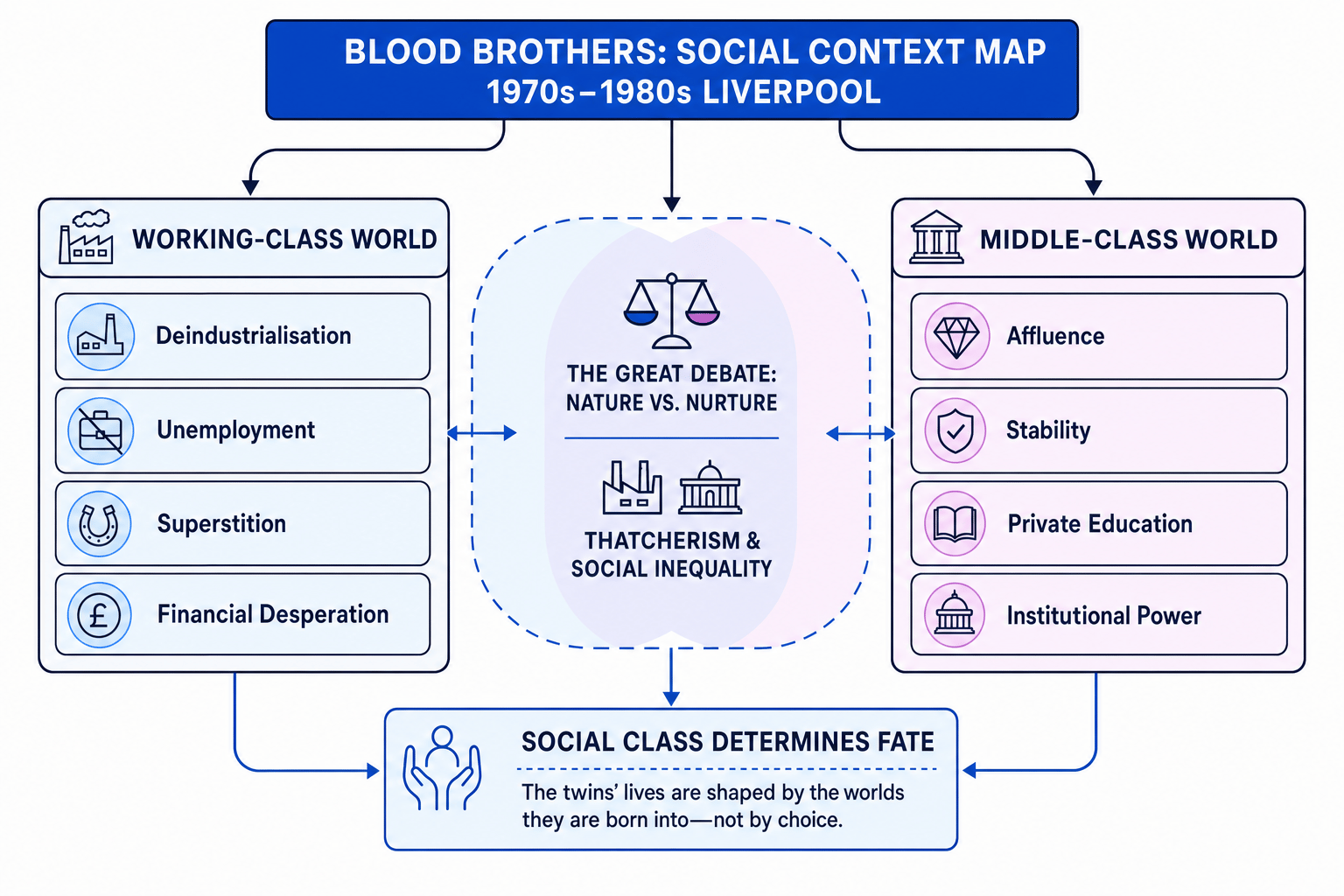
- How the class divide in 1970s and 1980s Britain determined an individual's life chances.
- How to seamlessly integrate context (AO3) into your literary analysis (AO1 and AO2) to gain top marks.
1. Willy Russell and Liverpool: The Personal is Political
To understand the play, you must understand where it came from. Willy Russell was born in 1947 in Whiston, near Liverpool. He grew up in a working-class family and left school at fifteen with one O-Level. He worked as a ladies' hairdresser and a warehouse worker before returning to education in his twenties to become a teacher and, ultimately, a playwright.
Because Russell lived through the challenges of the working class and worked his way through the British education system, he saw first-hand how society labels and limits people based on their accent, background, and school.
Deindustrialisation
The decline of industrial activity, particularly manufacturing and heavy industry, in a region or country. In Liverpool, this meant the closure of the traditional docks and factories, leading to mass unemployment.
Liverpool is not just a setting for the play; it is almost a character in itself. Throughout the mid-twentieth century, Liverpool went from being one of the wealthiest trading ports in the world to a city experiencing severe economic decline. By the late 1970s and 1980s—the period when the second half of Blood Brothers is set—the city was facing a devastating crisis.
2. Thatcherism and Deindustrialisation
The play's transition from Act One to Act Two mirrors a massive shift in British political history: the rise of Margaret Thatcher, who was Prime Minister of the UK from 1979 to 1990.
Thatcher's economic policies prioritised free-market capitalism, privatisation of state-owned industries, and the reduction of power held by trade unions. While these policies brought wealth to some parts of the UK (particularly the south of England and the financial sectors), they devastated traditional industrial areas in the north, including Liverpool.
The Tragedy of "The Scrap Heap"
In Act Two, we see Mickey, a working-class young man, lose his job at the factory. He is told he is "on the scrap heap." This was the reality for thousands of working-class men in Liverpool in the 1980s.
Unemployment in Liverpool rose to over 20% during this decade, and in some working-class estates, it was as high as 80%. Russell uses Mickey's downward spiral—from hopeful teenager to unemployed father, then to criminal, and finally to chemical dependency—to illustrate the devastating psychological impact of long-term unemployment.
Thatcherism and Individualism
Margaret Thatcher famously declared that "there is no such thing as society. There are individual men and women and there are families." Willy Russell's play is a direct protest against this ideology. He wrote Blood Brothers to prove that society does exist, and that if society fails to support its most vulnerable, tragedy is inevitable.
3. The Class Divide: Two Parallel Lives
The core dramatic premise of Blood Brothers is a controlled social experiment. Two genetically identical boys are separated at birth and brought up at opposite ends of the social spectrum.
| Character | Class | Housing | Education | Future Prospects |
|---|---|---|---|---|
| Mickey Johnstone | Working Class | Overcrowded terrace / Council estate | Underfunded secondary modern | Low-skilled factory work, redundancy |
| Edward Lyons | Middle Class | Spacious suburban house | Elite, private boarding school | University, high-paying corporate/political career |
Russell uses this contrast to critique the structural inequalities of the British class system. It is not a coincidence that Edward goes on to university and becomes a local councillor, while Mickey goes to prison.
Educational Inequality
In the UK in the mid-to-late twentieth century, the education system cemented class divisions rather than breaking them down. Private schools (like the one Edward attends) provided networking opportunities, confidence, and direct paths to prestigious universities.
State schools in working-class areas, meanwhile, were often underfunded and focused on training students for manual labor—jobs that were rapidly disappearing by the 1980s.
Blaming the individual
Many students write that Mickey's downfall is his own fault because he gets involved in Sammy's robbery. In your exam, remember that Russell's target is structural inequality. Mickey is driven to desperation because he has no safety net. Russell wants us to blame the system, not the victim.
4. Nature vs. Nurture and the Welfare State
At the heart of the play is a philosophical debate: are we shaped by our biology (nature) or our upbringing and environment (nurture)?
Determinism
The philosophical concept that all events, including human actions, are ultimately determined by causes external to the will. In Blood Brothers, social determinism suggests that your class at birth dictates your entire life path.
Russell is a firm believer in nurture. He shows that despite sharing the exact same DNA, Mickey and Edward become entirely different people because of their material circumstances.
Edward is given "room to breathe," books to read, and a secure home. Mickey is burdened from childhood with financial anxiety, overcrowding, and the expectation of failure.
The Collapse of the Welfare State
Mrs. Johnstone is a victim of a system that fails to protect single mothers. The post-war welfare state was designed to provide a "safety net" from the "cradle to the grave," but Mrs. Johnstone's experience shows the cracks in this system.
She is hounded by debt collectors ("the finance man") and is forced to make an agonizing, illegal agreement to give away one of her babies just to ensure the survival of the others. Russell highlights how poverty strips people of their moral autonomy; Mrs. Johnstone does not make her choice out of greed, but out of absolute, systemic desperation.
5. Fate and Superstition as Social Weapons
From the opening moments of the play, the Narrator introduces the theme of superstition. Mrs. Lyons invents the superstition that if separated twins find out they are related, "both shall immediately die."
Historically, superstition is often used as a coping mechanism by communities that feel they have no control over their own lives. Mrs. Johnstone, lacking economic power or education, is deeply superstitious.
[Mrs. Lyons' Manipulation]
   │
   ▼
[Exploits Mrs. Johnstone's Superstition] ("Shoes on the table")
   │
   ▼
[Creates a Self-Fulfilling Prophecy]
   │
   ▼
[Tragic Death of the Twins]
Mrs. Lyons, who is wealthy and educated, does not actually believe in these superstitions initially. However, she cynically weaponises Mrs. Johnstone's fear to control her.
Later in the play, as Mrs. Lyons' mental health deteriorates, she falls victim to her own lies. Russell uses superstition as a metaphor for the way the ruling classes use fear and ideology to keep the working classes submissive and divided.
The Narrator as Fate
The Narrator acts as a modern equivalent of a Greek Chorus. He constantly reminds the audience of the impending doom ("the devil's got your number"). This structural choice makes the twins' deaths feel inevitable, mirroring how social class under Thatcherism made the failure of working-class youth feel tragically predestined.
Integrating Context: A Worked Example
In your exam, you must never write "paragraphs of history" that are detached from the text. Instead, you must weave your historical context (AO3) directly into your analysis of Russell's language, structure, and stagecraft (AO2).
Analysing Mickey's loss of hope in Act Two
Walk through this step-by-step process of constructing an analytical paragraph that successfully integrates context.
-
State your point clearly, linking a character's state of mind to Russell's wider social intentions:
- Draft: Russell uses Mickey's transition into adulthood to illustrate how the economic realities of 1980s Liverpool systematically strip working-class youths of their hope and identity.
-
Introduce a precise, short quotation and identify the writer's literary method:
- Draft: This is demonstrated when Mickey, facing redundancy, bitter and exhausted, tells Edward, "I'm on all the scrap heap." The metaphor of the "scrap heap" is highly significant.
-
Analyse the language/method deeply (AO2), focusing on word choices and dramatic effect:
- Draft: By comparing himself to industrial waste, Mickey shows that he has internalised his economic worthlessness. The noun "scrap" implies something broken, discarded, and beyond repair, reflecting how Mickey's self-esteem has been completely shattered by his loss of employment.
-
Anchor the analysis in specific historical and political context (AO3), showing how the language reflects the real-world environment:
- Draft: This directly reflects the context of Thatcherite Britain in the early 1980s, where deindustrialisation in cities like Liverpool led to soaring unemployment rates. Under Margaret Thatcher's free-market policies, traditional manufacturing jobs vanished, leaving working-class men like Mickey feeling discarded by a government that prioritised corporate wealth over community welfare.
-
Conclude by linking the analysis back to the play's tragic themes and Russell's overall message:
- Draft: Ultimately, Russell uses Mickey's despair to argue that the class system does not just limit financial success, but actively destroys the human spirit, making the tragic ending of the play feel like an inevitable consequence of social neglect.
In the exam
- Never "bolt on" context: Do not start a paragraph with "In the 1980s under Margaret Thatcher..." Start with the play, the characters, and Russell's dramatic choices, then explain the context to show why those choices were made.
- Use Russell's intent: Frame your context using verbs of authorial intent. Write things like: "Russell uses this to critique...", "Russell highlights the injustice of...", or "The play acts as a polemic against..."
- Compare the parallel experiences: When discussing context, try to show how Russell structures the play to contrast Mickey and Edward's experiences of the same historical era (e.g., how the economic depression of the 1980s elevates Edward's status while destroying Mickey's).
Check yourself
- Can you explain the difference between the school experiences of Mickey and Edward, and link this directly to the British class system of the mid-to-late twentieth century?
- How does the economic policy of Thatcherism connect directly to Mickey's descent into depression and pill addiction in Act Two?
- Why does Mrs. Lyons' use of superstition reveal her class privilege, and how does this power dynamic shift by the end of the play?
