When studying Romeo and Juliet for your GCSE English Literature exam, it is easy to fall into the trap of talking about the characters as if they are real people. To achieve the highest marks, you must remember that they are deliberate artistic constructs. Shakespeare designed each character to perform a specific function, clash with others, and ultimately convey his core messages about love, conflict, and society.
What you'll learn:
- How to analyze characters as functional dramatic devices rather than real people.
- The thematic significance of the young lovers, their foils, and their flawed mentors.
- How to write top-tier analytical paragraphs linking character dialogue and structure to Elizabethan context.
Characters as Constructs and Dramatic Devices
Before we look at individual characters, let us establish the most important concept in analyzing literary characters:
Dramatic Device
A dramatic device is any technique or character function used by a playwright to move the plot forward, create tension, or highlight a theme. Characters do not have free will; they are tools used by the writer to communicate an overarching message to the audience.
In Romeo and Juliet, Shakespeare groups his characters into three distinct camps: the Montagues, the Capulets, and the "Intermediaries" (those caught in the middle). This division is not just a plot point; it represents the structural fragmentation of Verona’s society.
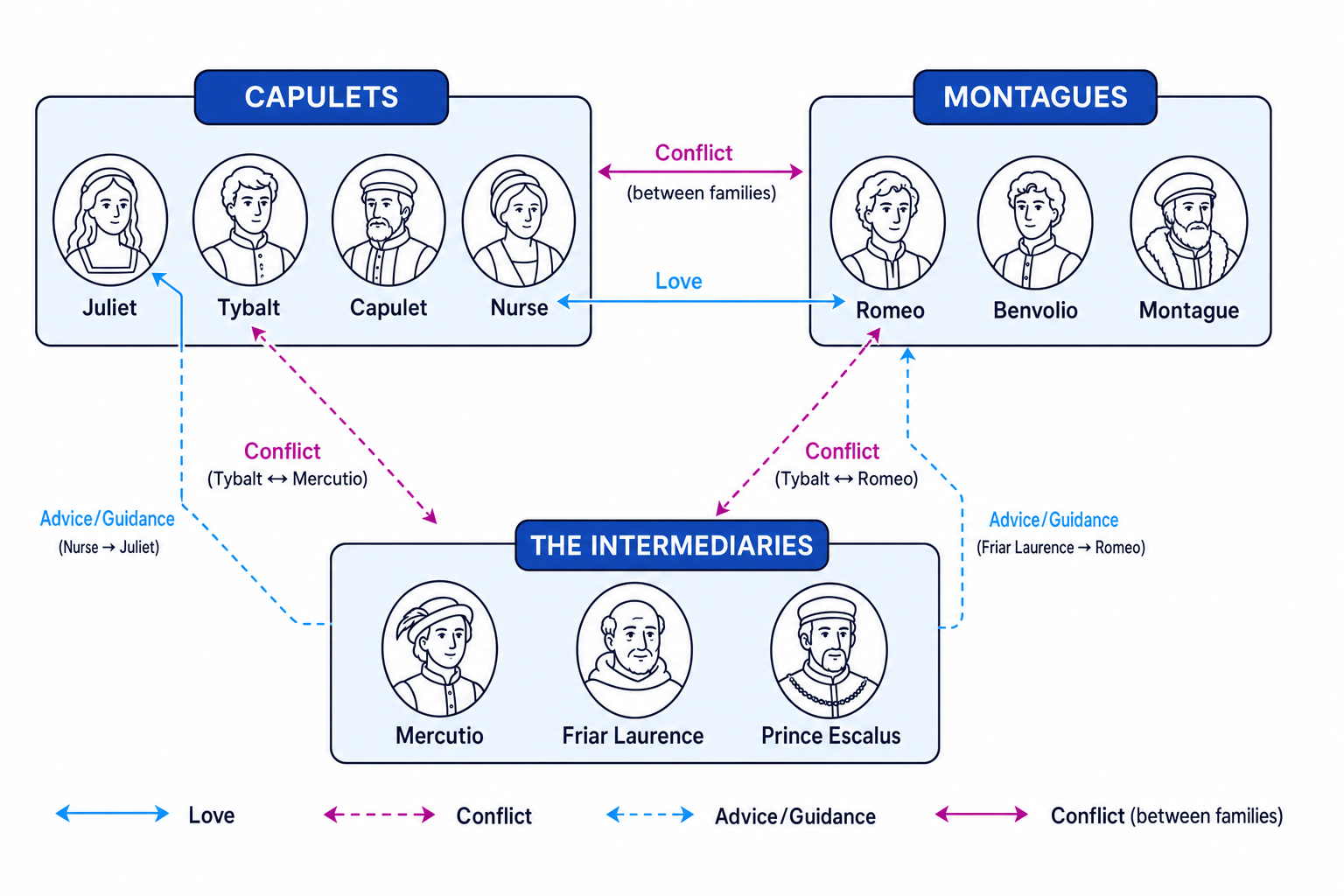
Treating characters like real people
Never write about what a character "should have done" or guess what they are "thinking" outside of the text. Instead of saying, "Romeo was very impulsive and should have waited for the Friar's letter," write: "Shakespeare constructs Romeo as an impulsive figure to warn his Elizabethan audience about the destructive nature of unchecked passion." This shows you are analyzing the writer's craft (AO2).
The Protagonists: Romeo and Juliet
The tragic trajectory of the play relies entirely on the rapid development of the two protagonists. Both characters begin the play confined by societal expectations but are radically transformed by their love.
Romeo: From Petrarchan Lover to Tragic Hero
At the start of the play, Romeo is introduced as a conventional lover who is suffering from unrequited love for Rosaline.
Petrarchan Lover
A Petrarchan Lover is a literary archetype of a man who is in love with the idea of being in love. He is typically dramatic, melancholy, sighs heavily, and uses exaggerated, clichéd language to describe his pain.
When we first hear of Romeo, Lord Montague notes that he is locked in his room, "with tears augmenting the fresh morning's dew" (Act 1, Scene 1). Romeo speaks in oxymorons such as "O brawling love, O loving hate," which demonstrates that his feelings are superficial and imitative of popular poetry.
However, his meeting with Juliet changes his language entirely. His speech becomes holy and elevated, filled with religious imagery: "This holy shrine, the gentle sin is this / My lips, two blushing pilgrims, ready stand" (Act 1, Scene 5).
Romeo's Hamartia
Romeo's tragic flaw (hamartia) is his impulsiveness. Whether falling instantly out of love with Rosaline and in love with Juliet, or instantly seeking revenge on Tybalt ("fire-eyed fury be my conduct now!"), Romeo acts without reflection. Shakespeare uses this to show how raw passion overpowers reason, leading directly to tragedy.
Juliet: From Obedient Daughter to Courageous Rebel
In Elizabethan England, daughters were legally the property of their fathers. When we first meet Juliet in Act 1, Scene 3, she is passive and obedient, stating of marriage: "It is an honour that I dream not of." She promises her mother to look at Paris with the intent to like him, but only "so peerly as your consent gives strength to make it fly."
Juliet's development is far more radical than Romeo's. She quickly sheds the passive role imposed on her by patriarchal society:
- Intellectual Maturity: In the balcony scene (Act 2, Scene 2), she warns Romeo against swearing by the "inconstant moon." She is the practical one, noting that their contract is "too rash, too unadvised, too sudden."
- Rebellion against Patriarchy: When her father demands she marry Paris in Act 3, Scene 5, she boldly refuses: "He shall not make me there a joyful bride."
- Physical Courage: While Romeo flees to Mantua, Juliet remains in Verona, facing her terrifying situation alone. Her soliloquy in Act 4, Scene 3 ("My dismal scene I needs must act alone") shows her conquering her fears of waking up in a tomb of dead ancestors to drink the Friar's potion.
Character Foils: Driving the Conflict
Shakespeare masterfully pairs characters with direct opposites to highlight their defining traits. This structural technique is known as foiling.
Character Foil
A foil is a character who contrasts sharply with another character, usually the protagonist, in order to highlight and emphasize the distinctive temperament or qualities of both.
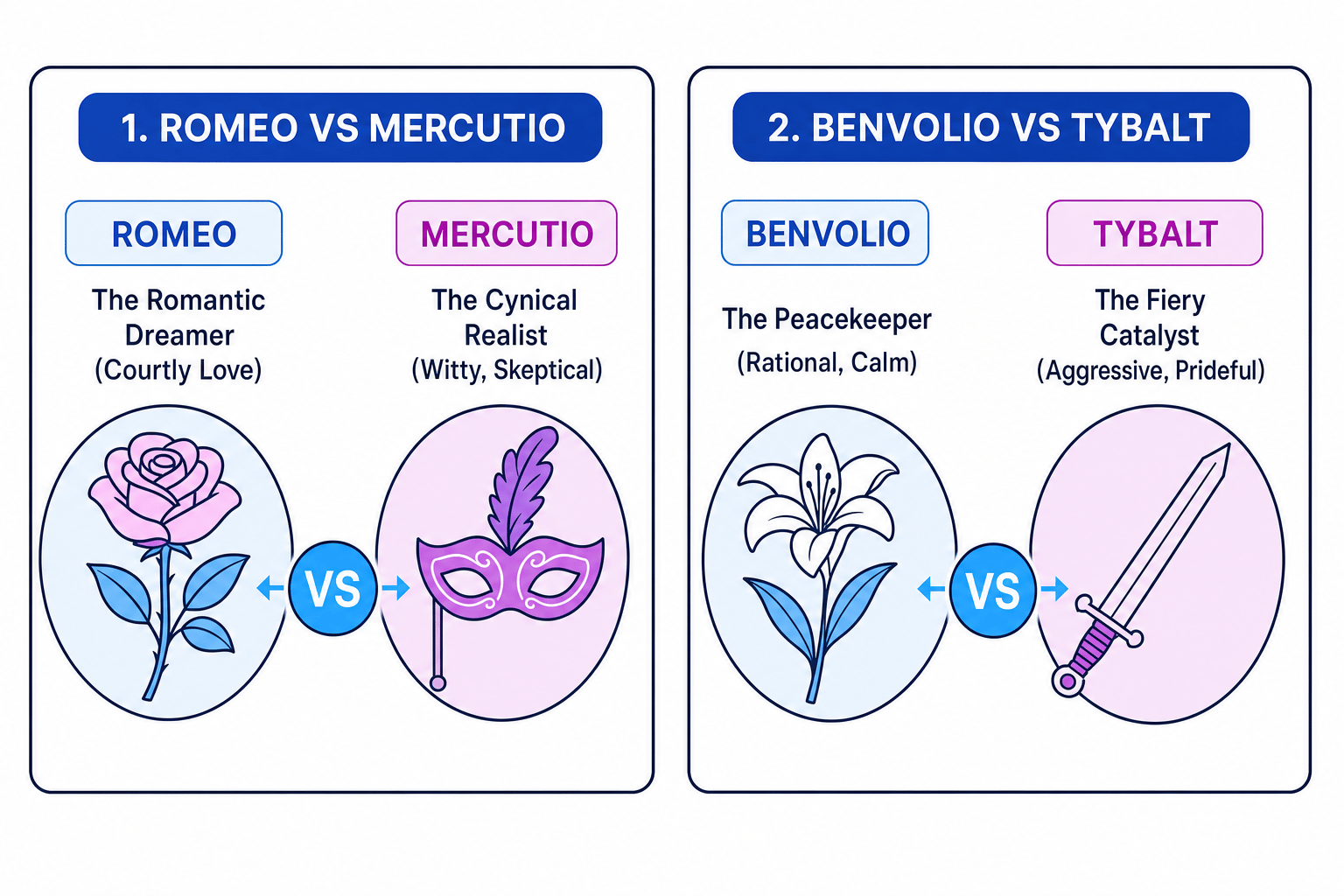
1. Romeo vs. Mercutio
Mercutio is cynical, pragmatic, and highly physical. He views love entirely as physical lust and a subject for mockery, mocking Romeo’s romantic ideals: "If love be rough with you, be rough with love" (Act 1, Scene 4).
By contrasting Mercutio's crude, witty puns with Romeo’s elevated, spiritual language, Shakespeare highlights the purity and exceptional nature of Romeo and Juliet's bond.
2. Benvolio vs. Tybalt
Benvolio (whose name literally means "goodwill") is defined by his desire for peace and law. He tries to beat down the weapons of the brawling servants in Act 1, Scene 1.
Tybalt, by contrast, is a fiery agent of chaos and toxic masculine pride. His response to Benvolio's peace-making is: "What, drawn, and talk of peace? I hate the word / As I hate hell, all Montagues, and thee." Tybalt represents the ancient feud kept alive by a rigid, fragile code of family honour.
Do not list devices without explaining effects
It is not enough to write: "Tybalt is Benvolio's foil." You must explain why Shakespeare created this contrast. For example: "By immediately countering Benvolio's calm rationality with Tybalt's explosive malice, Shakespeare establishes that the civil conflict in Verona is too deeply entrenched to be solved by reason alone."
The Flawed Guides: Surrogates and Enablers
Because the parents (Lord and Lady Capulet, Lord and Lady Montague) are distant, emotionally cold, or authoritarian, Romeo and Juliet turn to surrogate parents: the Nurse and Friar Laurence. While both mean well, their flaws make them direct catalysts for the tragedy.
Friar Laurence: The Hubristic Mediator
The Friar represents the intellectual and spiritual authority in Verona, but he is compromised by hubris (excessive pride).
- He agrees to marry the lovers not out of pastoral duty, but for political gain: "For this alliance may so happy prove / To turn your households' rancour to pure love" (Act 2, Scene 3).
- He advocates for moderation ("Wisely and slow; they stumble that run fast"), yet he constantly facilitates hasty, risky plans (secret marriage, faking Juliet's death).
- Under pressure, his moral courage fails. When Juliet wakes up in the tomb to find Romeo dead, the Friar hears a noise and flees ("I dare no longer stay"), leaving a traumatized, suicidal young girl alone in a crypt.
The Nurse: Pragmatic Love vs. Absolute Love
The Nurse provides warmth and comic relief in the early parts of the play. She is Juliet's physical protector and confidante. However, like Mercutio, the Nurse is a pragmatist who views love in physical and transactional terms.
When Lord Capulet threatens to disown Juliet if she does not marry Paris, the Nurse advises Juliet to commit bigamy: "I think it best you married with the County... Romeo's a dishclout to him" (Act 3, Scene 5). This advice breaks the moral and emotional trust between them. Juliet realizes that the Nurse cannot understand the absolute, spiritual nature of her love for Romeo, prompting her final isolation.
The Generational Divide
Shakespeare uses the Friar and the Nurse to demonstrate the failure of the older generation. The adults in Verona either fuel the conflict (Capulet/Tybalt) or fail to provide sound moral guidance (Friar/Nurse), leaving the young lovers structurally isolated and doomed.
Worked Example: Analyzing Character Construction
Let's walk through how to analyze a character's transformation in an exam-style response.
Task: Analyze how Shakespeare constructs the character of Juliet to show her development in Act 3, Scene 5.
Analyzing Juliet's rebellion
-
Identify the character's tragic trajectory and context: Start by identifying Juliet's position in this scene. She is being forced by her father to marry Paris, meaning she must choose between patriarchal submission and moral/marital fidelity to Romeo.
-
Select high-yield quotations and zoom in on methods: Look at Juliet's language when rejecting her father. She says: "He shall not make me there a joyful bride." Zoom in on the modal verb "shall not" and the contrast of "joyful bride" to analyze her tone and defiance.
-
Draft the analysis, linking language to the playwright's message and context (AO1/AO2/AO3): Model Paragraph: In Act 3, Scene 5, Shakespeare constructs Juliet as an increasingly defiant figure who rejects the patriarchal authority of her father. When told she must marry Paris, she states, "He shall not make me there a joyful bride." The absolute certainty of the modal verb "shall not" marks a radical departure from her submissive Act 1 persona, where her "consent" was dependent on her mother's approval. By refusing to become a "joyful bride," Juliet openly rebels against the early modern expectation that daughters were commodities to be bartered for social status. Shakespeare uses this linguistic defiance to heighten the dramatic stakes, isolating Juliet from her family and illustrating the tragic consequences when young love collides with rigid social structures.
Look for structural shifts
Always trace characters across the whole play. If you get an extract from Act 1, contrast the character's behavior there with their actions later in the play (e.g., Juliet's early obedience vs. her later desperation). This fulfills the AO1 requirement for a well-structured, cohesive response.
In the exam
- Always use the character's name as a subject with an active verb: Instead of writing "Juliet feels lonely," write "Shakespeare constructs Juliet as an isolated figure." This forces you to focus on the writer's craft (AO2).
- Anchor your analysis in context (AO3): Ensure you mention why a character's actions would shock or resonate with an Elizabethan audience (e.g., Juliet's rebellion against patriarchal marriage laws, or Romeo breaking the Prince's civil peace).
- Remember the tragic framework: Every character's arc in this play is bound to the genre of tragedy. Ensure you use terms like hamartia, catalyst, hubris, and fatalism when explaining why characters make their choices.
Check yourself
- Why does Shakespeare introduce Romeo as a "Petrarchan Lover" before he meets Juliet?
- In what ways does Mercutio act as a structural foil to Romeo?
- How does Juliet's language in her Act 4 soliloquy demonstrate that she has grown past her initial dependency on her family and nurse?
