To understand Chinonyerem Odimba’s Princess & The Hustler, you must look beyond a simple list of events. The play is structured around two distinct but deeply connected worlds: the private, domestic life of the Smith family, and the public, political struggle of the 1963 Bristol Bus Boycott.
By analyzing how these two plots mirror and crash into one another, you can unlock the deeper themes of identity, belonging, and self-worth that Odimba explores.
What you'll learn
- How the domestic life of the Smith family mirrors the historic Bristol Bus Boycott of 1963.
- The key narrative stages of the play, from Princess’s pageant dreams to the explosive climax.
- How Odimba uses parallel plotlines to explore themes of race, gender, and identity.
Concept 1: The Dual Narrative (Domestic vs. Political)
At the heart of Princess & The Hustler is a specific structural technique called a dual narrative.
Dual Narrative
A dual narrative is a storytelling structure where two separate plotlines run parallel to one another, frequently intersecting to highlight shared themes, contrasts, or ironies.
In this play, Odimba juxtaposes the local, history-making civil rights movement in Bristol with the personal, emotional journey of a ten-year-old girl.
1. The Political Plot: The Bristol Bus Boycott
The play is set in Bristol in the summer of 1963. This was a monumental moment in British civil rights history.
Boycott
A boycott is an act of voluntary and intentional abstention from using, buying, or dealing with a person, organization, or country as an expression of protest or coercion.
Colour Bar
The colour bar refers to a social and legal system of racial discrimination that prevents non-white people from accessing certain jobs, housing, or social spaces.
The political plot centers on the real-life Bristol Bus Boycott, which was organized to protest the Bristol Omnibus Company’s refusal to employ Black bus drivers and conductors. In the play, this public struggle is championed by Julius (known as "the Hustler"), who seeks a sense of purpose and dignity in a country that treats him as a second-class citizen.
2. The Domestic Plot: The Smith Family Household
While the streets of Bristol are filled with protests, the Smith family home is filled with its own quiet battles.
- Princess: A bright, imaginative ten-year-old girl who dreams of winning the Weston-super-Mare beauty pageant. She is fixated on fairy tales and Eurocentric standards of beauty.
- Margo: Her hardworking mother, who works exhausting hours sewing and cleaning. She is practical, fiercely protective, and weary of Julius’s erratic behavior.
- Julius ("The Hustler"): Princess's charming but unreliable father. He is a man of grand schemes and big promises who often lets his family down.
- Lorraine: Princess's studious older brother, who is struggling deeply with his identity, his name, and the overt racism he faces at school.
- Wendell: Princess’s younger brother, who idolizes his father and tries to copy his "hustling" ways.
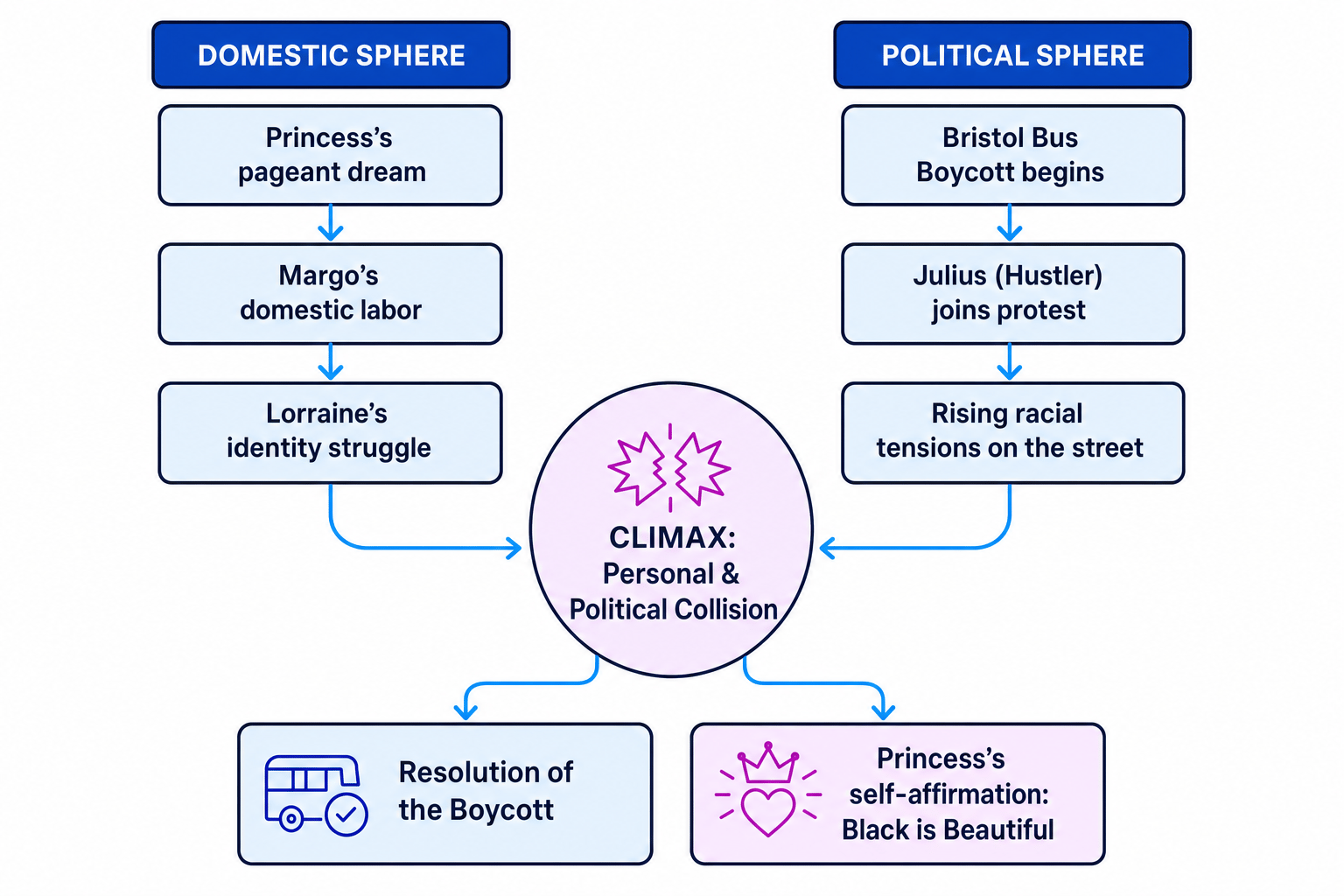
The image below maps how these two spheres—the private and the public—progress in tandem before colliding at the play's climax.
Concept 2: Act-by-Act Plot Development
Let's break down how the narrative unfolds chronologically across the play's two acts.
Act 1: Dreams, Realities, and Rising Action
The play opens in the domestic sphere. We are introduced to Princess's dream: she wants to be a "real-life princess" and win the Weston-super-Mare beauty contest. Her mother, Margo, is busy sewing a dress for her, though she is highly skeptical of Princess's chances in a society that does not value Black beauty.
Julius returns home with a television set—a symbol of wealth, modernization, and assimilation into British society. However, his return also brings tension. We learn about the colour bar on the Bristol buses. Julius, seeking a grand purpose, becomes increasingly involved in organizing the boycott alongside civil rights activists.
While Julius is swept up in the political movement, Lorraine is suffering in silence. He faces violent racial abuse at school, which he hides from his family. This shows that while Julius is fighting a public battle, his own son is losing a private one.
The Parallel Tension
As the heat of the summer rises, the political tension on the streets of Bristol and the domestic tension within the Smith household rise at the exact same rate. Odimba uses this parallel to show that political struggles are never separate from family life.
Act 2: The Climax and Personal Realizations
In Act 2, the boundary between the "home" and the "street" completely breaks down.
Lorraine’s internal conflict reaches a crisis point. He is physically assaulted offstage, and his physical injuries bring the terrifying reality of racial violence directly into the family living room.
Meanwhile, Princess’s dream of entering the beauty pageant is shattered when she is flatly rejected because she is Black. She is forced to confront the painful truth that her society’s definition of "beauty" and "royalty" excludes her.
Climax
The climax is the turning point of a narrative; the moment of highest tension and drama where the central conflicts must be addressed and resolved.
The climax of the play occurs when Julius’s obsession with the boycott causes him to neglect his family during their moments of deepest crisis. Margo confronts Julius, demanding to know how he can fight for the rights of "the community" when he is failing to protect and provide for his own children.
Concept 3: The Resolution
Resolution
The resolution is the final part of a play or story where the strands of the plot are drawn together and matters are explained or resolved.
The resolution of Princess & The Hustler delivers two distinct victories—one political, and one deeply personal.
- The Political Resolution: On August 28, 1963, the Bristol Omnibus Company officially capitulates and ends its colour bar. This historic victory happens on the very same day that Martin Luther King Jr. delivers his "I Have a Dream" speech in Washington D.C.
- The Personal Resolution: Despite being barred from the official pageant, Princess experiences her own private crowning. Margo finishes her beautiful dress, and Princess stands before her family, defining her own worth.
Self-Affirmation
Self-affirmation is the act of recognizing, validating, and asserting the worth and value of one's own identity, independent of external approval or societal standards.
Princess realizes she does not need a white-dominated beauty pageant to validate her identity. She is already a princess.
Treating the Boycott as Just Background
Many students write about the Bristol Bus Boycott as if it is simply historical context (AO3). Remember, Odimba uses the boycott as a vital structural device (AO2). It directly mirrors Julius's personal search for dignity and acts as the catalyst for the family's internal crises. Always link the historical events back to how they affect the characters' actions and emotional development.
Tracing the Narrative Structure
To write a high-scoring essay, you must analyze how Odimba transitions from one plotline to another to build dramatic tension.
Analyzing the structural transition from Act 1 to Act 2
Observe how Odimba moves the action from the optimistic domestic preparations of Act 1 to the intense conflict of Act 2, and use the following steps to build your analysis:
- Identify the shifting focus: In Act 1, scene focus is heavily placed on domestic preparations (Margo sewing the dress, Princess dancing). By the start of Act 2, the dialogue is dominated by the looming threat of the street protests and Lorraine's quiet withdrawal.
- Analyze a symbolic prop or action: Look at how the pageant dress changes meaning. In Act 1, it represents a young girl's naive hope. By Act 2, as Margo struggles to find time to finish it amidst family crisis, the dress represents the heavy emotional labor of Black motherhood.
- Link to the playwright's message: Explain how this transition shows that the family cannot escape the hostile environment of 1960s Britain. Odimba structuralizes the play this way to prove that personal joy (the pageant) cannot be separated from political justice (the boycott).
Spotting the Turning Point
Pay close attention to Lorraine's name. When he rejects his name "Lorraine" and insists on being called "Lorna," or when his academic books are ruined, it structurally signals that the external racial hostility of Bristol has breached the safety of the household.
In the exam
- Focus on structural relationships: If you get a question on Julius (the Hustler) or Margo, organize your essay around how their relationship deteriorates as the Boycott grows. This addresses AO2 (structure) and AO1 (argument) simultaneously.
- Anchor your analysis to key scenes: Ensure your essay moves chronologically or thematic-conceptually through the play: starting with the initial dreams (the television/the pageant), moving to the rising tensions (the street violence/Lorraine's assault), and finishing with the dual resolution (the lifting of the colour bar/Princess's self-crowning).
- Embed short, structural quotes: Memorize quotes that reflect the plot's progression, such as Princess's early plea, "I want to be beautiful," contrasted with her late realization of her own power.
Check yourself
- Why does the climax of the play occur inside the family home rather than on the protest line in the streets of Bristol?
- How does Julius's involvement in the political boycott structurally affect Margo's domestic workload?
- In what ways does the resolution of Princess's personal plotline subvert (rebel against) the traditional ending of a fairy tale?
