Chinonyerem Odimba’s Princess & The Hustler is a vibrant, moving exploration of family life against the backdrop of the 1963 Bristol Bus Boycott. In your GCSE exam, you will need to demonstrate a deep understanding of how the playwright uses individual characters to explore wider social issues such as race, identity, gender, and the immigrant experience in post-war Britain.
Remember, characters are not real people—they are constructs designed by the writer to convey specific themes and ideas.
What you'll learn
- How Princess’s personal journey reflects the play's central message of self-acceptance.
- The contrasting parenting styles and ideologies of Mavis and Wendell (The Hustler).
- How the sibling relationships between Princess, Lorna, and Buddy deepen our understanding of youth and race in 1960s Britain.
- How to write an analytical response tracking character development and linking it to historical context.
Princess (Phyllis): The Search for Identity
Phyllis, affectionately called "Princess" by her family, is the ten-year-old protagonist of the play. She is bright, energetic, and completely captivated by the glamour of beauty pageants.
Odimba uses Princess to explore how systemic prejudice affects the mind of a young child. At the start of the play, Princess desperately wants to enter the Weston-super-Mare beauty pageant. However, this dream is complicated by the fact that the pageants she sees only feature white women.
Internalised Racism
Internalised racism occurs when members of a marginalised group consciously or subconsciously accept and apply the racist stereotypes and beauty standards of the dominant culture to themselves.
Princess’s obsession with pageants is not just a childish whim; it is a manifestation of internalised racism. She associates beauty, royalty, and worth entirely with whiteness. Her journey throughout the play is about moving from a desire to assimilate into white standards of beauty to an active celebration of her own Blackness.
Key Character Traits & Evidence
- Naivety turning to awareness: At first, Princess is insulated from the racial tensions around her. When she asks, "Am I pretty, Mum?", she is seeking validation in a world that does not reflect her image back to her positively.
- Resilience: Despite the lack of representation and her mother’s initial reluctance, Princess remains determined. Her crowning moment at the end of the play is a powerful act of self-definition: she designs her own pageant, reclaiming her identity on her own terms.
The Family Dynamic: Mavis and Wendell
The heart of the play lies in the relationship between Princess’s parents, Mavis and Wendell (known as "The Hustler"). Odimba uses their marriage to represent two different responses to the hostile environment faced by the Windrush generation in Britain.
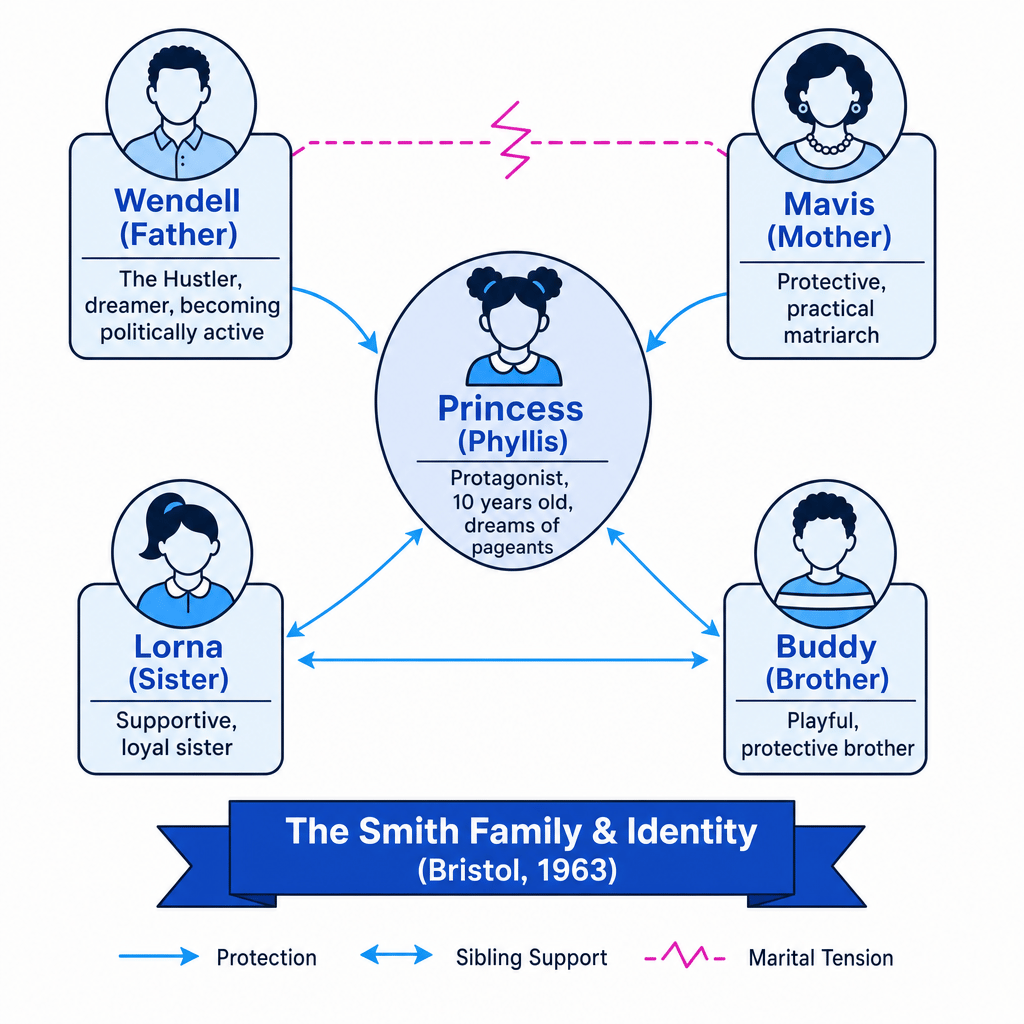
Microcosm
A microcosm is a miniature representation of something much larger. In literature, a family can act as a microcosm of an entire society or community.
The Smith household is a microcosm of the West Indian immigrant community in 1963 Britain, torn between the desire to quietly survive and the urgent need to fight for civil rights.
Mavis: The Pragmatic Protector
Mavis is the hardworking, grounded matriarch of the family. Her primary motivation is the physical and emotional survival of her children. Because of this, she initially advocates for assimilation and keeping a low profile.
- Her philosophy: Mavis believes that the safest way for a Black family to survive in Britain is to avoid trouble. She warns against getting involved in the Bristol Bus Boycott because she fears the repercussions.
- Her growth: Mavis is not weak; her caution comes from deep-seated love and fear. When she finally stands up and supports her family's involvement in the movement, it represents a monumental shift from survival-by-assimilation to survival-by-resistance.
Wendell: The Dreamer and "The Hustler"
Wendell is a charismatic, energetic man who struggles to find stable footing in a society designed to keep him down. He is called "The Hustler" because of his constant search for get-rich-quick schemes, which are born out of frustration with his limited employment options.
Foil
A foil is a character who contrasts sharply with another character in order to highlight specific qualities of both.
Wendell acts as a dramatic foil to Mavis. Where Mavis is cautious and realistic, Wendell is impulsive and idealistic.
- His political awakening: Initially, Wendell's "hustles" are individualistic—he wants to provide for his family and prove his worth. However, as he gets involved in the Bristol Bus Boycott, his energy shifts from personal gain to collective action. He realizes that true dignity cannot be bought; it must be fought for.
The Power of the Boycott
Odimba uses Wendell’s transformation to show that political activism is not just about changing laws; it is about restoring personal dignity and self-respect to individuals who have been marginalized.
The Siblings: Lorna and Buddy
Princess’s older siblings, Lorna and Buddy, offer further insight into what it was like to grow up Black in 1960s Britain.
Lorna: The Cynical Older Sister
Lorna is older than Princess and is much more aware of the realities of racism and gender expectations.
- She serves as a bridge of reality for Princess, often challenging her sister’s naive fantasies about pageants and "princesses."
- Lorna’s character highlights the specific pressures on young Black women to grow up quickly and shoulder domestic and emotional burdens.
Buddy: The Vulnerable Brother
Buddy is quiet, sensitive, and creative. Unlike his father, he does not have a "hustler" persona to hide behind, making him highly vulnerable to the hostile world outside.
- The impact of prejudice: Buddy experiences direct racial abuse, including an incident where he is spat on. This trauma deeply affects his self-esteem and sense of safety.
- His role in the play: Through Buddy, Odimba highlights the emotional and psychological toll that systemic racism takes on young Black boys, contrasting his gentle nature with the harsh, aggressive world he is forced to navigate.
Worked Example: Analysing Character Presentation
In your exam, you may be asked to explore how Odimba presents a specific character and how they relate to the wider themes of the play. Here is a step-by-step walkthrough of how to construct an analytical paragraph focusing on Wendell’s character development.
Analysing Wendell's character development
Question: How does Odimba present the character of Wendell ("The Hustler") in the play?
-
State a clear focus on the character's symbolic role (AO1): Start by identifying how Odimba uses Wendell to represent a shift in the Windrush generation's mindset.
Drafting: "Odimba presents Wendell not simply as a struggling father, but as a symbol of the transition from individual survival to collective political resistance within the Caribbean diaspora in 1960s Britain."
-
Introduce precise textual evidence (AO1): Select a short, memorable quotation that highlights his initial preoccupation with money and status, contrasting it with his later actions.
Drafting: "At the start of the play, Wendell is obsessed with his identity as 'The Hustler', chasing small-scale financial schemes because systemic discrimination denies him stable, dignified work. However, his involvement in the Bristol Bus Boycott changes his perspective, leading him to declare that he wants to be a man his children can be 'proud of', shifting his focus from financial wealth to moral and social justice."
-
Analyse the writer's methods and language (AO2): Look closely at the dramatic methods (characterisation, contrast, dialogue) Odimba uses to show this change.
Drafting: "Odimba uses the colloquial nickname 'The Hustler' as a dramatic method to highlight how Wendell has internalised the capitalist, individualistic pressures of British society. The noun 'hustler' suggests survival through manipulation and trickery. By abandoning his get-rich-quick schemes to join the collective action of the boycott, Odimba uses situational irony to show that Wendell only finds true power and respectability when he stops 'hustling' individuals and starts standing up for his community."
-
Link the analysis to historical and social context (AO3): Explain how this character arc reflects the real-world events of the 1963 Bristol Bus Boycott.
Drafting: "This transformation mirrors the historical reality of the 1963 Bristol Bus Boycott, led by figures like Paul Stephenson. Through Wendell's awakening, Odimba demonstrates how the boycott served as a catalyst for the West Indian community in Bristol, transforming private frustrations with colour bars into a unified, public fight for civil rights and institutional change."
Treating characters as real people
Do not write about the characters as if they are your friends or real historical figures. Avoid saying things like "Wendell is a bad husband because he spends all his money." Instead, frame it through the writer's intent: "Odimba uses Wendell's financial struggles to highlight the economic barriers faced by West Indian immigrants." Always keep the focus on the writer's craft!
Watch out for character names!
Pay attention to Odimba’s use of names. "Phyllis" is her real name, but "Princess" is her nickname. Think about what this choice of name symbolizes. A "princess" is historically associated with white European fairy tales, royalty, and untouchable beauty. By reclaiming the name "Princess" while embracing her natural hair and dark skin, she redefines what the word means.
In the exam
When writing about characters in Princess & The Hustler, use these three essential strategies:
- Track character arcs, not just static traits: The examiners want to see how characters change. Always contrast their attitudes at the beginning of the play with their actions at the climax and resolution.
- Weave context into character analysis: Every main character represents a different facet of the 1960s Black British experience. Link Princess to discussions of beauty standards, Wendell and Leon to civil rights/activism, and Mavis to the domestic pressures and fears of immigrant mothers.
- Analyse dramatic methods: Remember that this is a play, not a novel. Discuss how characters interact physically on stage, how their tone shifts in dialogue, and how stage directions reveal their internal feelings.
Check yourself
Use these questions to test your understanding of the characters before your exam:
- Why does Mavis initially object to Princess entering the Weston-super-Mare beauty contest, and how does her attitude change by the end?
- How does Odimba use the contrast between Wendell and Leon to explore different approaches to civil rights activism?
- In what ways does Buddy’s character challenge traditional, aggressive expectations of masculinity within the play?
