To excel in your AQA GCSE English Literature exam, you must look beyond simply memorising "what happens" in Much Ado About Nothing. Shakespeare is a master of structure. He uses a dual-plot layout to mirror, contrast, and challenge Elizabethan ideas of love, honour, and social expectation.
By understanding the mechanics of how the plot unfolds, you will be able to write sophisticated essays that analyse Shakespeare's dramatic craft (AO2) and explain how the structural twists would affect both an Elizabethan and a modern audience.
What you'll learn:
- How Shakespeare structures a traditional five-act comedy.
- The way the parallel plots of Hero/Claudio and Beatrice/Benedick interact and comment on each other.
- How to track the structural shift from order to chaos, and back to restored social harmony.
1. The Architecture of the Play
Before dive-bombing into individual acts, we need to understand the structural blueprint of a Shakespearean comedy. Unlike tragedies, which end in isolation and death, comedies traditionally move from order to temporary chaos (discord), before resolving into restored social harmony, almost always symbolised by marriage.
Exposition
The opening phase of a drama that introduces the main characters, setting, and initial conflicts, establishing the 'normal' state of the world before the main action begins.
In Much Ado About Nothing, Shakespeare does not just write one story; he weaves two distinct plotlines together:
- The Hero & Claudio Plot: A conventional, melodramatic courtly love story. It relies on formal courtship, social status, and external reputation. It represents the "high" drama of the play.
- The Beatrice & Benedick Plot: A witty, realistic, and psychological battle of wits. It relies on internal development, personal growth, and intellectual equality.
These two plots do not run on isolated tracks. Instead, they act as mirrors. When one plot is in a state of joy, the other is often in crisis. When one couple is torn apart by cruel deception, the other is brought together by genuine vulnerability.
2. Act-by-Act Plot Arc
Let us break down the narrative trajectory across the traditional five-act structure.
Act I: Exposition and the "Merry War"
The play opens in Messina, a peaceful Sicilian court. The soldiers—led by Don Pedro—return victorious from a minor war.
- The Claudio/Hero Plot begins: Claudio instantly falls in love with Hero's quiet beauty and asks Don Pedro to help him woo her.
- The Beatrice/Benedick Plot begins: We are introduced to the "merry war" of wits between Beatrice and Benedick. Both swear they will never marry.
- The Shadow of the Villain: Don Pedro’s illegitimate brother, Don John (the "bastard" villain), establishes his role as a malcontent who wants to disrupt the peace out of sheer bitterness.
Act II: The Art of Deception (Rising Action)
Deception is the engine of the entire plot. Shakespeare introduces two parallel "gullings" (tricks) that happen at a masked ball and in Leonato's orchard.
Gulling
An Elizabethan term meaning to trick, dupe, or deceive someone, usually for comic effect or to force a change in their behaviour.
- The Benevolent Deception: Don Pedro, Leonato, and Claudio stage a conversation for Benedick to overhear, claiming Beatrice is secretly dying of love for him.
- The Malevolent Deception: Don John and his henchman, Borachio, plot to ruin Claudio’s upcoming wedding by making it look as though Hero is unfaithful.
Act III: Traps Sprung
The parallel deceptions are executed, setting up the play's major turning points.
- Hero and Ursula stage a similar conversation for Beatrice to overhear, claiming Benedick is madly in love with her. Both Beatrice and Benedick are successfully tricked into letting down their defensive guards.
- Meanwhile, Don John takes Claudio and Don Pedro to Hero's window at night. They see Borachio kissing Margaret, who is dressed in Hero’s clothes. Believing Hero is a "loose woman," Claudio vows to shame her publicly at their wedding.
- The Comic Safety Valve: We meet Dogberry and the bumbling "Watch" (the local night patrol). They accidentally arrest Borachio and overhear the plot, but they are too foolish to explain it to Leonato in time. This structural choice reassures the audience that the truth will come out, preventing the play from turning into a pure tragedy.
Act IV: The Broken Altar (Climax)
The central climax of the play occurs in the church during the wedding scene (Act IV, Scene I).
- Claudio publicly denounces Hero, calling her an "approved wanton" (a loose woman) and a "rotten orange."
- Hero faints in shock, and her father, Leonato, initially wishes her dead from shame. Friar Francis, suspecting a conspiracy, advises the family to pretend Hero has actually died to buy time and make Claudio feel remorse.
- The Plots Collide: Left alone in the quiet church, Beatrice and Benedick confess their love for one another. However, this romantic climax is immediately pierced by Beatrice’s shocking command: "Kill Claudio." This forced choice forces Benedick to choose between his loyalty to his military brotherhood and his love for Beatrice.
Act V: Redemption and Revelry (Resolution)
The final act restores order through confession, penance, and double marriages.
- Dogberry’s Watch finally gets the truth to Leonato. Claudio is devastated to learn that his accusations "killed" an innocent girl.
- As penance, Leonato demands Claudio marry his "niece," who is said to be identical to Hero.
- At the second wedding, the masked niece reveals herself to be Hero, alive and vindicated. Beatrice and Benedick discover they were both tricked into loving each other, but they choose to marry anyway, concluding the play with dancing, music, and the banishment of Don John.
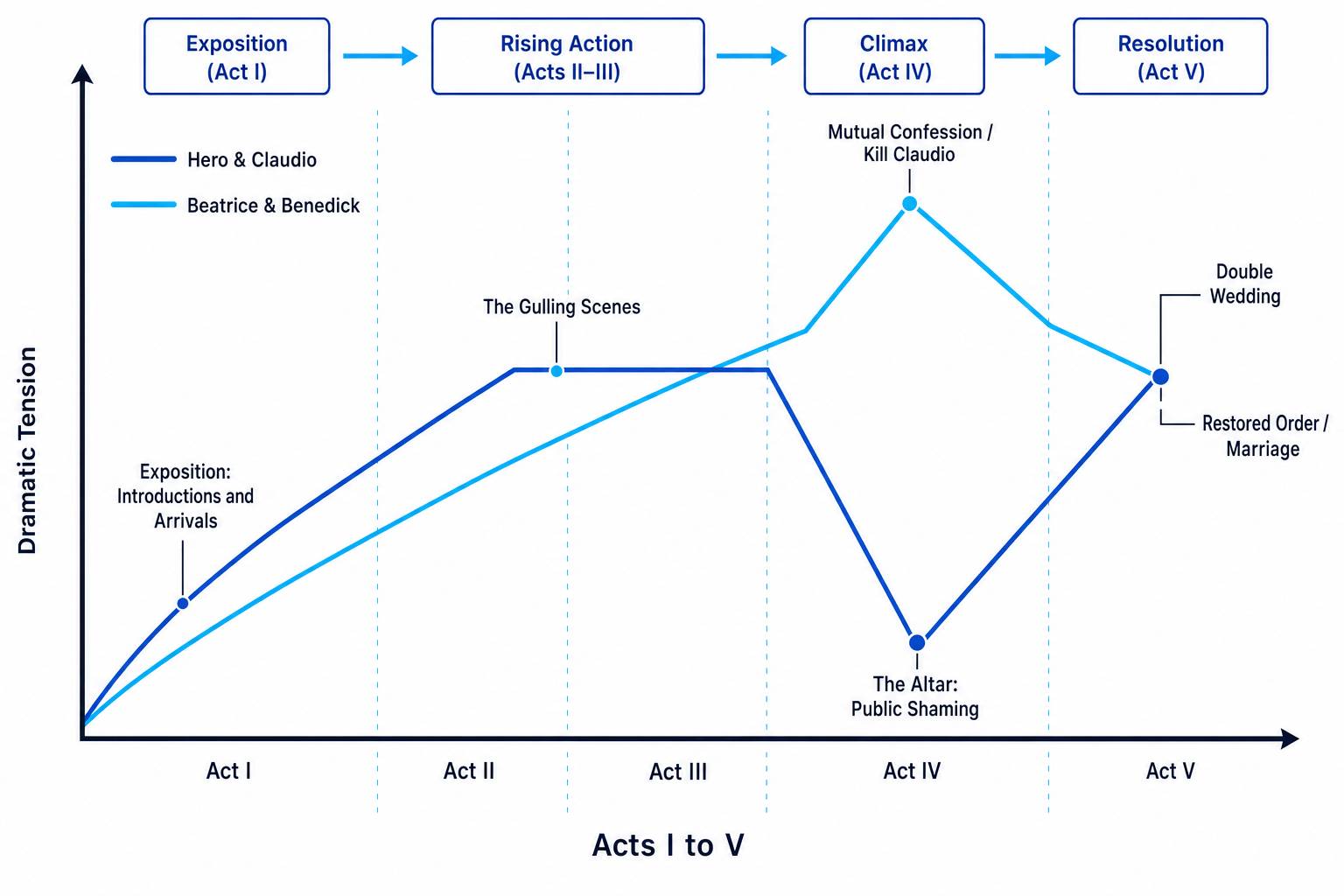
3. Structural Analysis
To achieve a Grade 7 or above, you cannot just retell the story. You must analyse why Shakespeare arranged the events in this specific order.
Let us look at how you can analyze a key structural pivot point where the two plots collide.
The Axis of Act IV, Scene I
The church scene is the structural pivot of the entire play. Shakespeare deliberately uses the tragic collapse of the Hero/Claudio wedding to force Beatrice and Benedick out of their safe, intellectual "merry war" and into a state of raw, dangerous emotional honesty.
Analyzing the Climax of Parallel Plots
Analyzing the structural shift in Act IV, Scene I
- Identify the structural contrast: Contrast the atmosphere of the first half of Act IV, Scene I (the public shaming of Hero) with the second half (Beatrice and Benedick's private dialogue). The first half is dominated by formal, high-status men throwing public accusations; the second half is a quiet, intimate duologue between two social outsiders.
- Examine the linguistic shift: Look at how the language changes structurally. Beatrice and Benedick drop their highly patterned, metaphorical prose "skirmishes of wit" and shift to short, direct, and declarative sentences. For example, Benedick states simply, "I do love nothing in the world so well as you. Is not that strange?" This structural stripping-away of wit signals that deception has ended and truth has begun.
- Evaluate the dramatic impact of Beatrice's command: Analyze Beatrice’s sudden, shocking imperative: "Kill Claudio." This structural shock-tactic forces the audience to realise that the "merry war" is over. The plot has escalated from a harmless comedy of words into a literal matter of life and death, forcing Benedick to reject the corrupt male code of honour represented by Claudio.
- Connect the structural collision to Shakespeare's broader message: Relate this collision back to the theme of gender and honour. By making Hero's public dishonour the direct catalyst for Beatrice and Benedick’s romantic union, Shakespeare structurally demonstrates that true love requires active protection of the vulnerable, rather than just witty banter or superficial, passive courtly rituals.
4. Key Pitfalls & Exam Tips
The 'Beatrice and Benedick are the Subplot' Trap
Do not write about Beatrice and Benedick as if they are merely an entertaining side-story. Structurally, they are the anchor of the play. While Hero and Claudio represent the superficial, fragile nature of Elizabethan courtly love, Beatrice and Benedick show the audience what mature, resilient, and equal love looks like. They are the emotional heart of the plot.
The Power of 'Noting'
In Shakespeare's time, "Nothing" and "Noting" (which meant eavesdropping, observing, or writing notes) were pronounced almost identically. The title of the play is a structural pun: the entire plot is literally Much Ado About "Noting" (eavesdropping and misinterpreting what you see). Keep this in mind when discussing how scenes of overhearing drive the characters' actions.
In the exam
If you get a question on structure or plot dynamics, use this three-step checklist to structure your essay paragraphs:
- Anchor the scene in the wider plot: Explain exactly where this moment sits in the play's overall five-act dramatic arc (e.g., "occurring in the immediate aftermath of the traumatic church scene..."). This shows the examiner you understand the macro-structure of the play.
- Examine the immediate structural contrast: Look for structural juxtaposition. Is a highly tense scene followed by a comic one? For example, the tragic tension of Hero's public humiliation is immediately followed by the comic, bumbling entrance of Dogberry. Shakespeare does this to relieve tension and remind the audience that order will eventually be restored.
- Analyse structural devices: Name specific dramatic techniques such as dramatic irony (when the audience knows Hero is innocent but Claudio does not) or parallelism (how Beatrice's gulling mirrors Benedick's). Always link these devices to the effect they have on the audience's emotions.
Check yourself
Before moving on to the next section, make sure you can answer these questions:
- How does Shakespeare use the character of Dogberry and the Watch structurally to manage the dramatic tension of the play?
- What are the major differences between the "gulling" of Benedick in Act II and the "gulling" of Beatrice in Act III?
- Why is it structurally significant that the play ends with a dance rather than just a wedding ceremony?
