In Shakespeare’s comedy Much Ado About Nothing, characters are not just vehicles for the plot; they are complex vessels through which Shakespeare explores Renaissance ideas of honor, gender, deception, and love.
By looking closely at how characters speak, react, and change, you will unlock the deeper themes of the play and learn how to write a sophisticated, top-mark essay.
What you'll learn
- How Beatrice and Benedick use wit as a defensive shield before transforming into mature lovers.
- How Hero and Claudio represent the fragile, reputation-obsessed ideals of Elizabethan courtly love.
- How the supporting characters (Don John, Don Pedro, and Dogberry) drive the narrative and highlight the play's social critiques.
The Two Couples: A Study in Contrasts
The dramatic core of Much Ado About Nothing relies on the structural mirroring and contrast between its two central romantic pairings.
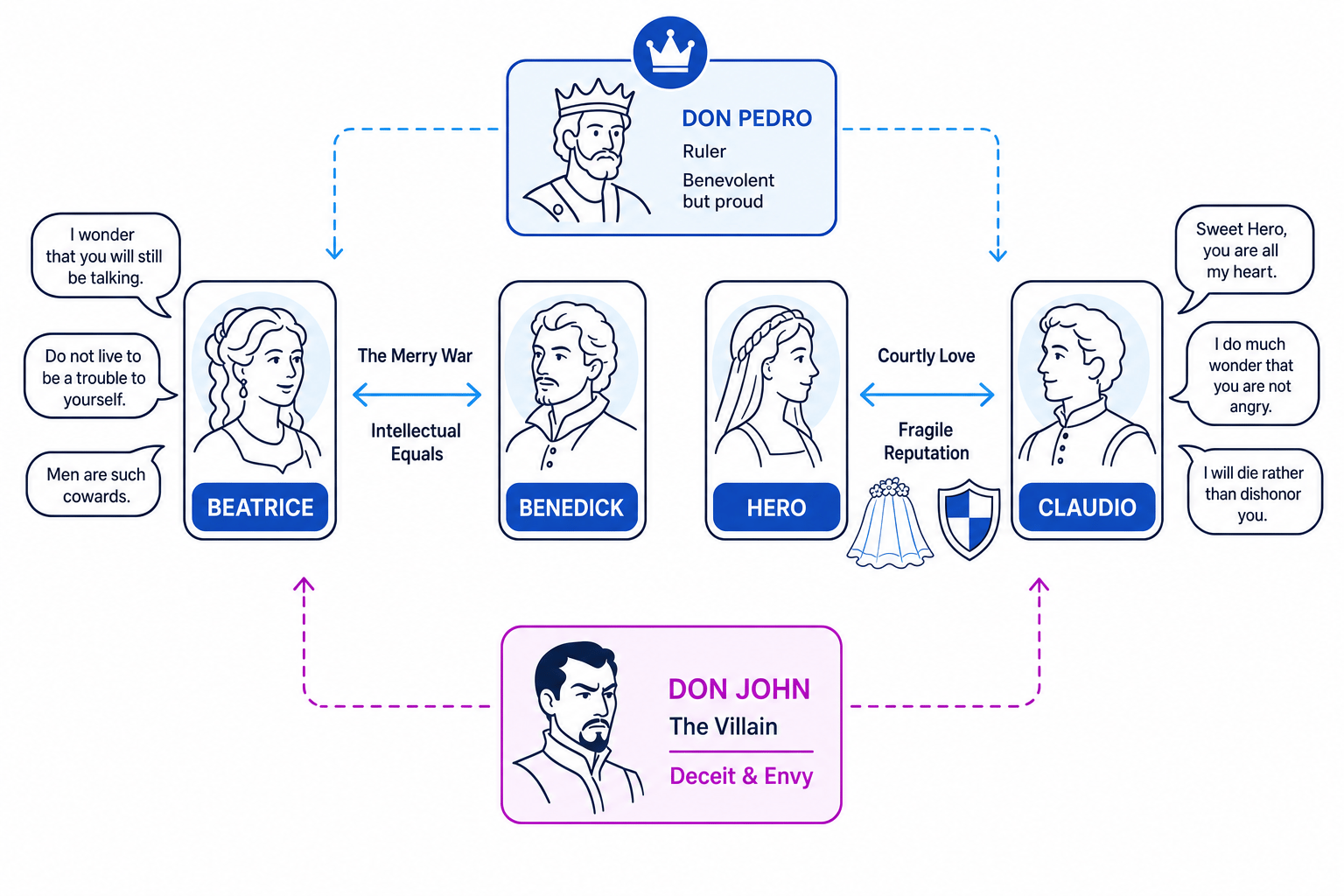
Beatrice and Benedick: The "Merry War"
Beatrice and Benedick are defined by their sharp intellects, verbal dexterity, and mutual cynicism toward marriage. When we first meet them, they are locked in a battle of wits.
Repartee
Repartee is a quick, witty, and sharp exchange of insults or remarks. In the play, Shakespeare uses rapid-fire repartee (stichomythia) to show that Beatrice and Benedick are intellectual equals.
- Beatrice is independent, fierce, and highly suspicious of patriarchal dominance. She refuses to be controlled by a husband, famously stating she would rather "hear my dog bark at a crow than a man swear he loves me" (Act 1, Scene 1).
- Benedick is a proud soldier and self-proclaimed "obstinate heretic" against love. He fears cuckoldry (being cheated on by a wife) and values his freedom, asking, "Shall I never see a bachelor of three-score?" (Act 1, Scene 1).
Wit as a Shield
For both Beatrice and Benedick, their cynical wit is a psychological defense mechanism. It shields them from the vulnerability of genuine emotional connection and the risk of public rejection.
Their Transformation
Their transformation from enemies to lovers is initiated by the "gulling" (tricking) scenes in Leonato's orchard (Act 2, Scene 3 and Act 3, Scene 1). Upon hearing that the other is "sick in love," both abandon their cynical facades.
Significantly, their language shifts:
- Benedick switches from cynical prose to reflective verse, and finally vows: "No, the world must be peopled" (Act 2, Scene 3).
- Beatrice sheds her defensive barbs, speaking in lyrical blank verse: "And, wild bird, love, thy wild heart to thy loving hand" (Act 3, Scene 1).
The ultimate test of their love comes not from trickery, but from tragedy. When Hero is slandered, Beatrice demands of Benedick: "Kill Claudio" (Act 4, Scene 1). By choosing Beatrice’s loyalty to her cousin over his military allegiance to Claudio, Benedick proves that his love has matured from a mere game of words into a deep, sacrificial commitment.
Hero and Claudio: The Courtly Ideal
In stark contrast to the lively, egalitarian dynamic of Beatrice and Benedick, Hero and Claudio operate within the strict conventions of Elizabethan courtly love.
Courtly Love
Courtly love is a highly stylized, conventional medieval and Renaissance literary tradition where a young nobleman worships a beautiful, idealized lady from afar. It is characterized by adoration, exaggerated praise, and extreme sensitivity to reputation.
- Claudio is a young, decorated Florentine soldier. He is highly romantic but immature, easily led, and deeply insecure about his social standing. His feelings for Hero are transactional and aesthetic; before committing, he asks Don Pedro if Leonato has any sons, establishing whether Hero is a wealthy heiress: "Hath Leonato any son, my lord?" (Act 1, Scene 1).
- Hero is the quiet, obedient, and submissive daughter of Leonato. She represents the ideal Elizabethan woman. In the first half of the play, she speaks very little, highlighting her passive role in her own marriage negotiations.
Overlooking Hero's Silence
Do not assume Hero's silence means she has no depth or personality. In a GCSE essay, explain that her silence is a structural reflection of her oppression within Messina's patriarchal society. She is spoken for and spoken about, but rarely allowed to speak for herself until she is falsely accused.
The Fragility of Courtly Love
Because Claudio’s love is built on external appearances and social reputation rather than deep mutual knowledge, it is incredibly fragile.
When Don John easily deceives him into believing Hero is unfaithful, Claudio’s idealization turns instantly to violent hatred. At the altar, he publicly shames her, using shocking sensory imagery:
"Give not this rotten orange to your friend; She’s but the sign and semblance of her honour." — Claudio (Act 4, Scene 1)
This public denunciation exposes the brutal double standards of Elizabethan Messina: a woman's value is entirely tied to her chastity, and a mere accusation from a man is enough to destroy her life.
Analysing a Character's Language
To score highly on Assessment Objective 2 (AO2), you must demonstrate how Shakespeare’s choice of language reveals character development and underlying social themes. Let’s walk through a concrete example of how to build an analytical paragraph.
Analysing Claudio's Accusation of Hero
Analyze how Shakespeare uses language in Act 4, Scene 1 to reveal Claudio’s character and attitudes toward women.
- State your point and contextualize the moment (AO1/AO3): At the interrupted wedding ceremony, Claudio publicly rejects Hero, exposing the fragility of his shallow affection and the ruthless nature of Elizabethan patriarchal honor.
- Introduce and analyze the language method (AO2): Shakespeare uses a vivid, corrupting metaphor when Claudio instructs Leonato to "Give not this rotten orange to your friend." The noun "orange" implies that Claudio viewed Hero as a fresh, decorative, and consumable prize to be acquired. However, the modifying adjective "rotten" reveals how quickly his superficial love turns to disgust once her reputation is tainted.
- Link to the effect on the audience and the writer's deeper purpose (AO3): By comparing Hero to spoiled fruit, Shakespeare highlights how women in Messina are treated as commodities traded between men (from father to husband). If the commodity is perceived as damaged, it is discarded with vitriol. This shocking imagery would leave a contemporary audience deeply unsettled by the ease with which male authority figures can ruin a woman's life based on unverified slander.
Supporting Characters: Foils and Catalysts
Don Pedro vs. Don John: The Royal Brothers
The half-brothers represent the structural binary of good and evil within the play, acting as dramatic foils to one another.
Foil
A foil is a character who contrasts sharply with another character, usually the protagonist, in order to highlight and emphasize particular qualities of the latter.
- Don Pedro, Prince of Aragon is the benevolent, powerful ruler of the military force. He is generous, using his high status to matchmake for both couples. However, he is also proud and deeply concerned with social decorum. When he is deceived by Don John, his immediate reaction is to protect his own royal honor, joining Claudio in slandering Hero.
- Don John, the "Bastard Brother" is the play's self-proclaimed "plain-dealing villain." Lacking the social status and legitimacy of his brother, he is motivated by raw envy and resentment: "I had rather be a canker in a hedge than a rose in his grace" (Act 1, Scene 3). He acts as the ultimate catalyst for the play's conflict, exploiting the insecurities of Claudio and Don Pedro to sow discord.
Dogberry: The Unintentional Hero
Dogberry is the comic constable of the Messina night watch. While he is initially introduced for physical comedy and light relief, he plays a crucial thematic role.
Malapropism
A malapropism is the mistaken use of an incorrect word in place of a similar-sounding one, often with an amusingly inappropriate result. Dogberry is famous for these (e.g., saying "comprehended" instead of "apprehended," or "tediousness" instead of "wealth").
The Irony of Dogberry
Remember the great structural irony of the play: the noblemen (Don Pedro and Claudio), who pride themselves on their wisdom and intellect, are completely blinded by Don John’s obvious lies. Meanwhile, the foolish, uneducated Dogberry and his watchmen are the ones who actually uncover the truth and save Hero.
In the exam
If you face a character question on Much Ado About Nothing in your GCSE paper, use these strategic steps to maximize your marks:
- Avoid writing a chronological character biography: Do not simply retell the plot of what Beatrice or Claudio does from Act 1 to Act 5. Instead, structure your essay around ideas (e.g., how their character reflects Elizabethan gender expectations or the theme of deception).
- Link character to context (AO3): Always explain why Shakespeare created a character a certain way. If discussing Beatrice, mention how her subversion of the "quiet, submissive woman" archetype would shock and entertain an Elizabethan audience. If writing about Claudio, discuss the vital importance of female chastity and patriarchal honor.
- Track character trajectories: Top marks are awarded to students who examine character development. Show how a character changes (or fails to change) from the exposition (the beginning) through the climax to the resolution.
Check yourself
- How does Benedick's shift from speaking prose to speaking verse in Act 2, Scene 3 signal his changing character?
- Why does Claudio care so much about Hero's reputation, and what does his "rotten orange" speech reveal about his values?
- In what ways does Shakespeare use Don John as a foil to his brother, Don Pedro?
