When you sit down to write your GCSE essay on Pride and Prejudice, the first 5 to 10 minutes are the most crucial. Without a structured plan, even a student with a brilliant memory for quotations can easily end up writing a disorganized summary of the plot rather than a focused, analytical argument.
These study notes will teach you how to design a high-scoring, thesis-driven essay plan that meets all the criteria of the AQA mark scheme.
What you'll learn
- How to deconstruct an exam question and formulate a powerful thesis statement.
- How to transition smoothly between the printed extract and the wider novel.
- How to build a logical, three-paragraph argument that integrates context and writer's methods.
Section 1: The Core of a Top-Tier Essay Plan
In the exam, you are assessed on your ability to maintain a "coherent and critical narrative" (AO1), analyze Austen's structural and linguistic methods (AO2), and link these to Regency context and Austen's social purpose (AO3). A great plan is the blueprint that holds these elements together.
To succeed, you must move away from a simple chronological retelling of the plot (e.g., "First Elizabeth does this, then Darcy does that") and instead focus on a thematic progression of ideas.
Thesis Statement
A thesis statement is a clear, argumentative sentence (or two) at the start of your essay that directly answers the question, establishing your main line of reasoning. It acts as a compass for your entire essay, showing the examiner exactly where your argument is going.
The Golden Rule: Thesis -> Antithesis -> Synthesis
The most sophisticated way to structure an English Literature essay plan is to follow a dialectic progression:
- Thesis: Present the dominant social expectation or starting state of the characters (e.g., the mercenary nature of marriage).
- Antithesis: Present a contrasting force, subversion, or complication (e.g., the rebellion against social expectations or the pain caused by pride and class prejudice).
- Synthesis: Bring these ideas together to show Austen’s ultimate moral message or resolution (e.g., the ideal marriage that balances financial stability with genuine moral and emotional respect).
Section 2: The "Why, How, What" Planning Template
Every body paragraph in your plan should follow a clear conceptual path. Instead of just listing points, plan your paragraphs by asking three questions:
- Why did Austen write this? (What is her moral or social purpose?)
- How does she show it? (Which language, structure, form, or narrative methods does she use?)
- What is the effect? (How does this develop the characters, theme, or the reader's response?)
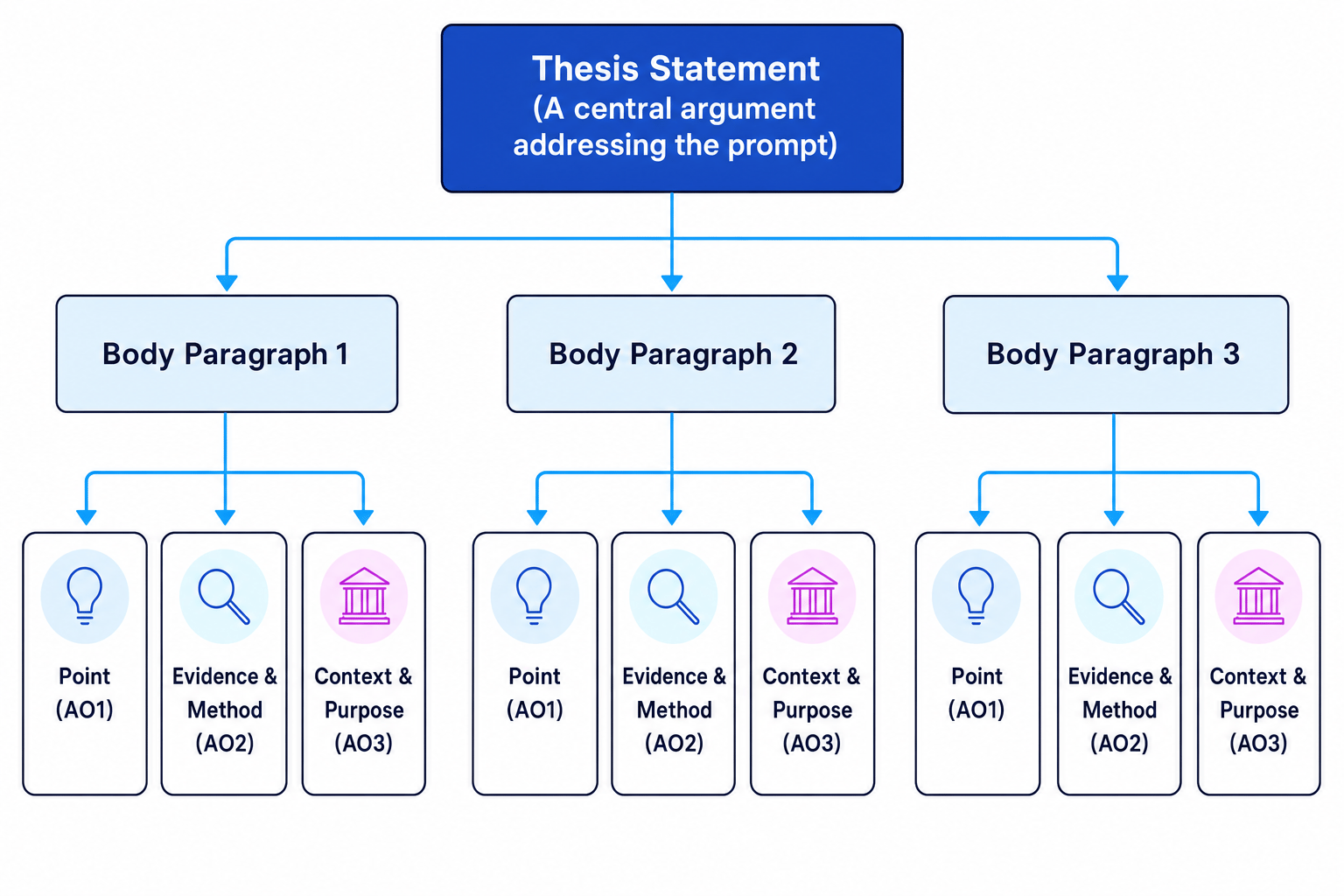
This structure ensures that you are constantly hitting AO1 (your point), AO2 (the method), and AO3 (the social context/purpose) in equal measure.
The 'Plot-Retelling' Trap
Many students write down a list of events rather than a list of analytical arguments. If your essay plan looks like a timeline of the plot, stop! Your paragraph headings should be arguments about ideas, not summaries of chapters.
Section 3: Step-by-Step Essay Planning
Let's look at how to construct a plan from scratch. We will use a classic exam-style question to walk through the process.
Planning an essay on social class and marriage
The Prompt: Explore how Austen presents the relationship between social class and marriage in Pride and Prejudice.
The Extract provided: Chapter 19, where Mr. Collins proposes to Elizabeth and lists his mercenary reasons for marriage (emphasizing Lady Catherine's advice and his own financial security).
Follow these four steps to build an outstanding essay plan:
-
Deconstruct the prompt to form a nuanced thesis statement. Do not just restate the question (e.g., "Austen shows that class is very important to marriage"). Instead, craft an argument that explores why Austen highlights this connection.
Your intellectual work: Ask yourself, "What is Austen's ultimate perspective on this?"
Resulting Thesis: "While Austen acknowledges that the harsh socio-economic realities of Regency England force many characters into mercenary marriages, she ultimately satirizes class-obsessed matches and argues that true conjugal happiness can only be achieved when mutual respect and moral equality transcend social boundaries."
-
Deconstruct the extract for key language and structural methods. Look closely at the extract for Mr. Collins's proposal.
Your intellectual work: Identify how Austen uses Collins as a caricature of societal obsession with rank.
Key evidence to plan: Collins's transactional language ("my active duties," "the design of this visit"). He lists his reasons in a numbered sequence, treating a marriage proposal like a legal contract or a business transaction. Note the irony: he claims to have "the highest esteem" for Elizabeth's virtues, yet he refuses to accept her rejection because her "portion is unhappily so small."
Contextual link (AO3): The Regency marriage market, the law of entailment, and the financial vulnerability of middle-class women who could not inherit wealth.
-
Select contrasting wider-novel evidence to build a thematic progression. You need two other main areas of the novel to complete your three-point plan, contrasting with Mr. Collins's approach.
Your intellectual work: Select evidence that shows different points on the spectrum of class and marriage.
Selection 1 (Pragmatic submission to class): Charlotte Lucas marrying Mr. Collins in Chapter 22. Quote: Marriage was Charlotte's "preservative from want" and she was "not romantic." Method: Free indirect discourse allows us to see Charlotte’s cold, logical justification without direct narrative condemnation, highlighting the tragic reality of women's choices.
Selection 2 (Class as an obstacle to love): Darcy's first proposal in Chapter 34. Quote: He dwells on her "inferiority" and its being a "degradation." Method: Direct speech highlights Darcy's aristocratic pride. Compare this with their final union in Chapter 56/60, where Elizabeth asserts her equality ("He is a gentleman; I am a gentleman's daughter; so far we are equal").
-
Organize the ideas into a clear, three-part conceptual structure. Now, compile your thesis and evidence into a clean, easy-to-read plan.
- Paragraph 1 (The Mercenary Reality): Use the extract (Mr. Collins) and Charlotte Lucas to show how social class reduces marriage to a cold business transaction.
- Method: Satire (Collins's absurd list of reasons) and free indirect discourse (Charlotte's pragmatism).
- Context: Entailment, the financial necessity of marriage for Regency women.
- Paragraph 2 (The Pride of Class-Consciousness): Explore how aristocratic class-consciousness almost destroys the possibility of genuine love, using Darcy's disastrous first proposal.
- Method: Structural contrast (the contrast between Darcy's insulting first proposal and his humble second proposal).
- Context: The rigid social hierarchy and the expectations of the landed gentry (represented by Lady Catherine de Bourgh).
- Paragraph 3 (The Ideal Synthesis): Analyze how Elizabeth and Darcy’s eventual marriage represents Austen’s ideal—a union where moral and intellectual equality triumphs over class divides.
- Method: Dialogue/repartee showing intellectual compatibility; the symbolic setting of Pemberley (combining natural beauty with aristocratic refinement).
- Context: Austen's progressive view that personal merit and mutual affection should dictate marriage, challenging the transactional class structures of her era.
- Paragraph 1 (The Mercenary Reality): Use the extract (Mr. Collins) and Charlotte Lucas to show how social class reduces marriage to a cold business transaction.
The Power of 'Micro-Quotes'
When planning, do not write out long sentences. Instead, plan to use "micro-quotes"—short, punchy phrases of one to three words (like "preservative from want" or "degradation") that you can easily weave directly into your own sentences. This keeps your writing fluid and dense with analysis.
The Extract Trap
AQA examiners frequently warn that students either spend 90% of their time on the extract and ignore the rest of the novel, or write a general essay and ignore the extract completely. Your plan must deliberately split your focus: use the extract as a springboard, analyzing its specific language in your first paragraph, and then broaden out to the wider novel in your next paragraphs.
In the exam
Follow this strategic checklist when planning your essay on Pride and Prejudice:
- Spend exactly 5 to 7 minutes planning. Do not skip this step to save time; a well-planned essay is faster to write and scores much higher on structure.
- Deconstruct the prompt immediately. Circle the key thematic word (e.g., "reputation," "pride," "family," "irony") and write down your 2-sentence thesis statement.
- Use the "Rule of Three." Group your thoughts into three distinct, progressing paragraphs that move from the immediate societal problem to Austen's deeper moral resolution.
- Annotate your extract quickly. Find 2 or 3 micro-quotes in the printed passage, identify the methods used, and write them directly into your plan for Paragraph 1.
- Jot down your wider novel links. Write down at least two specific chapters, scenes, or characters from the rest of the novel that directly contrast or develop the ideas in the extract.
Check yourself
Before you begin practicing your next essay, ask yourself these questions to make sure your plan is robust:
- Does my thesis statement directly answer the specific question, or is it just a generic statement about the novel?
- Are my three paragraphs structured around evolving ideas (Thesis -> Antithesis -> Synthesis) rather than just retelling the plot chronologically?
- Have I selected specific literary methods (like free indirect discourse, caricature, structural foils, or irony) to analyze in each paragraph?
