What you'll learn
- How to spot the chapters that matter most in My Name is Leon.
- How key chapters connect to family, identity, care, racism and belonging.
- How Kit de Waal uses structure, perspective and symbolism to make those chapters powerful.
- How to turn a chapter moment into a strong GCSE Literature paragraph.
Why “key chapters” matter
In the exam, you will not be asked simply to retell the plot. You need to choose moments from the novel that help you answer a question about a theme or character.
A key chapter is useful because it does one or more of these things:
- changes Leon’s situation
- reveals something important about a character
- develops a major theme
- shows one of de Waal’s methods clearly
- links Leon’s private life to the wider world of 1980s Britain
Key chapter
A key chapter is a chapter, or short cluster of chapters, that acts as a turning point in the novel. A turning point is a moment where the direction of the story changes in a significant way.
Because different editions may have different page layouts, revise these as chapter moments rather than page numbers. Use the timeline below as a mental map of the novel’s main movement.
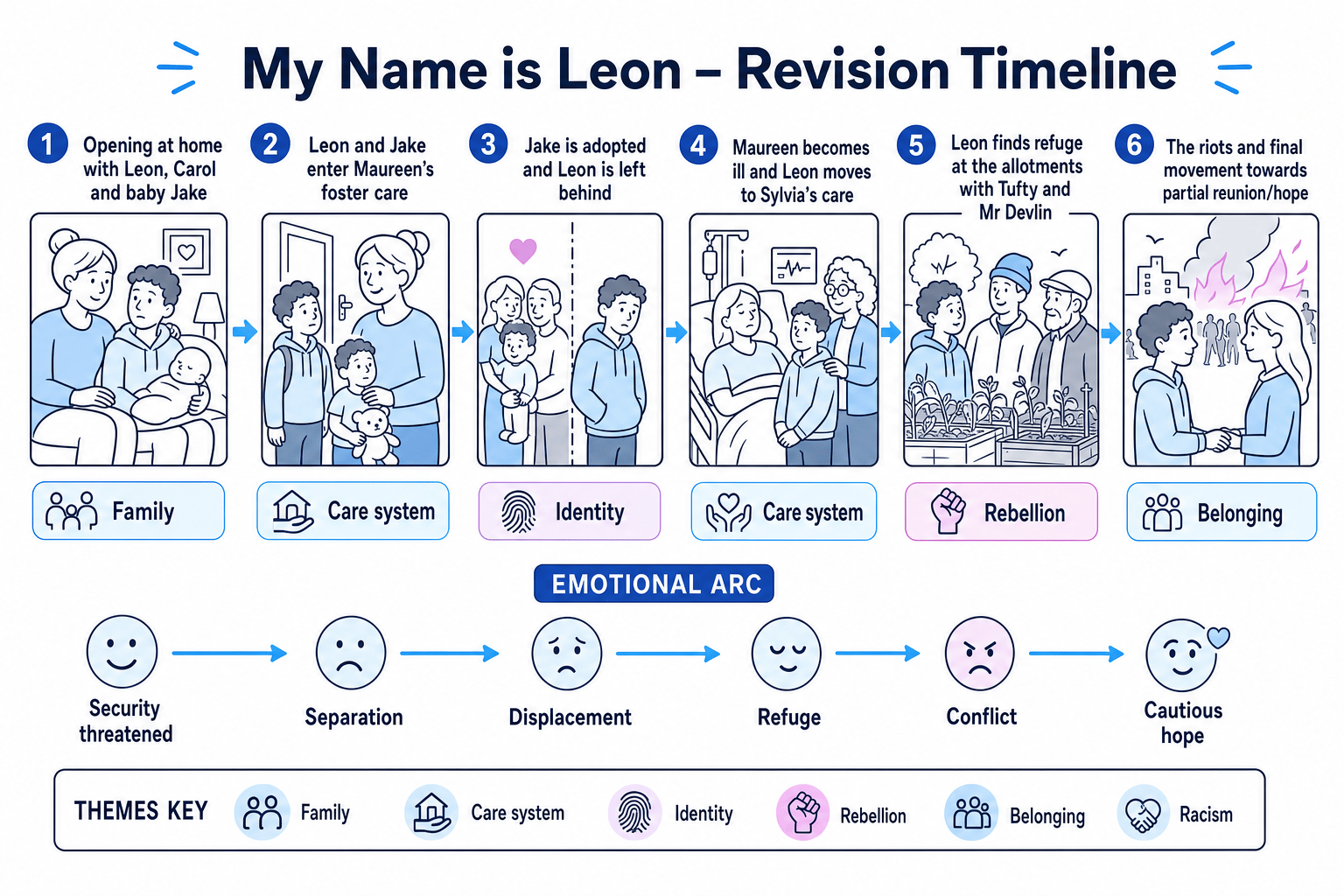
The opening chapters: Leon, Carol and Jake
The opening chapters establish Leon’s world: his mother Carol, his baby brother Jake, and the fragile home life around them. Leon’s love for Jake is immediate and intense, so the reader understands why Jake’s removal later feels so devastating.
The title, My Name is Leon, is important evidence in itself. It sounds simple, but it insists that Leon has an identity of his own. This matters because the care system often treats him as a “case” to be managed rather than as a child with feelings, memories and loyalties.
Focalisation
Focalisation means the viewpoint through which the reader experiences the story. In My Name is Leon, de Waal often uses close third-person focalisation: the narration says “Leon”, but events are filtered through his child’s understanding.
The opening chapters also introduce a painful contrast between Leon and Jake. Jake is a baby, white, and more easily placed for adoption. Leon is older, mixed-race, and harder for adults to “fit” into their systems. That contrast becomes one of the novel’s central injustices.
Opening function
The opening chapters make Jake emotionally irreplaceable to Leon, so the later separation is not just a plot event — it becomes the wound that drives much of Leon’s behaviour.
The move into Maureen’s care
Leon and Jake’s move into Maureen’s foster home is one of the first major turning points. A foster carer is an adult approved to look after a child temporarily when that child cannot safely live with their birth family.
Maureen’s home offers warmth, food and routine. However, it is also temporary. This creates tension: Leon experiences safety, but the reader knows that safety can be removed by adult decisions.
De Waal often uses dramatic irony here. Dramatic irony is when the reader understands more than a character does. Leon notices adult conversations, silences and changes of mood, but he does not always understand their full meaning. The reader can sense that decisions are being made about him and Jake before Leon fully grasps what is happening.
Useful exam angle
When writing about Maureen’s chapters, avoid saying simply “Maureen is kind”. Instead, explain how her kindness exposes what Leon has lacked: stability, attention and dependable adult care.
Jake’s adoption: the central separation
Jake’s adoption is one of the most important chapter moments in the whole novel. It is the emotional centre of Leon’s story because it separates the two brothers and confirms Leon’s fear that adults cannot be trusted to keep families together.
Structure
Structure means how a writer organises a text: the order of events, turning points, contrasts, beginnings and endings.
Structurally, Jake’s adoption changes Leon’s goal. Before this, Leon is mainly trying to protect Jake. After this, Leon becomes fixated on finding him and getting him back. The plot becomes shaped by absence: Jake is not physically present for much of the novel, but he remains emotionally present in Leon’s thoughts.
This chapter moment also links private grief to social inequality. Jake is separated from Leon partly because the adults see the brothers differently: Jake is a white baby who is easier to adopt, while Leon is an older mixed-race child. De Waal uses the brothers’ separation to criticise a system that claims to protect children but can still reproduce racial and social prejudice.
Only blaming one adult
Do not reduce Jake’s adoption to “one cruel person’s decision”. A stronger answer shows how de Waal presents a whole system of adult power: social workers, adoption processes, racial assumptions and Leon’s lack of control.
Worked example: using Jake’s adoption in an essay about family
Building an argument from the adoption chapter
-
Choose the chapter moment because it creates a family rupture. Jake’s adoption breaks the sibling bond that Leon has built his identity around, so it is directly relevant to any question about family, love or loss.
-
Connect the moment to de Waal’s method. The close focalisation means the reader experiences the adoption through Leon’s confusion and anger, not through official adult explanations. This makes the system feel emotionally harsh.
-
Link the personal event to a wider theme. Jake’s adoption is not only sad because Leon loses his brother; it also exposes inequality, because Jake’s whiteness and babyhood make him more “adoptable” than Leon.
-
Shape it into an analytical point. You could argue: de Waal presents family as something emotionally real but socially fragile, because Leon’s love for Jake cannot protect them from adult institutions.
Maureen’s illness and Sylvia’s care
Maureen’s illness creates another destabilising chapter moment. Just when Leon has begun to rely on Maureen, she becomes unavailable. This repeats a pattern in Leon’s life: every time he starts to feel settled, his living situation changes again.
This is an example of a cyclical structure. A cyclical structure is when similar events or patterns repeat. Leon repeatedly experiences attachment followed by loss or disruption.
Sylvia’s care complicates the novel’s view of family. She is not Leon’s birth mother, and she is not the same kind of comforting figure as Maureen, but she still becomes part of Leon’s network of care. De Waal suggests that family can be made through responsibility and loyalty, not only through biology.
Repeated displacement
The repeated moves in Leon’s life help the reader understand his anger. His behaviour is not presented as random “badness”; it is a response to instability, grief and powerlessness.
The allotment chapters: refuge and alternative family
The allotment chapters are essential because they widen the novel beyond Leon’s home and foster placements. An allotment is a small piece of land rented for growing fruit, vegetables or flowers. In the novel, the allotments become a place where Leon can escape adult control and meet people outside the official care system.
The allotment works as a symbol. A symbol is an object, place or action that represents a larger idea. The allotment suggests growth, patience, repair and belonging. Leon cannot immediately fix his family, but in the allotment world he sees people tending, planting and rebuilding.
Tufty and Mr Devlin also expose Leon to wider political realities. Through them, the novel connects Leon’s personal anger to racism, policing, poverty and protest in 1980s Britain. This matters because Leon’s story is not isolated: de Waal places one child’s pain inside a society marked by racial tension and inequality.
How the allotment chapters help with themes
| Theme | Why the allotment chapters matter |
|---|---|
| Belonging | Leon finds a space where he is noticed and valued. |
| Identity | He encounters Black male influence and political awareness through Tufty. |
| Anger | His private anger begins to connect with public injustice. |
| Healing | The natural setting suggests slow growth rather than instant solutions. |
Symbolism
Symbolism is when a writer uses a person, place or object to represent a bigger idea. The allotment symbolises refuge and the possibility of growth after damage.
The riot chapters: private anger meets public conflict
The riot chapters are another major structural climax. A climax is the most intense point of conflict in a story. In these chapters, the violence and tension in the wider community mirror Leon’s inner turmoil.
De Waal sets Leon’s personal crisis against the background of racial unrest in 1980s Britain. This is where context becomes especially useful. You do not need to write a history essay, but you should understand that the novel reflects a period of distrust between Black communities and the police, as well as unemployment, poverty and racism.
The riot chapters are powerful because Leon is still a child. He is drawn towards adult anger and political conflict, but he does not fully understand the danger. This keeps the reader emotionally close to him while also showing the frightening scale of the world around him.
Context without bolting it on
Link context to Leon’s experience. Instead of writing, “There were riots in the 1980s,” write that de Waal uses the riots to show how Leon’s personal feelings of injustice belong to a wider society shaped by racism and inequality.
The ending: partial resolution, not a fairy-tale
The ending of My Name is Leon offers hope, but not a simple happy ending. A resolution is the part of a narrative where major conflicts are settled or partly settled. In this novel, the resolution is deliberately partial: Leon gains some emotional repair, but the damage of separation has not disappeared.
This is important for exam answers because it stops you making the novel sound too neat. De Waal does not suggest that love magically fixes social injustice. Instead, she shows that care, honesty and connection can help Leon survive what has happened to him.
The ending also returns us to the importance of Leon’s name and identity. He is not only Jake’s brother, Carol’s son, or a child in care. He is Leon: a child with his own voice, memory and worth.
How to revise key chapters efficiently
A strong GCSE answer usually does three things with a chapter:
- It identifies what changes in the story.
- It explains how de Waal presents that change.
- It links the chapter to a bigger theme or context.
For example, if the question is about identity, the opening, Jake’s adoption and the allotment chapters are all useful. If the question is about family, choose the opening, Maureen’s care and Jake’s adoption. If the question is about injustice, choose Jake’s adoption and the riot chapters.
Best revision habit
Revise each key chapter as an argument, not a summary. Ask: “What does this moment prove about Leon, family, care, race or belonging?”
Quick key chapter map
| Chapter moment | Main function | Best themes |
|---|---|---|
| Opening with Carol and Jake | Establishes Leon’s love for Jake and his fragile home life | Family, childhood, identity |
| Move to Maureen’s foster care | Shows temporary safety and adult control | Care, stability, trust |
| Jake’s adoption | Creates the central wound of separation | Family, racism, injustice |
| Maureen’s illness / Sylvia’s care | Repeats Leon’s displacement but widens his care network | Loss, resilience, alternative family |
| Allotment chapters | Gives Leon refuge and political awareness | Belonging, growth, identity |
| Riot chapters and ending | Connects private anger to public conflict; offers cautious hope | Racism, protest, healing |
In the exam
-
Choose two or three key chapter moments that match the question, rather than trying to cover the whole novel.
-
For each moment, move from event to method: explain how de Waal uses focalisation, structure, symbolism or contrast to shape the reader’s response.
-
Keep linking back to Leon’s experience. The strongest answers show how the novel makes big social issues feel personal through one child’s point of view.
Check yourself
-
Which chapter moment best shows Leon’s loss of control over his own family life?
-
How do the allotment chapters change the way we understand Leon’s anger?
-
Why is the ending hopeful but not completely resolved?
