Kit de Waal’s My Name is Leon is a deeply moving novel written from the perspective of a nine-year-old boy navigating the British foster care system in the early 1980s. Because the GCSE English Literature exam is closed-book, you do not need to memorise vast chunks of text. Instead, you need a bank of short, high-yield quotes that can be adapted to answer questions on characters, themes, or social context.
What you'll learn
- How to select and memorise short, versatile quotations from My Name is Leon.
- How to analyse Kit de Waal’s use of language, structure, and perspective (AO2).
- How to link key quotes to the socio-historical context of 1980s Britain (AO3).
The Art of the 'High-Yield' Quote
To achieve top marks, you need to be strategic. A "high-yield" quote is short (often fewer than six words), easy to remember, and packed with literary devices or thematic significance. This means a single quote can be used in an essay about Leon's character, an essay about the theme of family, or an essay exploring systemic racism.
Third-Person Limited Narrative
A narrative style where the story is told in the third person ("he", "she", "they"), but the narrator’s perspective is strictly limited to the thoughts, feelings, and sensory experiences of a single character—in this case, Leon.
Because Kit de Waal uses a third-person limited narrative, the language of the novel often mirrors the simplicity, vulnerability, and confusion of a nine-year-old child. Analyzing this voice is key to your AO2 marks.
Theme 1: Brotherhood, Neglect, and Responsibility
The bond between Leon and his baby brother, Jake, is the emotional anchor of the novel. Leon’s sense of duty towards Jake highlights both his profound capacity for love and the tragic failure of the adults around him.
"Leon’s got a key."
This recurring phrase refers to the physical latchkey Leon wears around his neck.
- The Method: Symbolism and short syntax.
- The Analysis: The key is a physical symbol of neglect and premature independence. In 1980s Britain, "latchkey kids" were common, but for a nine-year-old, it highlights Carol’s maternal absence and postpartum depression. Structurally, the third-person limited voice ("Leon's got a key") sounds like a badge of pride to a child, but to the reader, it evokes dramatic irony and deep pathos. Leon views the key as a sign of maturity, while the reader recognises it as a symptom of parental abandonment.
"He is my brother. My baby brother."
Leon repeats this sentiment throughout the opening chapters, establishing his protective instinct.
- The Method: Repetition and possessive pronoun ("my").
- The Analysis: The repetition of "brother" coupled with the possessive pronoun "my" highlights Leon’s fierce sense of ownership and responsibility. The adjective "baby" emphasises Jake’s vulnerability and Leon's self-appointed role as protector. This quote is crucial for tracing Leon's emotional decline when the social care system separates them.
Theme 2: Race, Identity, and the Care System
Set against the backdrop of the 1981 Brixton and Handsworth riots, the novel explores how race affects identity and the treatment of children within the British state.
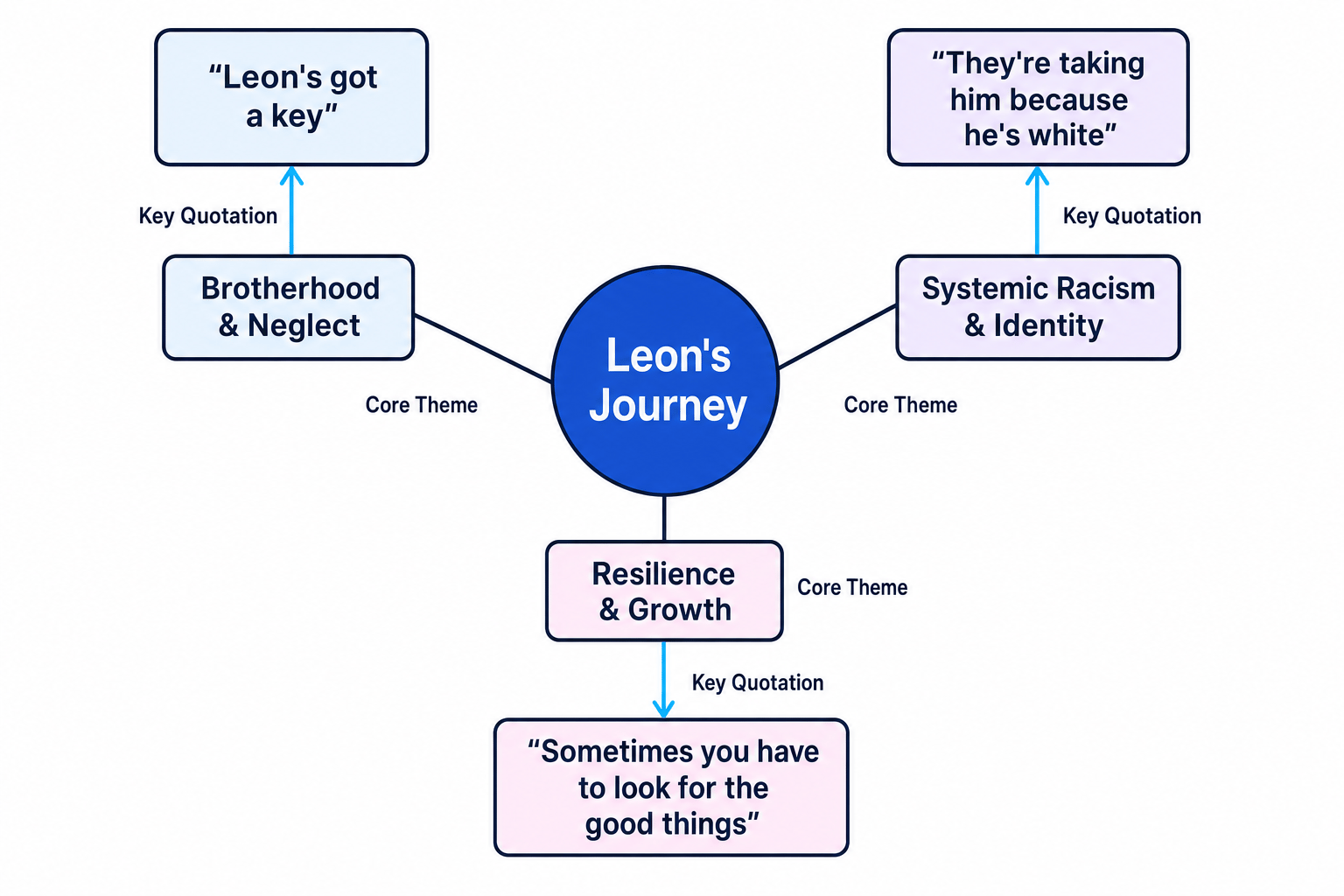
"They’re taking him because he’s white."
Leon comes to this stark conclusion when Jake is placed for adoption while Leon is left in foster care.
- The Method: Direct, monosyllabic phrasing.
- The Analysis: The devastating simplicity of this sentence reflects how quickly Leon internalises the racial dynamics of his society. In the 1980s, transracial adoption policies meant that white babies like Jake were highly sought after, whereas mixed-race older boys like Leon faced systemic barriers to adoption. De Waal uses this moment to show the loss of innocence; Leon's childhood is shattered not just by family separation, but by a sudden, painful awareness of racial prejudice.
"He was a mixed-up boy. Brown and white and blue and green."
This quote describes Leon’s internal conflict and his physical appearance.
- The Method: Polysyndeton (repeating "and") and colour imagery.
- The Analysis: The polysyndeton creates a listing effect that mirrors Leon's overwhelmed mental state. The juxtaposition of "brown and white" (his mixed-race heritage) with "blue and green" (representing his blue eyes, his clothes, or his bruises) symbolises his fragmented identity. He doesn't fit neatly into the binary racial categorisations of 1980s Britain, leaving him feeling physically and emotionally "mixed-up".
The Power of Child-Like Language
When analyzing de Waal's language, always note the contrast between the simplicity of Leon's words and the gravity of the adult situations he is describing. The tension between the child's perspective and the reader's adult understanding is where the emotional power of the novel lies.
Theme 3: Resilience, Growth, and Community
Despite his trauma, Leon finds sanctuary at the allotment with Tufty, Silvia, and Mr. Devlin. These characters provide him with a surrogate family and the tools to heal.
"Sometimes you have to look for the good things."
Tufty offers this piece of advice to Leon during a quiet moment at the allotment.
- The Method: Colloquial aphorism (a concise statement of a principle) and hopeful tone.
- The Analysis: Tufty, a black Caribbean man who has faced his own share of systemic struggle, acts as a mentor. This quote represents the theme of resilience. It teaches Leon that while he cannot control his external circumstances (the care system, his mother’s illness), he can control where he focuses his attention. The allotment itself becomes a physical manifestation of this "good thing."
"You’ve got to water them, Leon... they’ll grow."
Mr. Devlin’s instructions on planting seeds carry double meanings.
- The Method: Extended metaphor.
- The Analysis: The seeds and plants on the allotment are a metaphor for Leon’s own emotional development. Just as the seeds require care, patience, and the right environment to flourish in harsh soil, Leon needs the love of his foster mother, Silvia, and his friends to heal from his trauma. The verb "grow" reinforces the novel’s genre as a Bildungsroman (a coming-of-age story).
Analyzing Leon's voice and the theme of neglect
Analyze how Kit de Waal uses the following quotation to present Leon’s relationship with his mother: "Leon knows how to make the baby stop crying."
-
Identify the literal meaning and narrative voice: Start by explaining what is happening on a literal level. The quote shows a nine-year-old child performing parental duties. The use of the third-person limited narrative ("Leon knows") presents this domestic burden as a normal, everyday fact of Leon's life, which alerts the reader to his premature maturity.
-
Examine specific language choices and grammatical structures: Analyze the verb phrase "knows how to" and the noun phrase "the baby." The verb "knows" implies that Leon has had to learn and practice parenting techniques through repetition and necessity, rather than relying on his mother, Carol. Referring to his brother as "the baby" rather than "Jake" at this point reflects a detached, almost professional duty that has been thrust upon him.
-
Connect to the wider theme and social context: Link your linguistic analysis to the themes of neglect and parental role-reversal (parentification). In the context of 1980s Britain, Carol's struggles with mental health and postpartum depression are left unsupported by social services until it is too late. Leon is forced to step into the maternal vacuum, making this quote a powerful indictment of both parental neglect and social systemic failure.
Feature Spotting
Do not simply list literary techniques (e.g., "De Waal uses a metaphor here") without explaining why she used it. The examiner wants to see how the method creates meaning. If you identify a metaphor, explain what it reveals about Leon's inner thoughts or his circumstances.
Shorten Your Quotes
In the exam, instead of writing: "Leon says, 'He is my brother. My baby brother and I have to look after him,'"’ shorten it to the absolute essentials: Leon's fierce devotion is evident through his possession of his "baby brother". This makes your writing tighter and easier to integrate.
In the exam
- Choose your quotes wisely: Before you start writing, spend two minutes planning. Pick 3–4 short quotes that directly address the prompt and can be linked to both language features (AO2) and social context (AO3).
- Embed your quotes seamlessly: Never write: "A quote that shows this is..." Instead, weave the quote into your own sentence. For example: Leon’s childhood is dominated by premature responsibility, symbolised by the fact that he wears a "key on a piece of string around his neck."
- Explode the quote: Spend time digging into individual words. If you quote "mixed-up boy," analyze the adjective "mixed-up" to discuss racial confusion, emotional trauma, and structural instability.
- Link back to the writer's purpose: Always ask yourself: Why did Kit de Waal write this? She wrote the novel to give a voice to marginalized children in the care system and to expose the historical flaws of 1980s British social policy.
Check yourself
- Can you explain the symbolic significance of the "key" around Leon's neck?
- How does the quotation "They're taking him because he's white" reflect the social context of 1980s Britain?
- Why is the allotment (and the quotes associated with it) considered an extended metaphor for Leon's emotional growth?
