In your AQA GCSE English Literature exam, you will be assessed on your ability to analyse the structure of Jane Austen’s Pride and Prejudice (AO2) and link it to the contexts of Regency society (AO3). Rather than trying to memorise the entire novel, you should focus on a selection of critical chapters that act as structural turning points.
What you'll learn:
- How Jane Austen structured her novel using the traditional three-volume "triple-decker" format.
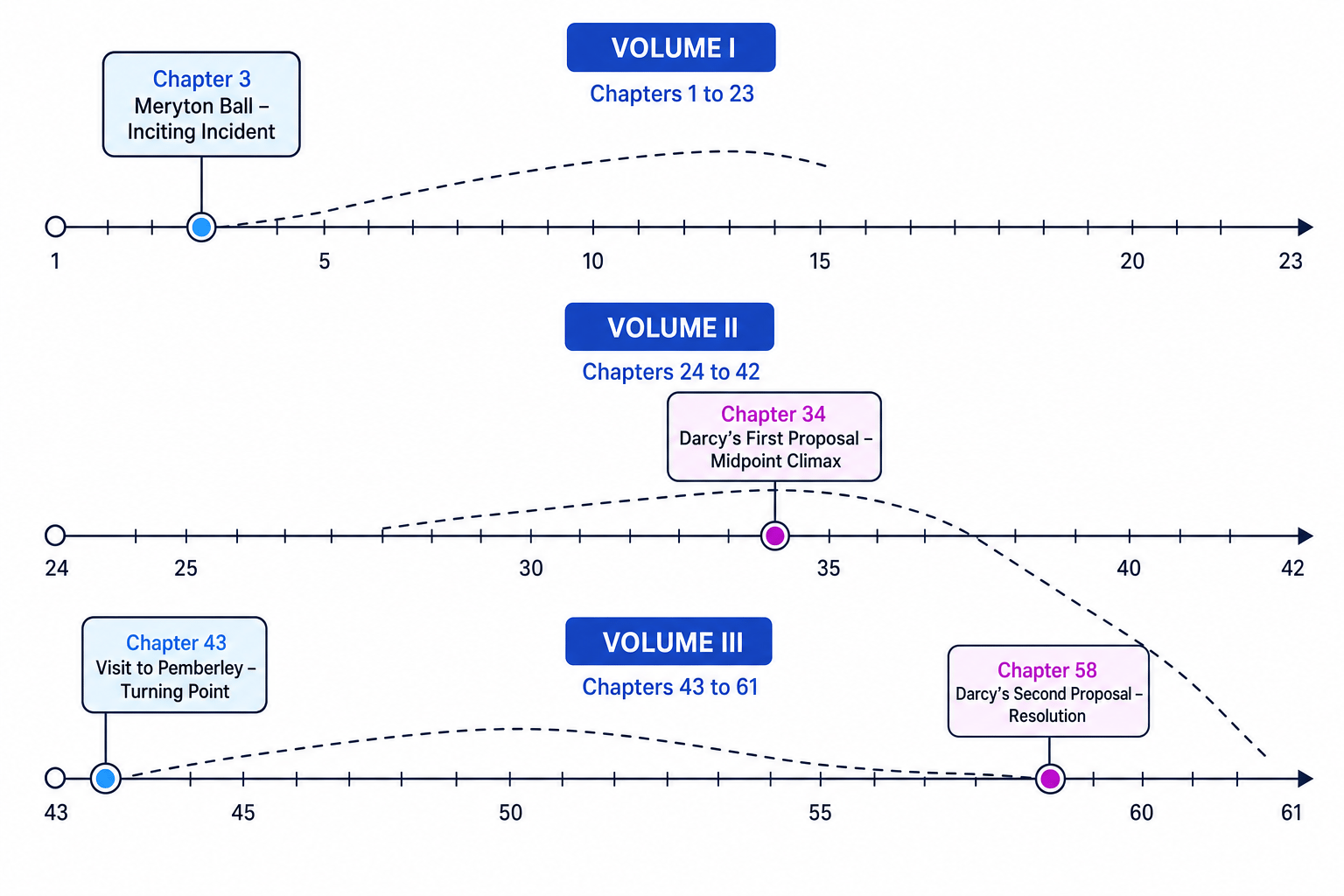
- The thematic and structural significance of four pivotal chapters: Chapter 3, Chapter 34, Chapter 43, and Chapter 58.
- How to write high-scoring analysis by linking structural shifts to Austen's language and historical context.
The Structural Architecture of Pride and Prejudice
Before diving into individual chapters, you must understand how the novel is put together. Pride and Prejudice was originally published in 1813 as a triple-decker novel—a common nineteenth-century publishing format where a book was split into three physical volumes.
Triple-Decker Novel
A 19th-century novel published in three separate physical volumes. Authors structured their plots around these volume divisions, creating suspense and mini-climaxes at the end of each volume to keep readers hooked.
Austen uses this three-part structure to mirror the emotional and psychological growth of Elizabeth Bennet and Fitzwilliam Darcy. The diagram below illustrates how the narrative arc rises, turns, and resolves across these volume boundaries:
Structure Reflects Theme
The novel’s structure is symmetrical. Volume I establishes the conflict (pride vs. prejudice), Volume II brings this conflict to a head (the failed proposal), and Volume III resolves it through mutual self-discovery and transformation.
Chapter 3: The Meryton Ball (Volume I)
What Happens
This chapter introduces the local assembly room at Meryton, where the Bennet family first meets Bingley and his snobbish friend, Mr Darcy. When Bingley suggests Darcy dance with Elizabeth, Darcy famously refuses:
"She is tolerable; but not handsome enough to tempt me; and I am in no humour at present to give consequence to young ladies who are slighted by other men."
Why It Is Structurally Crucial
This is the inciting incident of the novel's main plot. Darcy’s refusal is a public insult to Elizabeth’s appearance and social standing, wounding her pride and instantly sparking her prejudice against him. Conversely, Darcy's haughty dismissiveness establishes his pride in the eyes of the Hertfordshire community.
Key Literary Techniques to Analyse
- Social Satire: Austen uses the assembly room setting to mock the rigid social hierarchies of the Regency era. The provincial characters observe Darcy’s "fine, tall person, handsome features, noble mien" and his ten thousand pounds a year, but quickly declare him "proud, to be above his company" when his behavior does not match their expectations of politeness.
- Dialogue vs. Free Indirect Discourse: Austen relies on sharp dialogue to show how quickly reputations are cemented in small communities.
Contextual Link: The Ball as a Marriage Market
In the Regency era, balls were not merely social gatherings; they were highly transactional "marriage markets" where young women had to display their accomplishments to secure financial stability. Darcy's refusal to dance with Elizabeth is not just rude—it is a public devaluation of her "market worth" in front of her peers.
Chapter 34: Darcy's First Proposal (Volume II Climax)
What Happens
While Elizabeth is staying at Hunsford (the home of Mr Collins and Charlotte Lucas), Darcy unexpectedly visits her and confesses his love. However, his proposal is disastrously offensive:
"In vain have I struggled. It will not do. My feelings will not be repressed. You must allow me to tell you how ardently I admire and love you."
He immediately follows this declaration by detailing the obstacles his love has had to overcome, specifically highlighting the "inferiority" of her family and their social degradation.
Why It Is Structurally Crucial
This is the climax of the first half of the novel. It represents the direct collision of Darcy's social pride and Elizabeth's personal prejudice. Elizabeth fiercely rejects him, accusing him of ruining her sister Jane's happiness with Bingley and destroying the life of Mr Wickham.
Key Literary Techniques to Analyse
- Juxtaposition: Austen contrasts Darcy's internal emotional conflict (his "struggle" between his aristocratic pride and his passion for Elizabeth) with Elizabeth's mounting moral outrage.
- Syntactic Structure: Notice how Darcy’s speech is broken, featuring short, breathless sentences ("It will not do. My feelings will not be repressed."). This indicates his loss of cool, rational control, highlighting how deeply Elizabeth has disrupted his aristocratic composure.
Missing the Irony of 'In Vain'
Do not assume Darcy is being romantic here. His opening line, "In vain have I struggled," reveals that he has actively tried not to love Elizabeth because he considers her family socially inferior. Elizabeth objects to this "studious avoidability" of politeness, which makes his proposal insulting.
Chapter 43: The Visit to Pemberley (Volume III Turning Point)
What Happens
Elizabeth, travelling with her aunt and uncle Gardiner, visits Darcy's estate, Pemberley, believing him to be away. She is awed by the beauty of the grounds and is deeply moved by the glowing praise of Darcy's housekeeper, Mrs Reynolds, who describes him as the "best landlord, and the best master." Unexpectedly, Darcy arrives early, behaving with perfect politeness and respect toward Elizabeth and her middle-class relations.
Why It Is Structurally Crucial
This is the anagnorisis—the moment of recognition or turning point of the novel. Elizabeth’s prejudice begins to dissolve as she sees the physical manifestation of Darcy's character and hears him praised by those who know him best.
Key Literary Techniques to Analyse
- Setting as Symbolism: Pemberley is a physical symbol of Darcy himself:
"...it was a large, handsome, stone building, standing well on rising ground... and with less of formal decoration. Elizabeth was delighted. She had never seen a place where nature had done more, or where natural beauty had been so little counteracted by an awkward taste." The estate is "handsome" but "neither gaudy nor uselessly fine," representing Darcy’s genuine, unpretentious nobility, as opposed to Lady Catherine’s ostentatious, overbearing estate, Rosings.
- Narrative Perspective: Austen uses Elizabeth's shifting gaze to map her shifting heart. Her appreciation of the estate directly corresponds to her growing appreciation of its master.
Chapter 58: Darcy's Second Proposal (Volume III Resolution)
What Happens
After Darcy has secretly saved the Bennet family's reputation by forcing Wickham to marry Lydia, he and Elizabeth walk out together. Darcy proposes a second time, but this time his tone is humble and self-aware. Elizabeth happily accepts.
"If your feelings are still what they were in last April, tell me so at once. My affections and wishes are unchanged, but one word from you will silence me on this subject for ever."
Why It Is Structurally Crucial
This is the resolution of the novel. The symmetrical structure is completed: the pride and prejudice that drove them apart in Volume I and clashed in Volume II are fully resolved here through mutual growth.
Key Literary Techniques to Analyse
- Contrasting Parallelism: Contrast Darcy's second proposal with his first in Chapter 34. Here, there are no mentions of "inferiority" or "struggle." Instead, he displays humility and respect, granting Elizabeth total agency ("one word from you will silence me").
- Free Indirect Discourse: Austen uses this technique to show how both characters have educated each other. Darcy has learned to value Elizabeth's wit and moral integrity over aristocratic status, while Elizabeth has learned to look past first impressions and value Darcy's genuine benevolence.
Analysing Darcy's First Proposal
Read the following extract from Chapter 34 and explain how Austen uses language to present Darcy's attitude towards Elizabeth:
"He spoke of apprehension and anxiety, but his countenance expressed real security. Such a circumstance could not minister to favour of his suit. He took no pains to conceal his pride, but spoke of his apprehension of her inferior connection, of its being a degradation... in a manner which, though it showed the strength of his passion, was not more likely to recommend him."
Step 1: Identify the focus of the question and select key evidence.
The question asks about Darcy's attitude towards Elizabeth. The extract highlights his "real security" (he expects her to say yes), his "pride," and his view of her family as an "inferior connection" and "degradation."
Step 2: Analyse the writer's methods, focusing on key terminology.
Austen uses third-person narrative with free indirect discourse, aligning the reader with Elizabeth’s critical perspective. The noun "security" reveals Darcy's class-based arrogance; as a wealthy aristocrat, he cannot conceive that a socially inferior woman would reject him. The abstract nouns "pride" and "degradation" represent Darcy’s internalised class prejudice, showing that he views loving Elizabeth as a moral and social descent.
Step 3: Link the analysis to the wider themes of the novel and its historical context.
In Regency England, marriage was a financial contract. Darcy’s focus on "inferior connection" reflects the rigid class structure where marrying beneath oneself was viewed as a literal "degradation" of family status. However, Austen satirises this perspective by showing that Darcy’s failure to "conceal his pride" is what ultimately dooms his proposal, highlighting that true nobility is defined by character, not class.
In the exam
- Trace the structural journey: When writing about any character or theme (e.g., love, marriage, class), structure your essay chronologically across the key chapters. Show how an idea starts in Chapter 3, reaches a crisis in Chapter 34, and resolves in Chapter 58.
- Analyse structural devices: Don't just comment on the plot. Use terms like inciting incident, midpoint climax, turning point, symmetry, and parallelism to secure top marks for structural analysis (AO2).
- Connect settings to character states: Use Chapter 43 to show how Austen uses physical settings (like Pemberley) to reflect the psychological and moral condition of her characters.
Check yourself
- Why is the physical division of Pride and Prejudice into three volumes important to how we read the novel today?
- How does the setting of Chapter 43 (Pemberley) act as an indirect characterisation of Mr Darcy?
- Contrast Darcy’s use of language in his first proposal (Chapter 34) with his second proposal (Chapter 58). How does his syntax show his personal growth?
