What you'll learn
- How to choose short, flexible quotations for the closed-book anthology exam.
- A core quote bank for all 15 Power and Conflict poems.
- How to turn a quotation into analysis of method, meaning and comparison.
- Common mistakes to avoid when revising and using quotes.
Why a quote bank matters
In the AQA poetry anthology question, you will be given one printed poem and asked to compare it with one other poem from memory. That means your quote bank is mainly for the poem you choose yourself.
You do not need to memorise whole poems. You need short, accurate fragments that you can use flexibly for different questions about power, conflict, identity, memory, nature, war, oppression and loss.
Quotation bank
A quotation bank is a small set of carefully chosen quotations that you can remember, analyse and compare in the exam. The best quotes are short, accurate and rich in meaning.
A good quote bank is not just a list. For each quote, you should know: what it shows, how the writer presents it, and which other poems it links to.
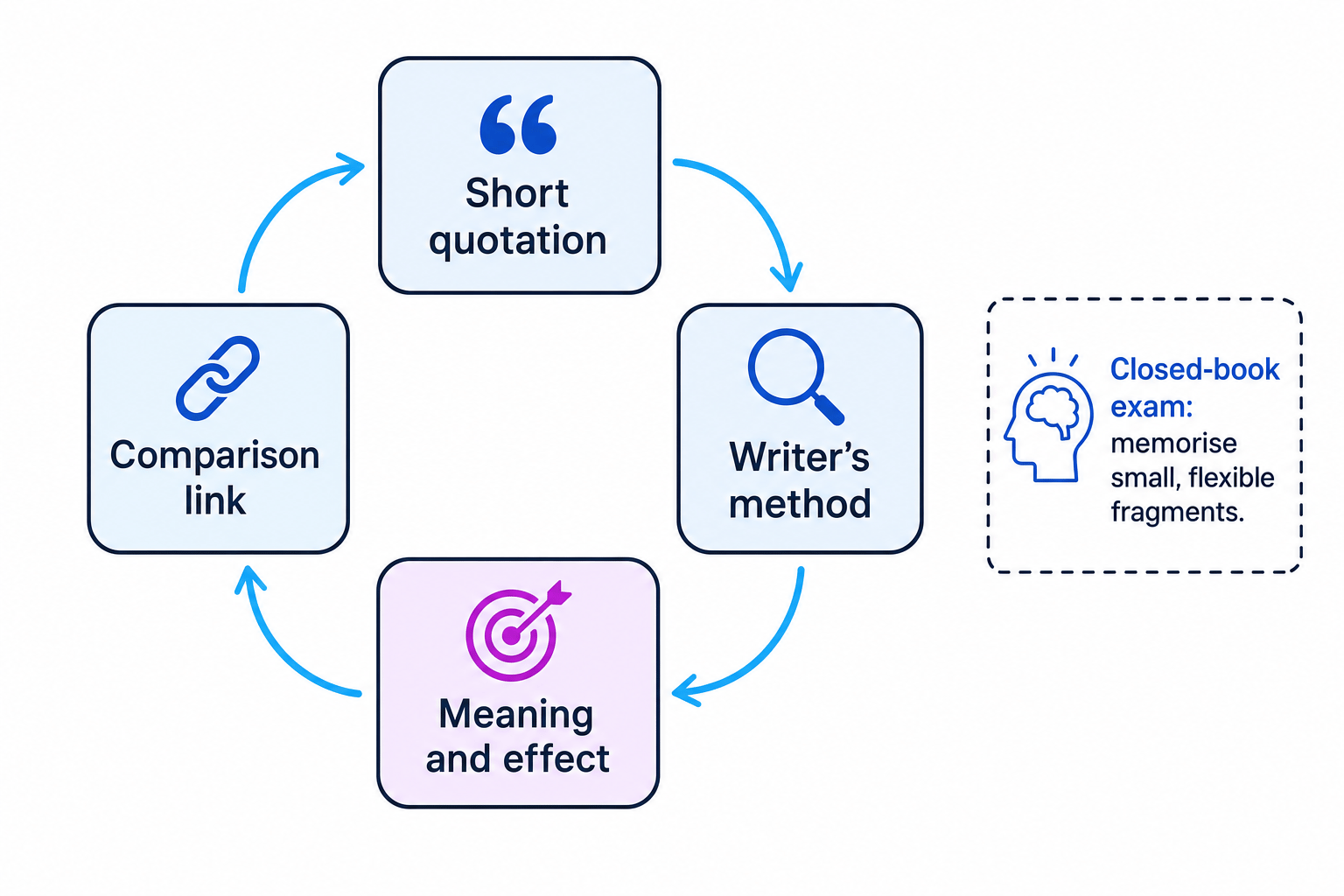
The basic technique: quote → method → effect → link
Method
A method is a deliberate choice made by the poet, such as metaphor, simile, personification, repetition, form, structure, speaker, rhythm or imagery. You should name the method only when you can explain its effect.
The strongest answers do not “feature spot”. Instead of writing, “This is a metaphor,” you explain what the metaphor suggests.
Memorise fragments, not speeches
For closed-book poetry, a tiny quote such as “mind-forg’d manacles” is often more useful than a long line because you can remember it accurately and analyse individual words closely.
Turning a quote into analysis
Use Blake’s phrase “mind-forg’d manacles” from London.
- The noun “manacles” suggests chains, imprisonment and physical restriction, so Blake presents people as trapped.
- The adjective “mind-forg’d” makes the oppression psychological as well as physical: the people have partly internalised the systems that control them.
- This links to power because Blake criticises institutions that limit ordinary people, and it can compare with Agard’s Checking Out Me History, where education also controls identity by “blind[ing]” the speaker.
Core quote bank: one essential quote per poem
Use this table as your minimum revision set. If you learn one secure quote for each poem, you will always have something to write about.
| Poem | Short key quote | Method and effect | Useful links |
|---|---|---|---|
| Ozymandias | “Look on my Works, ye Mighty, and despair!” | Imperative and irony: the ruler commands awe, but his power has collapsed. | Power, pride, time, nature |
| London | “mind-forg’d manacles” | Metaphor: oppression is mental as well as social. | Oppression, conflict, identity |
| Extract from The Prelude | “a huge peak, black and huge” | Repetition and visual imagery: nature becomes overwhelming and sublime. | Nature’s power, fear |
| My Last Duchess | “I gave commands; / Then all smiles stopped together” | Euphemism and caesura: the Duke calmly hints at murder. | Power, control, patriarchy |
| The Charge of the Light Brigade | “Theirs not to reason why” | Repetition: soldiers are obedient, even when leaders are wrong. | War, duty, authority |
| Exposure | “But nothing happens” | Refrain: war is shown as waiting, suffering and futility. | War, nature, trauma |
| Storm on the Island | “It is a huge nothing that we fear” | Paradox: the invisible storm creates real terror. | Nature, fear, conflict |
| Bayonet Charge | “King, honour, human dignity, etcetera” | Listing and dismissive ending: patriotic ideals become meaningless in battle. | War, fear, propaganda |
| Remains | “probably armed, possibly not” | Modal verbs: uncertainty creates guilt and trauma. | War, memory, guilt |
| Poppies | “released a song bird from its cage” | Metaphor: the mother lets her son go, mixing love with loss. | Memory, family, conflict |
| War Photographer | “spools of suffering” | Sibilance and metaphor: suffering is processed into photographs. | War, media, memory |
| Tissue | “Paper that lets the light / shine through” | Symbolism: paper represents fragile human power. | Power, identity, fragility |
| The Émigrée | “I am branded by an impression of sunlight” | Metaphor: memory permanently marks the speaker. | Identity, place, memory |
| Checking Out Me History | “Bandage up me eye with me own history” | Metaphor: colonial education blinds the speaker to identity. | Identity, power, oppression |
| Kamikaze | “a one-way / journey into history” | Enjambment and metaphor: duty pushes the pilot towards death and legend. | Conflict, honour, shame |
Learning quotes without methods
Do not revise a quote by itself. If you cannot say what the poet is doing with language, form or structure, the quotation will not help you much in the exam.
Extra powerful quotes by theme
Once the core bank is secure, add a few extra fragments. These help you adapt to different question wordings.
Power and pride
- Ozymandias: “sneer of cold command” — the ruler’s facial expression reveals arrogance and cruelty.
- My Last Duchess: “my gift of a nine-hundred-years-old name” — the Duke treats status as a form of ownership.
- Tissue: “turned into your skin” — human life is more important than paper records or political power.
War and conflict
- The Charge of the Light Brigade: “Into the valley of Death” — biblical allusion makes the battle seem heroic but doomed.
- Exposure: “merciless iced east winds that knife us” — personification makes nature seem like the true enemy.
- Bayonet Charge: “His terror’s touchy dynamite” — metaphor shows fear as explosive and uncontrollable.
- Remains: “his bloody life in my bloody hands” — allusion to guilt makes trauma feel inescapable.
Memory, trauma and loss
- War Photographer: “A hundred agonies in black-and-white” — the plural noun “agonies” compresses many people’s suffering into photographs.
- Poppies: “your playground voice catching on the wind” — auditory imagery shows the mother searching memory for her son.
- The Émigrée: “There once was a country…” — fairy-tale phrasing makes memory feel idealised and distant.
- Remains: “the drink and the drugs won’t flush him out” — the soldier cannot escape traumatic memory.
Identity and voice
- Checking Out Me History: “I carving out me identity” — the active verb “carving” shows the speaker creating his own sense of self.
- The Émigrée: “My city takes me dancing” — personification presents the city as emotionally alive in memory.
- Kamikaze: “they treated him / as though he no longer existed” — social rejection becomes a kind of living death.
Nature’s power
- The Prelude: “like a living thing, / Strode after me” — simile and personification make the mountain seem powerful and threatening.
- Storm on the Island: “spits like a tame cat / Turned savage” — simile shows nature changing from familiar to violent.
- Exposure: “All their eyes are ice” — metaphor shows nature physically and emotionally freezing the soldiers.
Flexible comparison pairs
Try learning pairs rather than isolated poems: Ozymandias with My Last Duchess for power; Exposure with Storm on the Island for nature; Remains with War Photographer for trauma; Checking Out Me History with The Émigrée for identity.
How to embed quotations smoothly
Embedded quotation
An embedded quotation is a short quotation fitted naturally into your own sentence, rather than dropped in as a separate sentence.
Weak: Blake uses the quote “mind-forg’d manacles.” This shows power.
Stronger: Blake’s metaphor “mind-forg’d manacles” suggests that oppression has become internalised, as if the people of London are mentally chained.
The stronger version does three things at once: it names the poet, identifies the method and explains the meaning.
Building a comparison from two quotes
Compare power in Ozymandias and My Last Duchess.
- In Ozymandias, the command “Look on my Works” shows a ruler trying to control how others see his legacy.
- Shelley makes this ironic because the statue is now a “colossal Wreck”, so time and nature have destroyed the ruler’s authority.
- In My Last Duchess, the Duke’s phrase “I gave commands” also presents power as controlling and dangerous, but Browning focuses on domestic and patriarchal control rather than political empire.
Accuracy matters
Because the exam is closed book, it is better to learn five words accurately than fifteen words vaguely. You can still get credit for close textual references, but precise quotation gives your analysis more authority.
Do not invent or modernise quotes
Avoid “near enough” versions. For example, Blake writes “mind-forg’d manacles”, not “mind-forged chains”. Changing the wording removes the poet’s method and weakens your analysis.
A quick revision method
Use a simple three-column page for each poem:
| Quote | Method | Use it for |
|---|---|---|
| “probably armed, possibly not” | Modal verbs, repetition of uncertainty | Guilt, trauma, moral conflict |
| “But nothing happens” | Refrain, circular structure | Futility, waiting, anti-war message |
| “I carving out me identity” | Active verb, non-standard dialect | Identity, resistance, voice |
Read the quote aloud, cover it, write it from memory, then add one sentence of analysis. That way, you are revising both memory and exam skill.
In the exam
- Choose your comparison poem because it fits the question, not just because it is your favourite.
- Use short embedded quotations and zoom in on one or two important words.
- Always connect method to meaning: explain how the poet presents power, conflict, identity, memory or suffering.
Check yourself
- Which three quotes could you use for a question about the power of nature?
- Can you explain the method and effect of “probably armed, possibly not” without looking?
- Which poem would you compare with Checking Out Me History for a question about identity?
