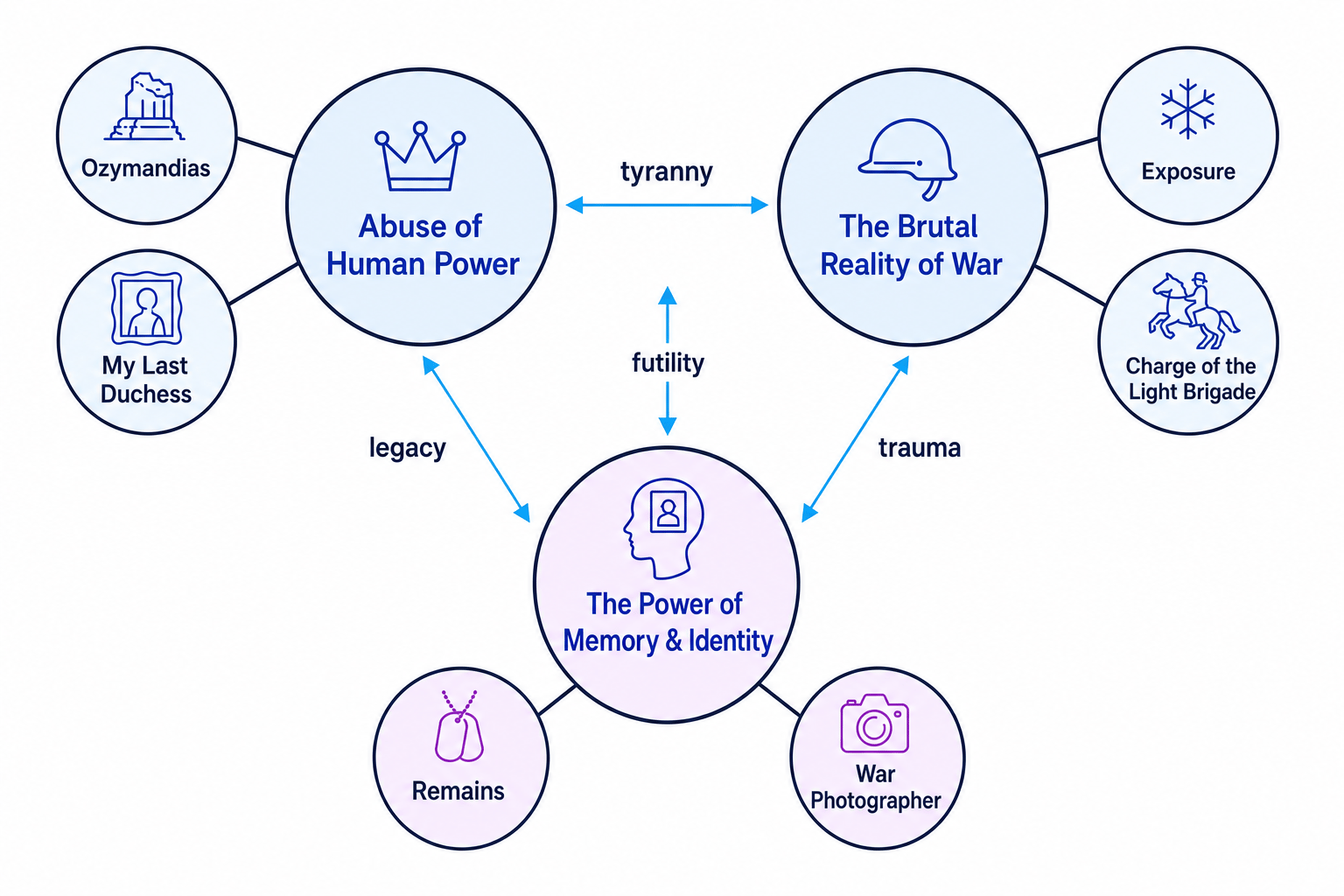
The Ultimate Pairing Hack
Never compare two poems that are identical in message. The examiner wants to see you explore nuance. The best comparisons look at two poems that share a broad theme (e.g., the effects of war) but differ in perspective, tone, or form (e.g., the direct, immediate trauma of battlefield action vs. the lingering, domestic aftermath of war).
Key Pairings by Theme
-
Abuse of Individual Power / Pride
- Ozymandias (Shelley) vs. My Last Duchess (Browning)
- The Connection: Both examine arrogant, dictatorial leaders who seek total control.
- The Contrast: Shelley shows that nature and time inevitably destroy human pride ("colossal wreck"), whereas Browning highlights how art and institutional power allow a tyrant to control his victim even after her death ("none puts by the curtain I have drawn but I").
-
The Grim Reality vs. Glorification of War
- Exposure (Owen) vs. The Charge of the Light Brigade (Tennyson)
- The Connection: Both portray soldiers in deadly combat situations.
- The Contrast: Owen exposes the monotonous, agonizing futility of war and the cruelty of the elements ("merciless iced east winds that knive us"), whereas Tennyson uses a structured, rhythmic dactylic dimeter to celebrate the courage and duty of the soldiers ("When can their glory fade?").
-
The Lasting Psychological Trauma of Conflict
- Remains (Armitage) vs. War Photographer (Duffy)
- The Connection: Both explore how witnessing violence leaves indelible mental scars.
- The Contrast: Armitage writes from the perspective of an active soldier suffering from PTSD in a chaotic, colloquial voice ("his bloody life in my bloody hands"), while Duffy presents an objective, isolated observer in a highly structured, clinical environment trying to process his emotions through his craft ("ordered rows").
Structuring Your Comparison
To write a cohesive essay, you must avoid the "handover" method—where you write half your essay on Poem A and the second half on Poem B. Instead, use an integrated comparative structure.
Every body paragraph must contain analysis of both poems, linked by a comparative transition word.
Comparative Transition Words
These are words used to signal similarities or differences between the texts.
- To show similarity: similarly, likewise, correspondingly, in the same way, in parallel.
- To show contrast: conversely, in contrast, on the other hand, whereas, whilst, alternatively.
The PEAL-C Comparative Paragraph Structure
To ensure you satisfy all assessment objectives, try structuring your body paragraphs like this:
- Point (Comparative): A topic sentence that states how both poems approach a specific sub-theme.
- Evidence & Analysis (Poem A): Introduce a quote from the printed poem, identify a technique, and analyse its impact.
- Link (Comparative Transition): Use a transition word to bridge the gap to your second poem.
- Evidence & Analysis (Poem B): Introduce a memorised quote from your chosen poem, identify a technique, and analyse its impact.
- Context (AO3 Comparison): Conclude the paragraph by explaining why the poets' presentations differ or align, linking back to their historical, political, or social contexts.
Planning a Comparative Paragraph
Task: Compare how the abuse of power is presented in Ozymandias and My Last Duchess.
Follow these steps to build a high-scoring comparative analysis:
- Formulate a comparative topic sentence: Identify a shared concept of control. For example: "Both Shelley and Browning present their subjects as tyrannical figures who seek to immortalise their supreme power through artistic mediums." This sets up a direct conceptual comparison from the first sentence.
- Analyse Poem A (Ozymandias): Focus on how Shelley uses the statue to present political pride. Focus on the quote: "sneer of cold command." Analyse the harsh alliterative "c" sounds and the noun "command", which show a ruler who governed through fear, believing his power would last forever.
- Deploy a comparative transition: Create a bridge to the second text. For example: "While Ozymandias’s power is reduced to a decaying ruin by time, Browning’s Duke similarly uses art to project control, yet successfully maintains his tyranny after death."
- Analyse Poem B (My Last Duchess): Focus on how the Duke controls the portrait. Use the quote: "none puts by the curtain I have drawn but I." Explain the symbolic method: the curtain represents physical boundaries and complete ownership. The control of who looks at the Duchess's face mimics his desire to control her smiles when she was alive.
- Weave in comparative context (AO3): Explain the underlying messages. For example: "Shelley, a Romantic poet, uses the ruined statue to critique the absolute power of contemporary European monarchs and promote the ultimate power of nature. Conversely, Browning uses the Renaissance setting to critique the oppressive, patriarchal nature of Victorian society, illustrating how wealthy men treated women as mere aesthetic possessions."
Common Pitfalls to Avoid
Feature Spotting without Effect
Identifying a device without explaining its purpose is called "feature spotting." Writing "Browning uses a dramatic monologue and enjambment" will gain you very few marks. You must explain the effect: "Browning employs run-on lines (enjambment) within the Duke's dramatic monologue to mimic a natural, conversational tone, which chillingly contrasts with the calculating control he exercised over his wife's life."
Structure is the Secret Weapon
Many students only focus on individual words (language). You can set yourself apart by analysing form and structure. Ask yourself: Why did the poet write this as a sonnet? Why did they use enjambment or caesura? For example, in Exposure, the repetitive AABB rhyme scheme and the final refrain "But nothing happens" structurally mirror the monotonous, never-ending torture of waiting in the trenches.
Unbalanced Comparisons
Do not write 80% of your essay on the printed poem and only 20% on your chosen poem. AQA examiners look for a 50/50 balance between the two texts. Keep your paragraphs evenly split, and make sure your chosen poem has enough strong, memorised quotes to support a deep analysis.
In the exam
- Spend 5 minutes planning before writing: Write down your comparative thesis statement and jot down 3 key quotes for your chosen poem. A clear plan ensures you do not wander off-topic.
- Start with an integrated introduction: Introduce both poems and state your thesis immediately. Show the examiner exactly how they compare in one or two sentences (e.g., "While Poem A presents conflict as a source of physical devastation, Poem B explores its quiet, long-term psychological destruction.").
- Use the printed poem to guide your quote selection: Use the visual cues in the printed poem to trigger your memory. If the printed poem has a great line about natural imagery, select a quote from your chosen poem that also uses nature, and contrast their effects.
- Anchor context to the writer's intent: Never write random history facts. Only include context if it explains why the writer wrote the poem or why they chose a specific word or form.
Check yourself
- Which poem in the cluster makes the best comparative partner for Remains when discussing the psychological impact of conflict, and why?
- What is the difference in structural form between Ozymandias (a sonnet) and My Last Duchess (a dramatic monologue), and how does this affect how their power is presented?
- Write down three transition words you can use to highlight a contrast between two poems.
