What you'll learn
- How to choose a comparison poem in the Power and Conflict anthology.
- How to build a sharp “both poems… but…” comparison.
- Reliable theme pairings for AQA’s poetry comparison question.
- How to turn a pairing into analysis of language, form and structure.
Why theme pairings matter
In AQA Paper 2, you are given one printed poem from the Power and Conflict cluster and asked to compare it with one other poem from the anthology. The second poem is from memory, so you need flexible pairings rather than a giant list of disconnected quotes.
A good pairing helps you do three things at once: answer the question, compare ideas, and discuss methods.
Core terms
- A theme is a big idea explored by a poem, such as power, conflict, memory, identity, fear, or loss.
- A theme pairing is a connection between two poems based on a shared theme.
- A comparative angle is your precise argument about how the poems are similar and different.
The aim is not just to say, “Both poems are about war.” That is true, but too vague. You need to ask: what do the poets suggest about war?
The best comparison shape
A strong comparison usually sounds like this: both poems explore the same theme, but they make different points about it.
From theme to comparative angle
A useful sentence frame is:
Both poets present [shared theme] as [main idea], but [poem A] focuses on [angle], while [poem B] focuses on [different angle].
For example:
Both Shelley and Browning expose the arrogance of powerful men, but Shelley shows power collapsing over time, while Browning shows power operating through private control and intimidation.
That is much stronger than: “Both poems show power.”
Choosing a comparison for power
- Separate the focus of the question: if it asks about human power, you want authority, control, pride, or social systems — not mainly the power of nature.
- Shortlist poems with human authority: Ozymandias, My Last Duchess, London, Tissue, and The Charge of the Light Brigade can all work in different ways.
- Choose the poem that gives the sharpest contrast: Ozymandias and My Last Duchess both present arrogant male rulers, but one ruler is dead and ruined, while the other is alive and still controlling the room.
- Form the angle: both poems expose prideful power as morally corrupt, but Shelley uses a ruined statue to show tyranny becoming ridiculous, while Browning uses the Duke’s own speech to reveal his cruelty.
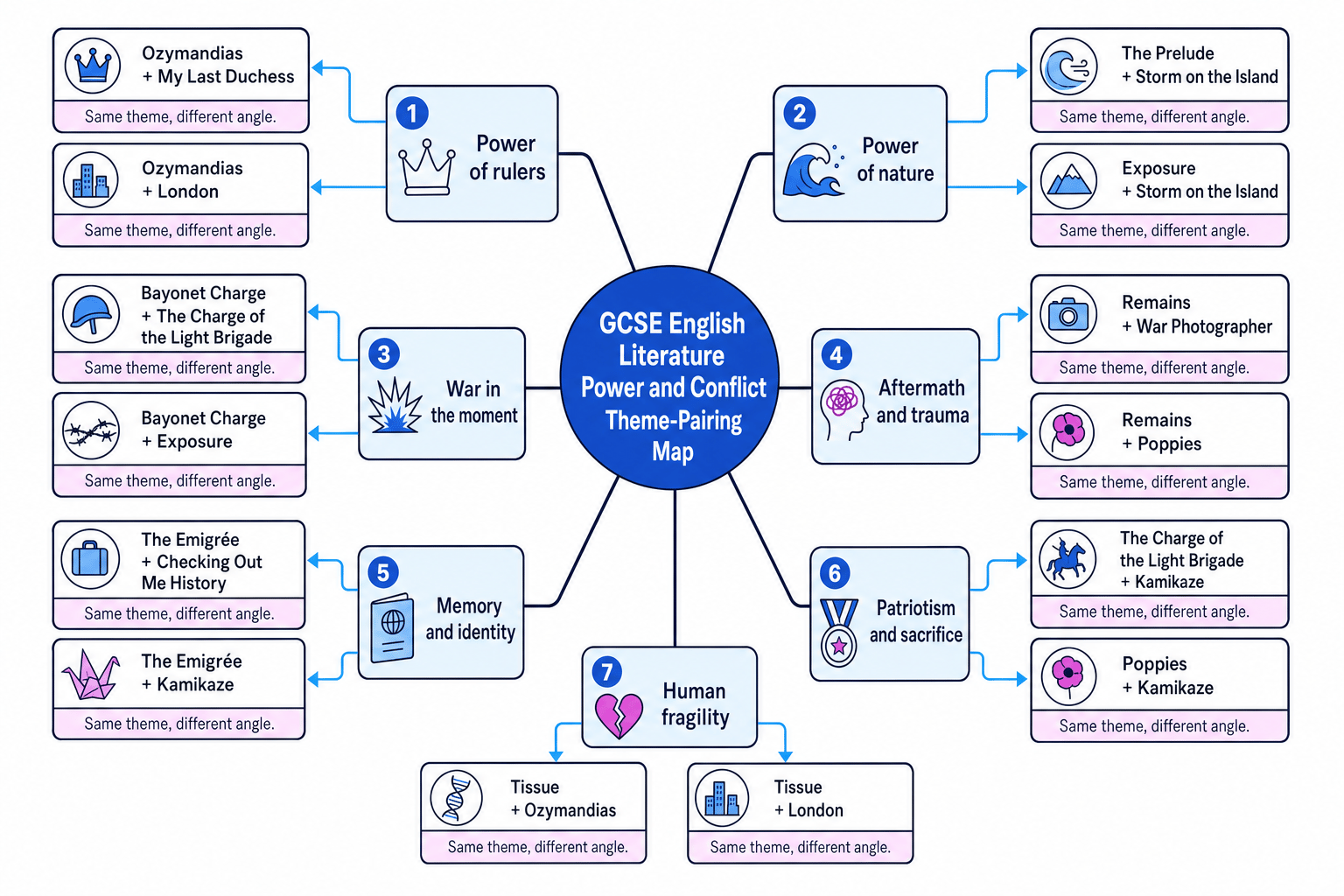
The map below shows some of the most useful routes through the anthology. You do not have to memorise every line of it; use it to practise choosing a poem based on the question’s theme.
What makes a strong pairing?
A strong pairing has four features:
- It matches the question wording. If the question is about memory, do not force a poem just because you know it well.
- It gives you similarity and difference. The poems should “speak” to each other, not repeat the same idea.
- It gives you methods to analyse. A writer’s method means a deliberate choice of language, form, or structure.
- It gives you short, accurate quotations. In a closed-book exam, short quotations are safer and more useful.
A speaker is the voice in the poem. It is not always the poet themselves, so it is often safer to write “the speaker suggests…” unless you are directly discussing the poet’s context.
Pairing by topic only
“Both poems are about war” is too broad. Upgrade it into a viewpoint: “Both poets challenge the idea that war is glorious, but Hughes focuses on panic during battle while Owen focuses on exhausting waiting.”
High-value theme pairings
Use this as a revision bank. The “angle” column is the part that helps you form an argument.
| Theme route | Strong pairing | Comparative angle | Short evidence |
|---|---|---|---|
| Power of rulers | Ozymandias + My Last Duchess | Arrogant male power is exposed and criticised. | “King of Kings”; “I gave commands” |
| Institutional power | London + Ozymandias | Political power traps people in the present but also decays over time. | “mind-forg’d manacles”; “lone and level sands” |
| Power of nature | The Prelude + Storm on the Island | Nature makes humans feel small, fearful, and uncertain. | “black and huge”; “huge nothing” |
| War in the moment | Bayonet Charge + The Charge of the Light Brigade | One poem questions patriotic heroism; the other commemorates collective bravery. | “patriotic tear”; “noble six hundred” |
| Futility of war | Exposure + Bayonet Charge | Soldiers suffer without clear purpose or control. | “But nothing happens”; “cold clockwork” |
| Aftermath of conflict | Remains + War Photographer | Conflict continues through guilt, memory, and images. | “bloody hands”; “spools of suffering” |
| Family and loss | Poppies + Kamikaze | War damages families even away from the battlefield. | “playground voice”; “no longer the father we loved” |
| Identity and memory | The Emigrée + Checking Out Me History | Identity is shaped by remembered places and recovered histories. | “sunlight-clear”; “I carving out me identity” |
| Fragility of power | Tissue + Ozymandias | Human structures and records are temporary. | “never meant to last”; “colossal Wreck” |
The main pairing routes
Human power and control
For human power, your safest poems are Ozymandias, My Last Duchess, London, and Tissue.
Ozymandias pairs beautifully with My Last Duchess because both poems criticise powerful men. Shelley presents a ruler whose boast — “Look on my Works” — is undercut by the empty desert. Browning presents the Duke through a dramatic monologue, a poem spoken by one character, where his polished voice accidentally reveals his possessiveness: “I gave commands.”
London gives you a broader, social version of power. Blake’s “mind-forg’d manacles” suggest oppression has entered people’s thoughts. This pairs well with Ozymandias if you want to compare political control: Shelley shows power ruined by time, while Blake shows power actively damaging ordinary people.
Nature’s power
For nature, choose The Prelude, Storm on the Island, or Exposure.
In The Prelude, Wordsworth presents the sublime, meaning the mixture of awe and fear humans feel when faced with something vast and overwhelming. The “huge peak, black and huge” makes the speaker feel morally and spiritually shaken.
In Storm on the Island, Heaney also presents nature as frightening, but the fear is communal and physical. The islanders say “we are prepared,” yet the poem ends with “it is a huge nothing that we fear,” suggesting nature’s power is partly invisible and psychological.
Exposure can pair with nature poems because Owen presents the weather almost as the real enemy. The repeated refrain “But nothing happens” makes suffering feel endless and pointless.
War, patriotism, and soldiers
For battle, use Bayonet Charge, The Charge of the Light Brigade, Exposure, and sometimes Remains.
The Charge of the Light Brigade presents public heroism. Tennyson’s repeated “Half a league” creates a driving rhythm, and “noble six hundred” turns the soldiers into a collective legend. However, “Theirs not to reason why” also hints that soldiers are trapped by command.
Bayonet Charge is more chaotic and individual. Hughes begins in the middle of action — “Suddenly he awoke and was running” — so the soldier seems confused before he can think. The “patriotic tear” becomes useless when faced with terror.
These two poems are excellent together because they let you compare public glory with private panic.
Aftermath, guilt, and trauma
For the effects after conflict, use Remains, War Photographer, Poppies, and Kamikaze.
Remains is one of the strongest poems for trauma. Armitage’s speaker repeats uncertainty — “probably armed, possibly not” — showing that guilt keeps replaying. The phrase “his bloody life in my bloody hands” uses a blood motif, a repeated image or idea, to connect physical violence with moral responsibility.
War Photographer also explores suffering after violence, but from the perspective of someone who records conflict. Duffy’s “spools of suffering set out in ordered rows” suggests an attempt to organise pain, while “they do not care” criticises the comfortable readers who quickly forget.
Linking methods across two poems
- Establish the shared idea: both Remains and War Photographer present conflict as something that continues after the physical danger has ended.
- Pair the evidence by image: Armitage’s “bloody hands” and Duffy’s “blood stained into foreign dust” both use blood to suggest suffering that cannot be easily washed away.
- Contrast the voices: Armitage’s first-person, colloquial speaker sounds trapped inside guilt, while Duffy’s more detached description of “ordered rows” suggests professional control.
- Build the comparison: both poets use blood imagery to show the lasting cost of conflict, but Armitage makes trauma feel personal and intrusive, while Duffy explores how distant audiences turn suffering into something momentary.
Identity, memory, and belonging
For identity, use The Emigrée, Checking Out Me History, and Kamikaze.
The Emigrée presents memory as protective. Even though the speaker’s homeland may be politically troubled, her memory remains “sunlight-clear.” The repeated light imagery suggests emotional resistance.
Checking Out Me History is more openly rebellious. Agard challenges colonial education through the repeated phrase “Dem tell me” and ends with “I carving out me identity.” The non-standard voice becomes part of the poem’s power: it refuses to be controlled by the version of history it criticises.
Kamikaze works well with identity and belonging because the pilot’s identity is destroyed socially after he returns. The final question — “which had been the better way to die” — is deliberately disturbing because it shows how society can treat shame as worse than death.
How to revise pairings efficiently
Do not try to learn every possible combination. Instead, learn route clusters:
- Power: Ozymandias, My Last Duchess, London, Tissue
- Nature: The Prelude, Storm on the Island, Exposure
- War experience: Bayonet Charge, The Charge of the Light Brigade, Exposure
- Aftermath: Remains, War Photographer, Poppies, Kamikaze
- Identity and memory: The Emigrée, Checking Out Me History, Kamikaze
Memorise quote-pairs, not quote-lists
Learn short quotations in pairs: “King of Kings” with “I gave commands”; “bloody hands” with “spools of suffering”; “sunlight-clear” with “I carving out me identity.” This trains your brain to compare automatically.
Using context without bolting it on
Context means relevant background about when, why, and how a text was written or received. In comparison, context is useful only when it sharpens your argument.
For example, mentioning that Tennyson was Poet Laureate helps explain the public, commemorative tone of The Charge of the Light Brigade. Mentioning Owen’s First World War experience helps explain the bitterness and futility in Exposure. But context should not replace analysis of the poem’s words.
Context dumping
Do not write a mini history paragraph and then forget the poem. Link context to meaning: “As Poet Laureate, Tennyson shapes the soldiers into a national legend, whereas Hughes strips away patriotic certainty through the soldier’s panic.”
In the exam
- Start with the exact theme in the question, then choose the poem that best fits that angle.
- Use a “both… but…” sentence early to create a clear line of argument.
- Compare methods, not just messages: language, form, structure, voice, and imagery all count.
- Keep quotations short and accurate, especially for the poem you choose from memory.
Check yourself
- Which poem would you pair with Ozymandias for human power, and why?
- How could you compare Bayonet Charge with The Charge of the Light Brigade without just saying “both are about war”?
- Which two poems would you choose for identity and memory, and what would your “both… but…” angle be?
