What you'll learn
- How to turn a My Name is Leon question into a clear argument.
- How to build model paragraphs that analyse Kit de Waal’s methods, not just events.
- How to use short, secure evidence in a closed-book exam.
- How to adapt a model response to questions on family, separation, identity, race, childhood and care.
What a model essay is
A model essay is not a script to memorise. It is an example of the thinking you need to show: a clear view of the question, supported by evidence, with analysis of how de Waal creates meaning.
Model essay
A model essay is a sample answer that shows strong essay habits: a focused argument, relevant textual references, analysis of the writer’s methods, and context used only when it deepens the interpretation.
In the AQA modern prose question, you are writing from memory. That means you can use short quotations when you know them exactly, but you can also use precise references to moments in the novel. A precise reference is much better than a made-up quotation.
The core ingredients
A strong answer combines three things:
- Argument: your clear interpretation of what de Waal is doing.
- Evidence: a short quotation or a precise reference to a moment in the novel.
- Method analysis: explanation of how language, form or structure creates meaning.
Line of argument
A line of argument is the main idea that runs through the whole essay. It should answer the question directly and develop from paragraph to paragraph.
For My Name is Leon, strong arguments usually notice that de Waal presents Leon’s life as both personal and social: his pain is emotional, but it is also shaped by race, adoption, class, childhood and the care system.
Argument before evidence
Do not start by listing everything you remember. Start with what you think de Waal is showing, then choose evidence that proves it.
The overall essay shape
A model essay should move from the question, to a thesis, to paragraphs that each prove one part of that thesis. The diagram below shows the basic structure to keep in your head.
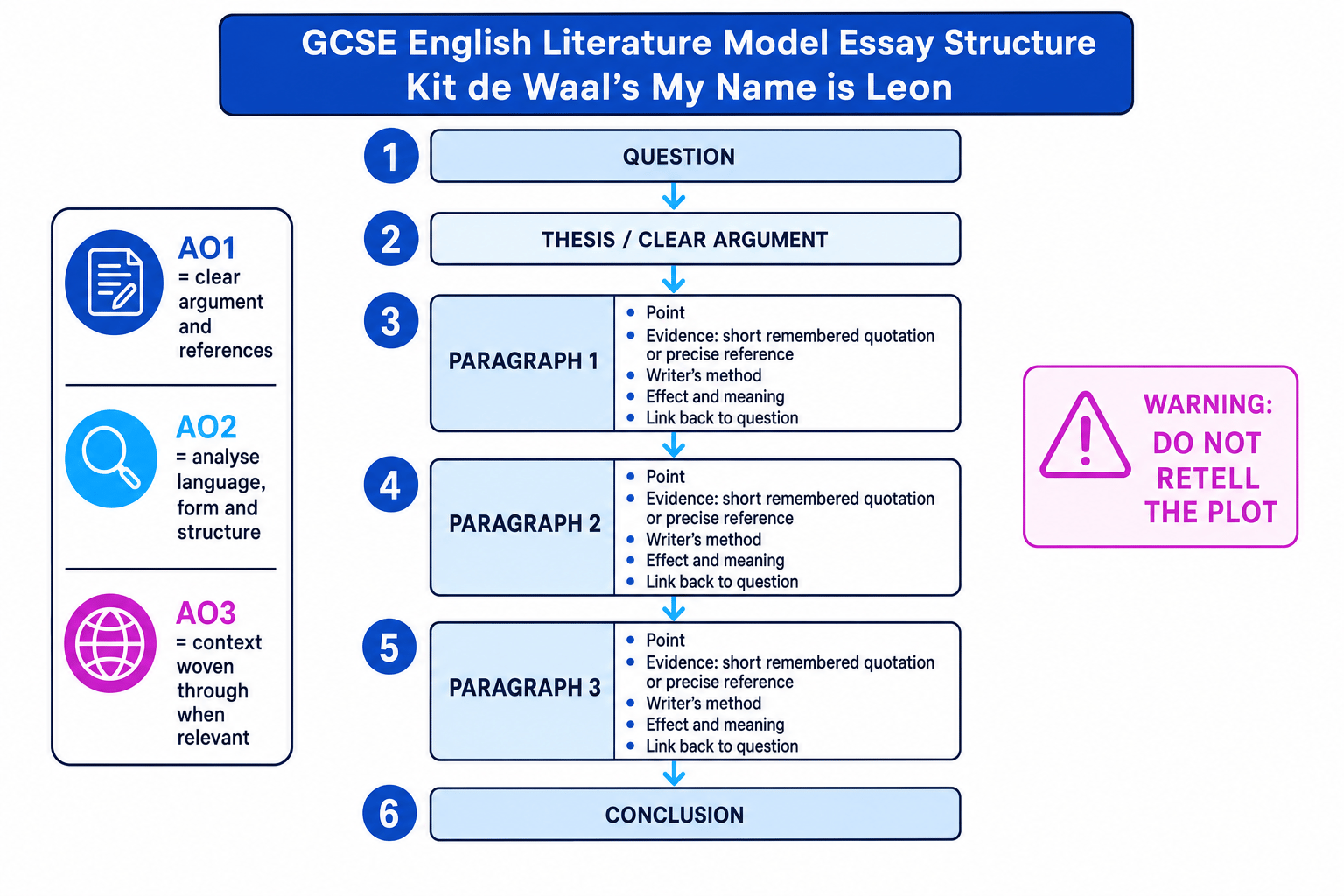
Step 1: Turn the question into a thesis
Thesis
A thesis is your overall answer to the question, usually given in the introduction. It should be specific, arguable and focused on the writer’s purpose.
A weak thesis simply repeats the question: “De Waal presents separation in many ways.”
A stronger thesis gives a view: “De Waal presents separation as a wound caused by both family crisis and social systems, but she also shows Leon creating new forms of belonging.”
Turning separation into a thesis
-
Treat separation as more than one event. In the novel, separation includes Leon losing daily life with Jake, being removed from Carol, and being moved through adult systems he cannot control.
-
Decide on a nuanced interpretation. De Waal does not present separation as only private sadness; she also shows how race, age and adoption affect which children are seen as “placeable”.
-
Choose methods that can prove the interpretation. You could discuss child focalisation — events filtered through Leon’s viewpoint — the contrast between Leon and Jake, and the structure of repeated loss and searching.
-
Shape this into a thesis: De Waal presents separation as the central wound in Leon’s childhood, using his child-centred perspective to expose both emotional pain and wider social injustice.
The pre-learned essay
Do not force the same memorised answer onto every question. If the question asks about adults, your essay must keep returning to adults; if it asks about identity, every paragraph must link back to identity.
Step 2: Build paragraphs that prove the thesis
A strong paragraph is not just “point, quote, technique”. It should develop an idea.
A topic sentence is the first sentence of a paragraph that makes a focused mini-argument. A writer’s method is any deliberate choice de Waal makes, such as narrative viewpoint, contrast, symbolism, sentence structure or the order of events.
Close child focalisation
Close child focalisation means the narration stays very near to Leon’s thoughts and understanding. Even when the novel is not written directly as “I”, the reader experiences adult decisions through what Leon notices, feels and misunderstands.
This method is especially important because Leon often cannot fully understand the adult world. That makes the reader feel his confusion and powerlessness, while also seeing the unfairness more clearly than he can.
Building a paragraph on identity and belonging
-
Choose a mini-argument: de Waal presents belonging as something Leon has to claim, because adults and institutions keep defining him.
-
Select secure evidence. The title phrase “My Name is Leon” is safe to quote exactly, and it immediately foregrounds name, identity and self-definition.
-
Analyse the language. The possessive pronoun “My” — a word showing ownership — suggests Leon claiming himself. The proper noun “Leon” — his specific name — centres him as an individual. The title is a declarative sentence, meaning a statement, so it sounds simple but firm.
-
Add relevant context carefully. Leon’s identity is shaped by being a mixed-race child in the care and adoption system of early 1980s Britain, so being “seen” accurately matters.
-
Combine the thinking into a paragraph: De Waal presents belonging as inseparable from identity. The title, “My Name is Leon”, sounds simple, but its declarative structure is quietly defiant: Leon claims a name before the adult world can label him as a foster child, a mixed-race child, or Jake’s brother. The possessive pronoun “My” suggests ownership, while the proper noun “Leon” centres him as an individual. Through close child focalisation, de Waal encourages the reader to judge social systems by their effect on one vulnerable child. Belonging, therefore, is not just having somewhere to live; it is being recognised fully.
Step 3: Use evidence safely in a closed-book essay
You do not need long quotations. In fact, long quotations are risky because they are harder to remember accurately.
A good My Name is Leon answer can use:
- the title phrase “My Name is Leon” for identity and voice;
- precise references to Leon caring for Jake;
- precise references to Jake’s adoption and Leon’s separation from him;
- precise references to Maureen, Sylvia, Tufty and the allotment community;
- precise references to race, policing and early 1980s Britain when relevant.
If you cannot quote it exactly
If you are unsure of the wording, do not put quotation marks around it. Write a precise reference instead, such as “when Jake is adopted and Leon remains in foster care”. Accurate reference is rewarded; invented quotation weakens your answer.
A condensed model response: separation and belonging
Below is a shortened model response. In a real exam answer, you would develop the paragraphs further, but notice how each paragraph has a clear job.
Question focus: How does de Waal present separation in My Name is Leon?
De Waal presents separation as the central wound in Leon’s childhood, but she does not reduce it to private sadness. Through Leon’s child-centred perspective, separation becomes emotional, because he loses daily life with Jake and Carol, but also social, because adult systems make decisions about him that he cannot control. The title phrase, “My Name is Leon”, suggests that the novel is also about a child trying to claim identity in a world that repeatedly moves, labels and judges him.
Leon’s separation from Jake is especially painful because de Waal first establishes Leon as a young carer as well as a brother. References to Leon feeding, watching and worrying about the baby make their bond feel practical and intimate, not sentimental. When Jake is adopted and Leon remains in foster care, the contrast between the white baby and the older mixed-race child exposes wider inequality. De Waal’s close child focalisation intensifies this injustice: adult explanations are filtered through Leon’s hurt and partial understanding, so the reader feels both his confusion and his lack of power.
However, de Waal also presents belonging as something Leon can begin to rebuild. Maureen and Sylvia are not perfect, but they offer forms of care that challenge a simple “good adult/bad adult” reading. The allotment community also becomes important because it gives Leon contact with adults such as Tufty and Mr Devlin, who help broaden his understanding of identity, race and loyalty. Symbolism means when a place, object or action stands for a bigger idea; the allotment can work symbolically as a place where damaged things may still grow.
Ultimately, de Waal presents separation as damaging but not as the whole of Leon’s identity. The novel’s title keeps returning us to the importance of Leon’s name and selfhood. He is shaped by loss, but he is not only a victim of it.
Nuance gets marks
The strongest essays avoid one-sided claims. De Waal presents the care system as harmful in many ways, but she also presents individual carers with warmth, humour and complexity.
Step 4: Weave context into analysis
Context
Context means relevant information about the world around the text: for this novel, that might include early 1980s Britain, race, adoption, fostering, class, policing and social attitudes.
Context should never feel like a separate history paragraph. It should explain why de Waal’s choices matter.
Weaving race and adoption context into analysis
-
Start with the character moment: Jake is adopted while Leon remains in foster care, which creates a painful contrast between the brothers.
-
Link the moment to context: the difference between a white baby and an older mixed-race child reflects unequal assumptions about adoption, race and who is considered easier to place.
-
Connect back to method: de Waal presents this through Leon’s limited understanding, so the reader recognises an injustice that Leon can feel before he can fully explain it.
-
Write the context as part of analysis: The contrast between the brothers turns a family separation into a criticism of social attitudes, because de Waal shows how race and age affect Leon’s chances of being chosen and protected.
Bolt-on context
Avoid sentences like “This was set in the 1980s” if you do not connect them to the question. Context only helps when it sharpens your interpretation of a character, theme or method.
How to adapt a model essay
A model essay becomes useful when you can reshape it. Keep the method and evidence, but adjust the argument.
| Question focus | Useful material to keep | What your argument should emphasise |
|---|---|---|
| Family | Leon, Jake, Carol, Maureen, Sylvia | Love is real, but family is disrupted and remade. |
| Identity | The title, Leon’s name, race, belonging | Leon needs to be recognised as himself, not labelled by others. |
| Childhood | Child focalisation, confusion, adult decisions | The child viewpoint makes injustice feel immediate. |
| Race | Leon and Jake’s different treatment, Tufty, 1980s Britain | Personal experience is shaped by wider social prejudice. |
| Care system | Foster care, adoption, social workers, carers | The system can protect and harm; individuals are complex. |
Making your style sound analytical
Try to use verbs that show interpretation:
- presents
- suggests
- implies
- contrasts
- foregrounds
- criticises
- complicates
- reveals
Instead of writing, “This shows Leon is sad,” write, “De Waal presents Leon’s sadness as a response to powerlessness, because adult decisions are made around him rather than with him.”
A simple sentence frame
Use this structure when you get stuck: De Waal presents [idea] through [method], which makes the reader understand [effect] because [link to question/context].
In the exam
-
Spend a few minutes turning the question into a thesis before you start writing.
-
Build each paragraph around one clear idea, then prove it with a short quotation or precise reference.
-
Analyse de Waal’s methods — especially child focalisation, contrast, structure and symbolism — instead of retelling the plot.
-
Use context only when it deepens your point about Leon, race, care, family or early 1980s Britain.
-
If you are unsure of a quotation, use a precise reference rather than inventing wording.
Check yourself
-
Can you write a thesis about separation, identity or family in one clear sentence?
-
Can you explain why “My Name is Leon” is a useful quotation for identity and belonging?
-
Can you turn one plot moment, such as Jake’s adoption, into analysis of method, effect and context?
