Planning is the most critical stage of your GCSE English Literature exam, especially for a modern novel like Kit de Waal's My Name is Leon. Because Section A of Paper 2 is closed-book and does not provide an extract, you must walk into the exam room with a robust strategy for mapping out your knowledge from memory.
A strong plan ensures that your essay reads as a coherent, deliberate argument (securing marks for organization) rather than a chaotic stream of consciousness.
What you'll learn
- How to unpack a closed-book exam question on My Name is Leon and identify the central debate.
- How to construct a powerful, thesis-led plan using a three-stage structural model.
- How to seamlessly weave together character development, language analysis, and 1980s social context.
The Anatomy of an AQA Essay Plan
In the exam, you will be given a choice of two questions on My Name is Leon. You must choose one and write a conceptual essay in approximately 45 minutes.
To score in the highest mark bands, your essay must not simply tell the story of Leon, Jake, and Tufty. It must treat the novel as a construct—a deliberate piece of art designed by Kit de Waal to communicate specific messages about society.
To do this, you need to master three fundamental planning tools.
Thesis Statement
A Thesis Statement is a one- or two-sentence summary of your central argument. It directly answers the exam question and outlines the writer's underlying purpose (why they wrote the novel). It acts as the anchor for your entire essay.
Topic Sentence
A Topic Sentence is the opening line of a body paragraph. It introduces a key conceptual point that supports your thesis, shifting the focus away from simple plot summary and onto the writer's methods and intentions.
The Rule of Three
Aim for a three-part structure. Your plan should divide the essay into three clear, chronological, or thematic stages. This shows the examiner that your response has a structured trajectory and is progressing toward a final, decisive conclusion.
The Planning Blueprint
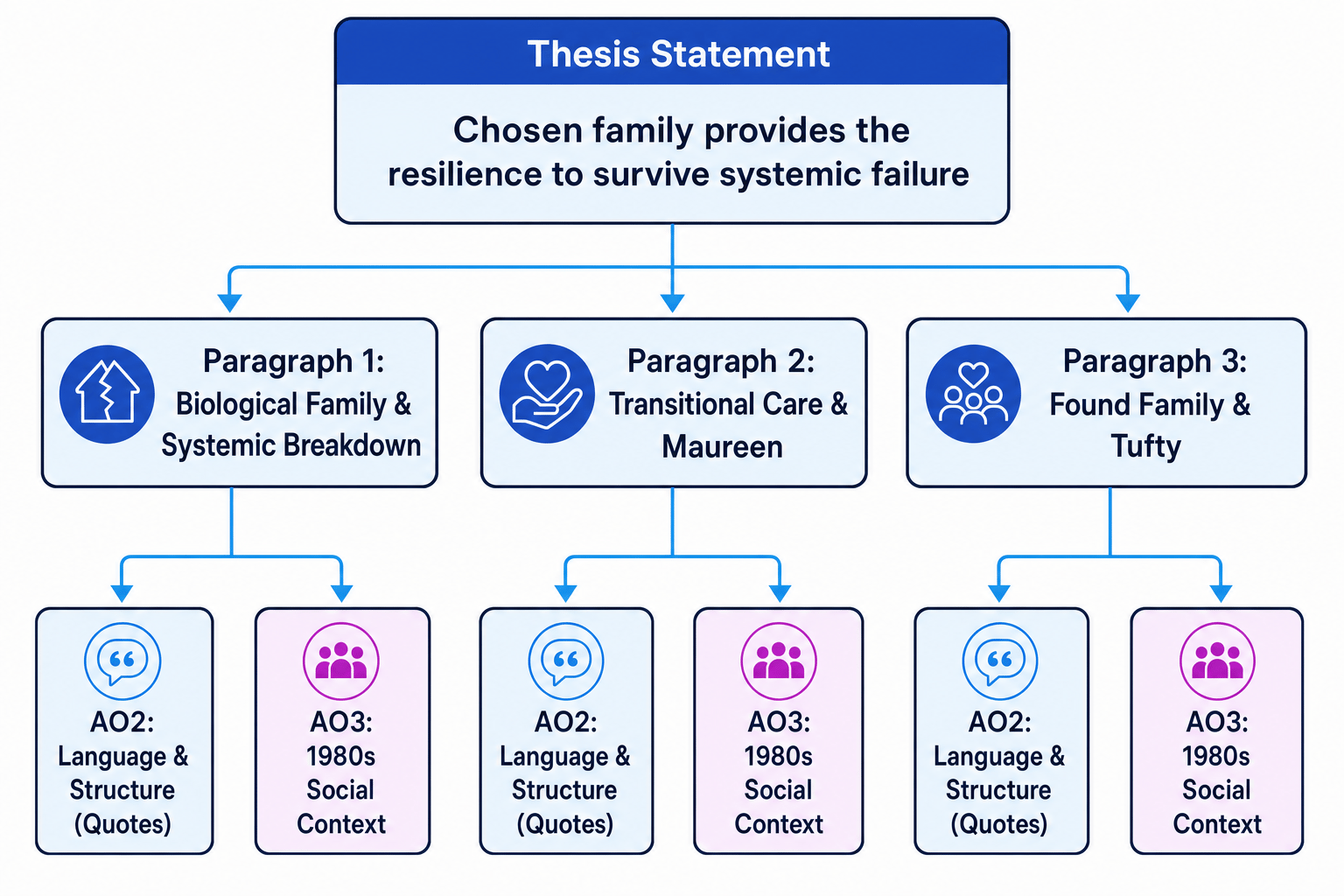
An effective plan acts as a bridge between the exam question and your final written response. Below is a visual map of how your thesis statement should dictate your paragraph topics, ensuring that language analysis (AO2) and social context (AO3) are fully integrated at every stage of the essay.
The Three-Step Planning Technique
When you open your exam paper, spend 5 to 8 minutes planning. Do not rush straight into writing. A well-planned essay is easier to write, flows more naturally, and scores significantly higher. Use this three-step process to plan any question on My Name is Leon:
1. Deconstruct the Prompt
Circle the key terms in the question (usually a character or a theme, such as "identity," "loss," "hope," or "belonging"). Ask yourself: What is the debate here? What does Kit de Waal want the reader to understand about this topic?
2. Formulate Your Thesis
Write down a single sentence that captures your overall perspective. Avoid safe, boring statements like "De Waal shows that family is important." Instead, construct a conceptual argument: "De Waal presents family not as a rigid biological unit, but as a fluid, chosen network of support that is essential for emotional survival in a hostile, systemic environment."
3. Map the "Rule of Three" Progression
Create three paragraph outlines. For each paragraph, write down:
- A conceptual Topic Sentence.
- Two key quotations or specific moments from memory.
- The literary methods used in those quotations (metaphor, symbolism, colloquial dialogue).
- The historical or social context (such as the 1981 Handsworth riots, institutional racism, or the failures of the UK foster care system).
Worked Example
Planning a thematic essay on family
Walk through the step-by-step process of planning an response to the prompt: "How does de Waal present the importance of family and belonging in My Name is Leon?"
- Deconstruct the prompt to find the core tension: Identify the central theme ("family and belonging"). Recognize that "family" in the novel has two contrasting forms: the biological family that breaks down due to postpartum depression and systemic failure, and the "found" family (Maureen, Silvia, Tufty, Devlin) that offers genuine, redemptive belonging.
- Draft a conceptual thesis statement: Formulate a thesis that links the theme to the author's purpose. Thesis: De Waal demonstrates that while biological family units can be fractured by societal neglect and poverty, marginalized individuals can construct alternative, "found" families that offer the unconditional love and cultural belonging necessary to heal.
- Map out Paragraph 1 (The Breakdown of Biological Family): Focus on the start of the novel. Write a topic sentence focusing on how poverty and isolation destroy Leon's early home life. Select the quote where Carol tells Leon, "Leon, rub my back," highlighting the parentification of Leon. Link this to AO2 (the role reversal and needy dialogue) and AO3 (the lack of systemic social support for struggling single mothers in 1980s Britain).
- Map out Paragraph 2 (The Liminal Space of Foster Care): Focus on the middle of the novel. Write a topic sentence analyzing foster care as a place of safety but also profound displacement. Select the contrast between Maureen's home ("smells of biscuits and clean washing") and Sylvia's harsh, pragmatic approach. Analyze the sensory imagery (AO2) and link it to the bureaucratic coldness of the care system (AO3), which prioritizes the adoption of the white baby, Jake, over the mixed-race child, Leon.
- Map out Paragraph 3 (The Redemptive Found Family): Focus on the latter half of the novel. Write a topic sentence explaining how the allotment community provides Leon with a sense of racial and masculine identity. Select the symbolism of the allotment, where Tufty explains how "different things grow together." Analyze this metaphor (AO2) and link it to the context of racial tensions, the Handsworth riots of 1981, and the vital role of Black community spaces in offering safety and mentorship (AO3).
Common Planning Pitfalls to Avoid
Planning is a skill that requires discipline. Watch out for these common traps that students fall into when planning under exam pressure:
The Plot-Summary Trap
Many students structure their plans by simply retelling the story chronologically: Paragraph 1 is the beginning, Paragraph 2 is the middle, Paragraph 3 is the end. This leads to a narrative summary rather than an analytical argument. Your plan must be organized around concepts, themes, or shifts in character perspective, not just "what happens next."
The Vocabulary Bank Hack
When planning, write down 3–4 high-level vocabulary words at the top of your page (such as systemic, marginalized, parentification, liminal, paternal, or redemptive). Having these words visible on your plan will prompt you to use them in your essay, instantly elevating your academic tone.
The Context Dump
Never plan a paragraph that is solely about historical context (like the 1981 riots or Thatcher's Britain). The examiner rewards context (AO3) only when it is directly linked to the writer’s literary choices (AO2) and your main argument (AO1). Always plan your paragraphs around a literary concept, never around a history lesson.
In the exam
- Spend the first 5 to 8 minutes planning: Do not skip this step. Write your plan directly on your exam answer booklet and draw a neat line through it when you are finished so the examiner knows it is your plan.
- Write your thesis statement out in full during your planning time: Having your exact thesis written down prevents your introduction from wandering off-topic.
- Check your quotes: Ensure you have at least two precise, memorable quotations written down for each paragraph in your plan before you start writing your essay.
- Keep your plan visible: Rest your booklet so you can refer to your plan constantly. Check off each point as you write it to ensure you do not leave out vital context or analysis.
Check yourself
- Can you write a thesis statement for a question on the character of Tufty in under two minutes?
- Do you have at least six short, versatile quotations memorized that could apply to essays on both the theme of race and the theme of childhood?
- Does each of your planned paragraph topics directly support and build upon your central thesis statement, or do they feel like three separate, disconnected mini-essays?
