Welcome to your study guide for the AQA Love and Relationships poetry cluster! If you are preparing for Paper 2, Section B of your GCSE English Literature exam, this is where you will demonstrate your ability to compare how poets present different experiences of human connection.
This overview will help you see the "big picture" of the 15 poems so you can navigate them with confidence in the exam room.
What you'll learn
- How the AQA Poetry Anthology exam is structured and what the examiners are looking for.
- How to categorise the 15 poems into three primary thematic groups to make comparison effortless.
- How to choose the perfect comparison poem under exam conditions.
- How to build a comparative thesis statement that addresses language, form, and context.
Understanding the Exam Format
Before diving into the poems, you need to know exactly how you will be tested. This prevents unpleasant surprises on exam day.
Section B: Poetry Anthology
In Paper 2, Section B, you will be given a comparative poetry essay question. The paper will print one poem from the cluster in full. You must compare this printed poem with one other poem of your choice from the Love and Relationships cluster, which you must recall from memory.
You will have approximately 45 minutes to write your response. Because it is a closed-book exam, you cannot take your anthology into the room. This means you do not need to memorise entire poems; instead, you need a flexible bank of 2–3 short, high-impact quotations for each poem, alongside a deep understanding of their forms, structures, and ideas.
Categorising the 15 Poems
Studying 15 individual poems can feel overwhelming if you treat them as separate entities. The secret to success is grouping them by their core themes. When you see the threads that connect them, comparison becomes natural.
We can split the Love and Relationships cluster into three broad categories:
1. Romantic Passion and Desire
These poems explore the intense, sometimes overwhelming feelings of romantic love, physical longing, and deep devotion.
- Sonnet 29 – ‘I think of thee!’ (Elizabeth Barrett Browning): Explores obsessive thoughts of a lover and the joy of physical presence over memory.
- Love’s Philosophy (Percy Bysshe Shelley): A playful, persuasive argument using natural imagery to convince a beloved to unite physically and romantically.
- Singh Song! (Daljit Nagra): A joyful, modern celebration of marriage, merging cultural identity with romantic devotion.
- The Farmer’s Bride (Charlotte Mew): A dark look at unrequited desire and mental distance in a damaged relationship, written from the perspective of an frustrated husband.
- Porphyria’s Lover (Robert Browning): A chilling dramatic monologue exploring destructive obsession, power, and toxic control.
2. Family and Parent-Child Bonds
These poems shift focus from romantic partners to the complex, evolving relationships between parents, children, and ancestors.
- Walking Away (Cecil Day-Lewis): A father reflects on the painful but natural process of watching his young son find independence.
- Eden Rock (Charles Causley): A poignant, nostalgic vision of the speaker's late parents, exploring the bridge between life and death.
- Follower (Seamus Heaney): A son reflects on his childhood admiration of his father’s physical skill, and how their roles have reversed in old age.
- Mother, Any Distance (Simon Armitage): A son navigates the physical and emotional transition of moving out of his mother's home, balancing fear and excitement.
- Before You Were Mine (Carol Ann Duffy): A daughter looks at a photo of her mother before parenthood, exploring sacrifice, admiration, and the passage of time.
- Climbing My Father (Andrew Waterhouse): An extended metaphor of climbing a mountain to represent a child's deep, physical exploration of his father's life and character.
3. Pain, Distance, and Loss
These poems deal with the "shadow side" of love—grief, separation, decay, and the emotional distance that can grow between two people.
- When We Two Parted (Lord Byron): A bitter reflection on a secret affair that has ended, exploring silent grief and betrayal.
- Neutral Tones (Thomas Hardy): A bleak, monochrome memory of the moment love died between two people, using a dead landscape to reflect dead feelings.
- Winter Swans (Owen Sheers): A couple walks through a waterlogged landscape, using the sight of two cohesive swans to resolve their emotional distance.
- Letters from Yorkshire (Maura Dooley): An exploration of physical distance between a rural worker and an urban writer, connected by the warmth of written letters.
The Theme Matrix
To help you visualise these links, look at how several key poems intersect across multiple themes. Notice how some poems bridge romantic love, distance, and nature, while others focus purely on family bonds.
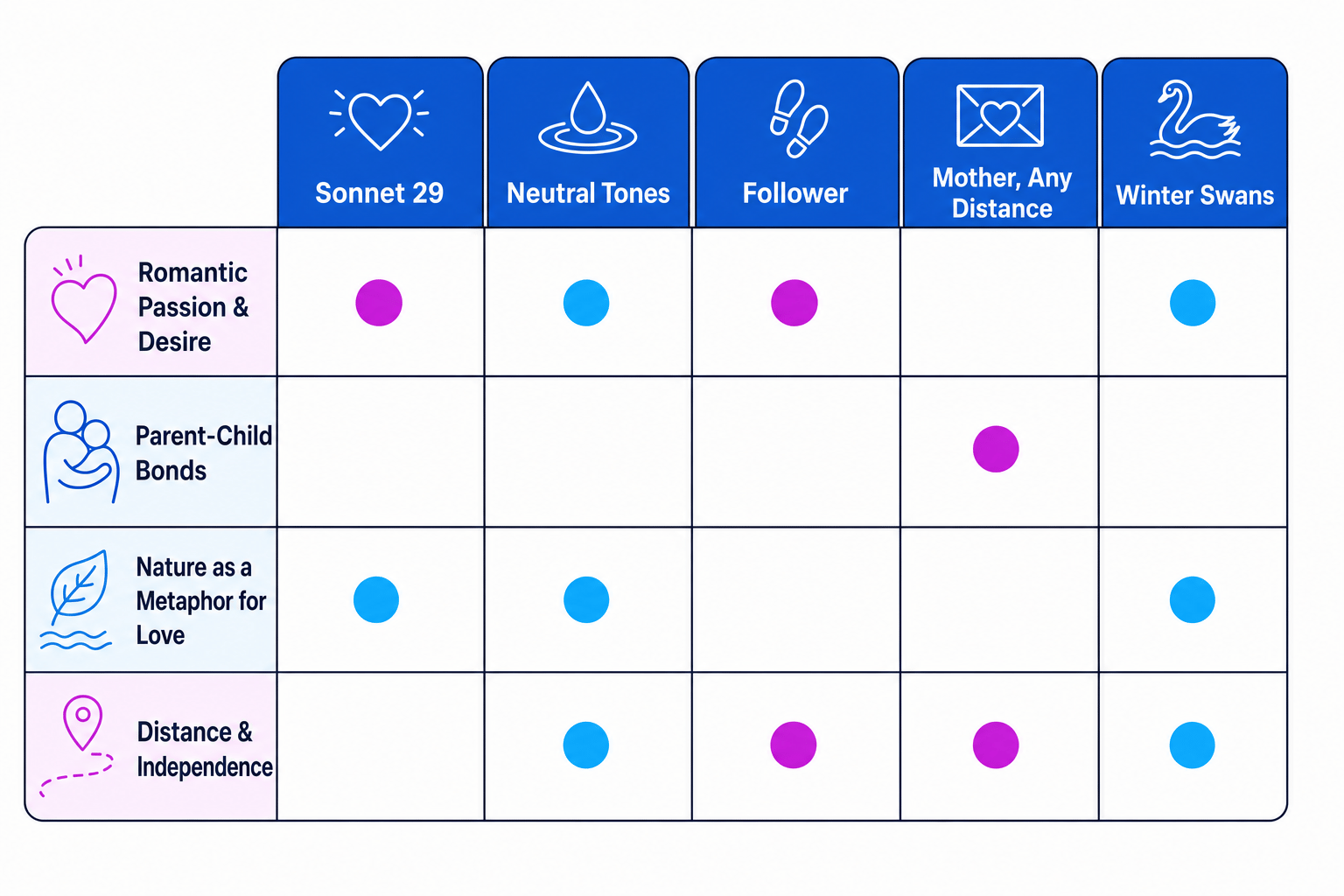
The Power of Overlap
Do not pigeonhole a poem into just one category. The best essays compare poems from different categories (e.g., comparing the natural imagery used to show a struggling romantic relationship in 'Winter Swans' with the natural imagery of parental separation in 'Walking Away'). This shows the examiner a highly sophisticated understanding of the cluster.
How to Compare: Form, Structure, and Language
To secure high marks in AO2 (Analysing Language, Form, and Structure), you must look beyond what the poem is saying and analyse how the writer has constructed it.
Form (The 'Type' of Poem)
Form is the architectural blueprint of the poem.
- Sonnets (like Sonnet 29) are historically associated with romantic love.
- Dramatic Monologues (like Porphyria's Lover and The Farmer's Bride) use a single, distinct persona, which often reveals a disturbing lack of balance or control.
- Free Verse (like Mother, Any Distance or Winter Swans) often reflects realistic speech or emotional instability through its lack of strict rhyme and rhythm.
Structure (The Layout and Flow)
Structure is how the poem moves from start to finish.
- Enjambment (running a sentence over the end of a line) can mimic natural speech, indicate a lack of control, or represent a physical spilling over of emotion.
- Caesura (a distinct pause within a line, e.g., using a full stop or dash) can signify an emotional roadblock, a sudden realization, or physical hesitation.
- Stanza Shape (such as regular quatrains vs. irregular stanzas) can reflect a speaker’s desire for order or their inner chaotic state.
Form and Content
Think of a poem's form as a glass and its content as water. If a poet uses a highly rigid, traditional form (like a Shakespearean sonnet) to write about wild, chaotic obsession, they are trying to force a wild flood of emotion into a very tight, controlled vessel. The tension between the shape of the "glass" and the movement of the "water" is where the deepest meaning lies!
Worked Example: Planning a Comparative Thesis
When you enter the exam, you cannot just write everything you know about two poems. You must construct a cohesive argument (AO1) based on a specific prompt. Let's walk through how to plan your comparison from scratch.
Selecting a partner poem and planning a thesis
The Exam Prompt: Compare how poets present difficulties in relationships in 'Neutral Tones' and one other poem from the 'Love and Relationships' cluster.
Here is how you can systematically unpack the prompt, select the best partner poem, and write a high-level comparative thesis.
-
Unpack the named poem ("Neutral Tones") to identify its core presentation of difficulty.
- What is the difficulty? It is the total death of feeling, emotional stagnation, and bitter resentment.
- How is it shown? Through dead natural imagery ("starved sod", "grayish leaves") and a bleak, monochrome color palette.
-
Select a partner poem that offers a meaningful comparison (a similarity or a productive contrast).
- Choice: 'Winter Swans' by Owen Sheers.
- Why? Both poems use nature as a metaphor for a couple's emotional state during a period of strain.
- The Contrast: While Hardy's 'Neutral Tones' presents a relationship that is permanently dead and frozen in the past, Sheers's 'Winter Swans' presents a temporary difficulty that is resolved through nature's healing influence.
-
Formulate a comparative thesis statement that links both poems under a central argument.
- Drafting the thesis: While both Hardy and Sheers utilise the natural world as a psychological mirror for relational strain, Hardy presents a bleak, fatalistic view where emotional decay is permanent and cyclical, whereas Sheers offers a more optimistic perspective, suggesting that acknowledging mutual vulnerability can allow couples to resolve their difficulties and find harmony.
The 'Ping-Pong' Essay
Many students write about the printed poem for 20 minutes, then write about their second poem for 20 minutes, and throw in a quick sentence at the end trying to link them. This is not a comparison! To get into the higher mark bands, you must integrate your comparison throughout. Aim for comparative topic sentences in every main paragraph (e.g., "Similarly to Hardy's dead landscape, Sheers initially presents a waterlogged environment, yet...").
In the exam
- Spend 5 minutes planning before writing. Read the printed poem, identify its main theme, and carefully select your comparison poem based on what will give you the deepest conceptual contrast or similarity.
- Write a strong, direct thesis statement in your introduction. Do not just repeat the question; state how and why the two poets present the theme differently.
- Use the "PEEL" structure with an integrated comparative twist. For each point, transition seamlessly between the two poems (e.g., comparing a structural device in Poem A directly with a structural device in Poem B).
- Do not forget context (AO3). Remember that context is about ideas and perspectives. Ask yourself: Why did Byron write about secret affairs in the Regency era? How does Armitage's modern depiction of independence reflect contemporary family dynamics? Avoid dumping random biographical facts; only use context that explains the poet's choices.
Check yourself
- Which two poems would you choose to compare if the exam question asked about "the theme of intense passion or physical desire"?
- What is the difference between a dramatic monologue (like Porphyria's Lover) and a sonnet (like Sonnet 29) in terms of how they present romantic power dynamics?
- Can you list three poems from the cluster that use nature as an extended metaphor for human emotions, and explain how their use of nature differs?
