What you'll learn
- What Much Ado About Nothing is broadly about, without getting lost in plot detail.
- Why the play is a comedy with surprisingly serious moments.
- How the title, structure, and two love plots help you form strong exam arguments.
- How to write overview points that link to language, form, structure, and context.
Start with the big picture
Much Ado About Nothing is a Shakespeare play set in Messina, Sicily, just after a war. Soldiers arrive at Leonato’s house, and the play shifts from military conflict to social conflict: love, reputation, gossip, deception, and public honour.
At its simplest, the play follows two relationships. Claudio and Hero seem to fall in love quickly, but their relationship is damaged by lies. Beatrice and Benedick begin as witty enemies, but are tricked into admitting they love each other.
Shakespearean comedy
A genre is a category of writing. A Shakespearean comedy usually moves from confusion and disorder towards restoration, often ending in marriage, music, forgiveness, or social harmony. It does not mean every moment is funny.
The overview in one sentence
Shakespeare uses a comic plot of mistaken beliefs and overheard conversations to explore how easily love and honour can be damaged by gossip, performance, and social pressure.
Reading the play as serious comedy
- Start with the comic pattern: the ending brings marriages, dancing, and restored social order, so the play fits the shape of Shakespearean comedy.
- Compare that with Act 4 Scene 1, where Claudio publicly rejects Hero — “There, Leonato, take her back again” — turning a wedding into humiliation.
- Build the interpretation: Shakespeare uses comedy not to avoid serious issues, but to expose how suspicion and male honour can harm women before forgiveness becomes possible.
The title: a joke with a serious point
The phrase “much ado” means a lot of fuss, noise, or trouble. “Nothing” suggests something trivial or empty. So the title sounds light-hearted: everyone is making a huge fuss over very little.
But there is a sharper joke. In Shakespeare’s time, “nothing” could sound close to “noting”, meaning observing, overhearing, or paying attention. Much of the play depends on characters “noting” things wrongly: they watch, listen, report, misread, and jump to conclusions.
A pun is wordplay based on similar sounds or multiple meanings. A motif is a repeated idea, image, or action across a text. In this play, “noting” becomes a motif because overhearing and observation keep driving the action.
Unpacking the title
- Take the surface meaning first: “much ado about nothing” suggests comic fuss and exaggeration.
- Add the pun on “noting”: characters repeatedly trust what they think they have seen or heard.
- Turn it into an argument: Shakespeare suggests that social judgement is often built on performance and hearsay rather than truth.
Calling it just a romance
Do not write as if the play is only about people falling in love. Love matters, but Shakespeare also examines reputation, gender expectations, deception, public shame, and the danger of judging by appearances.
The play at a glance
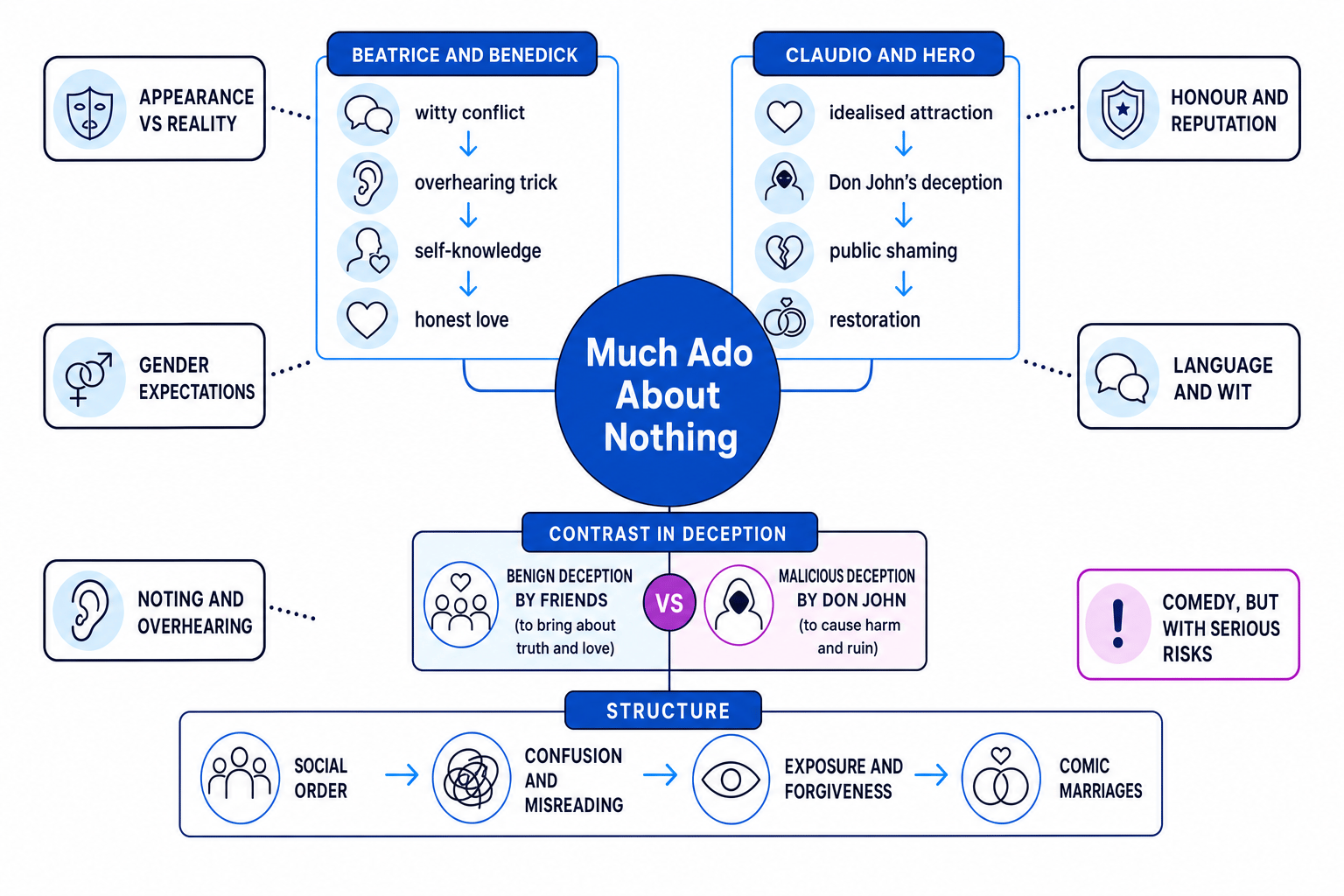
The diagram below gives you the main overview pattern: two love plots, two types of deception, and a comic structure that moves from order to confusion and back towards restoration.
Two love plots, two kinds of love
Shakespeare sets up a contrast between the two main couples.
Claudio’s love for Hero is quick, visual, and idealising. He asks, “Can the world buy such a jewel?” in Act 1 Scene 1, which presents Hero as precious but also object-like. His language can make love sound like possession or social value.
Beatrice and Benedick’s relationship is built on verbal conflict. Beatrice says she would rather hear her “dog bark at a crow” than hear a man swear he loves her, while Benedick insists, “I will live a bachelor.” Their resistance to love is comic, but it also means their eventual relationship feels earned through self-knowledge.
Comparing the two love plots
- Notice Claudio’s starting point: “Can the world buy such a jewel?” suggests admiration, but also links Hero to value and possession.
- Contrast Beatrice and Benedick: their witty arguments show intelligence, independence, and a more equal battle of minds.
- Form the overview point: Shakespeare contrasts love based on appearance and reputation with love that grows through challenge, honesty, and moral testing.
Deception: helpful and harmful
A central idea in the play is deception, meaning deliberate misleading. Shakespeare shows that deception is not always the same.
Some deception is comic and helpful. The friends trick Beatrice and Benedick into believing each loves the other. This deception exposes truths they are too proud to admit.
Other deception is malicious. Don John calls himself “a plain-dealing villain” and creates a false story about Hero. His deception nearly destroys her reputation and her future.
This is one reason the play is so exam-friendly: the same method — deception — produces opposite effects. It can lead to self-knowledge, or it can lead to cruelty.
Form and structure: why this is a play
Form means the type and shape of the text: here, a staged drama written for performance. Structure means how the events are arranged. Because this is a play, Shakespeare can make watching and overhearing part of the action itself.
Dramatic irony happens when the audience knows more than one or more characters. For example, once the audience knows Don John’s accusation is false, Claudio’s confidence at the wedding becomes more painful to watch. The audience sees how wrong he is before he does.
Shakespeare also uses a lot of prose, which is ordinary unrhymed speech, especially for witty social exchanges. Verse is speech arranged in rhythmic lines, often linked with heightened feeling or formality. In Much Ado About Nothing, the lively prose helps create speed, banter, and social energy.
A strong overview sentence
A useful exam sentence starts broad, then becomes precise: “Although Much Ado About Nothing ends as a comedy, Shakespeare uses the near-tragedy of Hero’s shaming to question a society that values reputation over truth.”
Social world: honour, gender, and reputation
A patriarchal society is one where men hold most public power and authority. In the world of the play, women’s reputations are closely linked to male honour. This is why the accusation against Hero has such destructive force: it is not treated as a private misunderstanding, but as a public disgrace.
Beatrice challenges this world most fiercely in Act 4 Scene 1. Her cry, “O God, that I were a man!”, shows frustration with the limits placed on women. Her command to Benedick — “Kill Claudio” — is shocking, but it also tests whether love will become moral action.
The song “Sigh no more, ladies” includes the line “Men were deceivers ever.” Even the play’s music hints that male betrayal and female endurance are part of the social pattern Shakespeare is examining.
Linking context to a moment
- Focus on the staging of Hero’s shaming: Claudio does not doubt her quietly; he rejects her in front of her father, friends, and community.
- Connect this to patriarchal honour: Hero’s supposed sexual reputation is treated as something that damages Leonato’s status as well as her own life.
- Keep the point literary: Shakespeare makes the accusation public to criticise how reputation can overpower compassion, evidence, and justice.
What an overview helps you do in the exam
For AQA GCSE English Literature, you will answer on Shakespeare in Paper 1. The exam is closed book, so you need short, accurate quotations from memory. You will be rewarded for an informed argument, close analysis of Shakespeare’s methods, relevant context, and accurate written expression.
An overview is not a plot summary. It is your mental map of the play’s main tensions. If you understand the overview, you can adapt your ideas to questions on love, honour, deception, gender, comedy, conflict, or reputation.
In the exam
- Begin with an argument about Shakespeare’s purpose, not a retelling of the story.
- Use short quotations accurately, then analyse a method such as contrast, dramatic irony, prose, symbolism, or structure.
- Link context to meaning: explain how ideas about honour, gender, and reputation shape the characters’ choices.
- Proofread names, quotations, and sentence control — spelling and punctuation are assessed on the Shakespeare question.
Check yourself
- Why is Much Ado About Nothing a comedy even though Hero’s shaming is serious?
- What does the title suggest about “nothing” and “noting”?
- How do the two central relationships create a contrast in the play?
