What you'll learn
- How to recognise the shape of a strong An Inspector Calls essay.
- How to build a clear argument rather than a list of points.
- How to use short quotations, methods, effects and context together.
- How to adapt model writing to different questions without memorising whole essays.
What makes a model essay “model”?
A model essay is not an essay you copy word-for-word. It is an example of the standard you are aiming for: clear argument, accurate quotations, close analysis of Priestley’s methods, and relevant context.
For AQA An Inspector Calls, you are writing about the whole play in a closed-book exam. That means your essay needs to show secure knowledge of the text without relying on long quotations.
Thesis
A thesis is your overall answer to the question: the main argument your whole essay will prove. In literature, it should usually include the writer’s name and a sense of their message.
A strong essay on An Inspector Calls does not just say, “Priestley presents responsibility.” It explains how and why he presents it: for example, to criticise selfish capitalism and encourage a more socially responsible society.
The model essay rule
Every paragraph should help prove one main argument about Priestley’s purpose. If a paragraph does not link back to the question or to Priestley’s message, it is probably drifting.
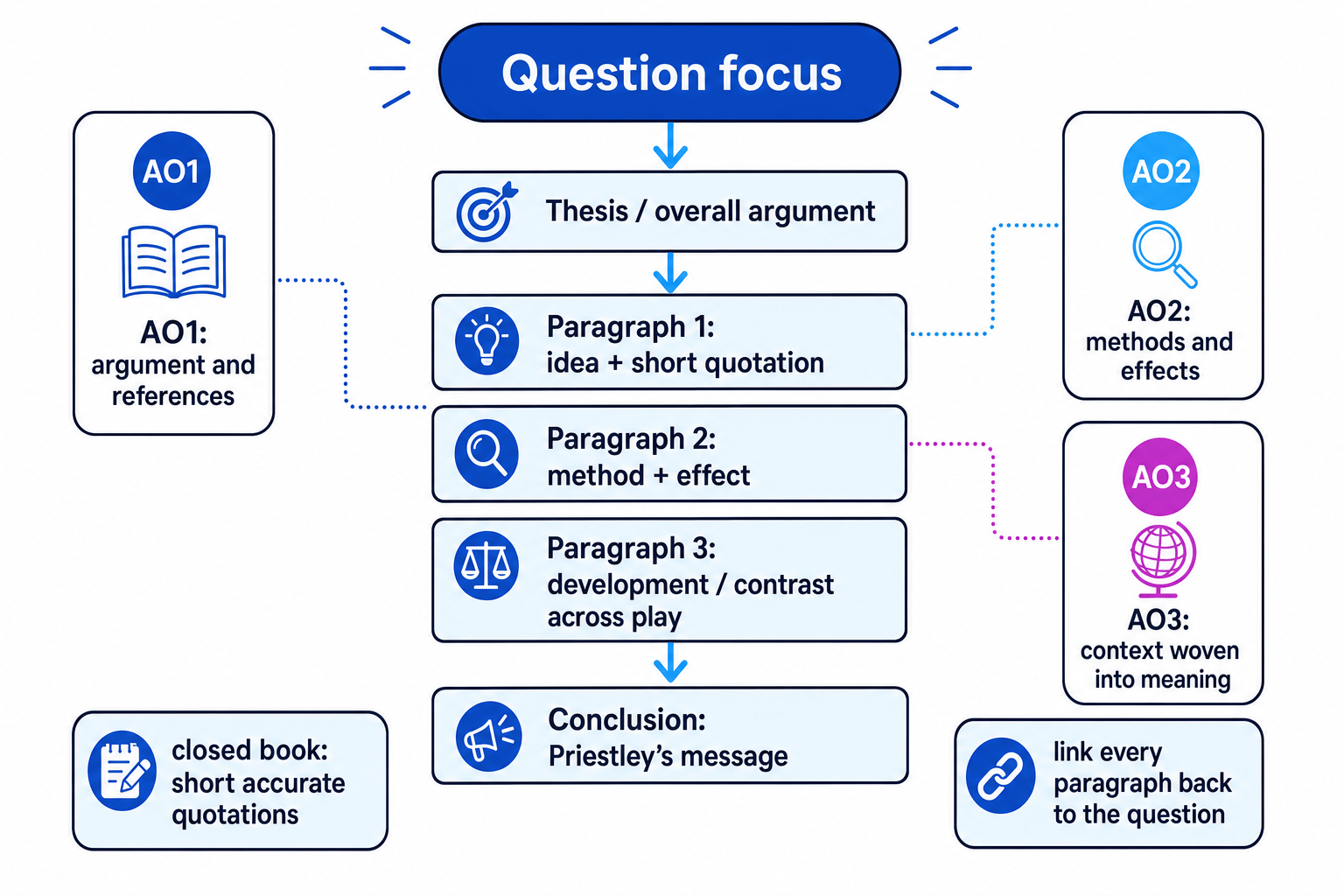
This diagram shows the basic architecture of a strong essay: question focus first, then a thesis, then analytical paragraphs that weave in references, methods, effects and context.
Start by decoding the question
Before you write, you need to understand exactly what the question is asking.
Question focus
The question focus is the key idea, character, relationship or theme you must keep returning to. In An Inspector Calls, common focuses include responsibility, social class, gender, age, selfishness, guilt, change, or Inspector Goole.
A model essay stays tightly focused. It may mention other themes, but only when they help answer the exact question.
Turning a question into a thesis
Question: How does Priestley present ideas about responsibility in An Inspector Calls?
- Identify the central focus: the question is about responsibility, so the essay must discuss who accepts it, who rejects it, and what Priestley wants the audience to learn.
- Decide Priestley’s overall message: Priestley suggests that society must be based on collective responsibility, not selfish individualism.
- Turn that into a thesis: Priestley presents responsibility as a moral duty that the older Birlings reject but the younger generation begin to understand, encouraging the audience to support social change.
Writing a character essay by accident
If the question is about responsibility, do not simply write one paragraph on Mr Birling, one on Sheila, one on Eric, and one on the Inspector unless each paragraph clearly proves something about responsibility.
The paragraph formula: idea, evidence, method, effect, link
A strong paragraph is not just “point + quote”. It needs to explain the writer’s choices.
Method
A method is a deliberate choice made by the writer, such as language, stage directions, structure, dramatic irony, symbolism, contrast, or the form of the play.
Dramatic irony
Dramatic irony happens when the audience knows something that a character does not. In An Inspector Calls, Priestley uses it when Mr Birling confidently says things the 1945 audience would know are wrong.
A model paragraph usually includes:
- a clear point that answers the question
- a short, accurate quotation or textual reference
- a named method, used naturally
- analysis of meaning and effect
- a link to Priestley’s wider message or context
Building a responsibility paragraph
Focus: Mr Birling rejects responsibility.
- Choose a precise point: Priestley presents Mr Birling as selfish because he sees responsibility only in terms of family and business, not society.
- Select a short quotation: Mr Birling claims that “a man has to mind his own business and look after himself and his own”.
- Analyse the method: the possessive phrase “his own” narrows his moral world to private property and family, while the phrase “mind his own business” makes social concern sound like interference.
- Link to context and message: this reflects capitalist individualism, which Priestley criticises because the Inspector later insists, “We are members of one body.”
- Shape it into a paragraph:
Priestley presents Mr Birling as a symbol of selfish capitalist responsibility. When Birling argues that “a man has to mind his own business and look after himself and his own”, the possessive phrase “his own” reveals how limited his morality is: he thinks duty stops at the boundaries of family and property. Priestley makes this attitude seem dangerously narrow by contrasting it with the Inspector’s later declaration that “We are members of one body.” Through this contrast, Priestley criticises individualism and encourages the audience to accept a more collective view of society.
Model essay: responsibility
Here is a compact model essay on one of the most central themes. Notice how it keeps returning to Priestley’s purpose.
Question
How does Priestley present ideas about responsibility in An Inspector Calls?
Model response
Priestley presents responsibility as the moral test of the play. Through the Inspector’s investigation, he exposes how the wealthy Birling family have harmed Eva Smith by treating her as someone beneath them. Priestley contrasts the older generation’s refusal to accept blame with the younger generation’s growing guilt, using this divide to argue that society must become more compassionate and collective.
At the start of the play, Mr Birling represents the selfish rejection of social responsibility. He tells Gerald and Eric that “a man has to mind his own business and look after himself and his own”. The repeated focus on the individual makes Birling sound narrow-minded and possessive, as if duty only belongs inside the family or business. Priestley makes this attitude seem foolish through dramatic irony: Birling also claims the Titanic is “unsinkable, absolutely unsinkable”, which the audience knows is false. This undermines his authority, encouraging the audience to distrust his confident capitalist views. In this way, Priestley presents irresponsibility not just as personal cruelty, but as part of a wider social and political problem.
Priestley also presents responsibility through Sheila’s development. At first, Sheila has used her class power selfishly, having Eva dismissed from Milwards because she felt jealous and humiliated. However, unlike her parents, she quickly accepts guilt, saying, “I know I’m to blame.” The simple directness of this sentence shows her honesty and moral growth. She also recognises Eva’s humanity when she says, “But these girls aren’t cheap labour — they’re people.” The contrast between “cheap labour” and “people” challenges the capitalist habit of reducing workers to profit. Through Sheila, Priestley suggests that change is possible when people honestly confront their actions.
The Inspector is Priestley’s strongest voice for collective responsibility. Near the end of the play, he warns that “We are members of one body. We are responsible for each other.” The metaphor of “one body” presents society as interconnected: if one part suffers, the whole body is damaged. His final warning of “fire and blood and anguish” sounds almost prophetic, suggesting that a society built on selfishness will face terrible consequences. For a 1945 audience, after two world wars, this warning would feel especially powerful. Priestley uses the Inspector to argue that social responsibility is not optional; it is necessary for survival.
By the end of the play, Priestley leaves the audience with a choice. Mr and Mrs Birling try to avoid guilt once they think the Inspector was not “real”, while Sheila and Eric understand that “the fact remains” they behaved wrongly. This structural contrast between generations presents responsibility as the foundation of moral progress. Priestley’s message is clear: whether or not the Inspector is a real police officer matters less than whether the characters, and the audience, accept their duty to others.
Why this model works
The model essay works because it does three things at once.
First, it keeps a clear argument: Priestley supports collective responsibility and attacks selfishness. Second, it uses short quotations accurately rather than trying to remember long chunks of the play. Third, it analyses Priestley’s methods, especially contrast, dramatic irony, metaphor and structure.
Structure
Structure means the way a text is organised. In drama, this includes the order of revelations, entrances and exits, contrasts between characters, the ending, and how tension develops across the play.
For An Inspector Calls, structure is especially important because the play is built like an investigation. Each character is exposed in turn, so Priestley makes the audience see responsibility as shared rather than isolated.
A flexible sentence frame
Try this pattern when you are stuck: Priestley uses [method] in “[quotation]” to present [idea], which encourages the audience to [response].
Weaving in context without bolting it on
Context
Context means the relevant circumstances around the text: when it was set, when it was written, and the social or political ideas Priestley was responding to.
An Inspector Calls is set in 1912 but was first performed in 1945. Priestley uses that gap deliberately. The audience can judge the Birlings’ pre-war confidence with knowledge of the disasters that followed.
Good context should explain meaning. Weak context sounds like a history paragraph dropped into the essay.
Making context analytical
Basic context sentence: Priestley was a socialist.
- Connect the context to a precise idea: socialism matters because the play criticises selfishness and promotes collective responsibility.
- Attach it to a quotation or moment: the Inspector’s “We are members of one body” expresses that collective ideal.
- Explain the effect on the audience: Priestley encourages a 1945 audience, rebuilding after war, to support a fairer society.
- Write it analytically: The Inspector’s metaphor “We are members of one body” reflects Priestley’s socialist belief that society should be collective rather than individualistic, a message that would have felt urgent to a 1945 audience after the shared suffering of war.
Context dumping
Do not write a whole paragraph about 1912, 1945, capitalism, socialism or gender roles unless you are linking every sentence to the question and to Priestley’s choices.
Adapting the model to other questions
You should not memorise the responsibility essay and force it into every answer. Instead, learn the moves it makes.
If the question is about Sheila, use the same evidence but make her development the centre of the argument. If the question is about social class, focus more on Eva as an exploited worker and on phrases like “cheap labour” and “girls of that class”. If the question is about the Inspector, make his role as moral judge, dramatic catalyst and voice of Priestley the main thread.
Dramatic catalyst
A dramatic catalyst is a character or event that causes change in the action. Inspector Goole is a catalyst because his arrival forces the Birlings’ secrets and moral failures into the open.
The best essays feel planned, not random. Even if you adapt a model paragraph, you must reshape the opening and closing sentences so they answer the exact question.
Mini model introductions
A good introduction should be short. It should not retell the plot. It should state your argument.
Responsibility question
Priestley presents responsibility as the central moral lesson of the play. By contrasting the older generation’s selfishness with Sheila and Eric’s growing guilt, he criticises capitalist individualism and encourages the audience to accept a more collective society.
Sheila question
Priestley presents Sheila as one of the play’s clearest examples of moral change. Through her movement from privileged immaturity to honest self-criticism, he suggests that the younger generation may be capable of building a fairer society.
Inspector question
Priestley presents Inspector Goole as more than a realistic police officer: he functions as a moral force within the play. Through his controlled questioning and final warning, Priestley challenges both the Birlings and the audience to recognise their responsibility for others.
In the exam
- Begin with a clear thesis that names Priestley and answers the exact question.
- Use short, accurate quotations from memory, then analyse the method and effect rather than adding lots of extra plot.
- Weave context into your analysis by explaining how it strengthens Priestley’s message.
- End by returning to the writer’s purpose: what does Priestley want the audience to think, feel or change?
Check yourself
- Can you turn a question about a theme or character into a one-sentence thesis?
- Can you analyse one short quotation by naming a method and explaining its effect?
- Can you add context in a way that supports your argument rather than interrupts it?
