What you'll learn
- Which scenes in Macbeth are most useful to revise for AQA GCSE English Literature.
- How each key scene develops character, theme and dramatic tension.
- Short, memorable quotations you can use in a closed-book exam.
- How to write about scenes as part of Shakespeare’s structure, not just as isolated moments.
First: what makes a scene “key”?
In Shakespeare, an act is a large section of the play, and a scene is a smaller unit within an act. Scenes often change when the location, time, or group of characters changes.
A scene is “key” when it does important work in the play: it might introduce a major idea, change a character’s direction, reveal conflict, or create a turning point in the plot.
Key scene
A key scene is a moment in the play that strongly shapes the audience’s understanding of character, theme, mood, or structure.
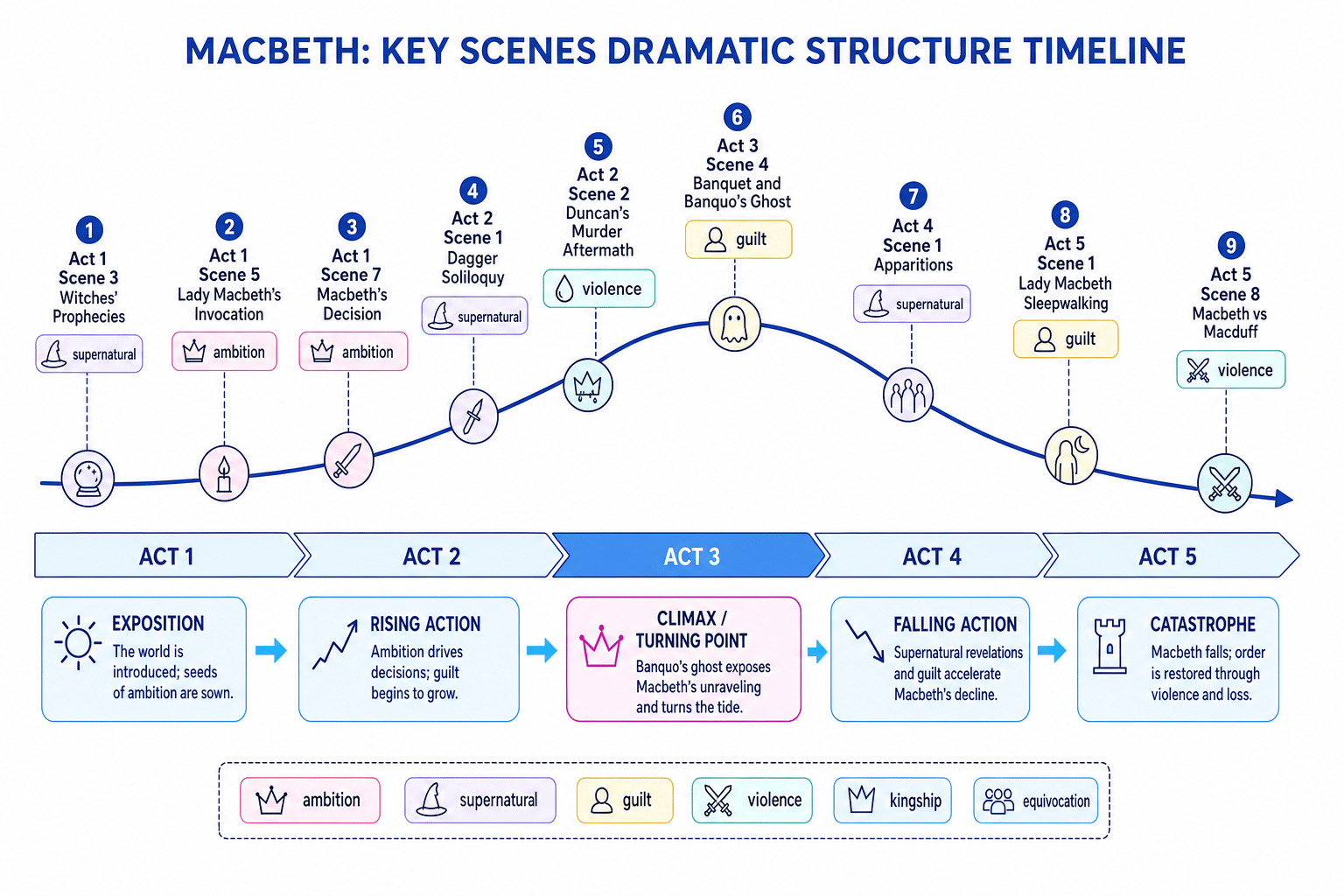
For Macbeth, the key scenes are especially useful because Shakespeare builds the tragedy through clear stages: temptation, choice, crime, guilt, tyranny, collapse and punishment.
Tragedy
A tragedy is a play in which a central character’s flaws and choices lead to suffering, death, and a final restoration of order.
The diagram below shows how the main scenes fit into the play’s dramatic structure.
Think structurally
In the exam, strong answers do not just say “this scene shows ambition”. They explain where the scene comes in the play and how it changes what happens next.
Act 1 Scene 3: the witches’ prophecies
This is Macbeth’s first meeting with the witches. They greet him as “Thane of Glamis”, “Thane of Cawdor” and “king hereafter”.
The scene is key because it plants the idea of kingship in Macbeth’s mind. Shakespeare does not show Macbeth deciding to murder Duncan immediately, but he does show Macbeth becoming fascinated by the possibility.
Macbeth says:
“This supernatural soliciting / Cannot be ill, cannot be good”
The noun phrase “supernatural soliciting” suggests Macbeth feels tempted or invited by forces beyond normal human control. The balanced structure “cannot be ill, cannot be good” shows confusion: he cannot decide whether the prophecy is evil or harmless.
This scene also introduces equivocation, where language is deliberately double-sided or misleading.
Equivocation
Equivocation means using language that can be understood in more than one way, often to deceive someone without technically lying.
The witches’ prophecies are dangerous because they sound clear but hide consequences. Macbeth hears “king hereafter” and begins to imagine power, but he does not understand the moral cost.
Act 1 Scene 5: Lady Macbeth reads the letter
Lady Macbeth reads Macbeth’s letter about the witches and immediately begins thinking about power. She worries Macbeth is “too full o’ th’ milk of human kindness” to seize the crown violently.
Her famous command is:
“Come, you spirits / That tend on mortal thoughts, unsex me here”
The imperative “Come” makes her sound forceful and commanding. “Unsex me” suggests she wants to reject Jacobean expectations of femininity, such as softness, motherhood and obedience. Shakespeare presents ambition as something that distorts natural identity and moral boundaries.
She also advises Macbeth:
“look like th’ innocent flower, / But be the serpent under’t”
This image contrasts appearance and reality. The “flower” suggests beauty and innocence, while the “serpent” suggests deceit, danger and the biblical tempter in the Garden of Eden.
Useful scene link
Act 1 Scene 5 links beautifully to Act 5 Scene 1. Lady Macbeth begins by calling on darkness and cruelty, but later she is destroyed by guilt and cannot escape the imagined blood on her hands.
Act 1 Scene 7: Macbeth decides to murder Duncan
This is one of the most important scenes in the play because Macbeth knows the murder is wrong before he commits it.
In his soliloquy, he admits:
“I have no spur / To prick the sides of my intent, but only / Vaulting ambition”
Soliloquy
A soliloquy is a speech where a character speaks their thoughts aloud, usually alone on stage, so the audience can understand their private feelings.
The metaphor of a rider and horse suggests Macbeth’s ambition is uncontrolled. “Vaulting” implies leaping too far and falling, which foreshadows his downfall. He has no moral reason to kill Duncan; only ambition pushes him.
Lady Macbeth then attacks his masculinity:
“When you durst do it, then you were a man”
This shows manipulation. She connects murder with manhood, pressuring Macbeth to prove himself through violence.
Analysing Macbeth’s decision
- Macbeth’s soliloquy shows he understands Duncan is a good king and guest, so his choice is morally conscious rather than accidental.
- The metaphor “vaulting ambition” presents ambition as unstable and excessive, suggesting Macbeth’s desire for power will overreach itself.
- Lady Macbeth’s challenge to his masculinity changes the scene from private doubt to external pressure, helping Shakespeare show how persuasion and personal weakness combine.
- Structurally, this scene is crucial because it moves Macbeth from temptation to action: after this point, the murder becomes planned rather than merely imagined.
Act 2 Scene 1: the dagger soliloquy
Before murdering Duncan, Macbeth sees—or imagines—a dagger:
“Is this a dagger which I see before me”
This scene is key because Shakespeare makes the audience watch Macbeth’s mind unravel before the murder. The dagger may be a hallucination, a supernatural sign, or a symbol of Macbeth’s violent desire.
He asks:
“A dagger of the mind, a false creation, / Proceeding from the heat-oppressed brain?”
The phrase “heat-oppressed brain” suggests mental pressure and feverish guilt. Even before the murder, Macbeth’s mind is disturbed.
Symbolism
Symbolism is when an object, image or action represents a bigger idea. The dagger symbolises Macbeth’s temptation, violence and disturbed conscience.
Act 2 Scene 2: after Duncan’s murder
The murder itself happens offstage, but the aftermath is shown in detail. This is typical of Shakespeare’s dramatic technique: the audience sees the psychological consequences rather than the physical act.
Macbeth says:
“Will all great Neptune’s ocean wash this blood / Clean from my hand?”
The reference to “Neptune”, the Roman god of the sea, makes Macbeth’s guilt seem enormous. The blood becomes a motif, a repeated image linked to guilt and violence.
Motif
A motif is a repeated image, idea or symbol that develops meaning across a text.
Lady Macbeth responds:
“A little water clears us of this deed”
At this point, she thinks guilt can be washed away physically. Shakespeare later proves her wrong in the sleepwalking scene.
Forgetting the contrast
Do not write that Macbeth and Lady Macbeth feel the same after Duncan’s murder. Macbeth is immediately horrified and spiritually disturbed; Lady Macbeth tries to be practical and dismissive.
Act 3 Scene 4: Banquo’s ghost at the banquet
This is a public turning point. Macbeth is now king, but he cannot enjoy kingship because he is haunted by guilt and fear.
When Banquo’s ghost appears, Macbeth cries:
“Never shake / Thy gory locks at me”
The adjective “gory” links Banquo’s ghost to blood and violence. Macbeth’s hidden crime becomes visible through his behaviour, even if the nobles cannot see the ghost.
This scene is also full of dramatic irony.
Dramatic irony
Dramatic irony happens when the audience knows something that some characters on stage do not.
The audience knows Macbeth arranged Banquo’s murder, but the guests do not. This makes Macbeth’s panic tense and revealing. Lady Macbeth tries to cover for him, but his authority is damaged.
Macbeth later says:
“I am in blood / Stepp’d in so far”
The image suggests he is trapped in a river of blood. Structurally, this scene shows Macbeth moving from guilty murderer to tyrant: instead of turning back, he chooses more violence.
Act 4 Scene 1: the apparitions
Macbeth returns to the witches, showing how dependent he has become on the supernatural. The apparitions tell him to “Beware Macduff”, but also that “none of woman born / Shall harm Macbeth” and that he will not be defeated until Birnam Wood moves to Dunsinane.
These prophecies create false confidence. Macbeth thinks he is safe because he interprets the words too literally.
The scene ends with his terrifying decision:
“The very firstlings of my heart shall be / The firstlings of my hand”
This means he will act on impulse immediately. Shakespeare shows Macbeth has lost the moral hesitation he had in Act 1 Scene 7. Thought and violence have become dangerously close.
Macbeth’s decline
Macbeth begins the play thinking deeply before acting. By Act 4, he acts violently before thinking morally.
Act 5 Scene 1: Lady Macbeth sleepwalks
Lady Macbeth’s sleepwalking scene reverses her earlier confidence. She tries to wash imagined blood from her hands:
“Out, damned spot!”
The “spot” is not physically there, but it represents guilt. The adjective “damned” suggests spiritual punishment and links her guilt to ideas of sin and hell.
She also says:
“All the perfumes of Arabia will not sweeten this little hand”
This echoes Macbeth’s earlier fear that the ocean could not wash his hands clean. The sensory image of smell suggests guilt has become inescapable.
Her line:
“What’s done cannot be undone”
is tragic because it recognises the truth too late. The couple cannot reverse Duncan’s murder or the chain of violence that followed.
Act 5 Scenes 5 and 8: despair and defeat
In Act 5 Scene 5, Macbeth hears that Lady Macbeth is dead and responds with the “Tomorrow” speech:
“Out, out, brief candle!”
The metaphor presents life as fragile and temporary. Macbeth’s ambition has not brought meaning; it has emptied life of value.
He concludes life is:
“a tale / Told by an idiot, full of sound and fury, / Signifying nothing”
This is a bleak moment of nihilism, meaning the belief that life has no purpose or value.
In Act 5 Scene 8, Macduff reveals he was:
“from his mother’s womb / Untimely ripped”
This fulfils the witches’ prophecy in an unexpected way. Macbeth was not invincible; he misunderstood equivocal language.
Macbeth still refuses to surrender:
“Lay on, Macduff”
His courage remains, but it is now separated from honour. Malcolm’s final description of Macbeth as a “dead butcher” helps restore moral order at the end of the tragedy.
How to use key scenes in essays
You do not need to retell the whole plot. Instead, choose scenes that let you track development.
For example, if the question is about ambition, you might move from:
- Act 1 Scene 3: the witches awaken Macbeth’s ambition.
- Act 1 Scene 7: Macbeth recognises “vaulting ambition” but chooses murder.
- Act 4 Scene 1: ambition has become tyranny and impulsive violence.
- Act 5 Scene 5: ambition has led to emptiness and despair.
This gives your answer a clear structure and helps you show a whole-play understanding.
In the exam
- Choose two or three key scenes that show change over time, rather than writing everything you know about one moment.
- Embed short quotations accurately, then zoom in on one method such as metaphor, symbolism, soliloquy, dramatic irony or structure.
- Link each scene back to Shakespeare’s wider message about ambition, guilt, kingship, the supernatural or violence.
Check yourself
- Which scene shows Macbeth consciously deciding to murder Duncan, and why is it structurally important?
- How does the blood motif change between Act 2 Scene 2 and Act 5 Scene 1?
- Why are the witches’ apparitions in Act 4 Scene 1 an example of equivocation?
