Planning is the single most important step in writing a high-scoring GCSE English Literature essay. A brilliant plan transforms your writing from a chaotic list of memorized facts into a coherent, sophisticated argument.
In this guide, you will learn how to design flexible, high-impact essay plans for An Inspector Calls that secure marks for structural cohesion, deep textual analysis, and historical context.
What you'll learn
- How to construct a powerful, thesis-driven introduction that answers the "how" and "why" of any prompt.
- How to map your essay paragraphs directly to J.B. Priestley’s dramatic arc.
- How to integrate writer’s methods and social context seamlessly into your planning routine.
The Philosophy of Planning: Why Your Plan is Your Map
Under timed exam conditions, it is tempting to start writing immediately. However, AQA examiners award high marks for well-structured arguments. This is assessed under AO1, which requires a "clear, explained, structured response" to the task.
If you write without a plan, your essay is likely to become a plot summary. A plan acts as a strategic roadmap, ensuring that every paragraph you write directly supports your central thesis.
Thesis Statement
A thesis statement is a single, concise argument that directly answers the essay prompt and outlines your main perspective. It moves beyond plot summary to explain why the writer created the text and what moral message they wanted to deliver.
To write a great thesis statement, you must ask yourself: Why did Priestley write this play, and how does this specific character or theme help him deliver his message?
Priestley's Message is Your North Star
Every question on the exam paper is a question about Priestley's political message. Whether the prompt is about Arthur Birling, Sheila, the Inspector, gender, or social class, your essay must demonstrate how Priestley uses these dramatic elements to promote Socialism and condemn Edwardian Capitalist greed.
Mapping Your Plan to the Dramatic Arc
A powerful way to organize your essay is to follow the chronological structure of the play itself. Priestley designed An Inspector Calls as a "well-made play"—a genre of drama characterized by a tight, logical plot that builds to a climax.
Your essay should mirror this structure by exploring how Priestley introduces, unravels, and ultimately resolves his central ideas.
Dramatic Arc
The dramatic arc is the chronological trajectory of a play's plot. In An Inspector Calls, this trajectory moves from initial complacency, through the disruption of secrets, to a final moral warning and division.
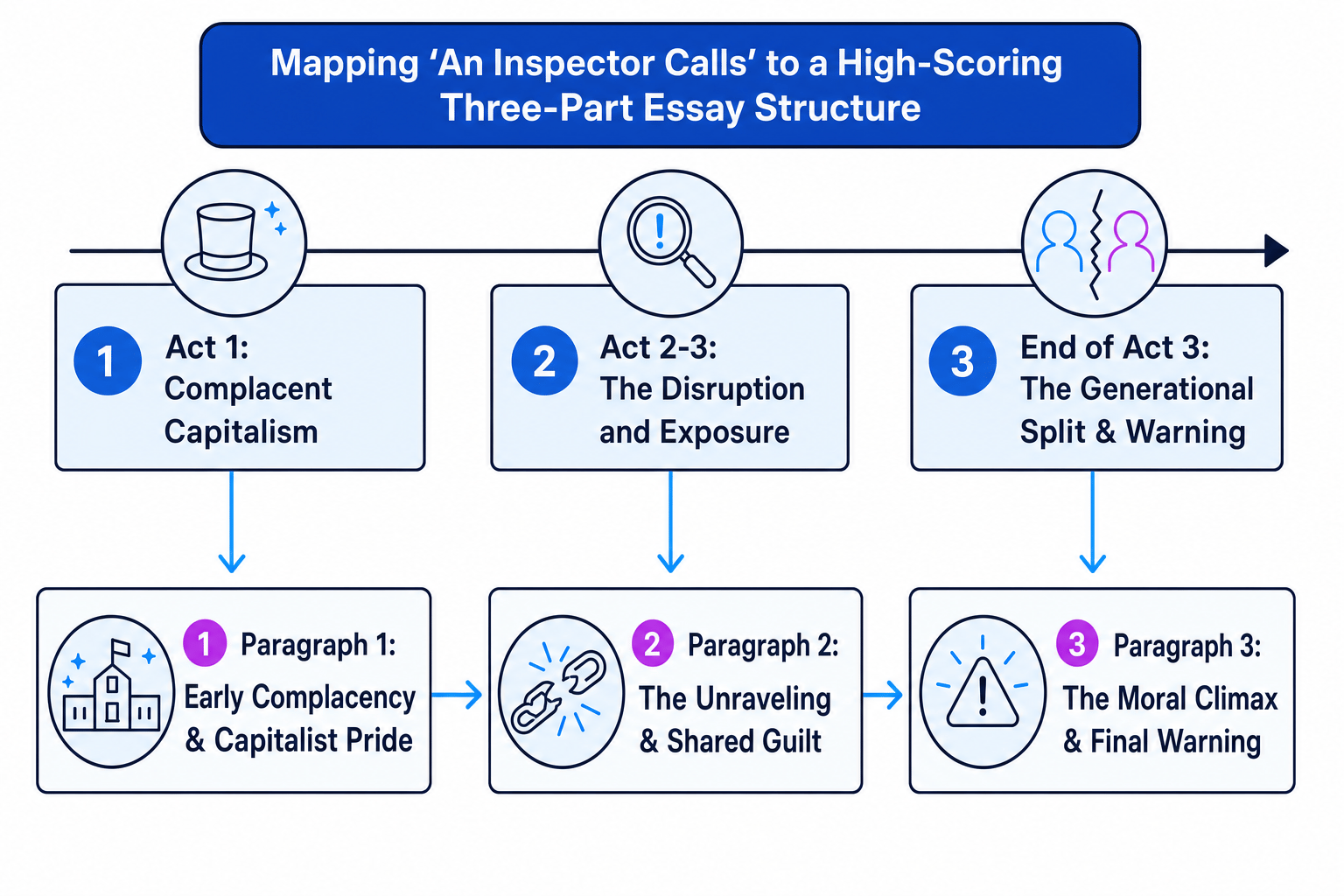
By dividing your essay into three main paragraphs that track this arc, you show the examiner that you understand the play as a complete piece of theatre:
- Paragraph 1 (The Exposition): Explore the initial status quo. This is where Priestley establishes the capitalist pride, complacency, and moral ignorance of characters like Mr. Birling and Gerald Croft.
- Paragraph 2 (The Rising Action/Disruption): Analyze how the Inspector's arrival disrupts this complacency, peeling back the layers of respectability to expose systemic exploitation and shared responsibility.
- Paragraph 3 (The Climax & Warning): Examine the aftermath of the Inspector’s exit, the split between the generations, and the prophetic warning of what will happen if society fails to change.
Designing the Plan: The Chronological-Thematic Formula
When planning under timed conditions, spend 5 to 7 minutes mapping out your structure. For each of your three body paragraphs, your plan should contain three key elements:
- The Chronological Focus: Where in the play is this paragraph looking?
- Evidence & Methods: Which two precise, short quotes and structural techniques will you analyze? (AO2)
- Social/Historical Context: How does this relate to the world of 1912 (when the play is set) versus 1945 (when the play was written and first performed)? (AO3)
The 'Character Profile' Pitfall
Many students plan essays by writing down everything they know about a character (e.g., "Sheila is childish at the start, then she gets sad, then she stands up to her parents"). This is a plot summary, not an analytical argument. You must analyze the character as a dramatic construct designed by Priestley to teach a lesson to the audience.
Worked Example: Planning an Essay on Social Responsibility
Let's look at how to put these concepts into practice. This worked example walks through the creation of a high-scoring plan.
Planning an essay on the theme of Social Responsibility
Let's construct a comprehensive essay plan in response to the prompt: "How does Priestley present ideas about social responsibility in An Inspector Calls?"
- Formulate a clear thesis statement answering the "how" and "why": Write a central argument stating that Priestley uses the play as a political allegory to expose the moral bankruptcy of Edwardian Capitalist individualism, arguing instead for a Socialist framework of collective social responsibility to prevent societal ruin.
- Draft Paragraph 1 targeting the initial complacent evasion of responsibility: Focus on the exposition of Act 1, analyzing Mr. Birling's rejection of collective responsibility when he states a man must "mind his own business and look after himself." Link this to context by showing how Priestley exposes the self-satisfied, capitalist greed of 1912 to a post-war 1945 audience who had recently voted for a Welfare State.
- Draft Paragraph 2 targeting the exposure of systemic moral complicity: Focus on the rising action of Acts 2 and 3, exploring how the Inspector reveals that the family's actions are interconnected. Use Mrs. Birling's dismissive phrase "girls of that class" to demonstrate how class prejudice and moral blindness are used to shield the wealthy from their social obligations.
- Draft Paragraph 3 targeting the generational split and the final moral ultimatum: Focus on the play's climax and the Inspector's exit, highlighting the split between the older Birlings (who reject responsibility once they think they can avoid a public scandal) and the younger generation (who accept guilt). Incorporate Goole's final warning that if humanity does not learn that "we are members of one body," they will be taught it in "fire and blood and anguish," a powerful dramatic irony reflecting the horrors of the two World Wars.
- Synthesize a conclusion that restates the moral purpose of the play: Outline a final thought showing that the physical departure of the Inspector is a test of moral growth, proving that responsibility is not a temporary legal inconvenience but an active, lifelong ethical choice.
Adapting Plans for Character Prompts
You can easily adapt this same three-part chronological structure for character-focused questions. Let's look at how to outline two of the most common character prompts on the exam.
Essay Plan 1: Sheila Birling
Your thesis statement for Sheila should argue that she acts as the play's moral conscience and a symbol of hope. She represents the capacity of the younger generation to reject Capitalist indoctrination and adopt Socialist ideals.
- Paragraph 1 (Exposition): Sheila as a submissive, materialistic Capitalist consumer in Act 1.
- Evidence: Stage directions ("pretty girl in her early twenties, very pleased with life"), her reaction to the engagement ring ("Now I really feel engaged").
- Analysis/Context: She represents the superficiality of Edwardian middle-class women, whose worth was defined by marriage and consumption.
- Paragraph 2 (Rising Action): Sheila's confrontation with her complicity and her immediate remorse in Act 1 & 2.
- Evidence: "These girls aren't cheap labour - they're people", her genuine distress at her role in Eva's firing from Milwards.
- Analysis/Context: Sheila becomes the first character to humanize the working class, rejecting her father's commodification of labor.
- Paragraph 3 (Climax/Aftermath): Sheila as the Inspector's surrogate and moral champion in Act 3.
- Evidence: "You're pretending everything's just as it was before", her refusal to accept Gerald's ring.
- Analysis/Context: She represents the post-war hope of 1945. By rejecting Gerald, she rejects the historical alliances of capitalist dynasties.
Essay Plan 2: Gerald Croft
Your thesis statement for Gerald should argue that he represents the stubborn, self-serving nature of the ruling elite. Despite his superficial charm and fleeting sympathy, his ultimate concern is the preservation of his own social and financial status.
- Paragraph 1 (Exposition): Gerald's alignment with Mr. Birling's capitalist views in Act 1.
- Evidence: "I believe you're right, sir", his easy acceptance of Birling's speech on individualism.
- Analysis/Context: Gerald represents the landed gentry marrying into industrial wealth, reinforcing class power structures.
- Paragraph 2 (Rising Action): Gerald's complex relationship with Daisy Renton in Act 2.
- Evidence: "I became at once the most important person in her life", his admission of his feelings.
- Analysis/Context: He demonstrates Edwardian double standards, using his socio-economic power to exploit a vulnerable working-class woman under the guise of "chivalry."
- Paragraph 3 (Climax/Aftermath): Gerald's desperate search for a loophole to escape responsibility in Act 3.
- Evidence: "Everything's all right now, Sheila", his quick declaration that the Inspector was a hoax.
- Analysis/Context: He symbolizes the ruling class's refusal to change. He chooses the comfort of status quo over moral reform, warning 1945 audiences that the upper classes cannot be trusted to self-regulate.
The Rule of Three
For every paragraph you plan, select exactly two key quotes and one writer's method. This constraint keeps your timed writing incredibly dense and analytical, preventing you from drifting into descriptive plot summaries.
In the exam
- Spend 5 to 7 minutes planning: Do not skip this step. A well-planned essay is always faster to write and easier to read.
- Write your thesis statement first: Draft it at the top of your planning space. Refer back to it constantly while writing to keep your essay focused.
- Structure chronologically: Divide your response into three main points that trace the journey from complacency (Act 1), to exposure (Acts 2 & 3), to the final generational split and moral warning (End of Act 3).
- Weave context into your plan: Do not treat context as a separate history paragraph. Instead, plan to link Edwardian capitalist hubris (1912) to the lessons of the post-war welfare state (1945) inside every single point.
Check yourself
- Can you write a thesis statement for Arthur Birling that focuses on his dramatic purpose as a capitalist construct rather than just describing his personality?
- Do you know which two key quotes you would use for each of the three stages of Sheila Birling's character development?
- How does the difference between the setting of the play (1912) and the year it was written (1945) directly support your argument on social responsibility?
