Planning is the single most important step to securing a high grade in your GCSE English Literature exam. Under timed conditions, it is incredibly easy to lose your way, repeat yourself, or forget to mention crucial context.
A well-structured essay plan acts as a roadmap, ensuring your argument remains focused, clear, and logically progressive. It keeps your writing structured, helps you manage your time, and guarantees you meet all the assessment objectives (AOs) required for a top mark.
What you'll learn
- How to deconstruct a Macbeth exam prompt to find the core debate.
- How to formulate a powerful, thesis-led conceptual argument.
- How to use a 3-part blueprint to balance the extract with the wider play.
- How to naturally weave in language analysis (AO2) and Jacobean context (AO3).
Deconstructing the AQA Exam Prompt
In your exam (Paper 1, Section A), you will be presented with a short printed extract from Macbeth and an essay question. The question will always ask you to do two things:
- Analyse a specific character or theme in the printed extract.
- Explore how that character or theme is presented in the play as a whole.
To get a Level 5 or 6 (the highest mark bands), your essay must not feel like two separate answers. It needs to be a unified, continuous argument.
Conceptual Line of Argument
A conceptual line of argument (often called the "Golden Thread") is a central idea that runs through your entire essay. Every paragraph you write should connect back to this main idea, proving it from different angles as the play progresses.
Before you start writing, you must define this central idea by drafting a thesis statement.
Thesis Statement
A thesis statement is a one- or two-sentence summary of your central argument. It directly answers the prompt by explaining what Shakespeare is presenting, how he uses dramatic methods to do it, and why he is showing this to his Jacobean audience (his moral purpose).
The Three-Stage Essay Blueprint
The most effective way to structure your 45-minute essay is using a three-stage analytical arc. This structure allows you to track a character's journey or the development of a theme from its introduction, through its complication, to its ultimate tragic resolution.
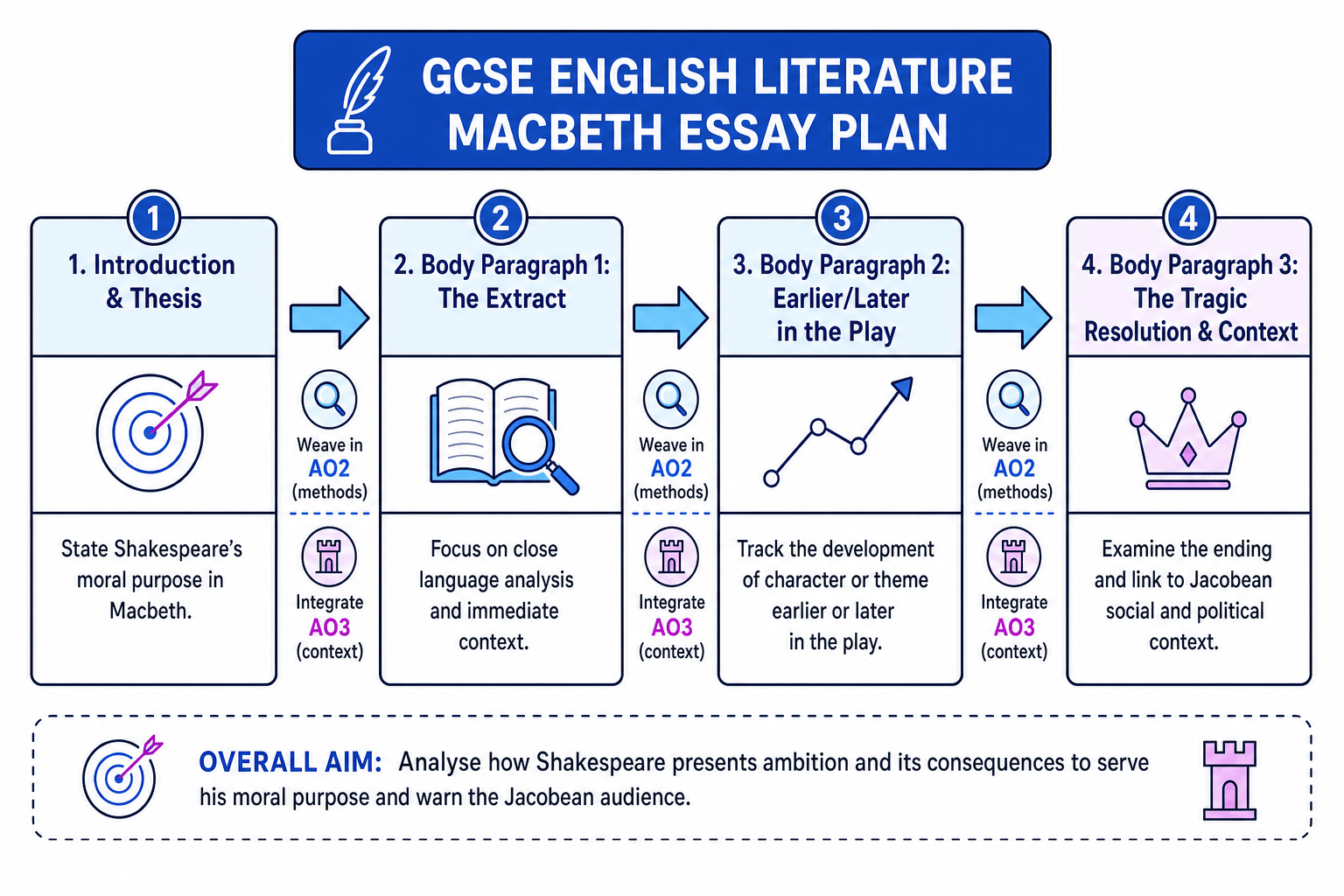
This blueprint contains five parts in total:
- Introduction: State your thesis statement clearly. Outline how Shakespeare uses the character or theme to deliver a moral message.
- Body Paragraph 1 (The Extract): Focus deeply on the printed extract. Conduct close word-level analysis (AO2) of key quotes, identifying techniques and their psychological effects.
- Body Paragraph 2 (Earlier / Elsewhere in the Play): Shift focus to another part of the play. Compare or contrast how this theme or character behaves elsewhere, tracking structural changes.
- Body Paragraph 3 (The Tragic Resolution): Examine the end of the play. How does this theme or character wrap up? This is where you focus heavily on Shakespeare's moral warning and Jacobean context (AO3).
- Conclusion: Briefly summarize how your argument has proved your thesis, ending with a final thought on Shakespeare's ultimate message.
The 'Why' is Key
To score highly on AO3 (Context), never treat historical facts like a history lesson. Always link context to Shakespeare's artistic choices. Ask yourself: Why did Shakespeare choose to show this happening to this character at this specific point in history?
Worked Example: Planning an Essay on Ambition
Let's walk through how to construct an essay plan from scratch using a typical GCSE prompt.
Planning an essay on ambition
Prompt: Starting with this extract [Act 1, Scene 5: Lady Macbeth’s "unsex me here" soliloquy], write about how Shakespeare presents ambition in Macbeth.
-
Deconstruct the prompt and draft a thesis statement. Instead of writing a basic point like "Shakespeare shows that ambition is bad," we must construct a sophisticated thesis that answers what, how, and why.
- Drafted Thesis: "Shakespeare presents ambition as a corrupting, unnatural force that leads to psychological ruin. While initial ambition is fueled by transgressive desires that upset the natural order, Shakespeare ultimately demonstrates that violating God's will results in self-destruction, thereby warning the Jacobean audience against treason."
-
Select and analyze evidence from the extract. Now, zoom in on the provided extract (Act 1, Scene 5) and choose two highly analytical quotes.
- Quote 1: "unsex me here"
- Method: Imperative verb ("unsex"), supernatural imagery.
- Analysis: Lady Macbeth attempts to strip away her feminine empathy, recognizing that traditional Jacobean femininity is incompatible with her ruthless ambition. She aligns herself with the witches, transgressing gender boundaries.
- Quote 2: "take my milk for gall"
- Method: Juxtaposition, visceral metaphor.
- Analysis: Replacing a symbol of maternal nurturing ("milk") with bitter poison ("gall") highlights the unnatural, toxic distortion caused by unchecked ambition.
- Quote 1: "unsex me here"
-
Map out whole-play anchor points (earlier or elsewhere). Select two moments from elsewhere in the play to contrast or expand on your extract analysis.
- Anchor Point 1 (Act 1, Scene 7): Macbeth's soliloquy where he admits he has "no spur / To prick the sides of my intent, but only / Vaulting ambition, which o'erleaps itself / And falls on th' other."
- Analysis: Macbeth's horse-riding metaphor reveals his self-awareness; he knows that ambition is an unstable, uncontrollable force that inevitably leads to disaster.
- Anchor Point 2 (Act 5, Scene 1): Lady Macbeth's sleepwalking scene ("Out, damned spot!").
- Analysis: Contrast her early control in the extract with her complete mental collapse here. The "spot" represents her indelible guilt. Ambition has destroyed her mind, reverting her to a state of absolute vulnerability.
- Anchor Point 1 (Act 1, Scene 7): Macbeth's soliloquy where he admits he has "no spur / To prick the sides of my intent, but only / Vaulting ambition, which o'erleaps itself / And falls on th' other."
-
Integrate context (AO3) to anchor the tragic resolution. Conclude your plan by looking at the play's ending (Macbeth's death, Malcolm's restoration of order) and tying it to Jacobean context.
- Contextual link: The Divine Right of Kings and the Great Chain of Being.
- Analysis: By killing Duncan, the Macbeths committed regicide and disrupted the cosmic order. The restoration of Malcolm (King James I's supposed ancestor, Banquo's line) at the end proves that the natural order will always restore itself. Shakespeare presents the tragic downfalls of the Macbeths as a direct warning to any Jacobean conspirators (reflecting the real-life Gunpowder Plot of 1605) that treason leads to eternal damnation and madness.
The Split Essay
Many students write about the extract for the first half of their exam, and then write about the rest of the play for the second half. This limits your mark. Always aim to weave connections back and forth, showing how the extract is a microcosm (a small representation) of the play's larger themes.
The Rule of Three
When preparing for your exam, memorize three highly versatile quotes for each major character and theme. For example, Macbeth's quote "Stars, hide your fires" works beautifully for essays on ambition, guilt, appearance versus reality, or the supernatural!
In the exam
- Spend the first 5 minutes planning. Do not start writing immediately. A 5-minute plan will save you 10 minutes of unfocused writing later.
- Write your thesis statement at the very top of your planning page. Keep referring back to it as you draft your body paragraphs to ensure your "Golden Thread" doesn't break.
- Check your plan for balance. Ensure you have allocated space for close language analysis of the extract, links to elsewhere in the play, and at least three clear references to Shakespeare's moral purpose and context.
- Remember AO4 (SPaG). Write your plan cleanly, and use your plan to pace yourself so you have 2 minutes at the end of the exam to check your spelling and punctuation.
Check yourself
- Can you explain the difference between a plot summary and a thesis statement?
- Why is it highly risky to write an essay that deals with the extract first and the wider play second?
- Which historical context point (AO3) best explains why Shakespeare presented the downfall of Macbeth so brutally to King James I's court?
