To truly understand Shakespeare’s Macbeth, you have to step back in time to 1606. This was a time of immense political tension, religious division, and superstitious fear.
In your GCSE exam, Assessment Objective 3 (AO3) asks you to show how the context in which the play was written influenced its themes, characters, and reception. This guide will help you understand the Jacobean world and show you how to weave this knowledge naturally into your essays.
What you'll learn:
- How the transition from the Elizabethan to the Jacobean era shaped the play.
- The impact of the Gunpowder Plot and the Divine Right of Kings on Shakespeare's plot.
- Why King James I's personal obsessions with witchcraft and ancestry are woven into the text.
- How to use context to explain Shakespeare's deeper message, avoiding the "history essay" trap.
The Jacobean Era and King James I
When Queen Elizabeth I died in 1603 without an heir, the Tudor dynasty ended. The throne passed to her cousin, King James VI of Scotland, who became King James I of England. This marked the start of the Jacobean era.
Jacobean
The period of English history dominated by the reign of King James I (1603–1625). The word comes from "Jacobus", the Latin name for James.
The transition of power was a nervous time for England. James was a Scottish outsider, and many English citizens were suspicious of him. Shakespeare’s acting company, The Lord Chamberlain's Men, was renamed The King’s Men when James became their patron. Shakespeare literally wrote Macbeth to please his new boss.
Flattering the King: Banquo’s Ancestry
In the play, Banquo is portrayed as a noble, loyal, and moral character. This was a deliberate choice by Shakespeare. Historically, Banquo was thought to be a direct ancestor of King James I.
By presenting Banquo as a virtuous hero whose descendants will reign forever (seen in the vision of the "show of eight kings" in Act 4, Scene 1), Shakespeare was validating James’s right to rule and paying him a massive compliment.
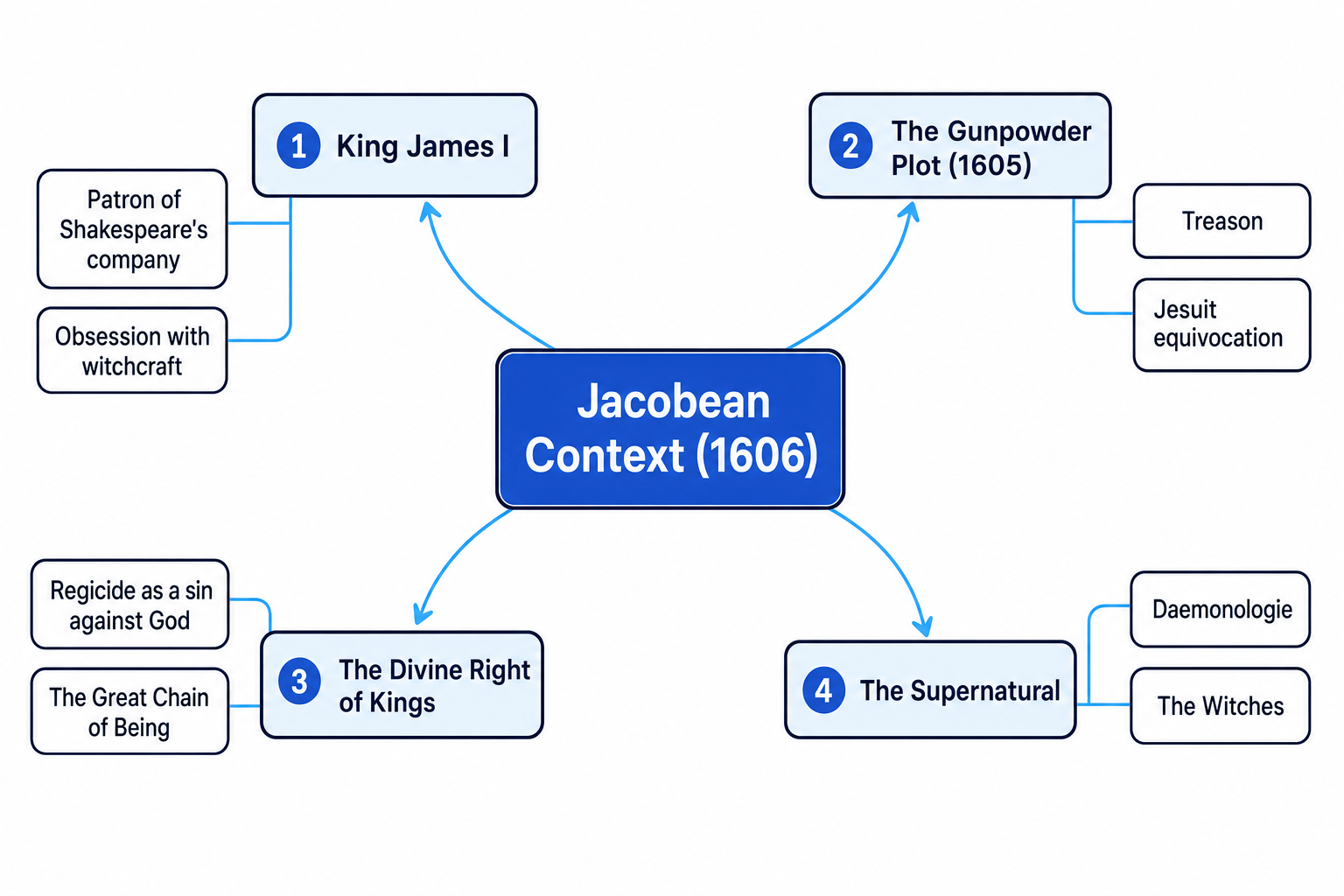
Political Tension: The Gunpowder Plot of 1605
Just one year before Macbeth was first performed, England survived a massive terrorist attempt. On 5th November 1605, a group of provincial English Catholics, including Guy Fawkes, attempted to blow up the Houses of Parliament and assassinate King James I.
This became known as the Gunpowder Plot. The plot failed, and the conspirators were brutally tortured and executed. The event shook the nation, creating an atmosphere of intense paranoia and fear of treason.
Equivocation and the Jesuit Priest
During the trials of the conspirators, a Jesuit priest named Father Henry Garnet was executed for treason. He defended himself by using equivocation.
Equivocation
The use of ambiguous or double-sided language to conceal the truth or avoid committing oneself. It allowed Catholics to lie under oath to protect their co-religionists without technically committing a sin in the eyes of God.
Shakespeare directly links this political scandal to the play. The Porter in Act 2, Scene 3 jokes about an "equivocator" going to hell. More importantly, the Witches themselves are the ultimate equivocators. They speak in half-truths ("none of woman born / Shall harm Macbeth") designed to trick Macbeth into his own destruction.
The Gunpowder Medal
Following the failure of the Gunpowder Plot, King James had a commemorative medal minted. It featured the image of a snake hidden beneath lilies and roses. This is the direct inspiration behind Lady Macbeth’s famous advice to her husband: "Look like the innocent flower, but be the serpent under't" (Act 1, Scene 5).
Religious and Philosophical Beliefs
To the Jacobean mind, the universe was not a chaotic accident; it was a highly ordered system designed by God.
The Great Chain of Being
The Jacobeans believed in a strict social and cosmic hierarchy known as the Great Chain of Being.
At the very top was God, followed by angels, then the King, then nobles, commoners, animals, and plants. Everyone had a fixed place. If you attempted to break your place in the chain (as Macbeth does by murdering the King), you upset the natural order of the entire universe.
The Great Chain of Being
Disrupting God's natural hierarchy results in cosmic chaos. When Macbeth kills Duncan, the physical world reflects this crime: horses eat each other, and dark night strangles the traveling lamp (the sun).
The Divine Right of Kings
Linked directly to the Great Chain of Being was the political theory of the Divine Right of Kings.
The Divine Right of Kings
The belief that monarchs are chosen by God to rule. Because they are God's representatives on Earth, any attempt to rebel against or murder a king is an act of direct treason against God.
Therefore, regicide (the act of killing a king) was viewed as the ultimate sin. By committing regicide, Macbeth does not just break the laws of Scotland; he condemns his own soul to eternal damnation.
Witchcraft and the Supernatural
In modern times, we view the three Witches in Macbeth as dramatic fantasy characters. To a Jacobean audience, however, they were terrifyingly real.
King James I was personally obsessed with the supernatural. In 1597, he wrote a book called Daemonologie, which was a textbook on how to identify, hunt, and prosecute witches. He believed that witches were active agents of the Devil, working actively to overthrow Christian kingdoms.
When Shakespeare put the Witches on stage, chanting in trochaic tetrameter ("Double, double toil and trouble"), he was directly tapping into the King's deepest fears.
How to Apply Context in Your Essays
The biggest mistake students make is writing "history-heavy" paragraphs that look like a history essay rather than an English literature essay. You must always link context back to Shakespeare's choices and his audience's reaction.
Do not write:
“In 1605, there was the Gunpowder Plot. This is why Macbeth is a traitor.”
Instead, use context to explain the writer's purpose (why Shakespeare wrote what he wrote).
Integrating historical context into analytical writing
-
State your analytical point and quote: Identify a specific literary method Shakespeare uses to present a theme or character.
Example: In Act 1, Scene 5, Lady Macbeth encourages her husband to "look like the innocent flower, / But be the serpent under't", using a biblical metaphor of the serpent to encourage deception.
-
Connect it to a specific contextual factor: Link the language of the quote to the historical reality of the Jacobean audience.
Example: The image of the "serpent" would have immediately resonated with a Jacobean audience, who would recognize it from the commemorative medal commissioned by King James I after the failed Gunpowder Plot of 1605, which depicted a snake hiding beneath lilies.
-
Explain Shakespeare's wider didactic purpose: Conclude by explaining why Shakespeare used this context—what was he trying to teach his audience?
Example: By aligning the Macbeths' deceptive behavior with the real-world treason of the Gunpowder plotters, Shakespeare acts as a royal propagandist. He warns his audience that while political duplicity might seem "innocent" initially, treason is inherently satanic and will inevitably lead to ruin.
The 'History Bolt-On'
Do not treat context like a checklist of facts to dump into your essay. Writing a paragraph about the North Berwick Witch Trials is useless unless you link it directly to how the Witches' manipulative language affects Macbeth's tragic downfall. Every piece of context must serve your analysis of the play's themes.
In the exam
- Always lead with the text: Start your paragraphs with an analytical point about characters or themes (AO1) and language/structure (AO2), then weave the context (AO3) in to explain why Shakespeare made those structural or linguistic choices.
- Use active verbs for the writer: Instead of saying "This context is shown in...", say "Shakespeare utilises Jacobean fears of the supernatural to..." or "Shakespeare mirrors the anxieties of the post-Gunpowder Plot era to...".
- Remember AO4 (SPAG): The Shakespeare essay carries 4 marks for Spelling, Punctuation, and Grammar. Capitalise proper nouns correctly (King James I, Jacobean, Gunpowder Plot, Divine Right of Kings).
Check yourself
- Why did Shakespeare change the historical character of Banquo from a co-conspirator of Macbeth (which he was in the historical chronicles) to a completely moral character?
- How does the concept of the Great Chain of Being explain the strange, unnatural storms and animal behavior that occur in Scotland after King Duncan is murdered?
- What was the purpose of King James I's book Daemonologie, and how does it relate to the audience's reaction to the three Witches?
