When you sit down to write about An Inspector Calls in your GCSE English Literature exam, it is easy to treat the play like a novel, focusing only on what the characters say. However, An Inspector Calls is a work of drama—it was written to be performed on a stage in front of a live audience.
To score highly, you must analyze J.B. Priestley's dramatic methods. These are the tools a playwright uses to craft a performance, build tension, shape the audience's reaction, and deliver key thematic messages.
What you'll learn:
- How Priestley adapts structural models like the Well-Made Play and the Morality Play to deliver a socialist message.
- How to analyze physical staging elements, including stage directions, lighting, and props.
- How dramatic irony and the structural pacing of cliffhangers manipulate audience tension.
- How to write a high-scoring analytical paragraph focused on dramatic methods.
1. Genre and Form: The Hybrid Play
Before examining individual lines, you need to understand the structural blueprint Priestley used. He did not invent a completely new format; instead, he blended three distinct theatrical genres to create something uniquely powerful.
The Three Unities
The Three Unities are rules of classical drama derived from Aristotle’s Poetics:
- Unity of Action: A play should have one main plot with minimal subplots.
- Unity of Place: The play should take place in a single physical location.
- Unity of Time: The action of the play should take place over a period of no more than 24 hours.
By confining the entire drama to the Birlings’ dining room over the course of a single evening, Priestley obeys these classical rules. This creates a claustrophobic, high-pressure environment—an "orderly" middle-class world that is slowly picked apart under the Inspector's spotlight.
The Well-Made Play (Pièce Bien Faite)
Popular in the 19th century, the Well-Made Play features a highly logical plot, a series of secrets that are gradually revealed, a climax near the end, and a neat resolution where order is restored.
Priestley adopts the structural neatness of this genre but subverts it at the very end. Instead of resolving the tension and restoring the Birlings' comfortable social order, the play ends on a shocking cliffhanger (the final phone call). Priestley does this to deny the audience a comfortable, easy escape; he wants us to leave the theatre feeling unsettled and personally responsible.
The Morality Play
Historically, Morality Plays were medieval Christian dramas designed to teach the audience how to avoid sin and achieve salvation. The characters were often personifications of abstract virtues and vices (such as Greed, Pride, or Charity).
An Inspector Calls acts as a modern, secular morality play. The Inspector behaves like a secular priest, exposing the "sins" of the Birling family (which closely map onto the Seven Deadly Sins: Birling's Greed, Sheila's Envy, Gerald's Lust, Sybil's Pride).
Priestley's Core Purpose
Priestley uses the dramatic framework of a morality play to replace traditional religious salvation with socialist salvation. The characters must repent not to save their souls for heaven, but to save society from the "fire and blood and anguish" of industrial conflict and war.
2. Structural Tension and Cliffhangers
The structure of An Inspector Calls does not follow a simple, single path of rising action to a climax. Instead, it is built like a series of waves.
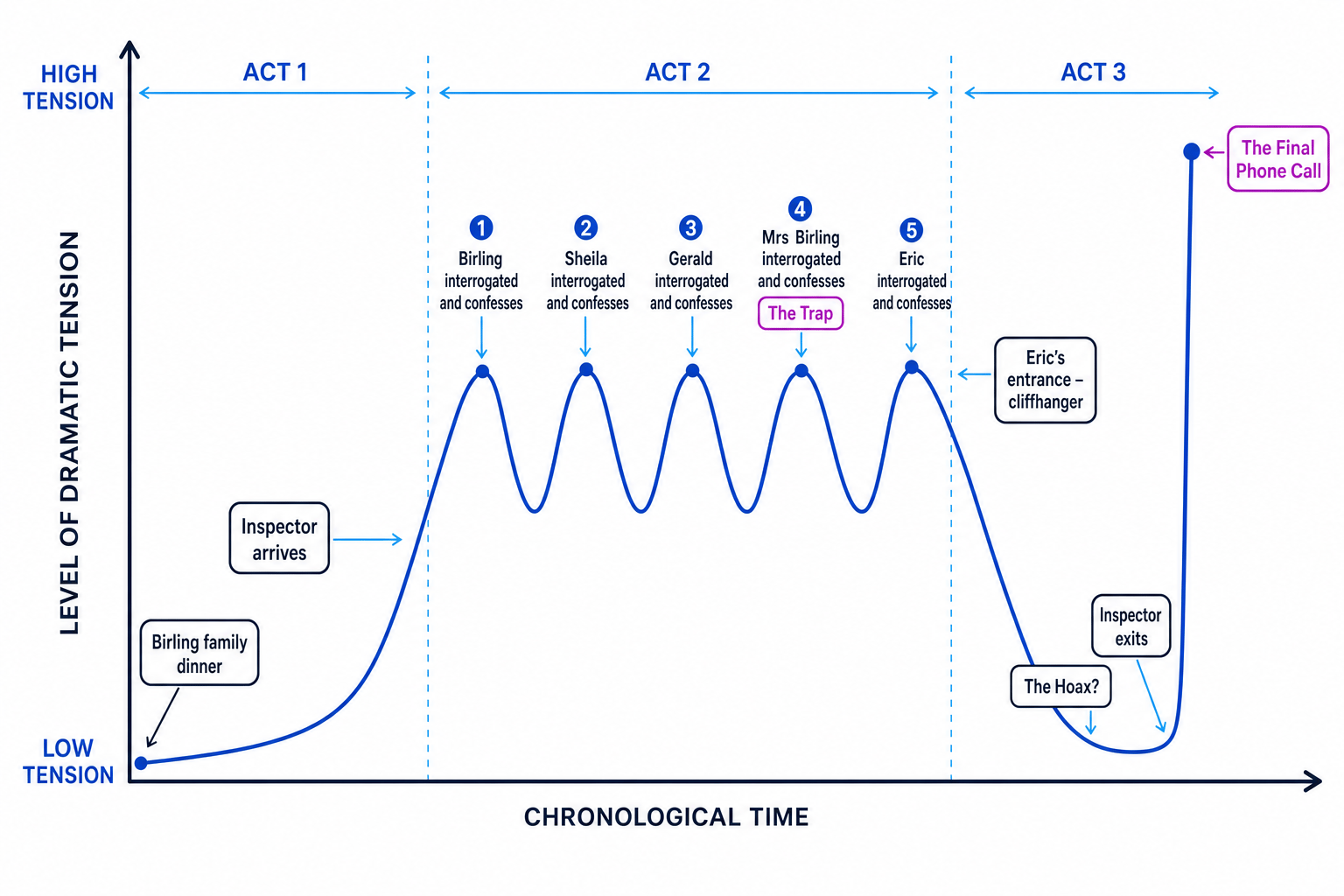
As shown in the tension graph above, Priestley uses a pattern of rising and falling tension. Every time a character confesses, there is a momentary release of tension, which is immediately rebuilt as the Inspector shifts his focus to the next target.
The Interrogation Order
The order in which the characters are questioned is a deliberate dramatic choice:
- Arthur Birling (The economic catalyst: sacking Eva)
- Sheila Birling (The emotional catalyst: getting Eva fired from Milwards out of jealousy)
- Gerald Croft (The sexual/romantic exploitation: keeping Eva/Daisy as a mistress)
- Mrs Sybil Birling (The moral/charitable failure: rejecting Eva's plea for help)
- Eric Birling (The physical/financial exploitation: theft and pregnancy)
This structure moves from the public sphere (the workplace) to the deeply private sphere (family dynamics, pregnancy, and theft), steadily heightening the emotional and moral stakes.
The Act Breaks (Cliffhangers)
Because the play was written for a live theatre audience, Priestley had to ensure that tension did not dissipate during the intervals. He achieves this through masterful cliffhangers:
- The Act 1/Act 2 transition: Act 1 ends with the Inspector opening the door and looking in at Gerald and Sheila, simply saying, "Well?" just as Gerald's affair with Daisy Renton is about to be laid bare.
- The Act 2/Act 3 transition: Act 2 ends with Mrs. Birling realizing she has trapped her own son, Eric, by demanding he be made an example of. The front door slams, Eric enters looking "extremely pale and distressed", and the curtain falls.
The Power of the Front Door Slam
Pay close attention to the sound of the front door slamming throughout the play. It is a recurring sound effect that signals an arrival or a departure, acting as a dramatic punctuation mark that shatters the family's privacy.
3. Stage Directions and Lighting
Stage directions are not just administrative instructions for actors; they are a vital dramatic method that conveys subtext, mood, and character development.
At the very start of the play's script, Priestley provides a detailed description of the set, including a highly famous instruction regarding the lighting:
"The lighting should be pink and intimate until the Inspector arrives, and then it should be bright and harder."
Ignoring the Lighting Shift
Students often write that the lighting changes "when the Inspector starts asking questions." In fact, the shift is instantaneous the moment the Inspector walks through the door. The lighting change itself is a non-verbal cue to the audience that the cozy, self-satisfied illusions of the Birlings are about to be exposed to the harsh light of truth.
Let's break down the symbolism of this dramatic shift:
- "Pink and intimate": This represents the Birlings' rose-tinted, insulated worldview. They are wrapped in their own privilege, looking at society through a distorting, romanticized lens.
- "Bright and harder": This mimics the sterile, exposing light of an interrogation room. It symbolizes the cold light of truth, social reality, and moral inspection.
4. Analytical Walkthrough
Let's look at how to analyze Priestley's dramatic methods in a structured, high-scoring essay paragraph.
Analysing a shift in stage lighting
Analyze how Priestley uses stage directions and lighting to present the Birling family at the start of the play.
- Point: Priestley uses physical stage lighting to visually signal the shift from middle-class complacency to moral accountability.
- Evidence: At the start of the play, the Birlings are bathed in a lighting that is described as "pink and intimate", which instantly changes to "bright and harder" upon the Inspector's arrival.
- Method: The adjective "pink" acts as a visual metaphor for the family’s rose-tinted, self-indulgent lifestyle, shielding them from the gritty realities of industrial Edwardian society.
- Effect: By shifting the lighting to a "harder" tone, Priestley uses a non-verbal dramatic method to alert the audience that the family's illusions are being stripped away. The word "harder" suggests an unyielding, objective truth that cannot be ignored or bought off with Birling's wealth.
- Link to Context/Theme: Through this atmospheric shift, Priestley mirrors his socialist message: the privileged classes cannot remain insulated in their cozy "pink" world forever; they must face the "bright", unforgiving light of social responsibility.
5. Dramatic Irony
Dramatic irony occurs when the audience knows key information that the characters on stage do not.
Priestley uses this technique heavily in Act 1 during Arthur Birling's long, pompous speeches to Gerald and Eric. Writing in 1945 about a play set in 1912, Priestley had the benefit of hindsight. He deliberately gave Birling a series of confident predictions that the 1945 audience would know were catastrophically false:
- Birling claims that the conflict between capital and labor will soon be resolved, dismissing the possibility of strikes.
- He describes the Titanic as "unsinkable, absolutely unsinkable".
- He scoffs at the idea of war, calling it "silly little war scares" and asserting that the world is entering a time of "rapid progress".
The Purpose of Irony
Priestley does not use dramatic irony just to make Birling look foolish. He uses it to systematically destroy Birling’s authority. If Birling's judgements on massive, historical events like the Titanic and World War I are so catastrophically wrong, the audience is forced to conclude that his capitalist economic views—such as "every man for himself"—are equally flawed and dangerous.
6. The Inspector as a Dramatic Device
Inspector Goole is not just a character; he is a highly constructed dramatic device (a tool used by the playwright to achieve a specific structural or thematic effect).
His Physical Staging
The stage directions state that Goole:
- "creates at once an impression of massiveness, solidity and purposefulness."
- Speaks "carefully, weightily".
- Has a habit of "looking hard" at the person he addresses.
He physically dominates the stage. Even though Arthur Birling is a wealthy magistrate and a prospective knight, the Inspector's imposing physical presence allows him to take control of both the household and the dramatic pace of the play.
Controlling the Visuals
The Inspector acts as an on-stage director. He controls who sees the photograph of Eva Smith, showing it to only "one person at a time". This visual trick prevents the characters (and the audience) from verifying if they are looking at the same girl or different girls, keeping the dramatic mystery alive and focusing the family's attention purely on their own individual guilt.
The Inspector as an On-Stage Mirror
Think of Inspector Goole as a physical mirror that Priestley holds up to the Birling family. He doesn't actually bring any new physical evidence of his own; instead, he simply forces each character to look at their own past actions and see their reflections clearly.
In the exam
- Never treat the play like a book: Avoid phrases like "the reader feels" or "this shows in the novel". Always use theatrical terminology: the audience, on stage, the playwright, the dramatic effect, spectators.
- Track the dramatic arc: When discussing a character's transformation (like Sheila's or Eric's), explicitly link it to the rising tension of the play's structure.
- Analyze stage directions with the same depth as dialogue: Do not just quote what characters say. Quote the parenthetical instructions (e.g., [miserably], [distressed], [with sudden anger]). Explain how these physical delivery instructions expose the character’s inner mental state.
Check yourself
- Why did J.B. Priestley choose to obey the Classical Greek Unities of time, place, and action?
- What is the precise dramatic effect of ending Act 2 at the exact moment Eric enters the room?
- How does the "pink and intimate" lighting contrast with the "bright and harder" lighting, and what does this represent symbolically?
