What you'll learn
- What “context” means for An Inspector Calls in the AQA GCSE exam.
- Why Priestley sets the play in 1912 but writes it for a 1945 audience.
- How class, gender, politics and theatre conventions shape the play’s meaning.
- How to use context in analysis without writing a disconnected history paragraph.
First: what does “context” mean?
Context
Context means the real-world circumstances surrounding a text: when it was set, when it was written, the society it responds to, and the ideas its first audiences may have recognised.
For An Inspector Calls, context is especially important because Priestley uses two different time periods at once:
- 1912: the year the play is set, before the First World War.
- 1945: the year the play was first performed, after the Second World War.
In the exam, context is rewarded when it helps you explain Priestley’s choices. It should not feel like a random history fact. Start with the play, then connect the context to meaning.
Context must explain meaning
A strong contextual point answers: Why would Priestley make this choice, and how would it affect the audience’s view of society?
Connecting context to a quotation
- Priestley has Mr Birling dismiss “community and all that nonsense”, so the first judgement is about Birling’s values: he rejects shared responsibility.
- A 1945 audience had just lived through the Second World War, when survival depended on cooperation, sacrifice and public service.
- This context makes Birling seem not just selfish, but dangerously out of date; Priestley encourages the audience to reject his individualism.
- Link the point back to the play’s message: Priestley presents social responsibility as morally necessary, not optional.
The double time frame: 1912 and 1945
Priestley sets the play in 1912, a world of wealth, servants, rigid class divisions and confidence in progress. He writes it in 1945, after two world wars had exposed the dangers of arrogance, inequality and failed leadership.
This gap matters because the audience knows what the Birlings do not. Use the timeline below to visualise how much history separates the characters’ world from Priestley’s audience.
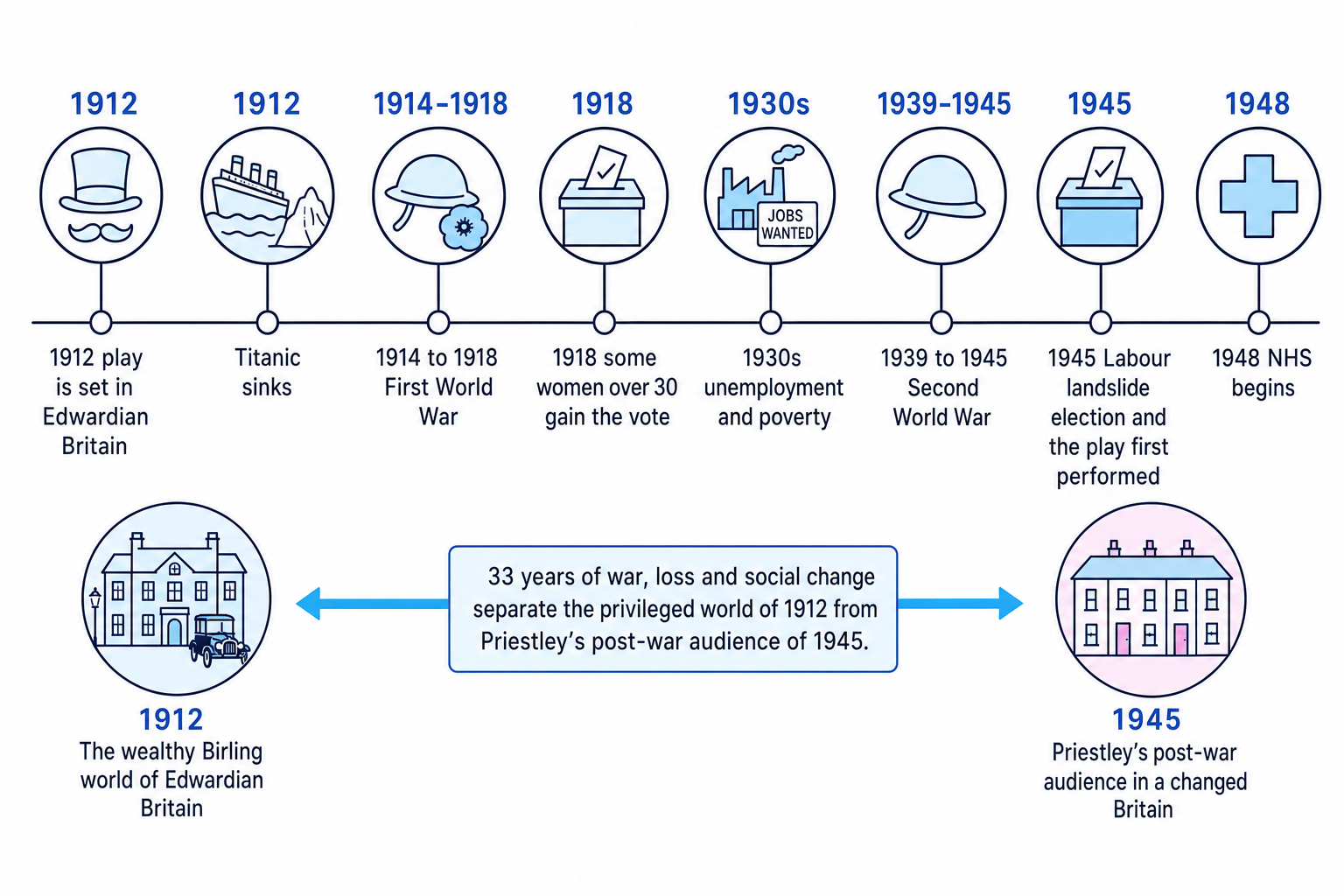
Dramatic irony
Dramatic irony happens when the audience knows more than the characters. Priestley uses it to make Mr Birling’s confidence look foolish and unreliable.
Mr Birling says the Titanic is “unsinkable, absolutely unsinkable” and claims “there isn’t a chance of war”. To the 1945 audience, both statements are obviously wrong.
Using dramatic irony about history
- Identify the method: Priestley gives Birling confident predictions that the audience knows are false.
- Connect the context: the Titanic sank in 1912, and the First World War began in 1914.
- Explain the effect: Birling’s political and moral opinions become less trustworthy because his understanding of the world is shown to be shallow.
- Link to Priestley’s purpose: by undermining Birling, Priestley also undermines the selfish capitalist attitudes Birling represents.
Class, work and inequality
Social class
Social class means a person’s position in society based on factors such as wealth, job, education, accent, family background and social power.
In 1912 Britain, class divisions were much sharper than today. The Birlings are wealthy, upper-middle-class employers. Eva Smith is a working-class woman whose survival depends on wages, references and the decisions of people above her.
Priestley shows how easily powerful people can damage the vulnerable. Mr Birling says “I refused, of course” when Eva asks for higher wages, treating her as a business problem rather than a human being. Sheila challenges this attitude when she says, “But these girls aren’t cheap labour — they’re people.”
Analysing class context in Sheila’s line
- Focus on the contrast in the quotation: “cheap labour” reduces working women to cost, while “people” restores their humanity.
- Link to context: in 1912, working-class employees often had limited protection against dismissal, poverty and exploitation.
- Explain Priestley’s message: Sheila’s line exposes the moral failure of seeing workers only through profit.
- Connect to audience response: a 1945 audience, more open to welfare reform and workers’ rights, would be encouraged to support Sheila’s growing sense of responsibility.
Writing a context dump
Do not write a paragraph that simply lists facts about 1912 Britain. Instead, attach each contextual point to a quotation, method and effect.
Capitalism, socialism and responsibility
Capitalism and socialism
Capitalism is an economic system where businesses are privately owned and profit is a major goal. Socialism is a political idea that society should be organised more fairly, with greater shared responsibility for people’s welfare.
Mr Birling represents a narrow capitalist mindset. He believes “a man has to make his own way” and should “look after himself”. Priestley presents this as morally inadequate.
The Inspector voices the opposite message: “We are members of one body. We are responsible for each other.” The metaphor of “one body” suggests society is interconnected: if one part suffers, the whole body is affected.
Priestley was left-wing and supported social responsibility, but you do not need to label him with extreme terms. The key point is that the play argues against selfish individualism and in favour of collective care.
Linking the Inspector’s message to post-war Britain
- Start with the method: the metaphor “members of one body” presents society as a living organism, not a set of separate individuals.
- Connect to 1945: after wartime rationing, bombing and public service, many people valued cooperation more strongly.
- Explain the warning: when the Inspector says society will be taught in “fire and blood and anguish”, Priestley links moral failure to real historical suffering.
- Link to purpose: Priestley urges his audience to build a fairer post-war society rather than return to Birling’s selfish values.
A useful context sentence starter
Try: “For Priestley’s 1945 audience, this would suggest…” Then explain how the audience might judge the character, idea or behaviour.
Gender and patriarchy
Patriarchy
Patriarchy means a society where men hold most power in politics, work, family life and moral judgement.
Women in 1912 had fewer rights and less independence than men. Most women could not vote, many jobs were low-paid, and reputation mattered especially harshly for women. This context shapes Eva’s vulnerability.
Eva is judged for being poor, female and sexually exploited. Mrs Birling’s phrase “girls of that class” shows both class prejudice and gender prejudice. She does not see Eva as an individual; she sees her as a type of person beneath sympathy.
Sheila’s position is different. She is wealthy and protected, but still expected to marry well and behave properly. Her early excitement — “Now I really feel engaged” — reflects how marriage is presented as a major social achievement for women in her class.
Applying gender context to Eva Smith
- Identify Eva’s lack of power: she depends on employers, charity committees and men such as Gerald and Eric.
- Connect to gender context: in 1912, working-class women had limited economic security and were often judged more harshly for sexual behaviour than men.
- Explain Priestley’s criticism: Eva’s treatment exposes a society that punishes vulnerable women while protecting respectable men and wealthy families.
- Link to audience effect: Priestley encourages the audience to question the moral authority of characters like Mrs Birling.
Generational change
The older Birlings resist responsibility. Mr and Mrs Birling care about reputation, status and avoiding blame. Sheila and Eric, although flawed, are more willing to admit guilt and change.
This matters in a 1945 context because Britain was deciding what kind of society to become after the war. The younger generation could represent the possibility of reform, while the older generation represents the danger of returning to the old class system.
The generations carry Priestley’s hope and warning
Priestley suggests society can improve only if people learn from the past. Sheila and Eric’s guilt matters because it shows moral growth is possible.
Literary and theatrical context
Morality play
A morality play is a drama designed to teach a moral lesson, often using characters to represent wider ideas such as sin, guilt, judgement or responsibility.
An Inspector Calls also borrows from detective drama. At first, the audience expects a mystery: who caused Eva Smith’s death? But Priestley changes the focus. The real question becomes: who is responsible for the suffering of vulnerable people?
Inspector Goole is not just a police figure. He works like a moral judge, forcing each character to confess their part in Eva’s death. This makes the play feel like a social warning, not only a crime story.
Reading the play as a moral warning
- Notice the form: the play begins like a detective investigation, with one character questioned at a time.
- Recognise the shift: the Inspector’s final speech turns the mystery into a lesson about collective responsibility.
- Connect to context: Priestley’s post-war audience had to decide whether Britain would become more equal and compassionate.
- Explain the effect: the audience is pushed to judge not only the Birlings, but also their own society.
Quick context bank
Use these as precise links, not as memorised paragraphs:
| Context | How it helps your analysis |
|---|---|
| 1912 setting | Shows a class-divided, patriarchal society before major social reforms. |
| 1945 audience | Makes Priestley’s message about rebuilding society feel urgent. |
| Two world wars | Make Birling’s confidence and selfishness seem dangerous. |
| Labour landslide and welfare reform | Support the play’s emphasis on collective responsibility. |
| Women’s limited rights | Explains Eva’s vulnerability and Sheila’s restricted social role. |
| Detective and morality play traditions | Help explain why the Inspector becomes a moral judge. |
In the exam
- Begin with the question and the text: make a clear point about Priestley’s message, then support it with a short quotation.
- Analyse a method — such as dramatic irony, metaphor, contrast, structure or stagecraft — before adding context.
- Be precise: write “a 1945 audience after the Second World War” rather than vague phrases like “in the olden days”.
- Keep context linked to purpose: explain how Priestley encourages the audience to judge characters, reject selfishness or support social responsibility.
Check yourself
- Why does Priestley set the play in 1912 but write it for a 1945 audience?
- How does dramatic irony make Mr Birling seem unreliable?
- How do class and gender context make Eva Smith particularly vulnerable?
