Welcome to one of the most vital guides for your AQA GCSE English Literature course. In Paper 2, Section B, you will be faced with a comparative poetry question. You don't just write about one poem; you must master the art of putting two poems into a dynamic, analytical conversation.
This guide will break down the structural, conceptual, and linguistic techniques you need to write a cohesive, high-scoring comparative essay.
What you'll learn
- How to decode the comparative essay prompt and choose the ideal partner poem.
- How to construct an "integrated" comparative paragraph using the "ping-pong" method.
- How to weave language analysis and context naturally between two texts.
- How to avoid the trap of writing two separate, unrelated essays.
The Core Concept: What is a Comparative Essay?
In the AQA GCSE English Literature exam, you are handed one poem printed on the exam paper (the "given" poem), and you must choose another poem from the Love and Relationships anthology cluster from memory (the "chosen" poem) to compare it with.
To score highly, you must address both poems in a balanced way, exploring how they present a shared theme (such as romantic loss, parental love, or distance).
Comparative Thesis Statement
A comparative thesis statement is a 3- to 4-sentence argument at the very start of your essay. It directly answers the exam prompt by outlining the main similarity and the main difference in how both poems present the central theme.
Many students write about the first poem, then write about the second poem, and only bring them together in the final paragraph. This is called "block structuring." While it is acceptable, it makes it very difficult to access the top marks. Examiners prefer an integrated structure, where you compare both poems within the same paragraph.
The Golden Rule of Comparison
Do not just write about Poem A, then write about Poem B. Every paragraph should be a mini-comparison, analyzing how both poets use different methods to explore a similar human experience.
Structuring an Integrated Paragraph
An integrated paragraph uses a "ping-pong" structure. Instead of keeping the poems separate, you bounce back and forth between them, linked by comparative discourse markers (words like similarly, likewise, by contrast, or whereas).
The flowchart below demonstrates how a model comparative paragraph flows logically from a shared concept down to a combined contextual conclusion.
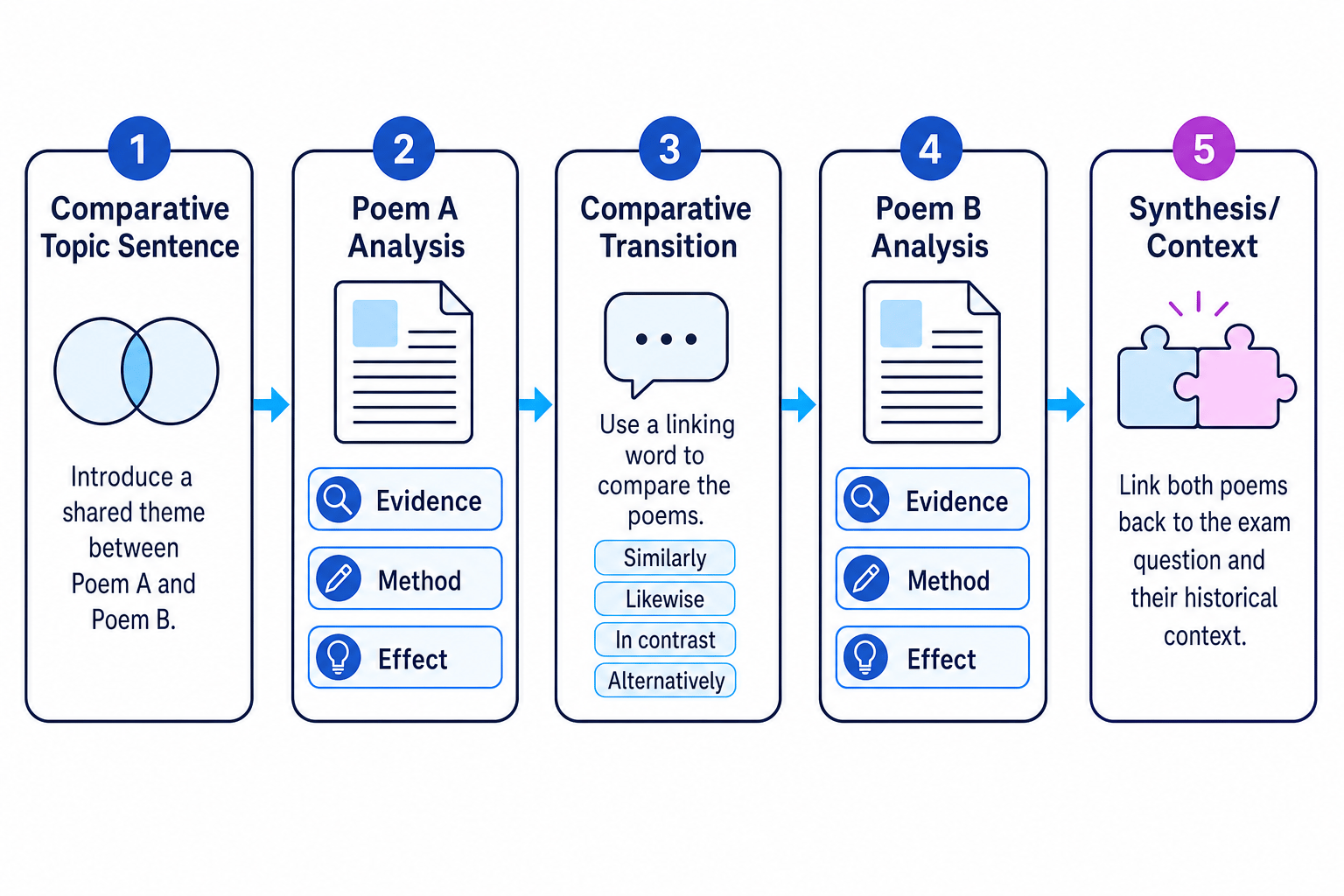
The Five Steps of an Integrated Paragraph
- Comparative Topic Sentence: Start with a sentence that introduces a shared thematic idea present in both poems. Do not mention specific quotes or devices yet; focus on what the poets are saying about love or relationships.
- Poem A Analysis: Introduce a key quote from the printed poem. Name the writer's method (e.g., metaphor, structure, tone) and analyze its deeper meaning and effect on the reader.
- Comparative Transition: Use a transition word to pivot to your chosen poem, immediately showing the examiner you are comparing them.
- Poem B Analysis: Introduce a key quote from your memorized poem. Name the method and analyze its effect, showing how it mirrors or contrasts with Poem A.
- Synthesis & Context: Finish the paragraph by explaining why the poets might have presented these ideas differently, linking their choices to their historical or biographical contexts.
Synthesis
Synthesis is the process of combining separate ideas, analyses, or texts into a single, unified conclusion. In your essay, synthesis happens when you explain what we learn about a theme by looking at both poems together.
Worked Example: Drafting an Integrated Comparative Paragraph
Let’s look at how to build an integrated paragraph step-by-step.
We will use the following practice prompt: "Compare how poets present painful memories of past love in Neutral Tones and one other poem from the Love and Relationships anthology." We will choose When We Two Parted by Lord Byron as our second poem.
Drafting an integrated comparative paragraph
- Write a comparative topic sentence that addresses the prompt. Focus on the shared theme of painful memories.
- Draft: Both Thomas Hardy in Neutral Tones and Lord Byron in When We Two Parted present memories of past love as cold, destructive forces that permanently damage the speaker's emotional state.
- Analyze Poem A (the given poem, Neutral Tones). Embed a quote, identify a specific literary method, and explain its psychological effect.
- Draft: In Neutral Tones, Hardy uses the pathetic fallacy of a winter landscape to reflect the deadness of the relationship. The speaker recalls how the "sun was white, as though chidden of God," where the adjective "white" strips the sun of its natural warmth, symbolizing a love completely devoid of passion. The harsh, retributive verb "chidden" implies a sense of divine punishment, suggesting that the speaker views the memory of this breakup as a cursed, formative trauma.
- Use a comparative transition to pivot to Poem B (When We Two Parted). Choose a transitional phrase that highlights a similarity or difference.
- Draft: Similarly, Byron also uses cold, natural imagery to convey the icy chill of a failing relationship, but he internalizes this coldness physically.
- Analyze Poem B (the chosen poem). Embed a quote, identify the method, and explain its effect, keeping the comparison alive.
- Draft: Byron describes his lover’s parting cheek as "pale" and "cold," noting that this sensory detail "colder thy kiss." The comparative adjective "colder" acts as a warning of the speaker's future sorrow. Unlike Hardy’s static, bleached landscape, Byron’s use of sensory language highlights a physical rejection, showing how the pain of the past memory still physically haunts him "in silence and tears."
- Conclude with a synthesis that links both poems to their context. Explain how the historical context of each poet shaped their presentation of these painful memories.
- Draft: Ultimately, while Byron’s Romantic focus leads him to express his pain through intense, deeply personal grief and a sense of betrayal, the Victorian Victorian realist Hardy uses his bleak landscape to present a more cynical, fatalistic view of human connection. Both writers show that the memory of a dead relationship acts as an inescapable prison.
The 'Device Spotting' Trap
Many students think they are comparing when they write: "Hardy uses a metaphor and Byron also uses a metaphor." This is called "device spotting." It does not get marks. You must compare the meaning and effect of the methods, not just name the devices.
Planning Your Comparisons
To write a great essay under timed conditions, you must decide on your poem pairings before you enter the exam room. Do not try to find a poem on the fly.
Here is a quick-reference guide to some of the strongest pairings in the Love and Relationships cluster:
| Theme / Topic | Poem A (Given or Chosen) | Poem B (Given or Chosen) | Key Point of Comparison |
|---|---|---|---|
| Romantic Loss & Pain | Neutral Tones (Hardy) | When We Two Parted (Byron) | Both use cold, lifeless natural imagery, but Hardy is cynical while Byron is intensely emotional. |
| Parent-Child Distance | Mother, Any Distance (Armitage) | Follower (Heaney) | Both explore a child growing up and gaining independence, but Armitage focuses on moving away, whereas Heaney focuses on the reversal of roles. |
| Longing & Desire | Love's Philosophy (Shelley) | Porphyria's Lover (Browning) | Both feature speakers desperate for physical unity, but Shelley uses playful, natural imagery while Browning uses destructive, psychotic control. |
| Family & Memory | Eden Rock (Causley) | Before You Were Mine (Duffy) | Both reconstruct past memories of parents, but Causley looks back with a peaceful, dreamlike nostalgia, while Duffy explores a bittersweet, possessive guilt. |
Structure and Form are Methods Too!
Don't just analyze words. You can compare the structure of the poems. For example, the circular structure of Neutral Tones (beginning and ending by the same pond) mirrors the speaker's inability to move past his grief, which contrasts with the steady, controlled regular stanzas of When We Two Parted that mask a chaotic, hidden sorrow.
In the exam
- Spend 5 minutes planning: Read the prompt carefully, highlight the key thematic word (e.g., "grief", "desire", "nature"), and select your comparison poem immediately. Write a quick 3-point plan.
- Write a strong comparative thesis: Spend your first 3 minutes writing a thesis statement that outlines the conceptual similarity and difference between the two poems' treatment of the theme.
- Use the "ping-pong" method: Structure your three main body paragraphs so that they each contain analytical points for both poems, linked by a comparative transition word.
- Balance your analysis: Aim for roughly an equal split of analysis between the printed poem (which is right in front of you) and your remembered poem (which requires precise, recalled quotes).
- Keep quotes short: Remember, the exam is closed-book. Use short, 2-to-3-word quotations that are easy to remember and rich in analytical potential (like "half in love," "cold, pale," or "anchor. kite").
Check yourself
- Can you list three comparative discourse markers that signal similarity, and three that signal contrast?
- Look at the poem Follower. Which other poem in the anthology would you pair with it to write an essay about family relationships, and why?
- What is the difference between "device spotting" and analyzing the comparative effect of a writer's methods?
