Welcome to your study guide for the AQA Power and Conflict Poetry Anthology (Specification 8702). This cluster contains 15 poems spanning over two centuries, from the Romantic era to the present day. While 15 poems might seem daunting at first, they are all connected by a web of shared ideas, recurring themes, and structural techniques.
By looking at the cluster as a whole, you will learn how to spot these connections naturally, making your exam preparation much more manageable and your essays far more sophisticated.
What you'll learn
- How the AQA Power and Conflict poetry exam is structured and assessed.
- The three "thematic pillars" that connect all 15 poems.
- How to construct a conceptual comparison between any two poems in the cluster.
The Big Picture: How the Exam Works
In Paper 2, Section B, you will face the poetry anthology question. The exam board will print one of the 15 poems on the exam paper and provide a prompt asking you to compare how a specific aspect of power or conflict is presented in that poem and one other poem of your own choice from the cluster.
Because this is a closed-book exam, you will not have a copy of your second chosen poem in front of you. This means you must know the core themes, key methods, and memorable quotations of all 15 poems from memory.
The Golden Rule of the Poetry Exam
You must never write two separate essays. The exam board rewards a comparative synthesis—an essay that constantly weaves back and forth between the two poems, comparing their ideas, language, structure, and contexts throughout.
Comparative Synthesis
The act of drawing two texts together to form a unified, integrated argument. Instead of writing about Poem A and then Poem B, you analyze them side-by-side to highlight deep similarities and differences.
The Three Thematic Pillars
To simplify your revision, you should group the 15 poems into three major conceptual areas, or "thematic pillars." Almost any exam question will target one of these concepts.
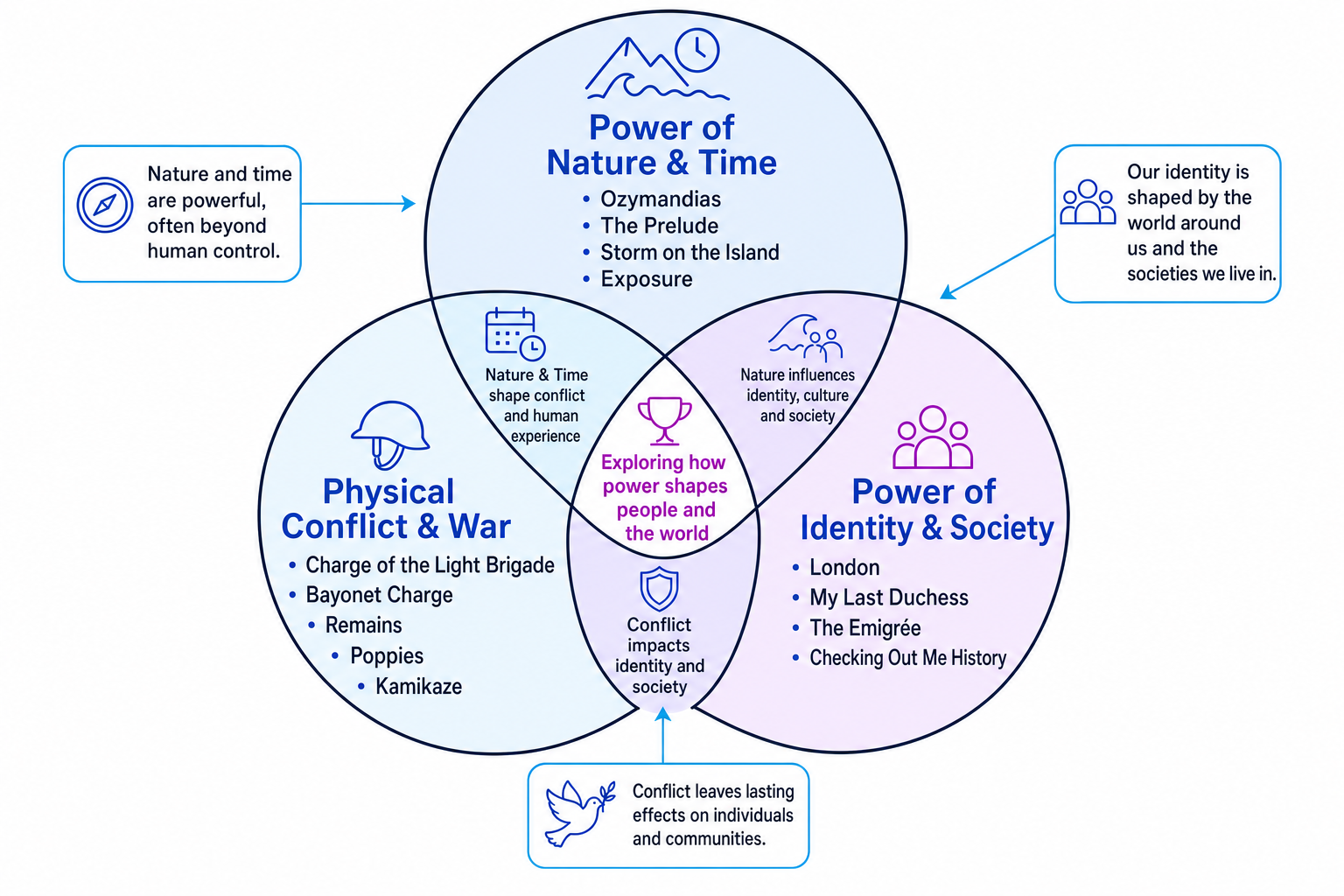
Pillar 1: The Power of Nature and Time
These poems explore the idea that human power is temporary, fragile, and ultimately insignificant compared to the forces of the natural world or the passage of time.
- Key Poems: Ozymandias (Shelley), The Prelude (Wordsworth), Storm on the Island (Heaney), Exposure (Owen).
- Core Idea: Humans build empires and display pride, but nature or time inevitably reclaims control.
Pillar 2: Physical Conflict and the Reality of War
These poems strip away the romanticized myths of glory and patriotism to expose the brutal, terrifying reality of warfare, as well as the lasting psychological damage it inflicts.
- Key Poems: Charge of the Light Brigade (Tennyson), Exposure (Owen), Bayonet Charge (Hughes), Remains (Armitage), Poppies (Weir), Kamikaze (Garland).
- Core Idea: War is destructive, chaotic, and leaves permanent scars on soldiers, families, and society.
Pillar 3: The Power of Identity, Society, and Control
These poems examine how individuals are controlled by political institutions, social hierarchies, or their own cultural heritages, and how they fight to define their own identities.
- Key Poems: London (Blake), My Last Duchess (Browning), The Emigrée (Rumens), Tissue (Dharker), Checking Out Me History (Agard).
- Core Idea: Power is often used by institutions or tyrannical individuals to suppress others, but memory, language, and cultural heritage can be acts of defiance.
Look for the Overlaps!
The best essays compare poems from different pillars to show a sophisticated understanding of the cluster. For example, comparing the psychological trauma of war in Remains (Pillar 2) with the oppressive social control in London (Pillar 3) demonstrates how power can damage the human mind in completely different contexts.
Master the Assessment Objectives (AOs)
To score highly, your essay must hit three main targets. Let's break down how to apply them directly to your poetry writing:
AO1: Clear, Informed Response (Read & Interpret)
Your essay must feature a clear, logical argument (thesis) that directly answers the question. You must support your points with precise, integrated quotations. Because you must quote from memory, aim for short, 2-to-3-word "explosive" quotes that are easy to remember and rich in meaning (e.g., "blood-shadow" in Remains, or "cold command" in Ozymandias).
AO2: Detailed Analysis of Methods (Language, Form, and Structure)
Do not just "feature-spot" (e.g., "The poet uses a simile here..."). Instead, explain how the poet's choices create meaning.
- Language: Analyze specific words, imagery, metaphors, and semantic fields.
- Form: Look at the poem's overall type (e.g., My Last Duchess is a dramatic monologue, which reinforces the Duke's absolute control).
- Structure: Pay attention to rhythm, rhyme, caesura (pauses), enjambment (run-on lines), and volta (a turning point in tone).
AO3: Historical, Social, and Literary Context (Why it was written)
You must show how the poem reflects the time in which it was written or the poet's personal/political intentions.
- The Romantic Poets (Blake, Shelley, Wordsworth): Often writing during revolutions, they criticized human institutions (like monarchy or the church) and revered the sublime power of nature.
- World War Poets: Wilfred Owen wrote Exposure from the trenches of WWI to expose the lies of propaganda. Contrast this with Lord Tennyson, who wrote The Charge of the Light Brigade as Poet Laureate, balancing a tribute to bravery with a subtle critique of military blunders.
Planning a Comparative Essay
The secret to a high-scoring essay is planning your conceptual links before you start writing. A conceptual link is a shared idea that connects both poems, even if they explore it differently.
The 'Two-Separate-Essays' Trap
Many students write half an essay on the printed poem, then write the second half on their chosen poem, with only a brief sentence at the end connecting them. This caps your mark. Your comparison must be woven throughout every single paragraph.
Let's walk through an example of how to plan a comparative response step-by-step.
Selecting a comparison poem and formulating a thesis
Exam Prompt: Compare how poets present the psychological impact of conflict in 'Remains' and one other poem of your choice.
-
Analyze the printed poem's core theme: Remains by Simon Armitage presents the psychological impact of war as inescapable guilt and trauma (PTSD) that haunts a soldier long after he has left the battlefield. The speaker is tormented by the memory of a looter he shot, showing how conflict devalues human life and leaves a permanent "blood-shadow" on the mind.
-
Select the most productive comparative partner: We need a poem that also deals with the psychological aftermath of conflict, but perhaps from a different perspective. War Photographer by Carol Ann Duffy is an excellent match. While the soldier in Remains has a first-hand, physical role in the violence, the photographer in War Photographer is an observer whose trauma comes from capturing others' suffering, experiencing a delayed emotional collapse when returning to the safety of "Rural England".
-
Formulate a conceptual thesis statement: Write a single, powerful sentence that unites both poems under a shared argument: Both Armitage in 'Remains' and Duffy in 'War Photographer' present the psychological impact of conflict as a haunting, inescapable trauma that disrupts the boundary between war zones and domestic reality; however, while Armitage's soldier is consumed by personal guilt over his actions, Duffy's photographer suffers from a profound sense of alienation and frustration at society's apathy toward global suffering.
-
Map out three comparative paragraphs:
- Paragraph 1 (The initial exposure to trauma): Compare the immediate reaction to violence. In Remains, the raw, conversational language and colloquial style ("three of a kind letting fly") show how violence is initially normalized, whereas in War Photographer, the structured, orderly stanza form reflects the photographer's attempts to impose clinical order on chaos.
- Paragraph 2 (The lasting psychological intrusion): Compare how the trauma follows them home. In Remains, visual and sensory memories break through ("he's torn apart in broad daylight" / "blink, and he bursts through the doors"). In War Photographer, sensory triggers like the development of the film bring the pain back ("a half-formed ghost").
- Paragraph 3 (The conclusion of their trauma / context): Compare their isolation and society's role. Armitage’s soldier is trapped in his own mind with "his bloody life in my bloody hands", showing the lack of support for returning soldiers (AO3). Duffy’s photographer remains isolated from an uncaring public who "do not care", criticizing western indifference to war (AO3).
In the exam
- Spend 5 minutes planning: Do not start writing immediately. Write down your thesis statement and your three conceptual paragraph links.
- Deconstruct the printed poem first: Highlight 2–3 short, high-yield quotations from the poem on the page.
- Draft a thesis that addresses both poets by name: Ensure your introduction outlines exactly how both poems address the keyword in the prompt.
- Structure your body paragraphs using a comparative chain: Start each paragraph with a comparative topic sentence, analyze the first poem, use a comparative transition word (e.g., conversely, similarly, on the other hand), and analyze the second poem, ending with a link back to your main thesis.
Check yourself
- Can you list all 15 poems in the Power and Conflict cluster from memory?
- Do you know which poems were written during the Romantic period, and what political/natural ideas those poets valued?
- For any given poem in the cluster, can you name at least one other poem that shares a similar theme and one that offers a contrasting perspective?
