When preparing for the AQA GCSE English Literature Paper 2 exam, memorising whole poems is impossible—and unnecessary. The secret to success in the closed-book exam is selecting a highly versatile Key Quote Bank.
By mastering a small, carefully chosen selection of short, "high-yield" quotations, you can write deep, award-winning analysis for any question on the Love and Relationships poetry cluster.
What you'll learn
- How to identify a "high-yield" quotation that can be used for multiple exam questions
- The core quotations for the three main relationship types: Romantic Conflict, Parent-Child Bonds, and Power & Control
- How to explode a single quotation to hit AO1, AO2, and AO3 simultaneously
The Strategy of "High-Yield" Quotations
Not all quotations are created equal. A high-yield quotation is short (ideally under eight words) and contains rich literary methods (like metaphors, sibilance, or caesura). Most importantly, it is highly versatile, meaning it can be linked to multiple themes such as distance, nature, memory, or change.
High-Yield Quotation
A short, memorable phrase from a text that contains multiple layers of meaning and literary devices, allowing you to use it to answer a wide variety of exam questions.
Using long, narrative quotes makes it difficult to focus on language analysis. By selecting short, punchy fragments, you can weave them naturally into your sentences and spend more time evaluating the writer’s craft.
1. Romantic Conflict, Pain, and Distance
This group of poems explores the difficulties of romantic love—whether through physical separation, emotional decay, or bitter memory.
Neutral Tones by Thomas Hardy
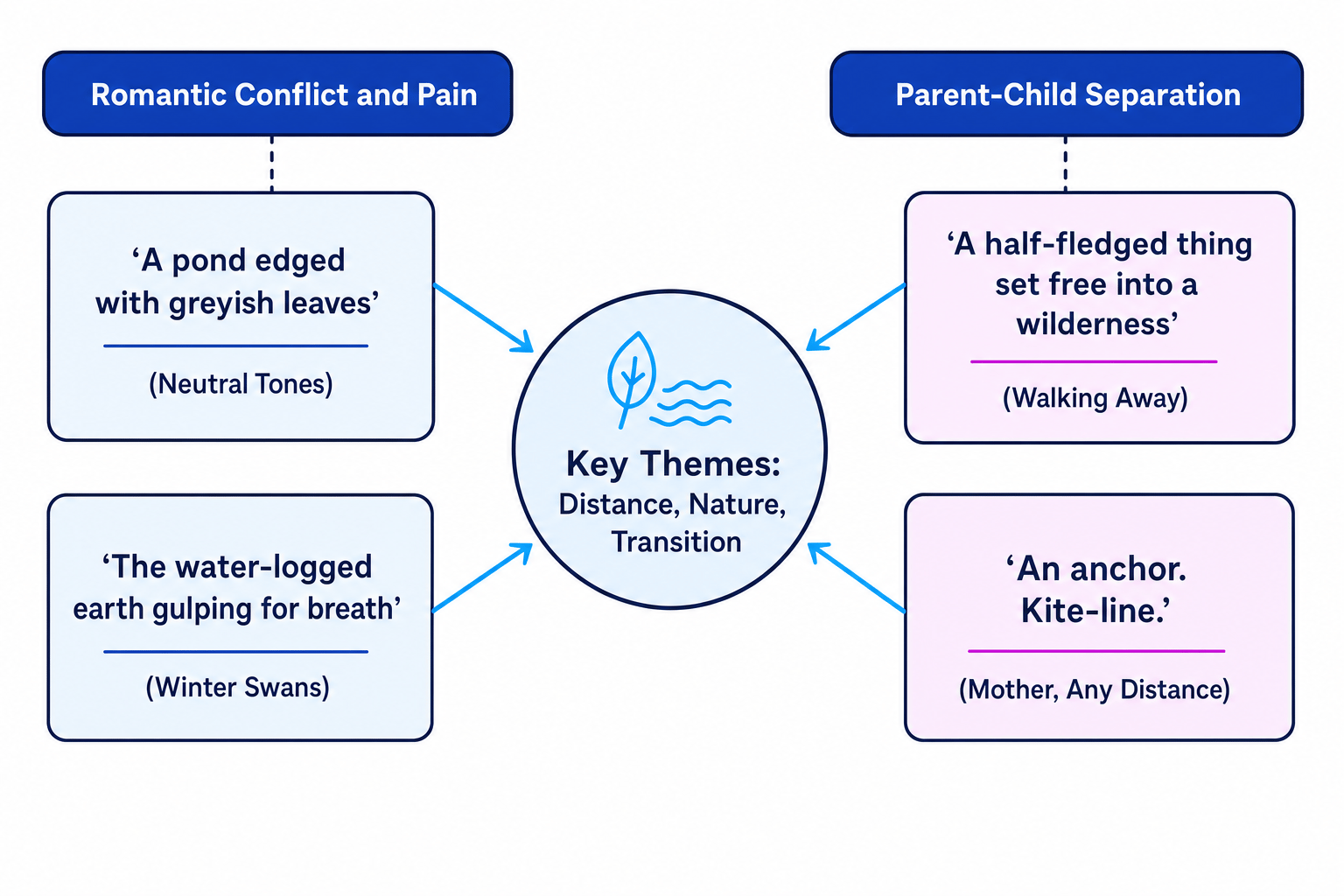
- "And a pond edged with greyish leaves."
- Method: Setting as a metaphor; bleak color imagery ("greyish").
- Analysis: The "greyish leaves" symbolize the decay of the relationship. The lack of vibrant color reflects the lack of life or passion left between the lovers. By starting and ending the poem with this image, Hardy uses a cyclical structure to show that the speaker is permanently trapped in the memory of this painful breakup.
- Themes: Loss of love, memory, nature.
Winter Swans by Owen Sheers
- "The water-logged earth / gulping for breath"
- Method: Personification; pathetic fallacy.
- Analysis: The earth is physically saturated and struggling, mirroring the emotional state of the couple whose relationship is weighed down by unspoken tension and conflict. The harsh verb "gulping" implies a desperate struggle for survival, suggesting that their love is on the verge of suffocating.
- Themes: Reconciliation, nature, emotional distance.
The Power of Pathetic Fallacy
Both Thomas Hardy and Owen Sheers use the natural landscape to mirror the inner emotional turmoil of their characters. In your essays, compare how Hardy's landscape remains stagnant and dead, while Sheers' landscape undergoes a transition that allows the couple to heal.
2. Parent-Child Bonds and Independence
These poems examine how love changes over time, focusing on the painful but necessary process of children growing up and establishing their independence.
Walking Away by Cecil Day-Lewis
- "A half-fledged thing set free / Into a wilderness"
- Method: Bird metaphor; natural imagery.
- Analysis: The adjective "half-fledged" describes a young bird not yet fully ready to fly, conveying the father’s deep anxiety about his son's vulnerability. The noun "wilderness" contrasts with the safety of the home, portraying the wider world as a chaotic, unpredictable, and dangerous place.
- Themes: Growing up, parental anxiety, independence.
Mother, Any Distance by Simon Armitage
- "An anchor. Kite-line."
- Method: Dual metaphor; single-word sentences (caesura).
- Analysis: The mother is represented as the "anchor," symbolizing security, stability, and a firm connection to home. However, an anchor also holds things back, implying she might limit his freedom. The son is the "kite," eager to soar and explore, but still tethered by the "line" of maternal love. The abrupt full stops create a tense pause, reflecting the delicate emotional boundary between security and restriction.
- Themes: Independence, maternal love, transition.
Misinterpreting 'Anchor'
Do not view the mother in Mother, Any Distance as purely negative or controlling. An "anchor" is a protective device that stops a ship from drifting into danger. Armitage uses this metaphor to show the complex dual nature of parental support: it provides essential safety, but growing up requires eventually lifting that anchor.
3. Power, Desire, and Control
Some poems in the anthology highlight the darker side of relationships, where love becomes obsessive, unequal, or silencing.
Porphyria's Lover by Robert Browning
- "And all night long we have not stirred, / And yet God has not said a word!"
- Method: Blasphemy/religious allusion; calm, matter-of-fact tone.
- Analysis: The speaker uses the silence of God to justify his murderous act of strangulation. He believes that because there is no divine intervention or immediate punishment, God approves of his actions. This highlights the speaker's extreme hubris (excessive pride) and absolute delusion of control.
- Themes: Control, madness, destructive passion.
The Farmer's Bride by Charlotte Mew
- "We chased her, flying like a hare"
- Method: Animalistic imagery (simile); hunting verbs ("chased").
- Analysis: The simile "like a hare" dehumanizes the bride, reducing her to prey. The collective pronoun "We" suggests that the entire community joins in the hunt, emphasizing her absolute isolation and vulnerability in a patriarchal Victorian society. She is not a partner; she is a captured animal.
- Themes: Unrequited love, control, fear.
Worked Example: Analyzing a Quotation Step-by-Step
In the exam, you need to transition smoothly from stating a quotation to delivering a multi-layered analysis that meets all assessment objectives (AO1, AO2, and AO3).
Analyzing a quotation for language, structure, and context
Question: Explore how the poet presents the relationship between parent and child in Walking Away.
Analyze the quotation: "love is proved in the letting go"
-
State the direct point (AO1): Identify the core message of the quotation. Here, the speaker reaches a philosophical realization at the end of the poem that true parental love requires allowing a child to become independent, even if it causes personal pain.
-
Identify and analyze the structural position and language choices (AO2): Examine how the writer constructs this line. The quote is placed in the final stanza, resolving the speaker's long-running internal conflict. The verb "proved" functions as a mathematical or scientific term, suggesting that this separation is an absolute, unavoidable truth of life.
-
Incorporate the structural meter and rhyme (AO2): Examine how the rhythm supports the meaning. The monosyllabic simplicity of "letting go" creates a quiet, solemn tone. The poem's steady ABACA rhyme scheme throughout the final stanza highlights a sense of order and acceptance; the father has finally come to terms with this natural progression.
-
Connect the analysis to the wider context of family transition (AO3): Link the analysis to the universal human experience of parental transition. Day-Lewis wrote this poem for his eldest son, Sean. The struggle between the natural instinct to protect a child and the biological necessity of letting them face the "wilderness" reflects the painful, universal transition of parenthood.
The 'Zoom-In' Technique
To score high marks for AO2 (Analysis of Language and Structure), always try to "zoom in" on a single word within your quote after you have explained its overall meaning. For example, after discussing "half-fledged thing," zoom in specifically on the word "thing" to show how the father feels his son is dehumanized and made helpless by his youth.
In the exam
- Choose your partner poem wisely: When the exam paper presents you with a named poem, look at your Key Quote Bank and choose a comparative poem that has contrasting or highly complementary imagery (e.g., pair Winter Swans with Neutral Tones for natural imagery of romantic conflict).
- Keep quotes under six words: This makes them easier to remember, ensures you weave them directly into your sentences, and prevents you from wasting time writing out long blocks of text.
- Analyze structure alongside language: Do not just comment on words. Look at where the quotation sits in the poem (the beginning, the turn/volta, or the ending) and mention punctuation choices like caesura or enjambment.
Check yourself
- Which two poems from your Quote Bank would you pair together to answer a question on "The Pain of Lost Love", and which specific quotes would you use?
- How does the metaphor of the "anchor" in Mother, Any Distance contrast with the "half-fledged thing" in Walking Away?
- Can you identify two distinct language methods used in Charlotte Mew's line "We chased her, flying like a hare"?
