In Paper 2, Section B of your AQA GCSE English Literature exam, you are faced with a unique challenge: you will be given one poem printed in full on the exam paper, and you must compare it to another poem of your own choosing from the Love and Relationships cluster.
Because the exam is closed-book, you cannot look up the second poem. This means your success depends on your ability to make deep, conceptual connections between texts, recall key quotes, and contrast structural and linguistic choices from memory.
What you'll learn
- How to quickly identify the thematic core of an exam question to select the ideal "partner poem" from memory.
- The structure of a high-scoring comparative paragraph that balances both poems dynamically.
- How to link language, form, and structural choices (AO2) to the poet's underlying intentions and context (AO3).
Concept 1: Understanding the Comparative Challenge
AQA examiners are not looking for two separate essays stuck together. They are looking for comparative synthesis.
Comparative Synthesis
Comparative synthesis is the analytical skill of combining your reading of two different texts to construct a single, unified argument. Instead of analyzing them in isolation, you explore how they echo, mirror, or directly oppose each other's ideas about human relationships.
To achieve top marks, you must target the core Assessment Objectives:
- AO1: Maintain a focused, comparative argument that directly answers the prompt, supported by well-selected, embedded quotes from both poems.
- AO2: Analyze how the poets use form, structure, and language to construct meaning, using accurate literary terminology.
- AO3: Link the poets' choices to their contexts—their historical backgrounds, biographical experiences, and overarching ideas about society or human nature.
The Golden Rule of Comparison
Never write two separate essays. If you write page after page about Poem A, and then write page after page about Poem B, you limit your ability to access the higher marks. Your essay should read like an ongoing conversation between the two poems.
Concept 2: Selecting the Perfect "Partner Poem"
When you open your exam paper, you will see one poem printed in front of you. Your first task is to read the prompt, identify the key theme (e.g., family conflict, romantic longing, physical desire, or destructive love), and select a partner poem from memory.
To do this effectively, you should group your 15 anthology poems into thematic categories before the exam.
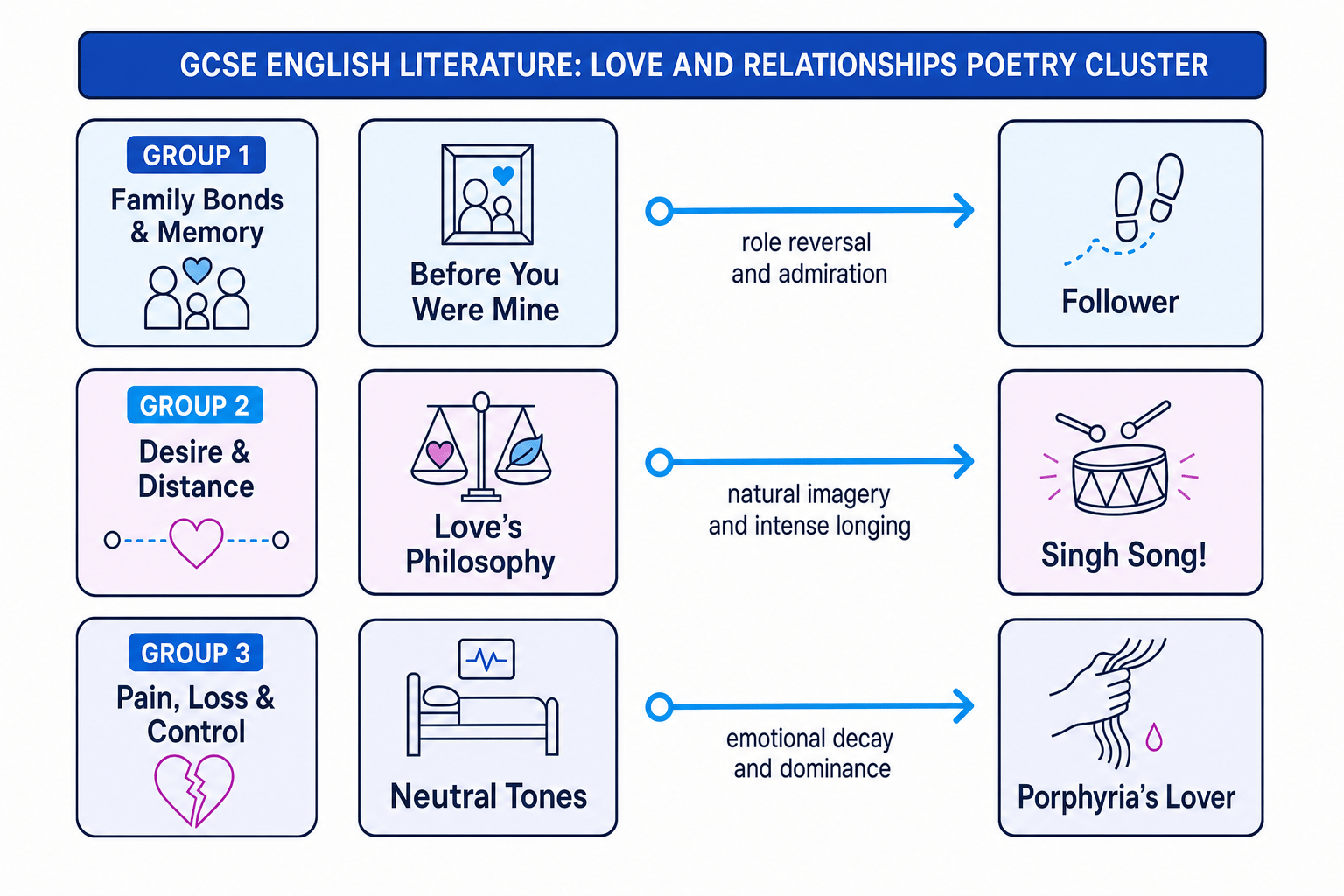
Match by contrast, not just similarity
While it is great to pair two poems that agree (e.g., both showing deep romantic devotion), some of the most sophisticated essays compare poems that approach a theme from opposite directions. Comparing a healthy, supportive relationship with a toxic, destructive one often makes for a far more interesting and evaluative essay.
Here are three highly effective thematic groupings based on the diagram above:
1. Family Bonds and Memory
These poems explore parent-child dynamics, aging, and the passage of time.
- Key Pairings: Before You Were Mine (Carol Ann Duffy) and Follower (Seamus Heaney).
- Why they match: Both poets look back at a parent with deep admiration and a sense of longing. While Heaney uses physical, agricultural imagery to depict his father ("His shoulders globed like a full sail strung"), Duffy uses glamorous, cinematic imagery to imagine her mother's youth ("Your polka-dot dress blows round your knees").
2. Desire and Distance
These poems examine the intense craving for romantic connection and the frustration when physical or emotional barriers stand in the way.
- Key Pairings: Love's Philosophy (Percy Bysshe Shelley) and Singh Song! (Daljit Nagra).
- Why they match: Both deal with desire, but through contrasting forms. Shelley uses a highly structured, classical lyric poem with natural imagery ("the sunlight clasps the earth") to persuade a lover, whereas Nagra uses a modern, playful, phonetic dialect-driven song structure to celebrate romantic and cultural joy ("vun night on de phone...").
3. Pain, Loss, and Control
These poems focus on the darker sides of relationships—heartbreak, decay, obsession, and the desire for absolute dominance.
- Key Pairings: Neutral Tones (Thomas Hardy) and Porphyria's Lover (Robert Browning).
- Why they match: Both poems use bleak landscapes and chilling dramatic techniques to capture dead or dying love. Hardy uses pathetic fallacy and a muted palette ("the sun was white, as though chidden of God") to show emotional decay, while Browning uses a dramatic monologue to explore the pathological psychological need for control and possession.
Concept 3: Structuring Your Comparison Paragraphs
To keep both poems balanced, you should use a woven comparative structure within each body paragraph. Rather than analyzing Poem A in its entirety and then moving to Poem B, you should transition back and forth within the paragraph itself.
Use this structured sequence to plan each analytical paragraph:
- Thematic Topic Sentence: State how both poems address the prompt (e.g., "Both Hardy and Sheers use natural imagery to depict relationships undergoing emotional strain, though they differ in their ultimate resolutions.")
- Analysis of Poem A (The Printed Poem): Introduce a quote, identify a specific method (language, form, or structure), and analyze its psychological or thematic effect.
- Comparative Transition: Use a transition word (e.g., In contrast, similarly, conversely, likewise) to pivot to the second poem.
- Analysis of Poem B (The Memorized Poem): Introduce a remembered quote, identify a method, and explain its effect.
- Synthesis & Context (AO3): Conclude the paragraph by explaining why these similarities or differences exist, linking them to the poets' contexts or wider intentions.
The Tennis Match
Think of a strong comparative essay as a tennis match. The ball must travel back and forth across the net. If you spend too long playing on one side of the court (analyzing only one poem), the game halts. Keep the analytical momentum moving back and forth!
Worked Example: Constructing a Comparative Paragraph
Let's walk through how to build a high-scoring comparative paragraph comparing the representation of emotional distance in Neutral Tones (Thomas Hardy) and Winter Swans (Owen Sheers).
Constructing a comparative paragraph
-
Step 1: Formulate a unified comparative topic sentence. We must construct a thesis-driven opening statement that identifies a shared method (pathetic fallacy/natural imagery) used by both poets to explore the central theme (emotional distance).
- Drafting: "Both Hardy in 'Neutral Tones' and Sheers in 'Winter Swans' utilize bleak, rain-swept natural landscapes as a physical manifestation of the emotional distance and stagnation within a romantic relationship."
-
Step 2: Integrate and analyze Poem A (the printed poem). Now, zoom in on a specific quotation from Neutral Tones, identifying a linguistic or structural method and linking it directly to the poet's message.
- Drafting: "Hardy establishes this sterile atmosphere immediately through his setting, noting that they 'stood by a pond that winter day' under a sun that was 'white, as though chidden of God'. The adjective 'white' strips the sun of its natural warmth and vitality, mirroring the emotionally drained state of the lovers, while the passive verb 'stood' emphasizes a lack of forward movement, showing that their relationship has ground to a painful, static halt."
-
Step 3: Transition smoothly and analyze Poem B (the memorized poem). Use a comparative transition word to pivot to Winter Swans, providing a contrasting or complementary analysis of how natural imagery is used there.
- Drafting: "Similarly, Sheers uses pathetic fallacy in 'Winter Swans' to mirror domestic discord, describing how 'the clouds had given their all - / two days of rain'. The personification of the clouds suggests a relationship saturated with exhaustion and conflict, where the emotional storm has left the couple physically walking in silence, 'silent and apart'."
-
Step 4: Synthesize the comparison and link to context/intentions (AO3). Finally, bring both analyses together to explain why the poets used these techniques, highlighting any key differences in their perspectives.
- Drafting: "However, while Hardy's landscape remains permanently deadened—symbolized by the 'starving sod' which reflects the bitter, cyclical nature of his pessimism and his Victorian anxieties about a godless, decaying world—Sheers offers a modern, hopeful resolution. By showing how the couple watch the swans 'porcelain over the still water', Sheers uses nature not as a symbol of permanent ruin, but as an instructive force that heals their rift, allowing their hands to eventually 'fold' together like a pair of wings."
Pitfalls to Avoid
The 'Half-and-Half' Essay
Writing about the printed poem for two pages, and then writing about your chosen poem for another two pages, is the most common mistake students make. This approach makes actual comparison incredibly difficult and usually results in a low score for AO1 because your ideas are not synthesized. Use the woven method instead.
Feature Spotting
Avoid listing poetic techniques without explaining their effects. Saying "In 'Follower', Heaney uses iambic tetrameter and enjambment" earns zero marks if you do not explain why he used them. Always link structural choices to meaning (e.g., the steady iambic rhythm mimics the precise, rhythmic movement of the father's ploughing).
In the exam
- Spend 5 minutes planning: Do not start writing immediately. Read the prompt, identify the key theme, select your memorized partner poem, and write down 2 or 3 core points of comparison.
- Weave your paragraphs: Ensure every main body paragraph contains analysis of both poems, linked together with comparative transition words (such as whereas, conversely, in contrast, similarly).
- Use short, precise quotes: Since you must quote the second poem from memory, keep your quotes short (one to four words). Memorize versatile, high-impact quotes like "starving sod" (Neutral Tones) or "half-fledged thing" (School Partner/Walking Away) that are easy to remember and rich in imagery.
- Balance your analysis: Try to give roughly equal weight to both poems. An essay that is 80% about the printed poem and only 20% about the memorized poem looks unbalanced and suggests poor preparation.
Check yourself
- Can you list three distinct poems from the cluster that you could pair with Porphyria's Lover if the exam question focused on "the theme of power or control"?
- What is the difference between a "half-and-half" essay structure and a "woven" comparative structure? Which one is more likely to help you reach Grade 7 to 9?
- Look at the quote "the water logged earth / gulping for breath" from Winter Swans. What literary device is used here, and how could you compare it to the natural imagery in Neutral Tones?
