Welcome to your individual poem study notes for the AQA Love and Relationships anthology cluster. In the GCSE English Literature exam (Paper 2, Section B), you will be given one printed poem from the anthology and asked to compare it to another poem of your choice from the cluster.
To achieve the highest marks, you need a deep, individual understanding of each poem's themes, language, structure, and context, as well as a clear strategy for linking them together.
What you'll learn:
- How to analyze key linguistic and structural methods across three core anthology poems.
- How to link context to a writer's deliberate choices to meet high-level mark schemes.
- A step-by-step method for extracting multiple layers of meaning from single quotations.
Laying the Foundations: Key Poetic Terms
Before we dive into the specific poems, we need to master the critical vocabulary that examiners look for when you are analyzing a writer's craft.
Lyric Poetry
Lyric poetry is a formal type of poetry which expresses personal emotions or feelings, typically spoken in the first person ("I", "we"). It focuses on internal states of mind rather than telling a chronological story.
Pathetic Fallacy
Pathetic fallacy is a literary device where the writer attributes human emotions and traits to nature or inanimate objects. In love poetry, this is frequently used to project a character's inner turmoil or harmony onto the weather or landscape.
Volta
A volta is a dramatic turning point in a poem’s tone, structure, or argument. It is highly common in sonnets and lyric poetry, marking a shift from problem to resolution, or from past to present.
Poem 1: 'When We Two Parted' by Lord Byron
Written in 1808 and published in 1816, this is a classic piece of Romantic-era lyric poetry. It details the painful, lingering end of a secret relationship and the bitter feelings of betrayal that followed.
Themes:
- Pain of loss and heartbreak.
- Secrecy, silence, and social shame.
- The destructive passage of time.
Key Analysis and Methods:
- "In silence and tears": This phrase opens and closes the poem, creating a cyclical structure. This tells us that the speaker is trapped in a loop of grief, unable to move past the pain. The use of "silence" highlights that the relationship was a secret, denying him the comfort of public mourning.
- "A knell to mine ear": Byron uses an auditory metaphor here. A "knell" is the solemn ringing of a church bell to announce a death. Hearing his former lover’s name acts as a metaphorical death knell, reminding him that their love is dead and buried.
- Accentual Verse and Rhythm: The poem relies on a heavily accented rhythm. However, Byron deliberately breaks this rhythm in lines like "Pale grew thy cheek and cold", where the extra stressed syllables draw out the pace. This mimics a shudder or a faltering heartbeat, reflecting the physical shock of rejection.
The Power of Silence
In 'When We Two Parted', silence is both a protective shield (to keep the affair secret) and a prison. It prevents the speaker from expressing his grief, making his heartbreak permanent and isolated.
Contextual Link:
Lord Byron was an infamous Romantic poet known for his scandalous personal life. This poem is widely believed to have been written about his affair with Lady Frances Webster. Because she was married, the affair had to remain strictly secret to protect her reputation and prevent Byron from facing social ruin.
Poem 2: 'Winter Swans' by Owen Sheers
In contrast to Byron's permanent heartbreak, Owen Sheers' modern poem 'Winter Swans' explores a temporary emotional distance between a couple and their subsequent reconciliation, facilitated by the natural world.
Themes:
- Emotional distance and unresolved conflict.
- Nature as a healing force.
- Quiet reconciliation and physical touch.
Key Analysis and Methods:
- "the clouds had given their all - / two days of rain": Sheers opens the poem with pathetic fallacy. The heavy rain represents the emotional storm and conflict the couple has endured. The phrase "given their all" suggests that the worst of the conflict is finally over; the storm has exhausted itself.
- "like boats righting in rough weather": This simile describes the swans as they dip underwater and resurface. It acts as a turning point (volta) in the poem, symbolizing that the couple’s relationship can also stabilize and recover after a period of turbulent emotional "weather".
- Stanza Form and Structure: The poem is written in three-line stanzas (tercets). This odd, uneven line count visually represents the imbalance and lack of harmony between the couple. However, the poem ends in a couplet (a two-line stanza): "our hands... folded, / one over the other, / like a pair of wings settling after flight." The physical transition from a three-line structure to a two-line couplet mirrors the couple coming back together as a unified pair.
Ignoring the physical structure of stanzas
Do not just analyze individual words. Highly successful students always link structural choices (like the shift from tercets to a couplet in 'Winter Swans') directly to the emotional state of the characters.
Poem 3: 'Singh Song!' by Daljit Nagra
'Singh Song!' is a vibrant, modern, and joyful poem that celebrates romantic love, marriage, and the rebellion against societal and parental expectations. It offers a bright contrast to the somber tones of Byron and the quiet tension of Sheers.
Themes:
- Joyful, passionate love.
- Cultural identity and collision.
- Rebellion against traditional work expectations.
Key Analysis and Methods:
- Phonetic Dialect: Nagra writes in "Punglish" (a blend of Punjabi and English), using phonetic spellings like "yor sheek to sheek" and "di stool of my stool". This deliberate choice celebrates his cultural heritage and shows that their love exists in a unique, joyous linguistic space that defies standard English conventions.
- "my bride": This phrase is repeated like a musical refrain throughout the poem. The repetition highlights the speaker's pride and child-like excitement at being married. It contrasts sharply with traditional arranged marriage expectations by focusing purely on romantic and physical attraction.
- "from di stool of my stool / ... she effing at my mum / in all di colours of Punjabi": Nagra uses humor and domestic imagery to ground their love in the real, chaotic world. Love here is not quiet or solemn; it is loud, funny, and rebellious.
Connecting the Anthology
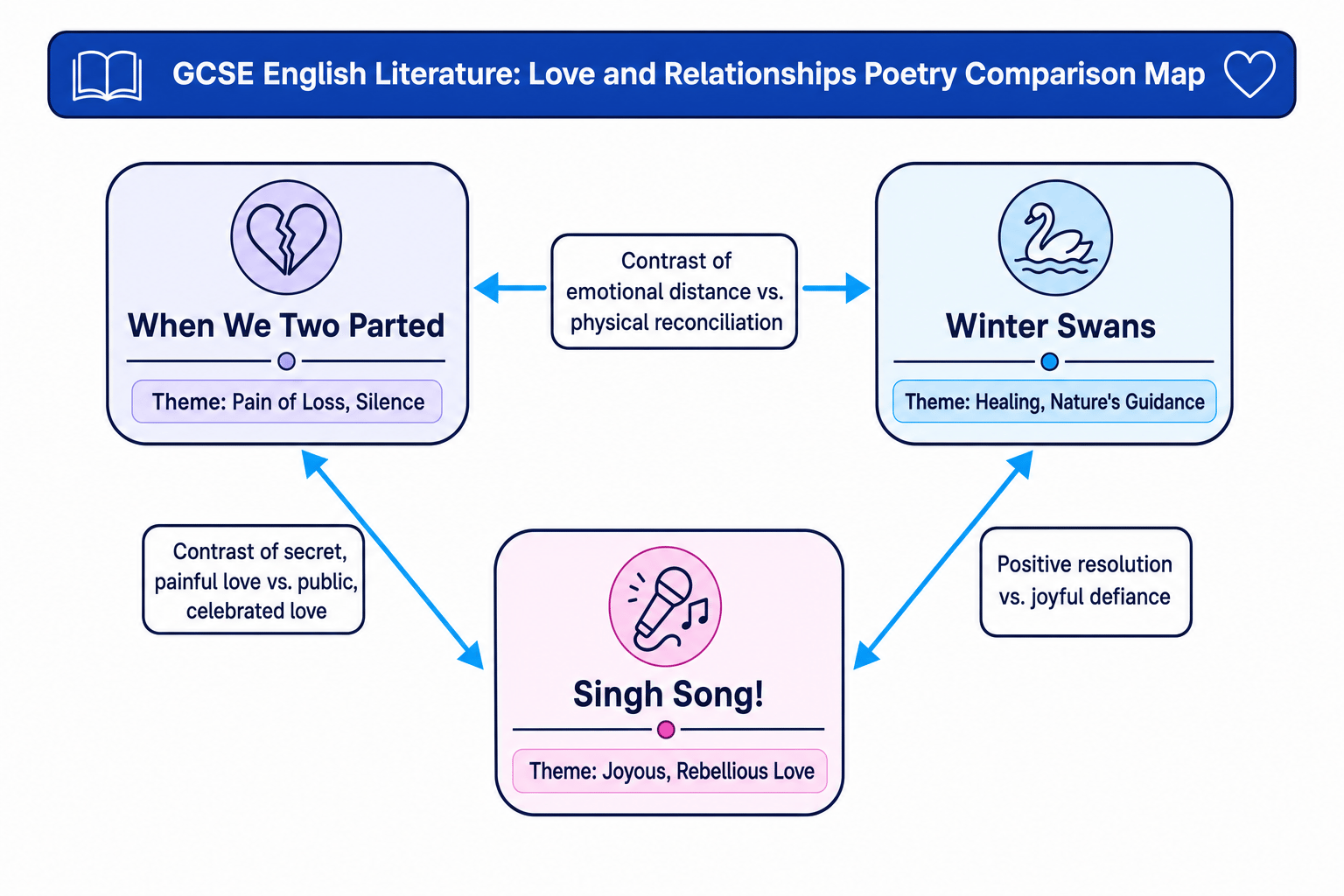
When preparing for your exam, you should never study these poems in isolation. Group them by theme so you are ready to compare whichever poem appears on your exam paper.
Choosing your comparison poem
In the exam, look at the theme of the printed poem first. If the printed poem is about painful, failed love (like 'When We Two Parted'), compare it to another poem about distance or reconciliation (like 'Winter Swans') to highlight contrasting resolutions.
Deepening Your Analysis: The Step-by-Step Method
To gain top marks for AO2 (Analysis of Language and Structure), you must go beyond simply identifying a device. You need to pull apart a quotation to show multiple layers of interpretation.
Here is a step-by-step walk-through of how to analyze a complex quotation.
Deconstructing a poetic method to reveal depth
Analyze the quote: "like boats righting in rough weather" (from 'Winter Swans').
- Identify the method: Identify the primary literary device. Here, Sheers uses a simile comparing the swans' physical movement to boats stabilizing on water.
- Analyze the literal imagery: Consider the literal properties of the image. "Righting" means to return to an upright, stable position after tilting or capsizing. "Rough weather" represents external, turbulent forces (storms, waves).
- Connect to the emotional context: Map the physical image onto the human relationship. The "rough weather" symbolizes the emotional arguments and silence the couple has experienced over the "two days of rain". The "righting" indicates that the relationship is not destroyed; it has the natural resilience to correct itself.
- Identify the structural purpose (the 'why'): Link the quote to the poem's trajectory. This simile occurs immediately after the swans display unity. It acts as a psychological catalyst, showing the reader that the couple has observed nature's resilience and is now ready to let go of their conflict, leading to the holding of hands at the end.
The 'Device Spotting' Pitfall
Never write: "The poet uses a simile in 'like boats righting' to show they are getting better." This merely spots the device without analyzing the mechanics of the imagery or linking it to the wider structure of the poem. Always use the step-by-step method to explore how the specific words function.
In the exam
- Spend 5 minutes planning: Write down 3 clear thematic connections between the printed poem and your chosen comparison poem before you begin writing.
- Lead with thesis statements: Start every paragraph with a conceptual point about love or relationships (e.g., "Both poets explore how physical distance reflects emotional division..."), rather than focusing purely on the names of the poems.
- Weave in short, embedded quotes: Avoid long, multi-line quotations. Use precise, 2-to-4-word fragments (e.g., "silence and tears" or "rough weather") packed tightly into your own sentences.
- Balance your comparison: Ensure you spend roughly equal time analyzing both poems. A common trap is writing 70% on the printed poem and only 30% on your chosen poem.
Check yourself
- Why does Byron use the cyclical structure of "silence and tears" at both the start and the end of 'When We Two Parted'?
- How does the stanza structure of 'Winter Swans' physically mimic the emotional progress of the couple?
- In what ways does Daljit Nagra use language/phonetics in 'Singh Song!' to show that the couple's love is rebellious and non-traditional?
