What you'll learn
- How to shape a strong A Christmas Carol essay for the AQA 19th-century novel question.
- How to move from quotation to analysis, rather than just retelling the plot.
- How to include Dickens’s methods and context naturally.
- What a compact model response looks like in practice.
What makes an essay a “model” essay?
A model essay is not a piece of writing you memorise word for word. It is a guide to the moves a strong answer makes: it answers the question directly, uses short evidence, analyses Dickens’s choices, and links everything back to the argument.
In A Christmas Carol, strong essays usually show how Dickens presents change: from selfishness to generosity, ignorance to awareness, isolation to community, or spiritual death to moral rebirth.
The aim of a model essay
A strong essay proves one clear interpretation of Dickens’s message, rather than listing everything you know about the novella.
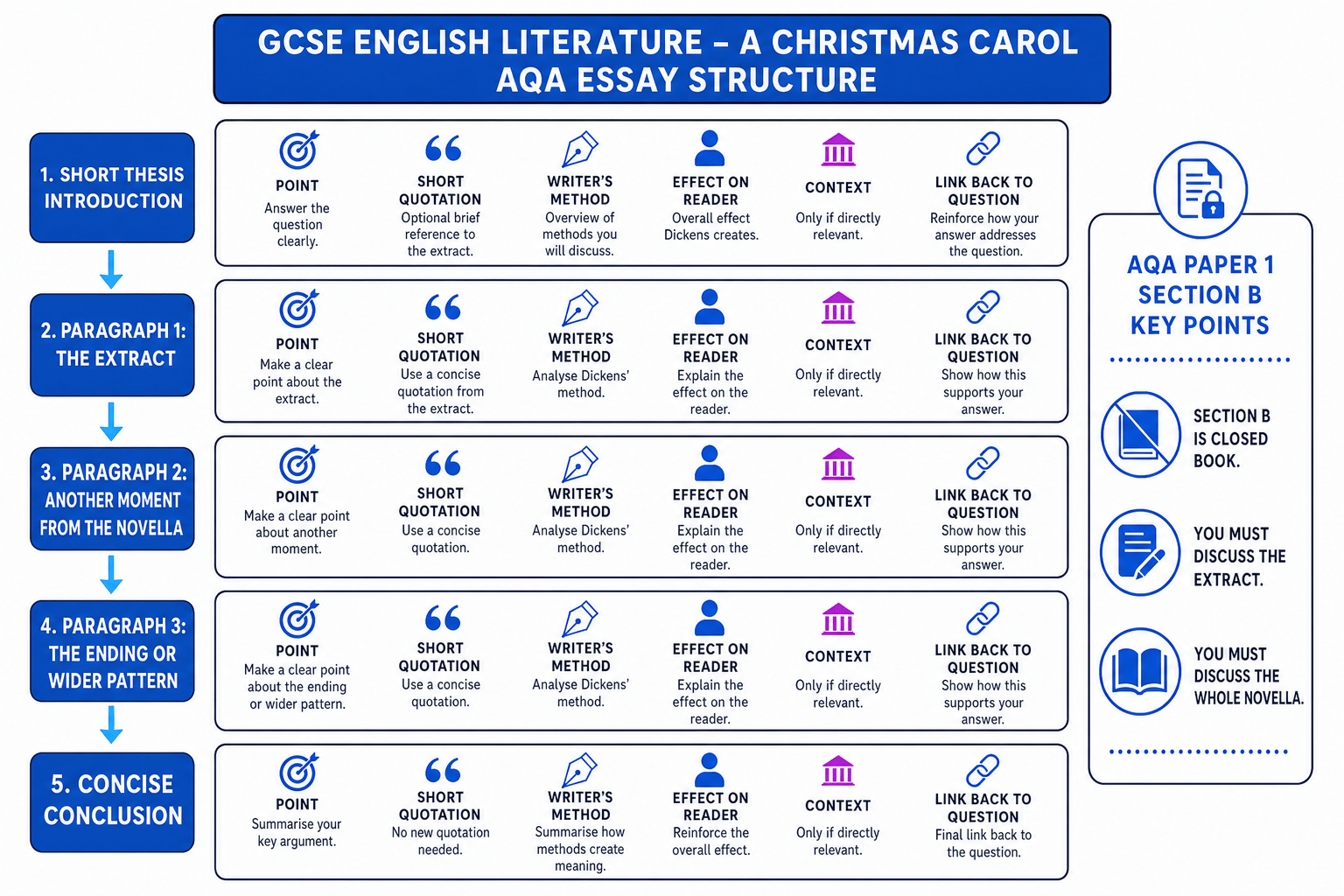
The AQA essay shape: extract + whole novella
In the AQA Paper 1 Section B question, you are given an extract: a short printed passage from the novella. You must write about that extract and the whole novella, meaning other relevant moments from across the text.
The exam is closed book, so you need to memorise short, accurate quotations. You do not need long quotations: phrases like “solitary as an oyster”, “surplus population”, “Mankind was my business”, and “I will honour Christmas in my heart” are enough if you analyse them well.
Turning the question into a focus
Suppose the question asks how Dickens presents Scrooge as an outsider.
- Decide what “outsider” means in this question. It could mean Scrooge is socially isolated, emotionally cold, and morally separated from Christian charity.
- Choose extract evidence that proves this idea. If the extract includes “solitary as an oyster”, Dickens’s simile suggests Scrooge has shut himself away from others.
- Choose whole-text evidence that develops the argument. You might move from “Are there no prisons?” in Stave One to his joyful generosity in Stave Five.
- Turn this into a thesis: Dickens first presents Scrooge as an outsider created by greed and fear, but uses his transformation to show that social connection and compassion can redeem even the most isolated person.
Start with a thesis
Thesis
A thesis is your overall answer to the question, usually in one or two sentences at the start of the essay.
A thesis should not simply repeat the question. It should give the examiner a clear line of argument.
Weak thesis: Dickens presents Scrooge as greedy.
Stronger thesis: Dickens presents Scrooge’s greed as a kind of moral imprisonment, then uses the supernatural visits to show that compassion can release him back into society.
Notice the stronger version includes how Dickens presents the idea and why it matters.
Improving a thesis
Question focus: How does Dickens present responsibility?
- Begin with the key idea: responsibility in the novella means caring for other people, especially the poor and vulnerable.
- Add Dickens’s contrast: Scrooge begins by rejecting responsibility through “surplus population”, while Marley warns that “Mankind was my business.”
- Link to Dickens’s purpose: the novella challenges wealthy Victorian readers who ignore poverty.
- Shape the thesis: Dickens presents responsibility as a moral duty that Scrooge initially refuses, but through Marley and the spirits Dickens shows that a good life depends on active compassion for others.
Build paragraphs around analysis, not plot
Analytical paragraph
An analytical paragraph is a paragraph that makes a point, supports it with evidence, analyses Dickens’s methods, and links back to the question.
A useful paragraph shape is:
- Point: answer the question in a focused sentence.
- Evidence: use a short quotation or precise reference.
- Method: name Dickens’s technique where useful.
- Effect: explain what the reader understands or feels.
- Link: connect back to the question and Dickens’s wider message.
Writer's method
A writer’s method is a deliberate choice of language, form or structure, such as simile, symbolism, contrast, motif, narrative voice, or the order of events.
Analysing “solitary as an oyster”
- Make a precise point: Dickens presents Scrooge’s isolation as self-protective as well as unpleasant.
- Identify the method: the simile “solitary as an oyster” compares Scrooge to a closed shell, suggesting he is emotionally sealed off from others.
- Develop the effect: an oyster is hard on the outside but may contain something valuable inside, so Dickens hints that Scrooge is not beyond redemption.
- Link to the wider novella: this prepares the reader for Scrooge’s later transformation, when he becomes “as good a friend, as good a master, and as good a man, as the good old city knew.”
Retelling the story
Avoid paragraphs that simply say what happens next. If your paragraph is mostly “then Scrooge sees…” or “after that…”, you are probably narrating the plot instead of analysing Dickens’s choices.
Use context as part of the argument
Context
Context means the real-world ideas, beliefs and conditions surrounding a text’s creation and reception.
For A Christmas Carol, context might include Victorian poverty, the 1834 Poor Law, workhouses, Christian morality, or Dickens’s concern for poor children. However, context only helps if it explains Dickens’s message.
Do not bolt on a sentence like: “This links to Victorian times.” Instead, connect context to a quotation and to Dickens’s purpose.
Integrating Poor Law context
- Start with Dickens’s words: Scrooge asks, “Are there no prisons?” and “Are there no workhouses?”, reducing the poor to a social problem.
- Connect the context: Victorian workhouses were feared because they were deliberately harsh, reflecting attitudes that poverty was often the fault of the poor.
- Explain Dickens’s challenge: by making Scrooge’s words sound cruel and inhuman, Dickens criticises wealthy readers who support systems without compassion.
- Link to the question: this presents Scrooge’s lack of responsibility as not just personal selfishness, but a wider social failure.
Context should be a lens
Use context to sharpen your analysis, not to replace it. The quotation should still be doing the main work.
Write about structure across the novella
Structure
Structure means how a text is organised: the order of events, contrasts, turning points, beginnings and endings.
Dickens structures the novella as a journey. Scrooge begins “hard and sharp as flint”, receives warnings from Marley and the spirits, confronts suffering and death, then wakes transformed, declaring, “I will honour Christmas in my heart.”
This whole-text movement is powerful because it lets you show development, not just describe a character at one moment.
Tracking Scrooge's transformation
- Establish the starting point: in Stave One, Scrooge is associated with coldness and isolation through phrases such as “No warmth could warm” him.
- Identify the turning pressure: Marley’s warning, “I wear the chain I forged in life,” forces Scrooge to see that selfish choices have spiritual consequences.
- Show the final contrast: in Stave Five, Scrooge becomes “light as a feather”, a simile that suggests freedom, joy and release from moral burden.
- Explain the structural effect: Dickens makes Scrooge’s change dramatic so readers believe moral reform is urgent but possible.
A compact model response
Question focus: How does Dickens present Scrooge’s transformation?
Dickens presents Scrooge’s transformation as a movement from spiritual imprisonment to joyful social responsibility. At first, Scrooge is a symbol of selfish capitalism, but by the end of the novella Dickens uses him to prove that redemption is possible when people choose compassion.
At the beginning, Dickens presents Scrooge as emotionally closed off from society. The narrator describes him as “solitary as an oyster”, a simile that suggests he is hard, cold and sealed away from human connection. However, the image also hints at hidden value, because an oyster may contain a pearl. This suggests that Dickens does not present Scrooge as purely evil, but as someone whose humanity has been buried by greed and isolation. For Victorian readers, Scrooge’s refusal to help the poor would have been especially troubling because Christmas was associated with Christian charity and community.
Marley’s ghost becomes a warning of what Scrooge may become if he refuses to change. Marley says, “I wear the chain I forged in life,” using the chain as a symbol of guilt and moral consequence. The verb “forged” suggests Marley made his punishment through his own choices, so Dickens presents responsibility as something unavoidable. Marley’s cry that “Mankind was my business” directly challenges Scrooge’s earlier attitude that the poor should go to “prisons” or “workhouses.” Through this supernatural warning, Dickens teaches that a life devoted only to money is spiritually empty.
By the end, Scrooge’s transformation is shown through warmth, generosity and joyful energy. When he wakes, he says, “I will honour Christmas in my heart,” showing that his change is internal, not just temporary behaviour. The verb “honour” suggests commitment and reverence, as if Christmas values have become a moral code for him. Dickens then shows Scrooge helping the Cratchits and becoming “as good a man, as the good old city knew.” This public judgement confirms that his private change has become social action.
Overall, Dickens presents Scrooge’s transformation as the moral heart of the novella. Through contrast, symbolism and structure, he shows that people can change, but only if they recognise their duty to others.
Do not memorise full essays
Memorising a whole model essay is risky because the exam question may be different. Memorise flexible quotations, paragraph moves and key interpretations instead.
In the exam
- Spend a few minutes planning a thesis and 3 clear paragraphs: one on the extract, two on the wider novella.
- Use short quotations and analyse individual words or methods closely.
- Include context only when it directly explains Dickens’s message.
- Keep linking back to the question so your essay feels like an argument, not a character summary.
Check yourself
- Can you write a thesis about Scrooge’s transformation in one or two sentences?
- Can you analyse “solitary as an oyster” without retelling the plot?
- Can you explain one piece of Victorian context and link it directly to Dickens’s purpose?
