Understanding the plot of An Inspector Calls is about much more than just remembering what happens and when. J.B. Priestley uses a highly deliberate, tense, and tightly wound structure to deliver a powerful message about social responsibility.
In this guide, you will learn how the events of the play unfold, how Priestley manipulates dramatic tension, and how the plot is engineered to challenge both the characters and the audience.
What you'll learn
- The chronological sequence of events across the play's three acts.
- How Priestley adapts structural models to construct a gripping moral mystery.
- How to trace the escalation of dramatic tension and analyze the play's shocking final twist.
The Architectural Design: The "Well-Made Play"
Before diving into the chronological events, we need to understand the structural blueprint Priestley uses. An Inspector Calls is structured as a modern adaptation of a classic theatrical genre.
The Well-Made Play (Pièce Bien Faite)
A popular 19th-century French drama genre characterized by a tight, logical plot that takes place in a continuous time frame. It typically features a secret revealed near the climax, mounting suspense, and a neat resolution where order is restored.
Priestley adopts the mechanics of the well-made play—the single room setting, the unfolding secrets, the ticking clock—but he turns the genre on its head. Instead of restoring the comfortable, capitalist social order at the end, Priestley shatters it to leave the audience with an urgent moral question.
The Chain of Events
The Inspector describes his investigation as a process of looking at "one line of inquiry at a time." This structural choice creates a "chain of events," physically demonstrating how the actions of the wealthy classes are inextricably linked to the lives of the working classes.
Act-by-Act Plot Breakdown
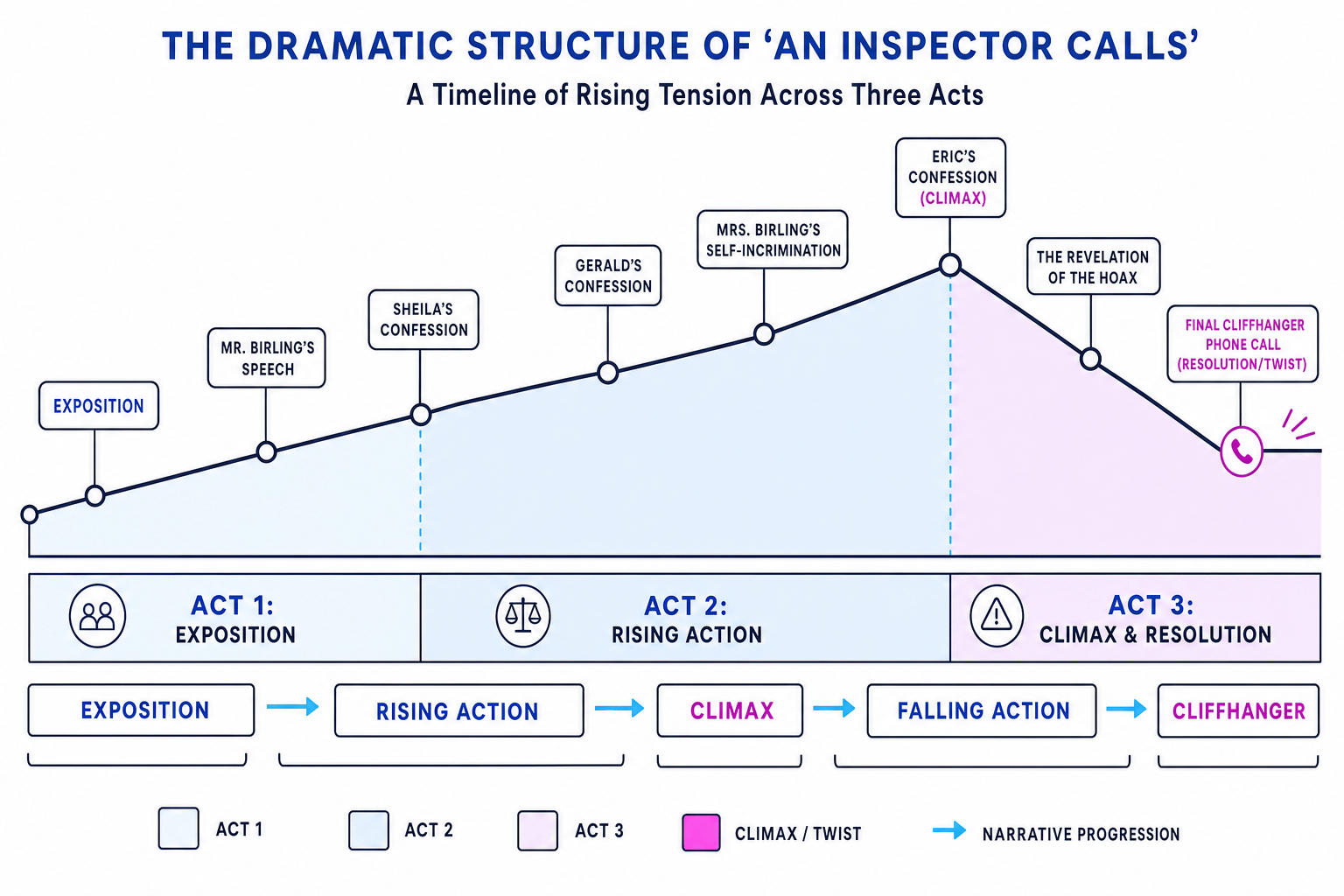
Act One: The Illusion of Order
The play opens in the dining room of the Birling family home in the industrial town of Brumley, North Midlands, in the spring of 1912.
- The Exposition: The wealthy Birling family is celebrating the engagement of Sheila Birling to Gerald Croft, the son of Mr. Birling’s rival competitor, Lord Croft. The atmosphere is self-congratulatory. Mr. Birling, a "heavy-looking, rather portentous man," delivers pompous speeches. He dismisses the threat of war as "silly little war scares," praises the Titanic as "unsinkable, absolutely unsinkable," and declares that "a man has to make his own way—has to look after himself."
- The Inciting Incident: A sharp ring of the doorbell interrupts Birling's individualistic speech. Inspector Goole arrives, investigating the suicide of a young working-class woman, Eva Smith, who died after drinking disinfectant.
- The First Link (Arthur Birling): The Inspector reveals that Birling sacked Eva two years prior from his factory for leading a strike for a minor wage increase ("twenty-two and six" shillings a week). Birling defends his decision as standard business practice.
- The Second Link (Sheila Birling): Sheila is shown a photograph of the girl. Distressed, she confesses that she used her social influence to get Eva fired from her next job at the high-end department store, Milwards, out of a fit of petty jealousy. Sheila feels deep, immediate remorse.
- The Cliffhanger: The Inspector mentions that the girl changed her name to Daisy Renton. Hearing this name, Gerald Croft flinches, revealing his guilt to Sheila before the Inspector even questions him.
Act Two: The Complications Deconstruct the Family
The second act begins immediately after the first, maintaining continuous dramatic time to heighten the tension.
- The Third Link (Gerald Croft): Under interrogation, Gerald admits to having a summer affair with Daisy Renton after rescuing her from the predatory local alderman, Meggarty. He set her up in a friend's rooms but eventually ended the relationship. Sheila respects his partial honesty but returns her engagement ring.
- The Fourth Link (Sybil Birling): Mrs. Birling tries to intimidate the Inspector using her social status, but her cold exterior cracks. It is revealed that as the head of the Brumley Women’s Charity, she rejected Eva's plea for financial support only two weeks prior. Eva was pregnant and desperate.
- The Trap is Sprung: Mrs. Birling insists she did her duty and blames the father of the unborn child, asserting he should be dealt with "very severely" and made an example of.
- The Realization: As Mrs. Birling rants, Sheila frantically begs her mother to stop. The audience and the characters suddenly realize the truth: the father of the child is Mrs. Birling's own son, Eric. Eric enters the room as the act ends.
Dramatic Irony
A literary device where the audience knows vital information that a character on stage does not. This is used most sharply when Mrs. Birling demands the father of the child be punished, unaware she is condemning her own son.
Act Three: Climax, Hoax, and the Final Verdict
The final act brings the confrontation to its peak and leaves the characters (and the audience) morally divided.
- The Fifth Link (Eric Birling): Eric confesses to meeting Eva at a music hall, forcing his way into her lodgings, and getting her pregnant. He stole £50 from his father's office to support her, which she refused to accept once she realized it was stolen.
- The Climax: The family is in ruins, trading bitter accusations. The Inspector cuts across the noise to deliver his final, apocalyptic warning to the family and the audience:
"We don't live alone. We are members of one body. We are responsible for each other. And I tell you that the time will soon come when, if men will not learn that lesson, then they will be taught it in fire and blood and anguish."
- The Falling Action (The Hoax): The Inspector departs. Gerald returns with news from a local police officer: there is no "Inspector Goole" on the force. A telephone call to the local infirmary confirms that no suicide has been reported that day.
- The Generational Divide: Mr. and Mrs. Birling, along with Gerald, are overjoyed, dismissing the evening as a clever hoax. However, Sheila and Eric remain deeply shaken. They realize that even if the Inspector wasn't real, their immoral actions still occurred.
- The Twist Resolution: The phone rings. Mr. Birling answers. He informs the family that a young girl has just died on her way to the infirmary after swallowing disinfectant, and a police inspector is on his way to question them. The curtain falls on a stage of stunned silence.
Confusing the Hoax with Absolution
Many students write that because Goole was a "fake" inspector, the Birlings did nothing wrong. Remember: the physical actions they confessed to (sacking her, getting her fired, exploiting her, denying her charity) are completely real. The hoax is a moral test, which the older Birlings fail by immediately trying to cover up their reputations once they think they are safe.
Deconstructing Structural Tension
To score highly on AO2 (Analysis of Language, Form, and Structure), you must be able to explain how Priestley constructs his scenes to maximize tension. Let’s walk through how to analyze a critical structural turning point.
Analyzing structural tension at the end of Act Two
The Task: Analyze how Priestley structures the dialogue and dramatic pace at the end of Act Two to build tension prior to Eric's entrance.
- Identify the structural pattern of the scene: Note how Priestley shifts from slow, methodical questioning to a rapid, out-of-control momentum. This is achieved by having Mrs. Birling dominate the stage with her arrogant declarations, while Sheila frantically attempts to intervene as the voice of caution.
- Select and analyze specific structural devices: Look at the sentence lengths and stage directions. As Mrs. Birling digs her own grave, she speaks in long, self-righteous sentences: "I blame the young man who was the father of the child... He should be made an example of." In contrast, Sheila’s warnings are short, panicked, and punctuated with dashes: "Mother—stop!—stop!" This creates a rhythmic clash on stage, accelerating the tempo.
- Examine the climax of the act's structure: Look at the physical actions dictated by the script. Mrs. Birling finally realizes her mistake, marked by the stage direction: (understanding now) "But surely... Oh, a lot of silly nonsense!" The tension is stretched to its absolute limit as the front door slams (heard offstage), and Eric walks in, looking "extremely pale and distressed."
- Link the structure to Priestley’s social message: Explain why Priestley structured the act to end on this precise cliffhanger. By ending the act at the moment Eric enters, Priestley forces the audience to sit in the tension of the intermission, contemplating how Mrs. Birling's capitalist, unsympathetic attitude has directly destroyed her own future grandchild.
Structuring Your Essay Paragraphs
When writing about the plot in your exam, try not to simply retell the story. Instead, use active verbs to describe Priestley's choices: “Priestley introduces...”, “Priestley deliberately contrasts...”, “Priestley employs dramatic irony to...”. This keeps your focus on the playwright’s craft (AO2) rather than just plot summary.
In the exam
- Never write a chronological plot summary: The examiner already knows the plot. Instead, structure your essay around themes (such as class, age, or gender) or characters, and use plot points as evidence to support your argument.
- Comment on the transitions between acts: Note how there is no time lapse between Acts One, Two, and Three. Point out that this "real-time" structure intensifies the pressure on the Birlings, making their breakdown feel inevitable and claustrophobic.
- Deconstruct the final twist: Be ready to argue why the twist happens. The second phone call represents a second chance that has been lost. Because the older Birlings refused to learn Goole's lesson, they are forced to go through the interrogation again—this time, with real legal consequences.
Check yourself
- Why is it structurally significant that Mr. Birling's capitalist "hard-headed business man" speech is interrupted by the ringing of the doorbell?
- How does the change in Gerald's attitude after he discovers the Inspector might be a "hoax" highlight the thematic divide between the older and younger generations?
- What is the dramatic effect of the play ending on a cliffhanger rather than a neat, closed resolution?
