In Macbeth, William Shakespeare constructs a dark, psychological tragedy that explores the fragile nature of morality, power, and the human mind. Rather than just memorizing what happens in the plot, top-grade students must understand why things happen. The characters' actions are driven by deep-seated thematic ideas that Shakespeare wanted his Jacobean audience to contemplate.
What you'll learn:
- How to analyze Shakespeare's main thematic messages (Ambition, Kingship, Deception, and Guilt).
- How to link these themes to the social, political, and historical context of King James I's reign.
- How to construct highly focused analytical paragraphs that show how these themes are built using language and structure.
The Landscape of Macbeth's Themes
To write a high-scoring essay, you need to see how these themes do not exist in isolation. They are constantly overlapping. For example, Macbeth's uncontrolled ambition leads him to violate the natural order of kingship, which forces him to adopt a mask of appearance vs. reality, ultimately destroying his mind through guilt.
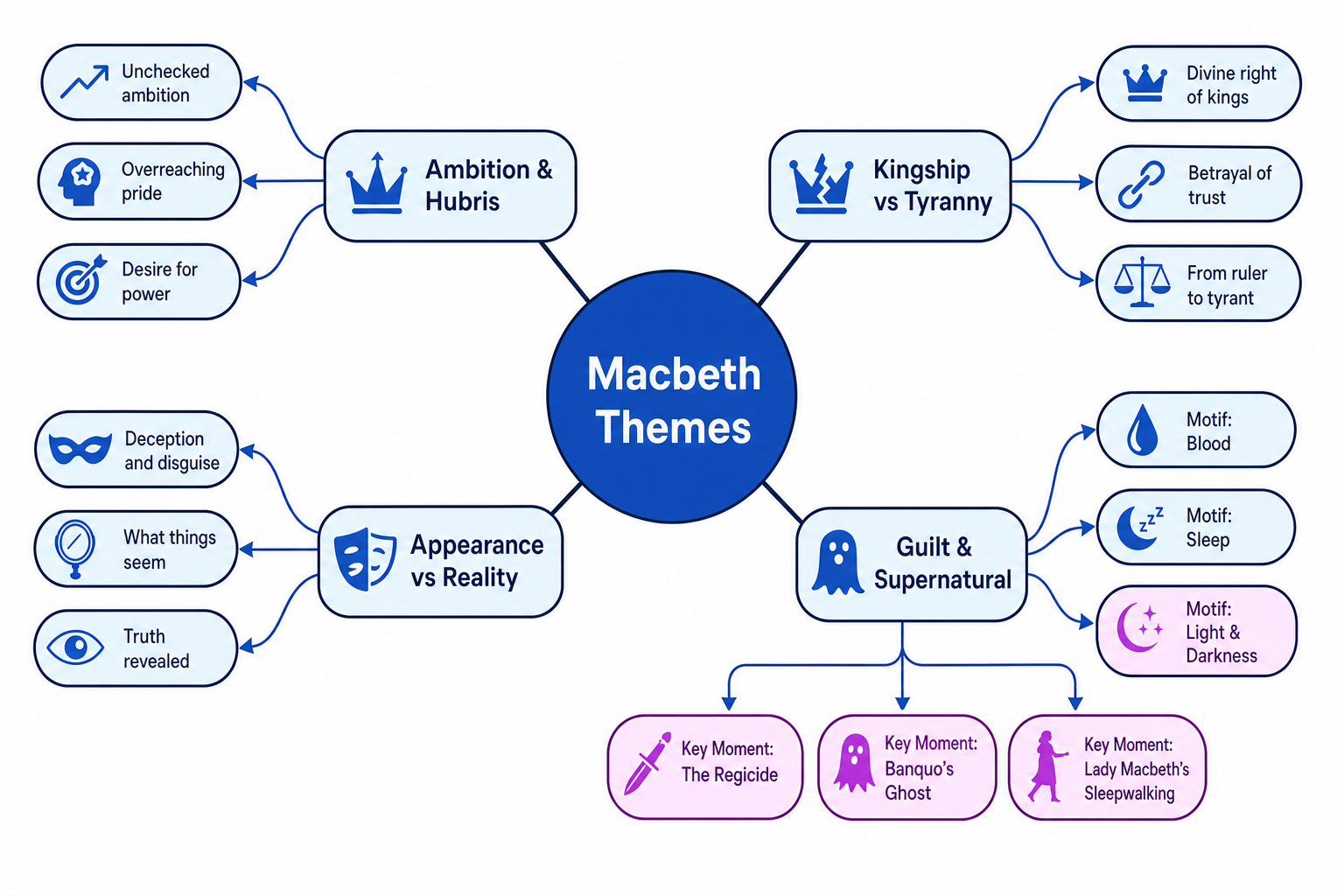
Ambition and Hubris (The Corrupting Force)
Ambition is the engine of the play, but Shakespeare is careful to distinguish between healthy loyalty and unchecked, destructive desire.
Hamartia & Hubris
Hamartia is the Greek tragedy term for a protagonist's fatal flaw that leads to their downfall. In Macbeth's case, his hamartia is unchecked ambition, which manifests as hubris (excessive pride or self-confidence that defies the gods or natural order).
At the start of the play, Macbeth is a celebrated warrior, described as "valiant" and "brave." However, the Witches' prophecies ignite a latent spark of ambition within him. Shakespeare presents ambition not as a sudden external force, but as a pre-existing vulnerability that the Witches and Lady Macbeth exploit.
By Act 1, Scene 7, Macbeth himself recognizes the danger of his desires. In his soliloquy, he admits:
"I have no spur / To prick the sides of my intent, but only / Vaulting ambition, which o'erleaps itself / And falls on the other."
Shakespeare uses the equestrian metaphor of a rider trying to leap onto a horse with too much force, only to overshoot and fall on the other side. This foreshadows Macbeth's inevitable self-destruction.
The Nature of Ambition
In Macbeth, ambition is a self-defeating force. Shakespeare shows that satisfying an unnatural ambition does not bring peace or security; instead, it breeds a relentless paranoia that forces the perpetrator to commit more acts of violence to protect what they have stolen.
Kingship versus Tyranny (The Political Order)
In Jacobean England, the monarch was not just a political leader, but God’s representative on Earth. This concept is vital for your essays.
The Divine Right of Kings
The Divine Right of Kings was the belief that monarchs were chosen by God and derived their authority directly from Him. To overthrow, harm, or assassinate a king was not just treason (a political crime); it was sacrilege (a sin against God) that disrupted the entire natural order of the universe.
Shakespeare contrasts three distinct rulers to explore what makes a good king versus a tyrant:
1. King Duncan: The Holy Ruler
Duncan is presented as a benevolent, virtuous, and legitimate monarch. His rule is associated with light, growth, and natural harmony. When Macbeth contemplates murdering him, he notes that Duncan’s virtues "will plead like angels, trumpet-tongued" against the murder. Duncan's death immediately triggers chaotic, unnatural events in the physical world (e.g., horses eating each other, darkness during the daytime), symbolizing that the Divine Right has been violated.
2. Macbeth: The Usurper and Tyrant
A usurper is someone who takes power by force without legal right. Macbeth’s rule is characterized by fear, isolation, and bloodshed. Unlike Duncan, who nurtures his subjects (promising to "plant" Macbeth and make him "full of growing"), Macbeth acts like a parasite, draining Scotland of its life. Under Macbeth's tyranny, Scotland is described as a place that "weeps, it bleeds; and each new day a gash / Is added to her wounds."
3. Malcolm: The Ideal Monarch
Malcolm represents the restoration of natural and divine order. In Act 4, Scene 3, he lists the "king-becoming graces," which include "justice, verity, temperance, stableness, bounty, perseverance, mercy, [and] lowliness." Malcolm is cautious, tests the loyalty of his allies, and ultimately heals Scotland with the help of the holy King Edward of England, restoring God's designed order.
Contextual Link (AO3)
Shakespeare wrote Macbeth in 1606, shortly after the Gunpowder Plot of 1605—a real-life conspiracy to blow up King James I. By showing the horrifying psychological and spiritual consequences of regicide, Shakespeare was writing a cautionary tale designed to flatter King James and warn potential rebels of the divine punishment that awaited traitors.
Appearance versus Reality (Equivocation and Deceit)
In Macbeth, nothing is as it seems. Shakespeare establishes this theme in the very first scene through the Witches' choral chant: "Fair is foul, and foul is fair." This paradox sets up a world of moral confusion, where traditional values are inverted.
Equivocation
Equivocation is the use of ambiguous or double-edged language to conceal the truth or avoid committing oneself. In the Jacobean era, it was famously associated with Jesuit conspirators who used misleading statements under oath to protect themselves without technically lying under the eyes of God.
The Witches are the ultimate equivocators. Their prophecies—such as the promise that "none of woman born" shall harm Macbeth, or that he is safe until Birnam Wood moves to Dunsinane—are designed to sound like absolute safety while secretly ensuring his doom. They use Macbeth’s hubris against him, feeding him half-truths to lead him to his destruction.
Humans also adopt masks of deception. Lady Macbeth instructs her husband:
"Look like the innocent flower, / But be the serpent under't."
This striking imagery references a commemorative medal King James I had struck after the Gunpowder Plot, which featured a snake hiding under lilies. The "serpent" also carries heavy biblical connotations of the Devil in the Garden of Eden, associating deceptive behavior with original sin and ultimate damnation.
Guilt, Conscience, and the Supernatural
Once the deed is done, the psychological consequences of the characters' actions take center stage. Shakespeare uses physical motifs to externalize their internal guilt.
The Motif of Blood
Blood represents the permanent stain of guilt on the soul. Immediately after killing Duncan, Macbeth is horrified by his own bloody hands, asking:
"Will all great Neptune's ocean wash this blood / Clean from my hand? No, this my hand will rather / The multitudinous seas incarnadine, / Making the green one red."
The hyperbolic image of turning the entire green ocean red highlights the infinite scale of his guilt. By the end of the play, Lady Macbeth—who originally dismissed the crime with the cold statement "A little water clears us of this deed"—is driven mad by the same guilt. In her sleepwalking scene (Act 5, Scene 1), she frantically tries to wash imaginary blood from her hands, weeping: "Out, damned spot! out, I say!"
The Motif of Sleep
Sleep is a symbol of innocence, peace, and natural rejuvenation. Because Macbeth murdered Duncan in his sleep, Macbeth has destroyed his own ability to ever rest peacefully again. He hears a disembodied voice cry:
"Macbeth shall sleep no more!"
Both Macbeth and Lady Macbeth are subsequently plagued by insomnia, nightmares, and sleepwalking, demonstrating that a mind tormented by guilt cannot access God's gift of peaceful rest.
Conflating Macbeth and Lady Macbeth's guilt
Do not write that Macbeth and Lady Macbeth experience guilt in the same way at the same time. Their psychological paths are inverted. Macbeth starts with immense hesitation and guilt but becomes hardened and cold-blooded as the play progresses. Lady Macbeth starts with ruthless confidence and suppresses her conscience, but is eventually utterly crushed by the delayed onset of her guilt, leading to her suicide.
Analyzing a Theme-Based Quotation
When analyzing a theme in the exam, your goal is to show how Shakespeare uses a specific linguistic or structural technique to reveal a deeper message. Let's walk through an analysis of a key quotation linked to the theme of Appearance vs. Reality.
Analyzing Macbeth's internal duplicity
Analyze how Shakespeare presents the conflict between internal desires and external appearance in Act 1, Scene 4: "Stars, hide your fires; / Let not light see my black and deep desires."
-
Formulate a clear thematic point (AO1): Identify the core idea. Shakespeare presents Macbeth as immediately aware of the moral corruption of his ambitions, showing that he must hide his treacherous thoughts from both heaven and his fellow peers.
-
Embed the quotation and identify the method (AO2): Integrate the quote naturally and identify its literary devices. Macbeth uses personification and the contrasting imagery of light and dark when he commands, "Stars, hide your fires; / Let not light see my black and deep desires."
-
Analyze the connotations and effects of the language (AO2): Unpack specific words. The "stars" and "light" represent heaven, God, or the moral universe. By asking them to "hide your fires," Macbeth is attempting to escape divine scrutiny. The adjective "black" carries connotations of evil, sin, and spiritual death, illustrating that Macbeth recognizes his "desires" (to murder King Duncan) as inherently corrupt.
-
Link to the wider context and author's purpose (AO3): Explain why Shakespeare wrote this. This demonstrates that Macbeth's descent into tyranny is conscious; he cannot blame the Witches entirely because he already possesses these "deep desires." For a Jacobean audience, this struggle mirrors the eternal battle between Christian morality and sinful temptation, reinforcing the idea that giving in to unlawful ambition requires one to hide from the light of God.
In the exam
- Focus on the writer's message: Do not write about the characters as if they are real people. Always frame your arguments around Shakespeare’s choices (e.g., "Shakespeare uses Macbeth's guilt to warn the audience..." rather than "Macbeth feels very guilty...").
- Track the trajectory of a theme: Choose three key moments in the play—the beginning, the middle, and the end—to show how a theme develops. For example, show how the theme of guilt evolves from Macbeth's initial fear of his bloody hands, to the appearance of Banquo's ghost, to Lady Macbeth's final descent into madness.
- Use the "Zoom-In, Zoom-Out" technique: Zoom in on a specific word choice or technique in your quote (e.g., the sensory details of "blood" or "sleep"), analyze its immediate effect, and then zoom out to explain how this reflects the political or religious context of Jacobean England (AO3).
Check yourself
- Why is the disruption of nature (like Duncan's horses eating each other) directly linked to the theme of Kingship?
- How does the motif of "sleep" develop the theme of guilt for both Macbeth and Lady Macbeth?
- What is the difference between equivocation and a direct lie, and why is this difference crucial to understanding the Witches' prophecies?
